
Capital alone won’t secure your commercial status in the Dutch market. While many founders assume that substantial private funding guarantees approval, securing Netherlands business residency for entrepreneurs actually hinges on an exacting, points-based assessment enforced by the Netherlands Enterprise Agency (RVO).
If you find the scoring thresholds opaque or worry about falling short on commercial viability standards, your concerns are well founded. Deciding between standard self-employment pathways, startup incubation, and bilateral treaty exemptions can feel daunting, especially when an incomplete business plan risks an immediate refusal.
You don’t have to leave your expansion to guesswork. This strategic guide delivers absolute clarity on the Netherlands Self Employed Visa criteria, showing you exactly how to achieve the mandatory 90 points across personal track record, business plan structure, and economic innovation. Read on for a clear, step-by-step roadmap designed to guide your enterprise from initial submission to approved commercial residency.
Key Takeaways
- Understand the foundational legal framework of Netherlands business residency for entrepreneurs and how commercial intent is assessed at the national level.
- Master the three-pillar RVO scoring model to strategically achieve the required benchmarks across founder background, financial forecasting, and innovation.
- Evaluate how the Dutch self-employed framework compares to peer routes like the France Passeport Talent and UK Innovator Founder Visa to determine your ideal European expansion strategy.
- Follow an orderly, step-by-step roadmap that aligns pre-incorporation groundwork and business plan validation with formal immigration filing.
- Identify and eliminate common technical documentation errors that trigger agency pushback or outright dossier refusal.
Navigating Netherlands Business Residency for Entrepreneurs in 2026
Securing Netherlands business residency for entrepreneurs grants non-EU founders the legal authority to live, operate, and scale an enterprise in one of the world’s most connected trading hubs. Dutch immigration authorities draw a strict dividing line between passive capital deployment and genuine commercial management. You cannot simply park capital in Dutch financial assets to secure residency; the statutory framework demands hands-on operational leadership, market engagement, and verifiable economic contribution.
Core Pathways to Dutch Commercial Residency
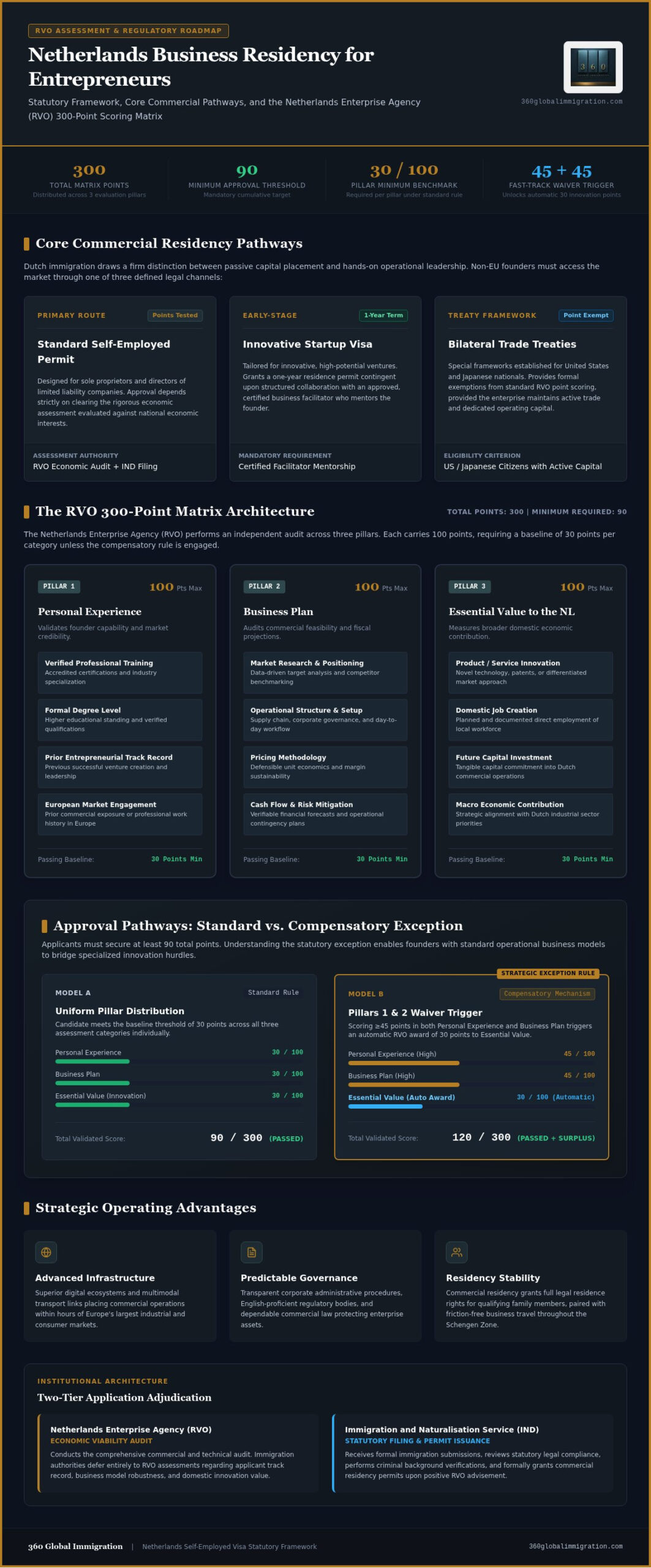
International founders evaluate three primary avenues to establish their legal and commercial presence:
- The Standard Self-Employed Permit: Intended for solo proprietors and directors of limited liability companies, this path requires candidates to clear a rigorous assessment evaluated against national economic interests.
- The Innovative Startup Visa: Tailored for early-stage ventures, this one-year residence permit hinges on collaboration with an approved, certified business facilitator who mentors the founder through early development.
- Bilateral Trade Treaties: Specific frameworks, notably for United States and Japanese nationals, provide exemptions from standard scoring metrics provided the business maintains active trade and dedicated operating capital.
When evaluated alongside alternative European founder and self-employment visa schemes, the Dutch structure stands out for its emphasis on verified business viability rather than arbitrary wealth thresholds.
Strategic Benefits of Operating in the Dutch Market
Beyond legal compliance, establishing your company here delivers tangible operational advantages for international expansion:
- Advanced Infrastructure and Connectivity: Superior digital ecosystems and seamless multimodal transport links place your commercial operations within hours of Europe’s largest industrial and consumer markets.
- Predictable Corporate Environment: Transparent administrative procedures, English-proficient regulatory bodies, and dependable commercial law protect enterprise assets and simplify corporate compliance.
- Residency Stability for Dependants: Securing Netherlands business residency for entrepreneurs grants full legal residence rights for qualifying family members, paired with friction-free business travel throughout the broader Schengen Zone.
The RVO Points System: Scoring Personal Experience and Business Viability
Adjudication of Netherlands business residency for entrepreneurs rests upon an external economic audit performed by the Netherlands Enterprise Agency (RVO). While administrative filings go directly to the IND, immigration officers defer entirely to RVO assessments on commercial viability. Understanding this evaluation rubric transforms what often feels like an unpredictable review into an exact, calculated submission.
The RVO evaluates applications against a 300-point matrix split across three distinct categories, each carrying a maximum of 100 points:
- Personal Experience (100 Points): Focuses on verified professional training, formal degree level, previous entrepreneurial ventures, work history, and prior commercial engagement within the European market.
- Business Plan (100 Points): Audits your market research, operational setup, pricing methodology, risk mitigation, and cash flow projections.
- Essential Value to the Netherlands (100 Points): Measures economic contribution, product or service innovation, planned domestic job creation, and future capital investment.
To pass, applicants must achieve a cumulative threshold of at least 90 out of 300 points. The standard rule requires at least 30 points in each pillar. However, a powerful exception exists: if you score 45 points or higher in Personal Experience and 45 points or higher in your Business Plan, the RVO automatically awards 30 points to Essential Value. This mechanism ensures that exceptional operational planning can compensate for specialized innovation hurdles.
Evidentiary Standards for Point Optimization
Speculative forecasts trigger swift refusals. In line with statutory IND self-employed residence permit requirements, your financial modeling must demonstrate personal income sustainability alongside commercial growth. Solo operators should consult our breakdown of the Netherlands freelance visa for non-EU applicants, as single-client reliance invites immediate regulatory scrutiny under domestic labor classification rules.
Maximizing points requires third-party substantiation. The RVO values signed letters of intent, pilot contracts, vendor agreements, and verifiable Dutch banking commitments far above theoretical market projections. Reviewing the complete criteria in our guide to Netherlands self employed visa requirements helps align each operational claim with RVO benchmarks. Professionals relocating from the Gulf region should also review our dedicated resource on the Netherlands business visa for UAE expats, which addresses how regional business achievements translate into criteria Dutch regulators accept.
Securing Netherlands business residency for entrepreneurs ultimately depends on dossier precision. If you want experienced eyes to evaluate your portfolio before filing, our team at 360 Global Immigration delivers bespoke document verification designed around government evaluation rubrics.
Evaluating Netherlands Residency Against Alternative European Founder Visas
Choosing the right jurisdiction determines how quickly your business can deploy across Europe. Securing Netherlands business residency for entrepreneurs offers unparalleled operational access to continental supply chains, but it represents only one strategic pathway among leading European commercial hubs. Evaluating international routes side by side allows founders to weigh administrative scrutiny against capital obligations and operational flexibility.
Comparing Market Access, Capital Rules, and Processing
Different European governments utilize fundamentally different screening mechanisms to evaluate incoming entrepreneurs:
- The Dutch Viability Model: Operates through centralized ministerial review by the RVO, prioritizing balanced economic value, founder expertise, and commercial viability over mandatory upfront cash thresholds.
- The French Talent Model: Founders pursuing the France Passeport Talent business creator route face clear academic and capital criteria, including a required master’s-level diploma or five years of equivalent professional experience alongside an established capital commitment.
- The British Endorsement Model: Operating outside the European Union, the UK framework replaces statutory points tables with independent business reviews. Applicants must secure formal approval through authorized UK innovator founder visa endorsement bodies that monitor verifiable business milestones.
Selecting the Ideal European Jurisdiction for Your Venture
Matching your commercial model to the appropriate regulatory environment prevents costly administrative delays. Digital agencies, international consultancy practices, and logistics operations thrive under the Dutch model due to widespread English business fluency, transparent corporate structures, and seamless digital filing. In contrast, highly localized ventures or founders with established ties to French commercial networks may find the French administrative framework more direct.
Settlement criteria also vary substantially. While British routes require separate bilateral compliance for European cross-border trade following Brexit, Netherlands business residency for entrepreneurs embeds your legal entity directly within the EU single market. This structural placement ensures friction-free delivery of cross-border services and simplified VAT mechanics across all member states.
Your ultimate decision should rest on your operational footprint, long-term talent acquisition goals, and corporate tax structuring. Founders seeking predictable market stability often favor the Dutch system, provided their documentation cleanly satisfies each scoring benchmark.
Step-by-Step Application Blueprint: From Business Plan to IND Approval
Executing an application for Netherlands business residency for entrepreneurs requires methodical sequencing. Submitting forms out of order, or lodging immigration requests before completing pre-incorporation groundwork, frequently leads to procedural rejection. A structured blueprint bridges the gap between commercial intent and formal administrative authorization.
Phase 1 to 3: Business Planning, Financial Modeling, and Legal Setup
Preparation begins long before contacting immigration officers. Successful applicants advance through three strict preparatory phases:
- Phase 1: Bespoke Plan Formulation: Draft an exhaustive, audit-ready operational dossier. Financial forecasts must substantiate continuous profitability alongside a monthly gross income that meets the IND statutory norm (€1,766.77 per month for the second half of 2026).
- Phase 2: Corporate Structuring: Select the optimal operating vehicle. Most international founders favor a private limited company (BV) to segregate liability and present institutional balance sheets. Secure initial registration with the Dutch Chamber of Commerce (KVK) or execute preliminary deed drafts via a civil-law notary.
- Phase 3: Evidentiary Substantiation: Assemble binding letters of commercial intent, signed customer contracts, partner agreements, and corporate bank statements to validate domestic market traction.
Phase 4 to 5: Agency Evaluation, Biometrics, and IND Formalities
With an audit-ready dossier assembled, legal execution moves to government adjudicators:
- Phase 4: IND Lodgment and RVO Assessment: Lodge the formal residence application with the Immigration and Naturalisation Service (IND). For non-treaty founders, the IND forwards the business dossier directly to the RVO for economic scoring. While statutory Aliens Act timelines state 90 days, standard inter-agency reviews often extend processing across six to nine months.
- Phase 5: Entry Clearance, Biometrics, and Issuance: Where applicable, obtain your provisional residence permit (MVV) through a Dutch diplomatic mission abroad. Upon arrival in the Netherlands, attend a scheduled IND desk appointment to record biometrics, obtain your official residency card, and finalize municipal registration (BRP) to secure your Citizen Service Number (BSN).
Meticulous alignment between your corporate filings and immigration paperwork is essential to avoid administrative stalls. To navigate this multi-stage pathway with experienced legal representation, schedule a strategic consultation with 360 Global Immigration to build your bespoke compliance roadmap.
Mitigating Rejection Risks Through Strategic Professional Representation
Navigating commercial immigration independently often exposes founders to severe administrative pitfalls. Unassisted direct applications face steep rejection rates primarily because applicants treat the process as a standard visa submission rather than a technical economic audit. Successfully acquiring Netherlands business residency for entrepreneurs requires a defensive dossier strategy that anticipates regulatory skepticism before an adjudicator reviews your file.
Common Deficiencies Leading to RVO and IND Ineligibility
Applications routinely falter on predictable evidentiary gaps rather than a lack of commercial ambition:
- Vague Market Justification: The RVO rejects generalized industry projections. Presenting broad sector growth data without verifiable local customer demand, signed preliminary contracts, or localized supplier agreements leads directly to failing marks on commercial viability.
- Credential Disconnects: A stark mismatch between your documented professional history and your proposed enterprise damages your scoring. If your background lacks clear operational overlap with your new corporate venture, assessors heavily penalize your Personal Experience score.
- Disguised Employment Indicators: In an era of strict regulatory enforcement against bogus self-employment, relying on a single dominant Dutch client triggers immediate compliance red flags. Authorities require undeniable proof of commercial autonomy across multiple revenue sources.
The 360 Global Immigration Bespoke Advisory Model
Mitigating these structural risks requires methodical pre-submission auditing. At 360 Global Immigration, we serve as an authoritative navigator for international founders, applying specialized expertise across complex European commercial pathways. Our bespoke advisory model is engineered around ministerial evaluation rubrics, ensuring your operational blueprint withstands institutional scrutiny.
Our advisors deploy structured document verification frameworks that systematically eliminate common application pitfalls. We refine your business documentation to reflect government scoring priorities, substantiate independent commercial viability, and structure financial forecasts to satisfy statutory norms. By managing end-to-end coordination across corporate formation, ministerial evaluations, and consular channels, we transform a complex transition into an organized, predictable pathway toward securing Netherlands business residency for entrepreneurs.
Chart Your Path to Dutch Commercial Expansion
Establishing a sustainable commercial presence in the Netherlands requires more than entrepreneurial drive; it demands an evidence-backed strategy aligned with Dutch economic priorities. Approval rests on satisfying the RVO’s rigorous scoring matrix, anchoring your financial model to statutory profitability norms, and maintaining strict procedural sequencing between commercial formation and formal immigration filings.
When properly orchestrated, acquiring Netherlands business residency for entrepreneurs positions your enterprise at the commercial heart of Europe while securing long-term operational stability. You don’t have to navigate these intricate administrative frameworks alone. As a specialized consultancy focusing on European founder and talent residency, 360 Global Immigration applies a rigorous document verification framework designed to prevent application refusal and eliminate procedural setbacks.
Take control of your international growth with absolute clarity and professional backing. Take the definitive step toward expanding your business into the European market: Secure Your European Business Residency Advisory.
Frequently Asked Questions
Can any non-EU entrepreneur apply for Netherlands business residency?
Yes, any non-EU citizen can apply, provided their commercial venture serves an essential Dutch economic interest or qualifies under bilateral treaties. Third-country nationals typically undergo the RVO points test assessing personal track record and operational viability. Nationals of the United States and Japan benefit from reciprocal treaty arrangements that bypass points testing entirely. All applicants must demonstrate legitimate commercial intent, personal integrity, and sustainable operational funding.
How many points are required to pass the Dutch enterprise evaluation?
Applicants must achieve a minimum score of 90 out of 300 points across the RVO scoring matrix. The evaluation system divides 300 points equally across three distinct pillars: Personal Experience, Business Plan, and Essential Value to the Netherlands. While standard criteria require 30 points per pillar, scoring at least 45 points in Personal Experience and 45 points in the Business Plan automatically credits 30 points to Essential Value.
Is an existing Dutch business contract mandatory before submitting an application?
An active, signed contract isn’t strictly mandatory under statutory immigration rules, but submitting an application without commercial pipeline evidence drastically lowers your approval chances. The RVO heavily penalizes speculative forecasts. To build a competitive case for Netherlands business residency for entrepreneurs, founders should include signed letters of intent, pilot agreements, or confirmed client communications showing verified domestic demand and sustainable revenue.
What is the primary difference between the self-employed and startup visa?
The primary difference lies in the innovation mandate, facilitator oversight, and initial permit duration. The Dutch Startup Visa grants a non-extendable, one-year residence permit requiring continuous mentorship from an accredited facilitator to launch an innovative commercial concept. In contrast, the standard self-employed pathway targets proven operators, granting a multi-year permit based directly on the RVO points evaluation without requiring incubator sponsorship.
Can family members and dependants be included in the business residency application?
Yes, qualifying family members can accompany the primary founder under Dutch family reunification provisions. Spouses, registered partners, and minor children are eligible to secure derivative residence permits connected to your commercial status. To sponsor dependants successfully, the founder must demonstrate sustainable, independent business earnings that satisfy IND statutory income thresholds alongside appropriate residential accommodation arrangements in the Netherlands.
How long does the Immigration and Naturalisation Service take to issue a decision?
While the formal statutory review window is 90 days, real-world processing times typically range between six and nine months. Because the IND routinely requests a binding economic viability report from the Netherlands Enterprise Agency, authorities regularly exercise their legal prerogative to extend the review window by up to six additional months. Preparing an audit-ready dossier minimizes agency clarification requests and prevents unexpected delays.
What happens if the Netherlands Enterprise Agency scores a business plan below threshold?
If the RVO issues negative advice resulting in an IND refusal, you have a statutory window of six weeks to lodge a formal administrative objection. Securing Netherlands business residency for entrepreneurs during the objection phase requires presenting fresh evidentiary documentation rather than repeating previous claims. Legal representatives address specific scoring deficiencies, introduce binding client agreements, and request an official RVO reassessment.