
Securing European commercial residency isn’t a routine administrative exercise; it’s a rigorous economic evaluation. If you’re pursuing a Netherlands business visa for UAE expats, treating your application like a standard immigration filing is the quickest path to procedural delay or outright refusal. Dutch authorities don’t just review forms; they assess your venture’s tangible innovation and lasting value to their domestic market.
You’ve likely already experienced the frustration of translating your regional business achievements into criteria foreign regulators accept. Unclear scoring metrics, complex corporate compliance rules, and multi-step document attestation between authorities can leave even seasoned founders feeling uncertain about their cross-border prospects.
This guide explains how non-EU professionals and founders living in the UAE can successfully secure Netherlands business residency in 2026. We break down the points-based evaluation model, show you how to structure an application that satisfies the Netherlands Enterprise Agency, and provide a clear roadmap to establish your European commercial presence with complete procedural confidence.
Key Takeaways
- Understand the critical legal distinctions between short-stay commercial travel and securing a long-term Netherlands business visa for UAE expats through self-employment.
- Learn how the Netherlands Enterprise Agency evaluates applicant credentials, commercial viability, and domestic economic impact across strict points-scoring thresholds.
- Discover the strategic steps required to translate an established UAE commercial background into a compelling, market-aligned European business case.
- Master the multi-stage document attestation sequence between UAE institutions and Dutch authorities to eliminate administrative delays and compliance flags.
- Explore how end-to-end application stewardship and tailored business planning ensure full procedural alignment with Dutch immigration criteria.
The Netherlands Business Visa Pathway for UAE Expats Explained
Expanding an enterprise into Europe requires selecting the correct legal instrument from the outset. Many entrepreneurs mistakenly conflate standard corporate visitor entry with genuine operational establishment. Pursuing a Netherlands business visa for UAE expats fundamentally centers on securing a long-term residence permit as a self-employed professional, rather than relying on short-term mobility permissions.
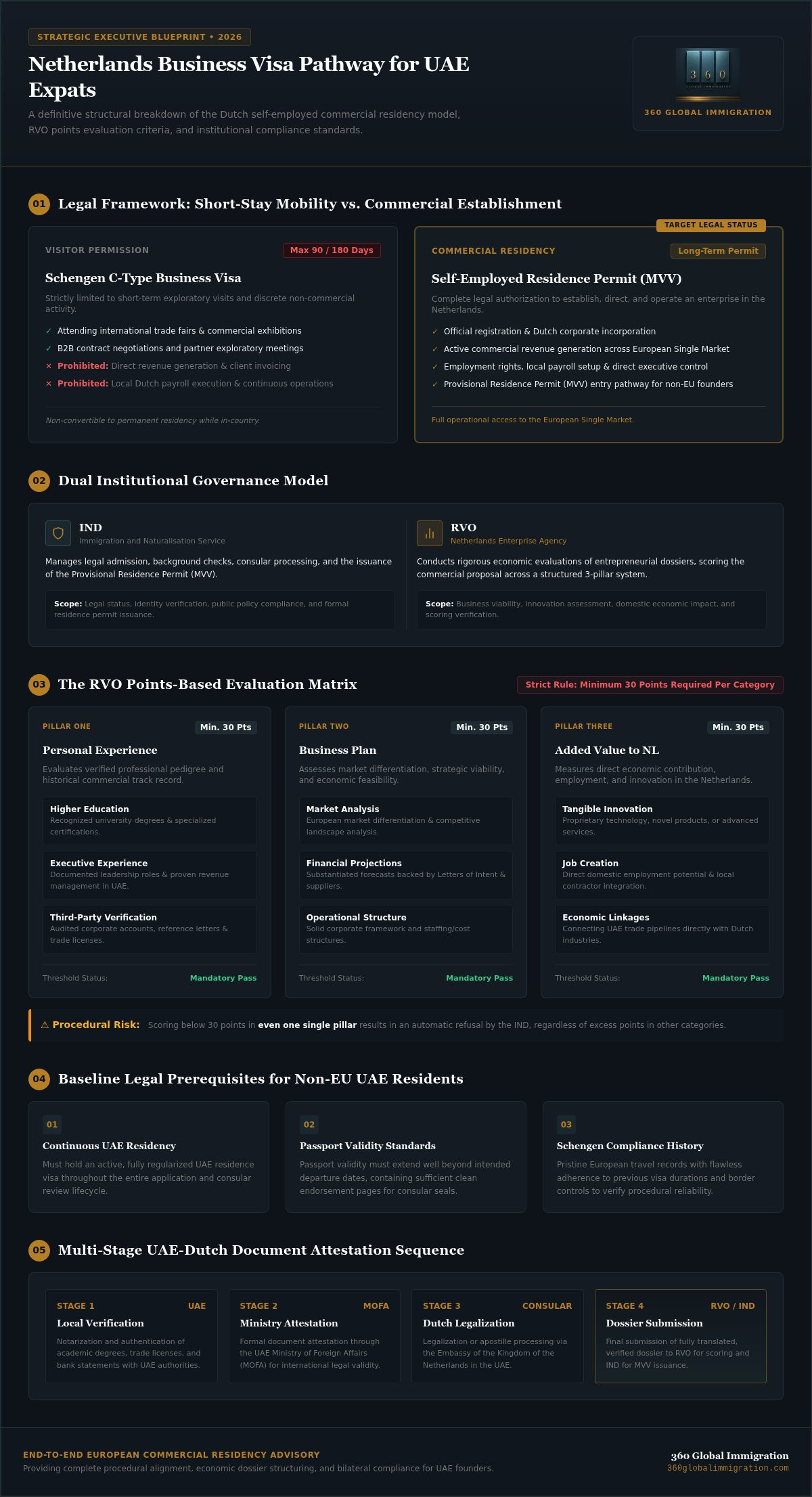
This pathway involves dual governmental oversight. The Immigration and Naturalisation Service (IND) manages the overall legal admission and issues the provisional residence permit, known as the MVV. Concurrently, the Netherlands Enterprise Agency assesses the commercial substance of your business. Anchoring your commercial venture within the stable, open structure of the Dutch economy unlocks frictionless trade across the European Single Market, serving as an ideal platform for Middle Eastern enterprises to scale internationally.
Short-Stay Business Travel vs Long-Term Commercial Residency
A standard Schengen C-type business visa permits stays up to 90 days within any 180-day window. It covers discrete activities: attending trade fairs, negotiating contracts, or meeting prospective partners. It strictly prohibits active revenue generation, local payroll execution, or permanent operational management. When your commercial objectives shift from exploratory visits to formal corporate incorporation, ongoing client invoicing, or regular physical operations, you must transition to a dedicated self-employed residence permit.
Legal Prerequisites for Non-EU UAE Residents
Qualifying for the Netherlands business visa for UAE expats requires meeting stringent baseline standards before Dutch authorities review your commercial proposal:
- Continuous residency status: You must hold a valid UAE residence visa throughout the entire application lifecycle, confirming your regularized status within the country.
- Passport validity standards: Your passport must maintain sufficient validity, typically extending well past your planned departure, and contain clean pages for consular endorsements.
- Schengen compliance history: Consular officers review past European travel records meticulously. Consistent adherence to visa durations and border regulations provides essential proof of procedural reliability.
Satisfying these fundamental criteria establishes baseline credibility. It enables evaluators to concentrate entirely on the economic value and viability of your enterprise.
Mastering the RVO Points System: Scoring Your Business Case
The Netherlands Enterprise Agency (RVO) evaluates every entrepreneurial dossier using a rigorous points system. Passing this assessment is mandatory; falling short in even one category results in a refusal by the IND, regardless of your overall score. When applying for the Netherlands business visa for UAE expats, your application must secure at least 30 points across each of three discrete pillars: personal experience, the business plan, and added value to the Dutch market.
To align your dossier with the official application requirements, you must construct an evidence-backed submission that translates your UAE commercial history into verified European benchmarks.
Evaluating Personal Experience and Entrepreneurial Track Record
This pillar reviews your professional pedigree. The RVO allocates points based on validated higher education, executive experience, and previous entrepreneurial success. High-scoring profiles typically feature recognized university degrees, proven revenue management in the UAE, and documented leadership roles. Evaluators demand tangible third-party verification, such as audited corporate accounts, letters of reference, and registered trade licenses proving past operational ownership.
Structuring the Business Plan for Economic and Added Value
A generic proposal guarantees rejection. The RVO requires an exhaustive market analysis proving product differentiation and commercial feasibility within Europe. Your strategic plan must clearly address three core elements:
- Realistic financial projections: Revenue forecasts substantiated by signed letters of intent, verifiable supplier networks, or cross-border service agreements.
- Direct economic contribution: Concrete domestic job creation, targeted investments, and integration into local industry ecosystems.
- Innovation: Proprietary technology, unique operating models, or novel international service offerings introduced from your Middle Eastern operations.
Navigating Financing and Capitalization Standards
Capital solvency verification requires proving that your venture can sustain itself while providing sufficient personal remuneration. Dutch regulations stipulate that self-employed applicants must generate an ongoing gross profit of at least €1,766.77 per month, supported by reliable operating cash reserves. Reviewing the Netherlands Self-Employed Visa Requirements: The 2026 Entrepreneur Guide will help you align your capitalization strategy with statutory standards.
If you prefer an expert audit of your qualifications before lodging your dossier, consulting with specialized immigration advisors can ensure your points allocation meets the RVO threshold seamlessly.
Case Study: Transitioning an Enterprise from the UAE to the Netherlands
Real-world execution highlights the precision required when securing commercial residency. Consider the operational profile of a non-EU founder managing an enterprise software consultancy across the UAE. While the firm demonstrated strong regional profitability, the initial application faced a common hurdle: convincing Dutch authorities that a mature Middle Eastern business would yield direct economic advantages within the Netherlands.
Without adjusting the commercial proposition for European authorities, traditional applications often falter during the agency review. Positioning a venture correctly transforms standard qualifications into an undeniable business case.
The Baseline Challenge: Bridging Cross-Border Operations
The founder maintained five years of verified executive leadership and healthy corporate balance sheets. However, an initial diagnostic revealed a clear points deficit under the RVO’s added value metric. The agency does not grant approvals simply because a firm succeeds elsewhere. The strategic hurdle was demonstrating that relocating executive operations would create local Dutch employment, foster technical collaboration, and introduce specialized domain expertise rather than merely extracting cross-border revenue.
Strategic Intervention: Perfecting the Submission Dossier
A comprehensive restructuring plan repositioned the consultancy as a digital trade bridge connecting Gulf enterprises with European software ecosystems. The revised dossier integrated three concrete elements:
- Empirical market analysis: Replacing high-level market assumptions with granular sector datasets from the Dutch Chamber of Commerce (KVK).
- Contractual pipeline validation: Securing two conditional service agreements with European corporate clients to guarantee early operating revenue.
- Regulatory harmonization: Upgrading the business plan while evaluating parallel tracks like the Netherlands startup residence permit before finalizing the self-employed route.
Outcome and Operational Expansion
The RVO awarded full passing marks across all evaluation pillars, issuing a formal positive recommendation to the IND within four months. This endorsement paved the way for immediate entry visa issuance and local municipality registration. Today, the consultancy operates as a fully regularized Dutch entity with active regional connectivity. Founders preparing a similar path can explore broader strategic considerations in our guide on Netherlands Entrepreneur Residency: 2026 Strategic Guide. This real-world transition proves that securing a Netherlands business visa for UAE expats relies entirely on aligning regional strength with explicit Dutch economic priorities.
Critical Compliance and Documentation Pitfalls UAE Residents Must Avoid
Administrative rejections rarely stem from unviable business ideas alone. More often, they happen because of procedural oversights, inconsistent financial trails, or improper legalization protocols. Securing a Netherlands business visa for UAE expats demands meticulous preparation that aligns documentation across two distinct legal jurisdictions.
Overlooking administrative standards creates friction with Dutch consular officials and stalls your progress. Eliminating vulnerabilities early protects your timeline and preserves your commercial momentum.
The Legalization and Attestation Verification Chain
Every official document issued within the UAE, from corporate licenses to academic credentials, must complete an exact multi-tier authentication chain before European authorities accept it. Bypassing a single step invalidates the entire submission:
- Local ministry attestation: Commercial and civil records must first receive certification from the appropriate government department and the UAE Ministry of Foreign Affairs.
- Consular legalization: Documents then require formal legalization through the Embassy of the Netherlands to establish cross-border evidentiary validity.
- Certified sworn translation: Any Arabic-language paperwork must be translated by accredited translators into Dutch or English, preventing procedural halts due to linguistic inaccuracies.
Financial Transparency and Source of Funds Verification
Dutch adjudicators enforce strict European anti-money laundering and corporate transparency standards. You must provide clean banking statements demonstrating an unbroken trail of capital origin. Blurring company liquidity with personal funds is a frequent trigger for compliance reviews. Maintain separate, audit-ready records that verify exactly where your capital originated, how it entered your commercial accounts, and how it will fund your European operations.
Mitigating Structural Business Model Deficiencies
The Netherlands Enterprise Agency actively screens for passive holding entities or disguised employment arrangements. Your business blueprint must clearly outline an active, operating enterprise providing measurable services to multiple independent clients. If you operate as a solo specialist or independent consultant, consult our guide on How to Secure a Netherlands Freelance Visa for Non-EU Citizens in 2026 to structure your operational model to meet European self-employment definitions.
Proactive legal management eliminates unexpected hurdles. To ensure your paperwork meets strict consular criteria before submission, book a strategic documentation audit to protect your commercial expansion.
Partnering with 360 Global Immigration for Seamless Dutch Residency
Filing a commercial immigration application on your own often leads to fragmented execution and avoidable missteps. While standard courier portals handle physical document intake, they don’t assess scoring viability, review commercial data, or defend your application against regulatory scrutiny. Securing a Netherlands business visa for UAE expats requires proactive legal strategy, detailed business modeling, and methodical procedural alignment across borders.
Entrusting your transition to experienced specialists replaces regulatory uncertainty with organized execution, ensuring every component of your dossier satisfies Dutch governmental standards from day one.
The Bespoke Advisory Methodology
Our advisory framework begins with an exhaustive diagnostic evaluation of your entrepreneurial credentials against established RVO scoring benchmarks:
- Diagnostic points assessment: We audit your academic credentials, managerial background, and corporate balance sheets to confirm you meet the mandatory 30-point threshold across all evaluation pillars.
- Strategic business plan drafting: Our commercial strategists construct a bespoke business proposal tailored directly to Dutch economic priorities, proving genuine innovation and operational feasibility.
- Attestation management: We coordinate the entire authentication sequence across UAE government ministries and Dutch consular authorities, ensuring every sworn translation meets stringent European evidentiary standards.
End-to-End Operational Execution
Achieving commercial residency requires structured representation throughout every phase of the process. We streamline your consular coordination and biometric appointments across the UAE, preventing administrative friction. Throughout the official review, our team oversees representation across the Netherlands Enterprise Agency and the IND, resolving clarification requests promptly with verified documentation.
This comprehensive oversight allows you to concentrate on your operational goals while we handle the regulatory complexities of your cross-border move. You can initiate your preliminary assessment today by connecting directly through 360 Global Immigration.
Taking the Next Step Toward European Commercial Establishment
Building a legitimate operational bridge to Europe transforms your commercial reach. Successfully obtaining a Netherlands business visa for UAE expats requires more than routine administrative filing; it demands translating your regional track record into the precise points metrics evaluated by the Netherlands Enterprise Agency while maintaining rigorous bilateral attestation discipline.
Navigating this path doesn’t have to be overwhelming. Backed by a proven track record securing complex European business residency permits, 360 Global Immigration provides dedicated advisory for expatriates across the UAE. We deliver bespoke business plan structuring tailored directly to Dutch benchmarks alongside end-to-end procedural stewardship, guiding your case smoothly from initial points evaluation to final filing.
Your vision of establishing a sustainable footprint in the European Single Market is entirely achievable with the right strategic partner by your side. Secure Your Netherlands Business Residency with 360 Global Immigration today and begin your cross-border journey with complete confidence.
Frequently Asked Questions
Can an expat living in the UAE apply for a Netherlands business visa without EU citizenship?
Yes. The self-employed residency track is specifically designed for non-EU nationals residing abroad, including foreign professionals living across the UAE. As long as you maintain a valid UAE residence visa and satisfy the necessary commercial, educational, and financial benchmarks, you can apply for a Netherlands business visa for UAE expats through formal diplomatic channels without holding European citizenship.
What is the minimum score required to pass the Netherlands Enterprise Agency business points assessment?
You must score at least 30 points across each of the three evaluation pillars: personal experience, the business plan, and added value to the Dutch economy. Achieving surplus points in one category won’t offset a shortfall in another. Failing to reach the 30-point threshold in any individual section results in an automatic refusal by immigration authorities.
How long does the Netherlands self-employed residence permit take to process from the UAE?
Statutory processing typically spans three to six months from formal file lodgment to final adjudication. This timeframe accommodates thorough evaluations by both the Netherlands Enterprise Agency and the Immigration and Naturalisation Service. Factoring in upfront document attestations across UAE ministries and translation logistics, applicants should plan their strategic timeline well in advance.
Can I bring my family to the Netherlands on a business residence permit?
Yes, principal applicants can sponsor their immediate family members, including a legal spouse or recognized partner and minor dependent children. Family applications can be submitted alongside your primary business dossier or initiated after securing your initial approval. You must simply demonstrate sufficient, recurring corporate earnings to maintain your household alongside compliant residential accommodations.
Do I need an existing commercial contract in the Netherlands to secure a business visa?
While signed client agreements aren’t strictly mandatory at submission, presenting verified letters of intent or pipeline commitments significantly bolsters your case. Evaluators look for proof that your enterprise can realistically generate revenue upon launch. Establishing verified commercial relationships helps satisfy critical market-readiness standards for a Netherlands business visa for UAE expats.
What is the difference between an MVV entry visa and the Dutch residence permit?
An MVV is a provisional entry clearance sticker placed inside your passport, whereas the residence permit is the physical biometric card granting long-term stay. After the immigration authorities approve your self-employed petition, you collect the MVV from the Dutch embassy. You then travel to the Netherlands to register locally and retrieve your permanent residence card.
Can a business founded in the UAE continue operating while expanding into the Netherlands?
Yes, you can retain your UAE commercial entity while incorporating a subsidiary, branch, or standalone enterprise in the Netherlands. Maintaining an operational enterprise in the UAE often provides helpful proof of past managerial acumen. You must simply establish clean corporate accounting divisions and demonstrate that you’ll dedicate sufficient operational oversight to the Dutch entity.