The Netherlands self employed visa requirements include a point-based assessment that can be difficult to plan for, particularly when the Netherlands Enterprise Agency (RVO) evaluates your business’s added value. A strong application makes that contribution clear with evidence, not guesswork.
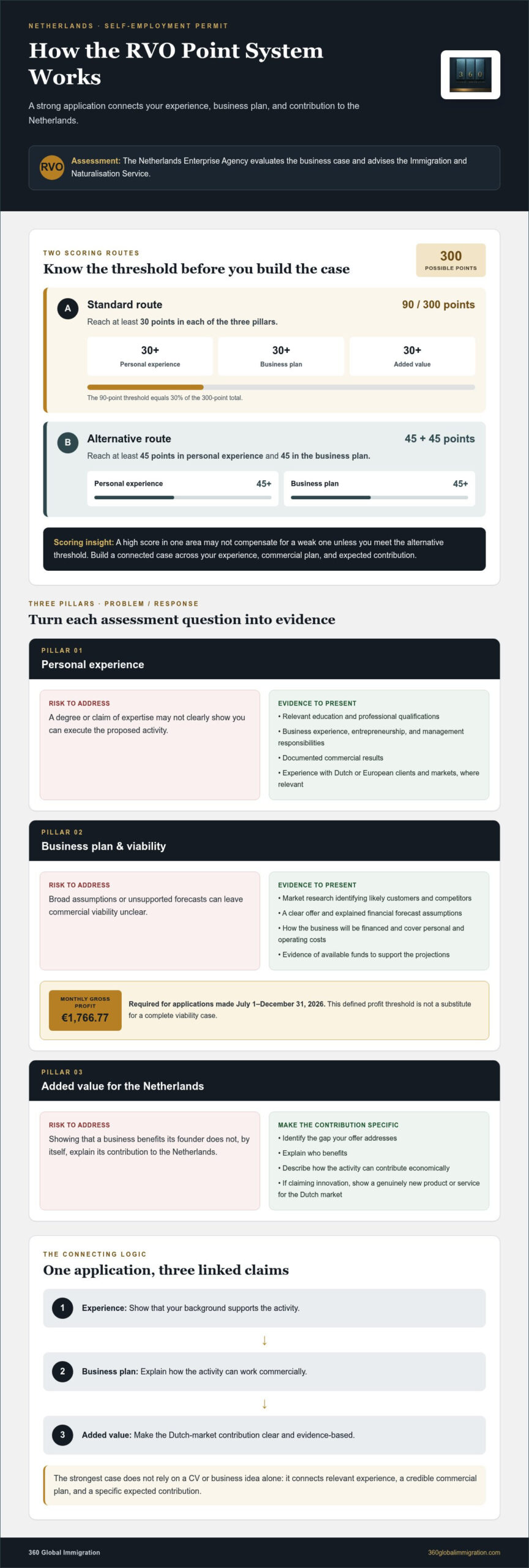
Applicants generally need 90 of 300 points, with at least 30 in each of three pillars: personal experience, business plan, and added value. An alternative route requires 45 points in both personal experience and the business plan. A strong CV or business idea on its own may not be enough. Your application needs to show how your experience, commercial plan, and expected contribution fit together.
This 2026 guide explains the scoring routes, the documents that support each pillar, and the Dutch registration and application steps to prepare for. It also covers how to build a market-specific business plan and present its added value clearly. 360 Global Immigration provides guidance with preparing a complete, carefully managed application.
Key Takeaways
- Understand how the Dutch self-employment permit supports founders building a business in the Netherlands.
- Organize your eligibility evidence around the assessment’s key criteria.
- Prepare core identity documents and plan for business registration with the Dutch Chamber of Commerce (KvK).
- Follow a structured application journey, from an initial feasibility review to a finalized business plan and document package.
- Use tailored business plan advice and careful document management to present a clearer, more complete application.
Understanding the Dutch Self-Employment Permit (ZZP Visa)
The Dutch residence permit for self-employment, formally the verblijfsvergunning arbeid als zelfstandige, allows eligible non-EU/EEA entrepreneurs to live in the Netherlands and work for their own business. Often called the ZZP visa, it is not a general work permit: the authorization is tied to self-employed activity, and other employment requires separate permission. For founders applying from the UAE, understanding this distinction is a practical first step when assessing the Netherlands self employed visa requirements.
The permit can provide a base in a country with established transport, digital, and financial infrastructure, as well as access to the wider European business environment. A Dutch residence permit can also support short-stay travel within the Schengen Area, subject to the applicable travel rules. It does not grant the right to live or work freely in every EU country. Its value is in establishing a legitimate Dutch operation, not in removing national borders.
The Strategic Value of Dutch Residency
The Netherlands has established legal and financial institutions that can provide predictability for companies serving international markets. Residency may also form part of a longer-term plan: after meeting the relevant conditions, a person may be able to apply for permanent residence or Dutch citizenship. These are separate applications, not automatic benefits of the self-employment permit. Your residence history, personal circumstances, and the rules in force all matter.
Target Profiles for the 2026 Application Cycle
This route may suit applicants whose professional experience and viable business plans make a clear case for operating in the Dutch market. Potential profiles include:
- Freelancers and ZZPers with specialist expertise, a credible client base, or a service positioned to meet a defined market need.
- Small and medium-sized business owners planning to establish or expand operations in Europe through a Dutch enterprise.
- Creators and founders whose products, services, or business activity can show meaningful added value for the Netherlands.
High earning potential may strengthen a commercial case, but income alone does not establish eligibility. Explain how your experience connects to the business model and why the planned activity has a credible place in the Dutch economy. Keep that explanation consistent across your application and support it with evidence rather than broad claims.
Innovative founders should also distinguish this permit from the Dutch Startup Visa. The startup route is a separate, one-year residence permit for entrepreneurs developing an innovative business with a recognized facilitator. It is designed as a preparatory pathway. After that year, an entrepreneur may apply for the self-employed permit, which is assessed under its own criteria. The startup visa is tied to the facilitator-based program, while the ZZP permit is for running your own enterprise. The general Self-employment visa overview also describes how national self-employment routes can differ from startup pathways.
Decoding the Point-Based System: The Three Pillars of Eligibility
The Netherlands Enterprise Agency (RVO) assesses the business case and advises the Immigration and Naturalisation Service (IND). The assessment has three pillars: personal experience, the business plan, and added value for the Netherlands. Applicants generally need at least 90 points out of 300, with a minimum of 30 points in each pillar. An alternative route requires at least 45 points for personal experience and 45 for the business plan.
That structure matters. A high score in one area may not compensate for a weak one unless you meet the alternative threshold. The Netherlands self employed visa requirements call for a balanced application: show that you can run the business, explain why it is commercially credible, and make a specific case for its contribution to the Dutch economy. The assessment is not simply a test of whether an idea is innovative. Your evidence needs to connect your experience, plan, and expected impact.
Pillar 1: Personal Experience and Professional Background
Present a coherent record of relevant education, professional qualifications, and business experience. A degree or certification is most persuasive when it directly supports the proposed activity. Previous entrepreneurship, management responsibilities, and documented commercial results can help demonstrate your ability to execute the plan. Experience with Dutch or European clients and markets can make your market knowledge more tangible. Support each claim with relevant records rather than assuming experience alone guarantees points.
Pillar 2: The Business Plan and Economic Viability
Make the plan testable. Include market research that identifies likely customers and competitors, describe your offer, and explain the assumptions behind your financial forecasts. Show how you will finance the business and meet personal and operating costs. Evidence of available funds can help make your projections more credible. For applications made from July 1 through December 31, 2026, the business plan must show gross profit of at least €1,766.77 per month. This is a defined profit threshold, not a substitute for a complete viability case.
Pillar 3: Added Value for the Dutch Economy
Added value can be the hardest pillar to articulate. A business that benefits its founder does not, by itself, explain its contribution to the Netherlands. Identify the gap your offer addresses, who benefits, and how the activity can contribute economically. Innovation may mean introducing a genuinely new product or service to the Dutch market, not simply describing a familiar offer as innovative. Potential hiring, investment, or activity in areas such as technology or green energy can strengthen the case when your plan substantiates the impact.
Before submission, cross-check every claim across your CV, business plan, forecasts, and supporting evidence. If one pillar is less developed, strengthen it with verifiable detail instead of promotional language. 360 Global Immigration’s Netherlands visa support includes business plan guidance to help entrepreneurs organize their case and present the three pillars consistently.
Mandatory Documentation and Financial Solvency Standards
A strong application is more than a collection of forms. Your documents should establish who you are, where you are lawfully resident, what business you intend to operate, and whether the plan is financially credible. Organize the evidence early and check that names, dates, business details, and financial figures are consistent throughout the file. These checks make the Netherlands self employed visa requirements easier to manage.
- Identity and residence: Prepare a valid passport and evidence of your legal stay in your current country of residence.
- Business registration: The business must be registered in the Dutch Chamber of Commerce Trade Register, known as the KVK. Plan this step in line with the application process and the instructions that apply to your case.
- Financial evidence: Include clear forecasts and supporting records that explain how the business will generate revenue and remain viable.
For applications submitted from July 1 through December 31, 2026, the business plan must show gross profit of at least €1,766.77 per month. Treat this as a defined business-plan threshold, not as a substitute for demonstrating the broader viability of the enterprise. Keep projected income, expenses, and supporting assumptions aligned across the plan and financial documents.
The Crucial Role of the Business Plan
A generic plan may describe a business without demonstrating why it is viable in the Netherlands. Build a market-specific case: identify target customers and competitors, explain your marketing and sales approach, and connect your offer to evidence of demand. A SWOT analysis can clarify strengths, risks, and responses. Three-year projections can help show how the business is expected to develop, provided each forecast is explained and supportable. Organize the narrative around the assessment pillars so the plan connects your background, commercial logic, and Dutch economic contribution.
Evidence of Professional Credentials
Support qualifications and experience with documents that can be verified. Useful evidence may include degrees, relevant certificates, prior contracts, client references, invoices, and records showing business revenue or management responsibility. If a foreign official document needs an apostille, legalization, or translation, the requirement depends on the document and issuing country. Check the applicable instructions before submitting it, and don’t assume every document follows the same process.
Where innovation is part of your case, make it tangible. Patents, product documentation, technical material, or a clearly explained methodology can help show what is distinctive and how it serves the Dutch market. Avoid relying on labels such as “unique” without evidence.
Include insurance in your preparation. Review the coverage relevant to your residence and business situation, and plan for appropriate health coverage under the rules that apply to you. Insurance documentation addresses a separate practical responsibility; it does not prove business viability.
The Application Journey: From Submission to Residency
A well-prepared application is only part of the process. You also need to coordinate the assessment, immigration steps, and practical arrangements for establishing a business in the Netherlands. Use the sequence below as a planning framework and follow the IND’s instructions for your individual application and nationality.
- Assess feasibility. Review your professional background, business model, market evidence, and finances against the eligibility criteria. A pre-application scoring review can help identify gaps before they become part of the formal case.
- Finalize the file. Align the business plan, supporting documents, and financial forecasts. Check that facts agree across documents, and prepare translations or document formalities where applicable.
- Submit to the IND. The IND handles residence permit applications and may ask the Netherlands Enterprise Agency (RVO) for advice on the business plan. RVO’s review forms part of the assessment, rather than a separate visa application.
- Complete post-decision formalities. Follow the IND’s decision instructions. If your nationality requires an MVV entry visa, arrange its collection through the designated process. If you do not require an MVV, follow the relevant entry instructions instead. Biometrics and permit collection are arranged as directed.
- Settle and register. After arrival, arrange registration with the municipality where you live to obtain a citizen service number (BSN). Complete the applicable KVK business registration steps and make practical arrangements, such as a Dutch business bank account, as needed.
Timeline and Processing Expectations in 2026
The legal decision period for an application is 90 days, although it can be extended. RVO’s advice is considered within the application process, and a separate standard RVO turnaround should not be assumed. Build flexibility into travel, housing, and business-launch plans rather than treating the decision period as a guaranteed completion date.
If the IND requests additional information, read the request closely, note the response deadline, and answer each point with relevant evidence. Keep copies of your submission and make sure new information is consistent with the original business plan. Organizing supporting records in advance can make it easier to prepare a complete response.
Post-Arrival Administrative Steps
After reaching the Netherlands, contact the relevant municipality about resident registration and the BSN process. The BSN is used in dealings with public authorities and other institutions. Coordinate your KVK registration with your business start-up plans, and prepare for any checks required by a bank when opening a business account. These steps support your settlement, but they don’t replace the conditions attached to your residence permit.
Your self-employed permit authorizes work for your own enterprise. Taking other employment requires separate permission. Keep your business activity aligned with the application and permit conditions. For coordinated application support, work with 360 Global Immigration on your Netherlands self-employed visa application.
Navigating Complexities with 360 Global Immigration
A Dutch self-employment application needs a connected case, not just a stack of documents. Your professional record, business plan, financial evidence, and explanation of Dutch economic value must support one another. Coordinating these elements across different records and administrative steps can be demanding. 360 Global Immigration provides support for the Netherlands Self-Employed Visa, helping applicants organize a clear, consistent case.
Professional guidance does not replace the eligibility criteria or guarantee a decision. It can help you identify gaps, refine how you present your business case, and manage the paperwork methodically. This is particularly useful when the Netherlands self employed visa requirements involve both detailed documentation and an assessment of the plan’s viability and contribution.
The 360 Global Immigration Advantage
360 Global Immigration specializes in business residency and talent-based visa programs for Europe and the UK, and provides guidance for the Netherlands Self Employed Visa. Its support combines tailored business plan advice with document management, helping keep your evidence aligned with the claims in your application.
- Tailored planning: Shape the business plan around your experience, intended Dutch activity, and market rationale.
- Organized documentation: Structure records so key claims are supported and inconsistencies are easier to spot before submission.
- Coordinated preparation: Map application tasks and relocation considerations into a practical sequence for your circumstances.
Your Next Steps Toward EU Residency
Start with a feasibility assessment. Gather a concise overview of your qualifications, business concept, relevant commercial history, funding plan, and intended Dutch market. This makes it easier to identify strengths and areas that need further evidence before you finalize the application.
Planning for a 2026 application gives you time to develop market research, prepare financial forecasts, and organize documents that may need additional formalities. It also helps you coordinate business preparation with the IND process and a potential move from the UAE. A carefully built file is a more reliable foundation than a rushed one.
360 Global Immigration provides guidance and application management for entrepreneurs preparing for this process. If you’re ready to assess your profile and plan the next steps, discuss your Netherlands business residency application with 360 Global Immigration.
Take the Next Step With Confidence
Your Netherlands business plans deserve a clear, considered path from ambition to application. Begin by defining what you want to build in the Dutch market and gathering the evidence that demonstrates your readiness to do it. A focused feasibility assessment can turn that starting point into a practical plan.
The Netherlands self employed visa requirements can feel demanding, but you don’t have to approach the process alone. 360 Global Immigration offers support for the Netherlands Self-Employed Visa, including business plan advice and application preparation for entrepreneurs applying from the UAE. This support can help you present your plans clearly and prepare for the steps ahead.
Make your next move a well-informed one. Consult with 360 Global Immigration about your Netherlands Self-Employed Visa application.
Frequently Asked Questions
How many points do I need for the Netherlands self-employed visa?
You generally need at least 90 points out of 300, with a minimum of 30 points in each pillar: personal experience, business plan, and added value for the Netherlands. An alternative is to score at least 45 points in personal experience and 45 in the business plan. A high experience score alone won’t meet either route if another required pillar falls short.
Can I apply for the Dutch self-employed visa as a freelancer?
Yes, freelancers can apply if they can demonstrate a credible Dutch business case and meet the assessment criteria. Explain the specialist service you offer, your intended customer base, and how the activity will generate sustainable business income. For instance, a consultant could support the plan with relevant project records and evidence of market demand. The permit authorizes work for your own enterprise, not unrelated employment.
What is the minimum capital required for the Netherlands business visa?
For the standard self-employed route, the assessment focuses on the business’s viability and financial evidence. There is no single universal minimum capital deposit for this route. For applications from July 1 through December 31, 2026, the business plan must show gross profit of at least €1,766.77 per month. US and Japanese citizens may have separate treaty routes with a €4,500 business investment requirement.
How long does the Netherlands self-employed visa process take?
The legal decision period is 90 days, but it can be extended. This is not a guaranteed end-to-end timeline for relocation: document preparation, RVO’s business-plan advice, requests for additional information, and post-decision steps can affect your schedule. Avoid making non-refundable plans based solely on the decision period. Keep your application reference and a complete copy of submitted documents so you can respond accurately if the IND contacts you.
Do I need a Dutch business partner to apply for this visa?
No, a Dutch business partner is not a general requirement for the self-employed residence permit. You must present a credible business of your own and meet the applicable assessment and registration requirements. A local partner might be part of your chosen business model, but a partnership does not replace the need to demonstrate your role, relevant experience, and the business’s commercial rationale.
What happens if my application for the self-employed visa is rejected?
If the IND refuses your application, read the decision carefully and identify the reasons given, such as gaps in evidence or concerns about the business case. The decision will explain the next steps available and any applicable deadline. Consider getting qualified guidance before responding or preparing a new application. Address the specific weaknesses with relevant evidence rather than resubmitting the same case unchanged.
Can my family join me on a Netherlands self-employed visa?
Your family members may be able to apply for residence in the Netherlands, but they are not automatically included in your self-employed permit. Their applications are assessed separately under the rules for family members, and the requirements depend on each person’s circumstances. Plan the timing and documentation for your family alongside your own application, and review the IND’s current instructions for the relevant family residence route.
Is there an English language requirement for the Dutch entrepreneur visa?
A general English-language test is not identified as a standard requirement for the self-employed permit. You still need to understand the application instructions and present a clear business case. If your supporting documents are in another language, follow the IND’s requirements for translations and document formalities. English may help with international business, while knowledge of Dutch can be useful for local customers and administration.