
Securing a Netherlands freelance visa for non-EU professionals is not a bureaucratic lottery; it’s an exacting evaluation where your business plan serves as the decisive variable. You likely already recognize how daunting the Dutch points-based immigration system can feel from the outside. Wondering whether your commercial track record will satisfy rigorous government examiners, or worrying that an administrative misstep could derail your European ambitions, is a natural response to such high-stakes scrutiny.
You don’t have to leave your international relocation to chance. This guide provides a clear, reliable roadmap to master the Netherlands Self-Employed Visa process, professionally validate your enterprise, and establish your independent practice in the European Union with absolute confidence. Ahead, we break down the official 300-point assessment framework, verified income thresholds, and strategic milestones required to secure your Dutch residence in 2026.
Key Takeaways
- Master the Netherlands Enterprise Agency (RVO) three-pillar scoring matrix and learn the exact point thresholds required to substantiate your commercial viability.
- Discover the precise legal criteria to secure a Netherlands freelance visa for non-EU professionals and establish your independent practice in the European Union.
- Identify the core elements of an audit-proof business plan, alongside mandatory apostille and document verification standards for UAE-based applicants.
- Navigate the complete administrative timeline with clarity, from determining provisional entry visa (MVV) requirements to receiving your formal residence card.
- Learn how partnering with a dedicated consultancy eliminates the operational risks of self-directed submissions and protects your residency ambitions.
Understanding the Netherlands Self-Employed Visa Pathway
Establishing an independent enterprise abroad demands regulatory precision. The Netherlands Self-Employed Visa is a formal residence permit issued to third-country nationals seeking to operate an independent business or freelance practice. Under Dutch immigration legislation, freelancers operate as independent entrepreneurs without personnel, designated domestically as zelfstandige zonder personeel (ZZP’er). Administered primarily through the Immigration and Naturalisation Service (IND), this permit grants the right to reside and trade legally within the country for an initial period of up to two years.
Many prospective applicants mistakenly confuse the general self-employed route with the Dutch-American Friendship Treaty (DAFT). This distinction is critical. While DAFT grants American nationals an exemption from complex merit reviews by requiring a €4,500 capital deposit, the standard Netherlands freelance visa for non-EU applicants requires an objective assessment by government bodies. The Netherlands stands out as an exceptional operational base across continental Europe; its multilingual commercial environment, modern infrastructure, and strategic access to the EU single market make it a compelling jurisdiction for ambitious founders.
Is the Freelance Visa Right for You?
This pathway serves specialized consultants, digital strategists, and technical experts who maintain their own client portfolios. Unlike the Highly Skilled Migrant visa, which binds your legal status directly to an employment contract with a recognized sponsor, the self-employed permit affords complete corporate autonomy. Securing this permit lays the groundwork for permanent EU integration. After five continuous years of lawful residence, entrepreneurs can apply for long-term Dutch residency, removing independent work limitations entirely.
Key Eligibility Requirements for Non-EU Applicants
Qualifying for the Netherlands freelance visa for non-EU nationals requires satisfying strict baseline criteria before the technical evaluation begins:
- Valid Identification and Background: You must hold a valid passport with at least six months of remaining validity and formally submit an antecedents certificate confirming a clean criminal record.
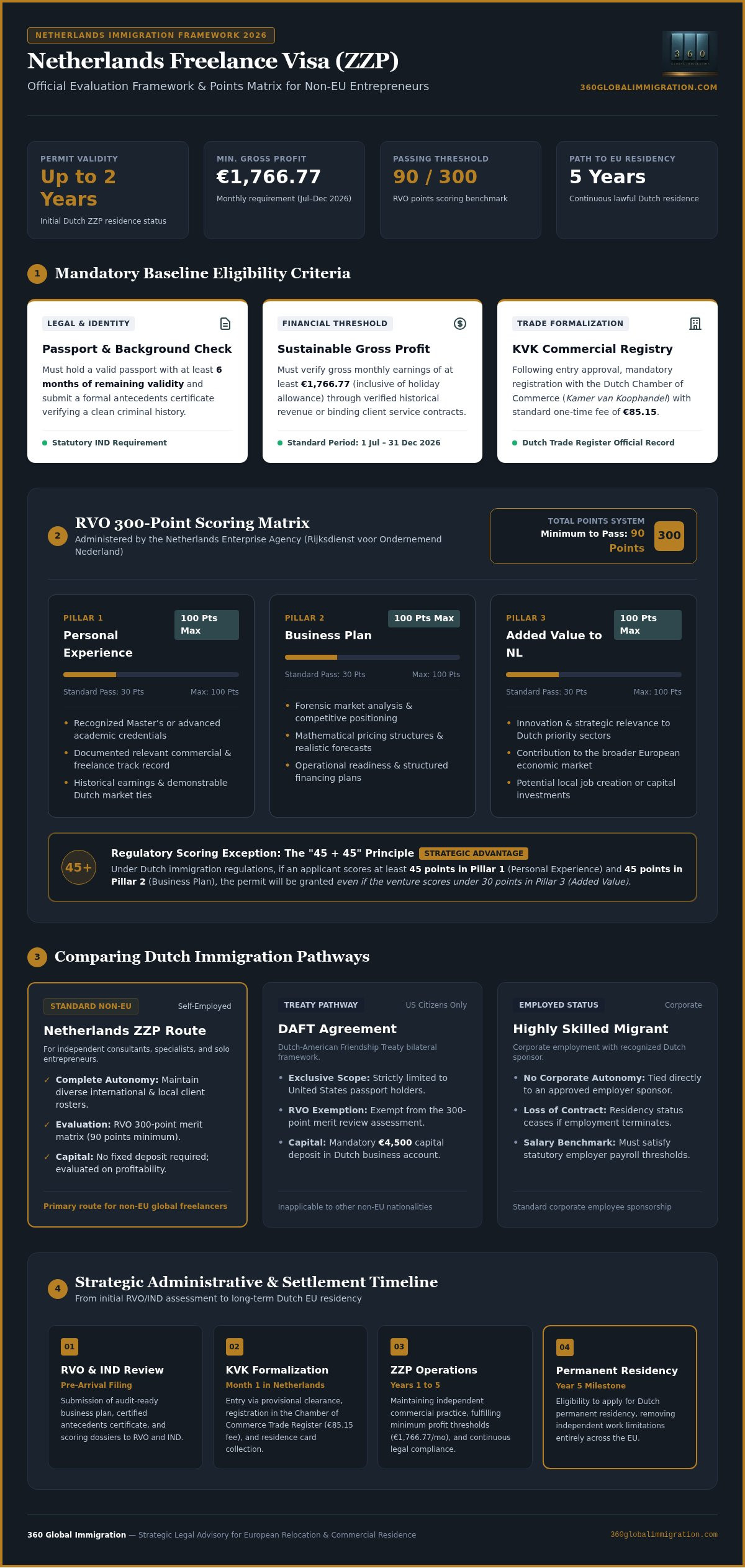
- Financial Sustainability: Applicants must verify sustainable earning capacity. For applications evaluated between 1 July 2026 and 31 December 2026, you must demonstrate a gross monthly profit of at least €1,766.77 (including holiday allowance) through historical performance or binding client contracts.
- Commercial Registration: Following provisional clearance, you must formally register your enterprise within the Dutch Trade Register at the Chamber of Commerce (Kamer van Koophandel or KVK), paying the standard one-time fee of €85.15.
Decoding the Points-Based System for Non-EU Freelancers
The evaluation of a Netherlands freelance visa for non-EU applicants hinges on an objective, merit-based matrix. The Immigration and Naturalisation Service delegates this commercial assessment to the Netherlands Enterprise Agency (Rijksdienst voor Ondernemend Nederland or RVO). To succeed, an entrepreneur must accumulate at least 90 points out of a maximum 300, divided equally across three core pillars. Under standard rules, you must achieve at least 30 points in each category. A valuable regulatory exception exists: securing 45 points in Personal Experience and 45 points in the Business Plan grants approval, even if your venture scores under 30 in Added Value. You can cross-reference these criteria directly with the official IND self-employed residence permit requirements.
Pillar 1: Personal Experience and Qualifications
Under this pillar, the RVO evaluates your academic credentials, historical earnings, and commercial track record. Recognized master’s degrees, specialized certifications, and proven entrepreneurial achievements carry substantial weight. For the RVO, relevant experience is defined as documented, hands-on commercial activity directly aligned with your proposed freelance venture rather than theoretical expertise. Demonstrable prior business ties within the Dutch market also provide a measurable scoring advantage.
Pillar 2: The Business Plan Assessment
Your business plan represents the operational core of the submission. Evaluators inspect your competitive positioning, pricing structures, and financial forecasts with forensic precision. Projections must be realistic and mathematically sound; speculative revenue assumptions without signed letters of intent or historical accounts trigger severe point deductions. Defensible cash-flow forecasts proving you will comfortably surpass statutory monthly income thresholds remain essential to pass this phase.
Pillar 3: Added Value for the Dutch Economy
The final pillar measures how your independent practice enriches the local commercial ecosystem. Points are awarded for genuine innovation, such as proprietary digital methodologies, pioneering consulting frameworks, or specialized technical products. While solo freelancers don’t need to hire personnel immediately, demonstrating future subcontracting potential or aligning your practice with Dutch priority sectors, such as Tech, Energy, and Logistics, strengthens your case.
Substantiating every point on this matrix demands meticulous legal preparation. Securing expert guidance on your Netherlands Self Employed Visa ensures your dossier is structured to satisfy RVO benchmarks, eliminating avoidable administrative vulnerabilities. Founders who want a deeper strategic overview of the scoring framework can also consult our dedicated resource on Netherlands business residency for entrepreneurs, which maps every pillar against real-world commercial evidence standards.
Essential Documentation and the Strategic Business Plan
Securing a Netherlands freelance visa for non-EU professionals requires assembling an ironclad evidentiary portfolio. For applicants applying from the UAE, this process demands meticulous administrative preparation. Official non-Dutch civil certificates, academic credentials, and commercial reference letters must be translated into English or Dutch by a certified sworn translator and properly apostilled to guarantee legal recognition before Dutch authorities. UAE-based founders navigating these requirements can find additional context in our comprehensive overview of the Netherlands business visa for UAE expats, which details how Dutch authorities evaluate ventures originating from the Gulf region.
Your strategic business plan operates as the intellectual core of your petition. It must speak the precise institutional language of the RVO rather than reading like a marketing pitch. Evaluators scrutinize your executive summary, target market segmentation, risk mitigation matrices, and three-year profit-and-loss models with exacting forensic standards. Every financial assumption must connect directly to documented commercial reality.
Proving the ‘Essential Interest’ for the Netherlands
Government assessors reserve positive determinations for ventures that serve an essential Dutch interest. Standard freelance services often struggle during review unless you clearly show how your practice fills a specific domestic capability gap. Securing signed letters of intent (LOIs) or preliminary service agreements with Dutch enterprises serves as decisive evidence. These commitments prove tangible commercial traction and demonstrate immediate economic contribution. Detailed procedural benchmarks can be confirmed via the official IND residence permit for a self-employed person guidance.
Financial Readiness and Solvency
Your financial submission must demonstrate sustained solvency. The regulatory threshold requires verifying a defensible gross monthly profit of at least €1,766.77 (inclusive of holiday allowance). Demonstrating this capacity requires clear financial documentation, including:
- Liquid Capital Verification: Official bank statements showing unencumbered startup funds sufficient to cover personal living expenses and initial operational overhead.
- Financial Modeling: Realistic, month-by-month cash flow projections supported by historical revenue records or active client billings.
- Operational Budgeting: Clear allocation for essential administrative costs, statutory trade registrations, and compulsory local health coverage.
Structuring these figures requires strict adherence to institutional accounting practices. To examine the comprehensive benchmarks in detail, consult our dedicated Netherlands Self-Employed Visa Requirements: The 2026 Entrepreneur Guide.
Step-by-Step Application Guide for Global Professionals
Executing your relocation demands a structured operational sequence. For third-country nationals, securing a Netherlands freelance visa for non-EU citizens typically requires the combined Entry and Residence Procedure (TEV). Unless you hold citizenship in an exempt state, you must secure a provisional residence permit, known as an MVV (Machtiging tot voorlopig verblijf), via the Dutch diplomatic mission in your country of residence prior to traveling. The statutory IND review window is 90 days; however, mandatory RVO consultations generally extend actual processing timelines to six to nine months. Government application processing carries an IND filing fee of €423.
Phase 1: Preparation and Submission
The administrative journey begins with compiling your legalized portfolio. UAE residents must complete all required document attestations and sworn translations before filing. Once your file is submitted to the IND, you’ll attend an appointment at the Dutch embassy or visa application center to register biometrics. During the subsequent waiting period, the RVO often issues requests for information to clarify financial modeling or client commitments. Responding promptly with precise commercial evidence prevents procedural rejections.
Phase 2: Arrival and Settlement
Receiving your positive IND decision allows you to collect your MVV sticker and enter the Netherlands to execute local compliance steps:
- Residency Card Collection: Book an appointment at an IND desk to collect your physical biometric residence permit (VVR).
- Municipal Registration (BRP): Register your residential address at the local municipality (Gemeente) to obtain your unique Citizen Service Number (BSN).
- Corporate Setup: Finalize your KVK trade registration, activate a dedicated Dutch business bank account, and establish quarterly VAT reporting structures.
- Mandatory Insurance: Procure statutory Dutch basic healthcare insurance (basisverzekering) within four months of establishing official residence.
Managing government liaisons and cross-border timelines doesn’t need to disrupt your commercial focus. Let our specialists manage the heavy lifting and apply for the Netherlands Self Employed Visa with seasoned guidance every step of the way.
Navigating the Transition with 360 Global Immigration
Self-directed immigration applications carry substantial operational risk. Attempting a DIY submission for a Netherlands freelance visa for non-EU professionals frequently exposes candidates to procedural setbacks or outright refusal. The primary vulnerability lies in misinterpreting official guidelines; off-the-shelf business plan templates fail to articulate the nuanced commercial value Dutch evaluators demand. A single misaligned financial projection or an improperly legalized certificate can stall your international relocation plans for months. Engaging specialized immigration consultancy transforms an unpredictable administrative trial into a structured, confident relocation strategy.
Professional representation provides objective clarity. By aligning your application directly with the expectations of both the IND and the RVO, an experienced advisor insulates your professional transition from administrative pitfalls, allowing you to maintain uninterrupted focus on running your business.
Bespoke Guidance for Complex Cases
Modern advisory practices rarely conform to rigid bureaucratic molds. Cross-border digital specialists, independent technical consultants, and corporate advisors require a bespoke submission that maps directly onto RVO scoring metrics. We refine your business narrative, stress-test your financial forecasts, and structure your client agreements into compelling proof of domestic economic relevance. Discover how our strategic advisory helps you Secure European Residency for Entrepreneurs Today with tailored legal representation.
Your Safe Harbor for Global Relocation
Acting as your protective navigator, 360 Global Immigration manages the heavy lifting involved in cross-border administrative and legal compliance. For independent professionals based in the UAE, our advisors oversee every phase of preparation, from document attestations to formal IND dossier structuring. This meticulous pre-vetting neutralizes risks before governmental review begins, insulating your enterprise from unexpected refusals. We anchor your application in enduring regulatory standards, paving a predictable pathway toward permanent residency in the EU. Contact 360 Global Immigration for a professional consultation to initiate your European expansion.
Chart Your European Future with Absolute Confidence
Relocating your independent practice to Europe is a transformative commercial milestone that demands structured preparation. Securing a Netherlands freelance visa for non-EU professionals is entirely achievable when you systematically address the RVO points matrix, substantiate your essential economic interest, and present defensible financial forecasts. With an approved residence permit, the Netherlands provides an extraordinary springboard for sustained continental expansion and long-term residency.
You don’t have to carry the burden of intricate administrative protocols alone. Serving as your dedicated protective navigator, 360 Global Immigration offers bespoke consultancy for UAE-based entrepreneurs and senior consultants. Our team handles the heavy lifting, delivering specialized support for business plan architecture and complete evidentiary verification. Your European enterprise is within reach. Take the decisive step today and Secure Your Professional Future in the Netherlands with 360 Global Immigration.
Frequently Asked Questions
Can I apply for the Netherlands freelance visa while living in the UAE?
Yes, you can initiate the entire application process while resident in the UAE. Through the combined Entry and Residence Procedure (TEV), non-EU nationals submit their evidentiary files to the IND and complete required biometric appointments at the Dutch diplomatic mission in the UAE. Your residency permit and entry visa are pre-approved before you relocate, ensuring full regulatory compliance prior to establishing your European base.
How many points do I actually need to pass the self-employed assessment?
You need a minimum of 90 points out of a possible 300 to pass the RVO evaluation. Under standard scoring, you must secure at least 30 points in each of the three pillars: Personal Experience, Business Plan, and Added Value. Alternatively, a safe-harbor rule permits qualification if you attain at least 45 points in Personal Experience and 45 points in your Business Plan, irrespective of the Added Value score.
What is the difference between the DAFT visa and the self-employed visa for non-EU citizens?
The fundamental distinction lies in nationality eligibility and evaluation criteria. The Dutch-American Friendship Treaty (DAFT) applies strictly to United States citizens, bypassing the RVO points matrix entirely with a €4,500 capital deposit. In contrast, securing a Netherlands freelance visa for non-EU nationals from other third countries requires rigorous vetting through the points-based system to substantiate commercial viability and domestic economic interest.
Do I need to speak Dutch to qualify for the freelance visa?
No, Dutch language proficiency isn’t required to qualify for an initial self-employed residence permit. Applications, business plans, and supporting documentation can be formally submitted in English. However, if you choose to pursue permanent residency or Dutch citizenship after completing five continuous years of lawful residence, you will need to pass the civic integration examination (inburgeringsexamen), which tests basic Dutch language competence.
How much money do I need to show in my bank account for the application?
You must demonstrate sufficient capital to sustain your operations and verify a minimum gross monthly profit of €1,766.77. While statutory regulations don’t mandate a fixed bank balance, evaluators look for unencumbered liquid funds sufficient to cover personal living costs and business overhead for at least one full year. Presenting verified bank statements proving strong capital reserves directly strengthens your financial solvency score.
Can I bring my family with me on a Netherlands freelance visa?
Yes, approved applicants can sponsor direct family members, including a legal spouse, registered partner, and minor children. Family members submit dependent residence applications alongside or following the principal applicant’s approval, subject to standard IND filing fees. Your commercial forecasts must demonstrate adequate, sustainable earnings to support your household according to Dutch family reunification income standards without drawing on public funds.
What happens if my business plan is rejected by the RVO?
If the RVO issues an adverse recommendation, the IND will serve an intended decision to reject (voornemen). You have a formal opportunity to submit written objections and supplementary evidence addressing specific scoring deficits within a set legal deadline. Structuring your Netherlands freelance visa for non-EU application with professional oversight from the outset mitigates this risk, ensuring your business plan fully aligns with RVO scoring matrices before initial filing.
How long does the entire application process take from the UAE?
The end-to-end process typically spans six to nine months for UAE-based applicants. Although the IND maintains a formal 90-day statutory target, referring files to the RVO for commercial scoring automatically extends the timeline by up to six months. Additional preparation phases, including commercial document legalization, certified translations, and consular biometric appointments within the UAE, must be factored into your broader relocation timeline.