
What if the biggest risk in moving your business from the UAE to Europe isn’t the distance, but treating residency, company structure and daily operations as separate decisions? This UAE to Europe business relocation guide brings those workstreams together. A UAE company generally can’t simply be transferred to a European country. Businesses commonly establish a new entity and restructure their operations.
It’s understandable to feel uncertain about where to move, which residency pathway fits your business, and how to keep clients, staff and essential work on track. Set a clear sequence before committing to major decisions, then verify current immigration, tax and business requirements for your chosen destination.
Use this step-by-step guide to compare destinations, shortlist pathways such as France’s Passeport Talent, the Netherlands Self-Employed Visa, or business residence options in Cyprus and Ireland, and plan your transition around business continuity. You’ll learn how to coordinate pathway assessment, entity planning, operational handover and personal relocation, so each decision supports the next. Professional immigration guidance can help you assess pathway fit and prepare an application as part of the wider move.
Key Takeaways
- Use the UAE to Europe business relocation guide to map founder, company, staff, assets and residency decisions into one coordinated plan.
- Shortlist destinations by business fit, residency pathway and practical requirements, while accounting for the UK’s separate immigration system.
- Plan how client service, invoicing, contracts, staff responsibilities, data access and critical suppliers will be managed before, during and after the move.
- Build a staged timeline from destination research to application preparation and operational transition, with evidence tailored to the chosen route.
- Assess relevant options, including France Passeport Talent, the Netherlands Self-Employed Visa and the UK Innovator Founder Visa, before preparing an application.
UAE to Europe business relocation: define what is actually moving
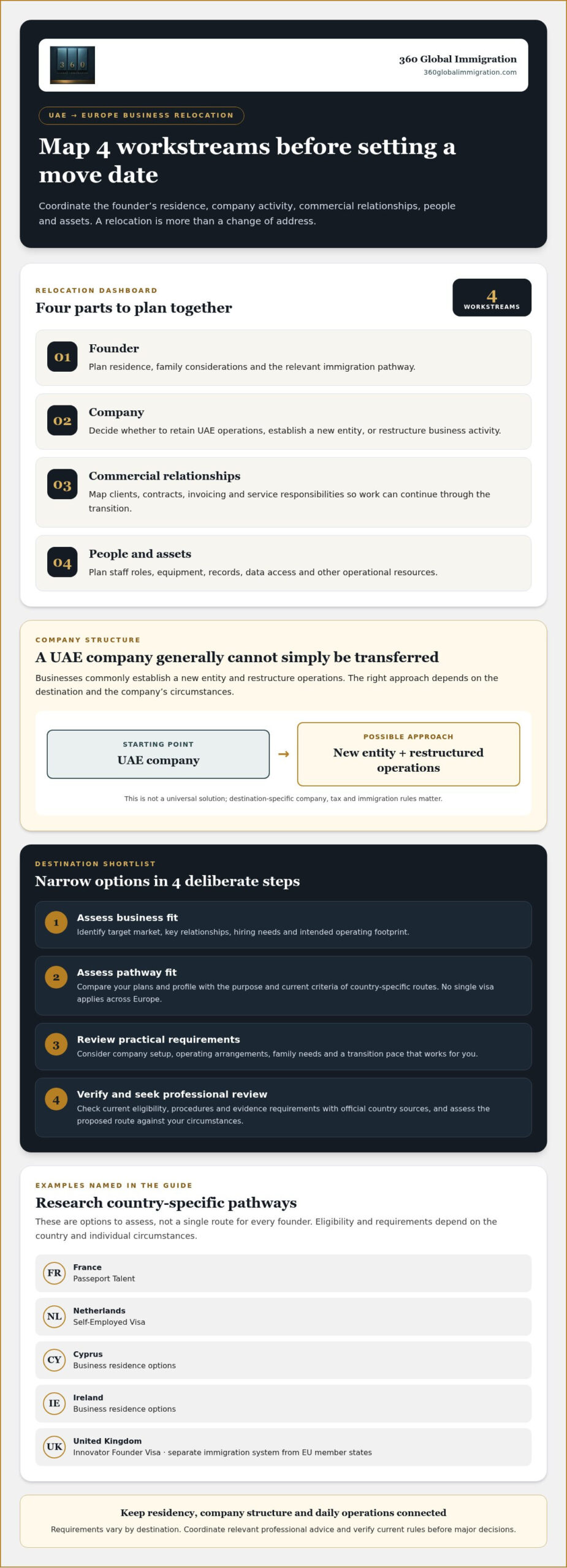
A UAE-to-Europe business relocation coordinates the founder’s residence, company activity, staff, assets and operating arrangements in a chosen European country. It is not simply a shipment or a change of address. In many cases, a UAE company cannot be directly transferred to Europe. The business may instead establish a new legal entity and restructure its operations. The right approach depends on the destination and the company’s circumstances.
Keep the main workstreams distinct. Immigration planning covers the founder’s residency route and application. Business operations involve clients, contracts, staffing and service delivery. Tax and company-structure decisions require destination-specific professional advice. Property choices and physical shipping are separate practical matters, not substitutes for resolving residency or operating plans. Treating all of these as one task can leave important decisions out of sequence.
Which parts of a UAE business relocation need separate plans?
Map each element before setting a move date:
- Founder: residence plans, family considerations and the relevant immigration pathway.
- Company: whether to retain UAE operations, establish a new entity, or restructure activity.
- Commercial relationships: clients, contracts, invoicing and service responsibilities.
- People and assets: staff roles, business equipment, records, data access and other operational resources.
These decisions can depend on destination-country immigration, company, employment and tax rules. Immigration guidance can support pathway assessment and application preparation, but it is distinct from physical moving, travel arrangements or company-registration work. Coordinate the relevant professional advice so each workstream informs the others.
What should founders decide before selecting a destination?
Start with the business itself: its model, target customers, hiring plans and intended operating footprint. Then consider personal priorities, including language, family needs and how quickly you want to transition. A founder serving customers across several countries may weigh different factors from one building a locally focused team. Create a shortlist based on these needs instead of assuming a popular destination will suit every business.
Europe is not one uniform administrative or immigration system. Requirements and available residency pathways vary by country, and the UK has a separate immigration system from EU member states. Company forms also differ. For example, the Societas Europaea company structure is a specific European public limited-liability company form, not a default solution for every relocating business. In this UAE to Europe business relocation guide, destination selection starts with fit, then moves to route-specific assessment and coordinated planning.
How to shortlist a European destination and residency pathway
A strong shortlist starts with the business, not a visa label or a popular destination. Compare where your customers, suppliers, partners and potential employees are based, then consider how you plan to operate. Launching a new venture, expanding an established company, freelancing and managing an existing business may raise different practical and residency questions.
Use this sequence to narrow the options:
- Assess business fit. Identify your target market, key relationships, hiring needs and intended operating footprint. Consider language and customer access as research factors, not promises of a particular outcome.
- Assess pathway fit. Compare your plans and profile with the purpose and current criteria of relevant country-specific routes. No single visa applies across Europe.
- Review practical requirements. Research company setup, operating arrangements, family needs and the pace of transition that works for you. The official EU business setup guide explains practical considerations for establishing a business in an EU member state.
- Seek professional review. Have the proposed destination and residency route assessed against your circumstances before preparing an application. Verify current eligibility, procedures and evidence requirements through the relevant country’s official sources.
How do business goals shape the country shortlist?
Map where your business operates now and where you plan to grow. A founder serving customers across borders may weigh market access and partner relationships differently from one building a local team. Add family priorities, language and the desired transition pace to the comparison. These factors help identify a workable shortlist, but they don’t determine immigration eligibility or guarantee business results.
The UK is geographically in Europe, but it has a separate immigration system from EU member states. Treat it as a distinct option in your research rather than assuming an EU pathway or process applies there.
Which business and talent routes could founders research?
Examples include France’s Passeport Talent for eligible business creators and the distinct UK Innovator Founder Visa for eligible founders. The Netherlands Self-Employed Visa, Cyprus Business Residence Visa, Ireland Business Residence Visa and Denmark Startup Visa are also country-specific options. Their criteria and procedures differ, so assess each route against the founder’s plans and verify current requirements before drawing conclusions.
For a wider overview of route types, read this talent-based immigration to Europe guide. Tailored pathway guidance can connect your destination shortlist with the residency workstream in your UAE to Europe business relocation guide, before you move into application planning.
360 Global Immigration provides business and talent residency guidance to help assess relevant pathways and prepare applications. For a comparison of European residency by investment alternatives, including business, startup, self-employed and talent routes, review how their eligibility and activity requirements differ.
How to protect business continuity while planning the move
A relocation plan should protect day-to-day service while the founder’s location and business arrangements change. Identify essential functions, assign a primary owner and backup for each, and decide how clients, staff and suppliers will receive updates. Then coordinate those operational milestones with immigration and company-planning decisions. Residency status and permission to carry out particular business activities depend on the destination’s rules, so don’t assume that a move or application alone authorises every activity.
Use this phased plan to make responsibilities visible. Adapt it to your business model and destination.
| Phase | Business continuity tasks |
|---|---|
| Pre-move | List active clients, service commitments, contracts, invoicing cycles and critical suppliers. Assign owners and backup contacts for time-sensitive work. Map staff responsibilities, records and the secure access the team will need during the transition. |
| Transition period | Set out who handles client queries, approvals, payments and supplier issues while responsibilities or locations change. Keep a clear handover record, maintain agreed communication channels and track deadlines for contracts and invoices. |
| Post-arrival | Review whether service delivery, staff roles, invoicing and supplier arrangements are working as planned. Confirm ongoing ownership of records and access, and update the continuity plan as the operating setup develops. |
For destination research, the European Commission’s guide to investing in the EU offers an official starting point on investment in the EU and links to national investment agencies. Use country-specific information to frame questions about your intended business footprint, not as a substitute for advice on your circumstances.
How can founders keep clients and operations supported?
Identify which services must continue, then name a primary owner and backup for each client relationship and operational deadline. Prepare a communication plan for clients, employees and business-critical suppliers, with clear points of contact and handover dates. Organise business records, secure access and document retention so authorised team members can retrieve what they need throughout the move.
What professional advice may need coordinating?
Keep immigration guidance distinct from tax, legal, accounting and company-structure advice. Coordinate the workstreams, but direct specialist questions to the relevant qualified adviser in each jurisdiction. Firms such as CiDATax SRL can assist with cross-border tax and regulatory requirements across the UK and the European Union. Prepare questions about contracts, employment arrangements, intellectual property and cross-border obligations. The answers may affect what changes, when it changes and who is responsible.
This UAE to Europe business relocation guide can help structure the planning, but general information cannot resolve every individual legal or tax question. A clear continuity plan, paired with advice tailored to the destination and business, gives the transition a more reliable foundation.
A step-by-step UAE to Europe business relocation plan
A reliable move depends on sequencing, not rushing through a checklist. Use these stages to connect business decisions, residency preparation and operational readiness. Build in dependencies, such as confirming which route fits before assembling route-specific evidence, and tie dates to verified official guidance rather than assuming a universal application schedule.
- Set business objectives. Define why you’re relocating, what activity will take place in Europe, which customers you intend to serve and what must continue in the UAE.
- Research destinations and pathways. Compare business needs with potential country-specific routes, then verify current eligibility and procedures through official sources.
- Coordinate specialist review. Align immigration planning with relevant company, tax, accounting and legal advice. Record open questions and decisions that depend on each other.
- Prepare the application and transition plan. Organise evidence for the selected route while assigning responsibilities for clients, staff, contracts, records and suppliers.
- Track milestones and adjust. Maintain a central tracker for owners, documents, dependencies, decisions and verified deadlines. Update it when official guidance or your circumstances change.
What should a founder organise before an application?
Build a document-readiness checklist around the chosen pathway. Depending on the route and applicant, relevant records may include:
- Identity: current identity and travel documents, plus personal records requested by the route.
- Business: company records, business plans, project details and evidence of the proposed activity.
- Financial and professional: relevant financial records, qualifications, work history or evidence of business experience.
These are preparation categories, not a universal list of required evidence. Check the destination’s current official instructions for document format, translation, certification and submission rules. Before filing, compare details across forms and supporting documents, including names, dates, business information and descriptions of the proposed activity. Resolve inconsistencies rather than leaving the reviewer to reconcile them.
How should the move be sequenced after pathway research?
Coordinate application preparation with family arrangements and business-continuity tasks, so a change in one workstream doesn’t leave another unprepared. Avoid irreversible commitments until you understand the relevant requirements and how they apply to your circumstances. In your tracker, note each milestone’s owner, prerequisites, evidence needed and source for its deadline. This makes dependencies visible without promising a fixed processing schedule.
A well-organised UAE to Europe business relocation guide turns a complex move into decisions you can manage one stage at a time. For a framework on assessing specialist support, review business immigration expert selection guidance. 360 Global Immigration provides business immigration guidance for residency pathway assessment and application preparation.
How 360 Global Immigration can support the residency workstream
Immigration planning is one part of a wider business relocation, but it can influence the order of other decisions. 360 Global Immigration helps founders assess relevant business and talent-based residency pathways, plan an application and organise supporting documents around the route and the applicant’s circumstances. Guidance on the process can also help clarify stages and outstanding questions, without promising a particular outcome or processing time.
Relevant options include France’s Passeport Talent, the UK Innovator Founder Visa, the Netherlands Self-Employed Visa, Cyprus Business Residence Visa, Ireland Business Residence Visa and Denmark Startup Visa. These are distinct, country-specific pathways, not a single permit for relocating throughout Europe. Eligibility, evidence and procedures vary, so the appropriate route depends on the founder’s profile, business objectives and destination requirements.
Keep the boundaries clear. Immigration consultancy can support pathway assessment and application preparation, but it doesn’t replace qualified tax, legal, accounting or corporate advice. Questions about company structure, tax treatment, contracts, employment or intellectual property should be addressed through relevant professional advice for the jurisdictions involved. Coordinating these workstreams helps you understand how residency planning fits into the wider move.
What does tailored immigration guidance help organise?
Guidance connects your business profile and plans with route research before you prepare an application. It helps structure document preparation around the applicable pathway, highlight information that needs attention and make the process easier to follow. Requirements can differ between routes and applicants, so preparation should be specific rather than based on a generic checklist.
How can founders prepare for an initial planning conversation?
Bring a concise overview of your business model, current operations, preferred destinations and intended move. A prepared list of questions can make the discussion more focused:
- Which residency pathways may align with my profile and business plans?
- What evidence and application stages apply to the route I’m considering?
- How should I account for dependants and coordinate application steps with my transition plan?
Use the discussion to clarify the immigration workstream, then coordinate separate advice for tax, legal and corporate matters. This gives your UAE to Europe business relocation guide a practical next step: identify the residency questions to resolve first, while keeping business continuity and personal planning in view.
To discuss your business residency plans and identify the questions to address first, discuss your business residency plans.
Make your relocation plan work as one
A successful move depends on aligning the founder’s residency pathway with the company’s destination, operational needs and transition plan. Treat these as connected workstreams, but give each the right expertise: immigration guidance supports pathway assessment and application preparation, while tax, legal and corporate questions need their own qualified advice.
This UAE to Europe business relocation guide has outlined a practical sequence: define what is moving, shortlist destinations by business and personal fit, protect client and staff operations, and organise milestones around verified requirements. The right residency option is country-specific. France, the UK, the Netherlands, Cyprus, Ireland and Denmark each have distinct pathways, with application support tailored to the founder or professional and their circumstances.
With a clear view of your business model, intended destination and open questions, you can take the next step with greater confidence. A well-coordinated plan can help you move forward thoughtfully while keeping your business priorities in focus.
Frequently Asked Questions
How do I relocate my business from the UAE to Europe?
Plan the move as connected business, residency and personal workstreams. Start by defining what will move, your operating goals and where customers, staff and suppliers are based. Shortlist destinations, then assess country-specific residency pathways and business requirements. Prepare relevant documents, coordinate qualified immigration, tax and corporate advice, and assign owners to continuity tasks such as client communication, invoicing and data access. Keep milestones tied to verified requirements rather than assumed timelines.
Can I move my UAE company to an EU country?
Generally, a UAE company cannot simply be transferred to an EU country as the same legal entity. A common approach is to establish a new entity in the destination country and restructure operations, while deciding how the UAE business will continue. The right structure depends on the countries involved and your circumstances. Get qualified advice on corporate, tax and legal implications before making changes to ownership, contracts or operations.
Which European country is best for relocating a business from the UAE?
No single country is best for every business. Compare where your customers, suppliers, partners and potential employees are located, alongside your business model, intended footprint, language considerations and family priorities. Then assess whether a country-specific residency pathway aligns with your plans. Options to research may include France, the UK, the Netherlands, Cyprus, Ireland and Denmark, but requirements differ. Treat your shortlist as a starting point for detailed research, not a guarantee of suitability.
Do I need a business visa to move from the UAE to Europe?
If you plan to live in a European country and conduct business there, identify the relevant residency and activity permissions for that destination. A short-stay professional business visit is different from relocating and operating a business long term. Rules vary by country, and the UK has a separate immigration system from EU member states. Assess your intended activities and circumstances against current official requirements before planning the move.
What documents are needed for a European business residency application?
Required documents depend on the route and applicant. Preparation may involve identity records, business and project information, financial evidence, and professional or experience records. Some pathways may request different supporting evidence, formats or steps. Use the destination’s current official instructions as your checklist, including any translation, certification or submission requirements. Check that names, dates and business details are consistent across forms and supporting documents before submission.
How long does it take to relocate a business from the UAE to Europe?
There isn’t one reliable timeline for every move. The overall schedule depends on destination research, pathway requirements, document preparation, application processing and the work needed to establish or restructure operations. Family arrangements and business handovers can add further dependencies. Build a milestone tracker with responsible owners and deadlines verified against current official guidance. Avoid treating an estimated application processing period as the full relocation timeline or as a guaranteed result.
Can I keep serving UAE clients after moving to Europe?
Possibly, but plan how client service will continue and review the arrangements for your specific business. Map contracts, invoicing, service responsibilities, staff coverage and access to business records. Ask qualified advisers in the relevant jurisdictions about tax, corporate, legal and contractual considerations. Also verify whether your residency status permits the activities you intend to carry out from the destination country. Clear responsibilities and communication can help reduce disruption for UAE clients during the transition.