
The best alternative to a passive European investment visa may not involve another investment. European residency by investment alternatives can instead be based on building a business, launching a startup, working independently, or qualifying through professional talent. The right route depends on what you plan to do and how your experience and documents support that plan, not simply on how much capital you can commit.
Business, startup, self-employed, and talent permits can have different eligibility tests, activity requirements, and rules for family members or future settlement. This 2026 comparison explains how these pathways differ from passive investment-led programs and outlines options to consider, including France’s Passeport Talent, the Netherlands Self-Employed route, and Denmark’s Startup Visa. It also shows what to clarify before applying: your role in a project, the fit between your experience and the route, and the evidence your case may require. Because each country sets its own rules, choosing a route that matches your actual plans is an essential first step.
Key Takeaways
- European residency by investment alternatives are assessed through qualifying activity or professional profile, not simply by substituting one investment amount for another.
- Compare business, startup, self-employed, employment, and talent routes by who qualifies, what involvement is expected, and what evidence supports the application.
- Use your real objective and experience to narrow the options, then weigh relocation priorities, family needs, and long-term plans separately from eligibility.
- Residence, renewal, family, and settlement rules differ by country, so assess each national pathway on its own current requirements.
- Prepare a clear profile, project or career evidence, and supporting documents before pursuing a route-specific eligibility review.
European residency by investment alternatives: what counts as an alternative?
For business investors, “alternative” might sound like a different way to meet the same investment threshold. In practice, it often means changing the basis of the application. Investment-led residence relies on meeting a prescribed investment or economic-contribution criterion; activity-based residence relies on qualifying work, business, startup, self-employment, or talent. The precise legal meaning depends on the country and permit.
There is no single European residence-by-investment permit with one shared set of rules. Countries set their own immigration categories, eligibility tests, and application procedures. The UK, though geographically in Europe, also operates its own immigration system. So European residency by investment alternatives is best understood as a comparison of national routes, not a common Europe-wide application.
Investment residence and activity-based residence are different route categories
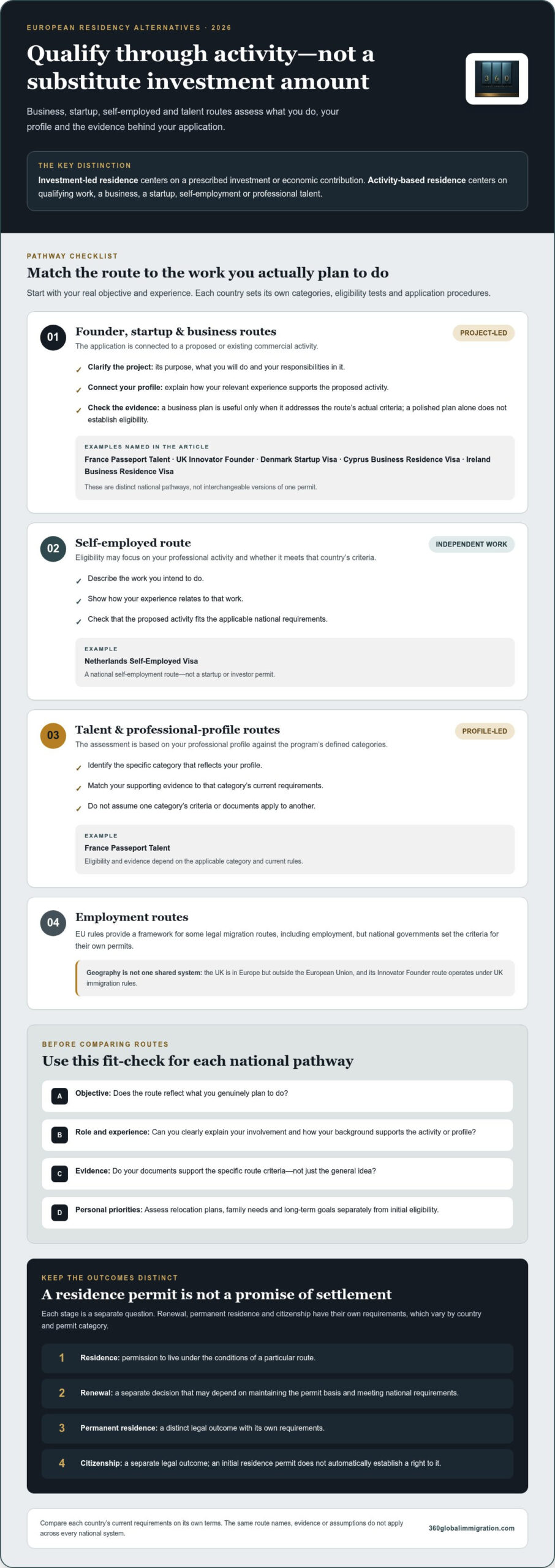
An investment-led route makes a specified investment or other qualifying economic contribution central to eligibility. An activity-based route instead assesses the applicant’s proposed or existing work, business activity, experience, or professional profile. Depending on the national program, this could mean a startup, self-employed work, a business project, or specialist talent. Countries don’t all offer the same categories or define them in the same way.
France Passeport Talent, the Netherlands Self Employed Visa, and Denmark Startup Visa are distinct national pathways, each with its own requirements. They are not interchangeable substitutes for a passive investment route. Your application needs to show a credible fit between your profile, the route’s criteria, and the evidence you submit. The Immigrant investor programs overview also distinguishes residence-by-investment programs from citizenship-by-investment programs.
Residence permission is not the same as permanent residence or citizenship
A residence permit grants permission to reside under the conditions of that particular route. Renewal is a separate decision, while permanent residence and citizenship are distinct legal outcomes with their own requirements. An initial permit doesn’t, by itself, establish an automatic right to either.
Eligibility periods, renewal conditions, and settlement rules vary by country and permit category. They may also depend on maintaining the basis of the permit or meeting other national requirements. If long-term residence is part of your plan, assess it separately from initial eligibility. Treat residence, renewal, permanent residence, and citizenship as four distinct questions, and verify each against current official guidance for the relevant country and permit.
Which European pathways can replace a passive investment route?
The useful comparison is not how much capital different routes require. It is what each route asks you to qualify through: a business project, active self-employment, a startup proposal, or a recognised professional profile. These European residency by investment alternatives suit different applicants. Documents that support one category may not establish eligibility for another.
EU rules provide a framework for some legal migration routes, including employment, but national governments set the criteria for their own permits. The European Parliament’s overview of EU immigration policy offers useful context. The UK is in Europe but outside the European Union, and its Innovator Founder route operates under UK immigration rules.
Founder, startup, and business residence routes
Business routes generally connect residence eligibility to a proposed or existing commercial activity. Depending on the country and category, an application may need to explain the project, your role, relevant experience, and how the activity meets current criteria. A business plan is useful only when it addresses the route’s actual requirements; professional immigration advice for startups can help founders align their plans with the relevant pathway.
France Passeport Talent and the UK Innovator Founder route are distinct examples, not interchangeable versions of one European permit. Denmark Startup Visa, Cyprus Business Residence Visa, and Ireland Business Residence Visa are other country-specific pathways to compare. For each one, identify the current eligibility criteria and required evidence, then check them against the business you genuinely intend to pursue. A practical comparison starts with the project’s purpose, your responsibilities, and the records you can provide to support both.
Self-employed and talent-based routes
A self-employed pathway may focus on your professional activity and whether it meets the destination country’s criteria. The Netherlands Self Employed Visa, for example, is a national self-employment route, not a startup or investor permit. Be ready to explain what work you will do, how your experience relates to it, and how the proposed activity fits the applicable requirements.
Talent-based routes take a different approach: they assess a professional profile against the program’s defined categories. France Passeport Talent is a relevant example, but eligibility and supporting evidence depend on the applicable category and current rules. For wider context on professional pathways, see Talent-Based Immigration to Europe: 2026 Guide.
Start with the route that best reflects your actual work and background. Compare its criteria with your career records, qualifications, project details, and proposed activity before deciding what needs further preparation. Business and talent residence guidance from 360 Global Immigration can help you organize that assessment.
How do the alternatives compare on eligibility, obligations, and outcomes?
A side-by-side review is most useful when it separates each route’s qualifying basis from the evidence and ongoing conditions set by current national rules. The table below is a planning guide, not a statement that every suggested document is mandatory. Check each program’s 2026 criteria and application requirements against official guidance before relying on them.
| Route example | Qualifying basis and likely profile | Activity expectations to assess | Evidence to prepare for review |
|---|---|---|---|
| France Passeport Talent | A talent-based route for applicants who may fit a program-defined category. | Establish how your professional profile aligns with the relevant category. | Career history, qualifications, achievements, and category-specific supporting records. |
| UK Innovator Founder | A founder route for applicants proposing or developing a business venture. | Clarify your role in the venture and how you’ll pursue the business activity. | Business proposal, relevant experience, and supporting documents required under current rules. |
| Netherlands Self Employed Visa | A self-employment route for applicants whose professional activity may meet national criteria. | Show how your work will be conducted as self-employed activity. | Professional background, proposed services or activity, and applicable business records. |
| Cyprus and Ireland Business Residence Visas | Business residence categories for applicants whose plans align with each country’s route. | Set out the proposed or existing business activity and your involvement. | Project or company information, role details, and country-specific documents. |
| Denmark Startup Visa | A startup-focused pathway for applicants with a venture that fits the program’s current criteria. | Explain the startup concept and your role in developing it. | Venture materials, founder credentials, and any required assessment documents. |
Compare what each route asks you to demonstrate
Business and startup applicants should organize evidence around the venture, their role, and the activity they intend to pursue. Self-employed applicants should distinguish their professional work from a startup proposal or innovation assessment. Talent applicants should map their credentials and career evidence to the specific qualifying category. These are preparation themes, not guaranteed document lists; exact requirements vary by route and can change.
Compare residence outcomes separately
Route suitability depends on the applicant’s qualifying profile and the obligations attached to the permit. Approval, renewal, family provisions, and settlement are separate considerations. Check each one under the relevant country’s current rules rather than assuming it follows automatically from the qualifying basis. A permit from one country also shouldn’t be treated as permission to reside or work elsewhere in Europe.
This comparison of European residency by investment alternatives helps identify which routes deserve further research without ranking countries or promising an immigration outcome.
How can you identify the right European residency alternative?
Begin with what you genuinely plan to do, not a destination shortlist. A suitable route should align your objective, professional or business profile, and intended activity with a country’s current criteria. Use this framework to narrow the options before preparing an application.
- Define your real objective. Clarify whether you want to build or operate a business, launch a startup, continue self-employed work, or qualify through a talent category. Describe the activity you intend to pursue and your role in it.
- Map your profile to a route category. Identify whether your experience and plans support an active business, startup, self-employment, or talent-based application. Assess each route on its own merits instead of treating it as a workaround if you don’t qualify under another category.
- Take stock of your evidence. Gather relevant career records, qualifications, business information, project materials, and other documents connected to your proposed route. List what you already have, what needs updating, and what may need further preparation.
- Separate personal priorities from eligibility. Record your relocation purpose, the activities you need permission to undertake, family considerations, and longer-term plans. These priorities help you compare routes, but they don’t replace a program’s eligibility tests.
- Verify rules and keep a dated record. For each plausible route, review current official guidance on eligibility, permitted activities, renewal, family provisions, and settlement objectives where applicable. Record the source and date you reviewed, then revisit the information before acting because national criteria can change.
Turn priorities into a practical comparison
Use a checklist to compare what each route means for your plans, not just whether you appear to meet its entry criteria. Consider whether the permit aligns with your intended work, what conditions may apply at renewal, how family applications are treated, and whether the route supports your long-term objectives. Confirm each point for the specific country and permit. A residence permit in one country doesn’t automatically give you residence or work rights elsewhere in Europe.
For relocation planning from the UAE and professional visit visa services UAE applicants may need, the UAE to Europe Business Relocation Guide: Plan Your Move in 2026 can help you organize decisions alongside route research. Professional guidance can also help structure your comparison and identify the evidence relevant to your profile and intended activity.
Build your comparison around clear objectives and credible evidence. Explore tailored business and talent residence guidance from 360 Global Immigration to assess which pathways merit closer review.
Plan your next steps with a tailored residency strategy
There’s no universal substitute for a passive investment route. The right direction depends on how your objectives and professional or business profile align with a country’s current criteria. A founder planning to build a company, a self-employed professional, and an applicant with a qualifying talent profile may need to consider different routes, evidence, and ongoing commitments.
Use the comparison to identify a plausible category, not to assume eligibility. A structured preparation process can turn broad relocation goals into a focused assessment of the routes worth exploring.
Prepare a clear brief before assessing a pathway
Bring your personal circumstances and intended activity into one concise summary. This gives an initial review a practical starting point and helps separate your priorities from each program’s eligibility requirements.
- Personal details: Note your nationality, current residence status, and any family considerations relevant to relocation planning.
- Relocation objectives: Explain why you’re considering a move, where you hope to establish residence, and what your longer-term plans involve.
- Professional or business activity: Describe your experience, current work, proposed venture, or startup role. Be clear about what you intend to do in the destination country.
- Available records: Organize relevant identity, professional, business, and financial documents. Identify gaps without assuming that any particular document guarantees eligibility.
Then compare the potential route with current official rules. Names, criteria, and application procedures can change, so use summaries to guide your research rather than as a substitute for verification. A sound assessment considers the facts of your case alongside the rules for the specific country and permit.
Get structured guidance across relevant route categories
360 Global Immigration supports business and talent-based residency application planning across Europe and the UK. Relevant pathways include France Passeport Talent, UK Innovator Founder, Netherlands Self-Employed, Cyprus and Ireland business residence, and Denmark startup routes. These are separate national programs, each with its own criteria and evidence requirements.
Guidance can help organize eligibility analysis, clarify which route categories merit further review, and structure supporting evidence around your profile and project. The relevant authorities’ rules still determine the requirements and outcome. The goal is a clear, carefully prepared strategy that connects your plans to a plausible pathway.
When you’re ready to discuss your circumstances and possible routes, Discuss your European residency strategy with 360 Global Immigration.
Choose a pathway that fits your plans
The right residency route isn’t simply the one that replaces a passive investment requirement. It’s the one whose qualifying basis matches your profile and intended activity, whether that involves a business, a startup, self-employment, or a talent category. These European residency by investment alternatives follow country-specific rules, so assess eligibility, ongoing obligations, family provisions, and future settlement options separately.
Before taking the next step, define your relocation objectives, identify the route category that appears most plausible, and organize the evidence that supports your professional or business profile. Then review the latest official requirements for the specific country and permit. A clear comparison can help you move from broad interest to a focused application plan.
360 Global Immigration provides guidance across business and talent-based residency pathways, tailored to an applicant’s profile and intended activity. For a structured review of potential routes and supporting evidence, discuss your European residency strategy.
Frequently Asked Questions
What are alternatives to European residency by investment?
Alternatives include residence pathways based on business activity, startups, self-employment, employment, or professional talent rather than passive investment alone. The right category depends on the country’s rules, your profile, your intended activity, and the evidence you can provide. Examples include France Passeport Talent, the Netherlands Self Employed Visa, and Denmark Startup Visa. These are national routes, not one shared European permit, and each program has its own eligibility requirements.
Can I get European residency without making a large investment?
Potentially, yes. Some routes assess a person’s business project, professional activity, or qualifications instead of relying on a passive investment. However, avoiding a large investment doesn’t mean there are no financial or other requirements. A program may require evidence connected to the proposed activity or sufficient resources under its rules. Compare the total obligations and verify current criteria for the specific country and permit before making plans.
Which European countries offer business or startup residency routes?
Examples include France, the UK, the Netherlands, Cyprus, Ireland, and Denmark, each with distinct business, startup, self-employed, or talent-based routes. These include France Passeport Talent, UK Innovator Founder, Netherlands Self Employed, Cyprus and Ireland business residence, and Denmark Startup pathways. The UK is in Europe but outside the European Union. Program names, availability, and requirements can change, so review current details through official country guidance.
Is a startup visa the same as residency by investment?
No. A startup route generally assesses a venture and the applicant’s role or fit with its program criteria. An investment-led route makes a prescribed investment or other defined economic contribution central to qualification. A startup application may still involve financial evidence or other conditions, but that doesn’t make it equivalent to passive investment residence. Review the specific country’s requirements, permitted activity, and ongoing obligations before choosing a route.
Does European residency in one country let me live anywhere in Europe?
No. A residence permit is issued under the rules of a particular country and shouldn’t be treated as permission to live or work throughout Europe. The European Union and Europe are not the same geographic or legal scope, and the UK has its own immigration system. Before planning a move, check the issuing country’s permit conditions and separately verify any rules that apply to travel or residence elsewhere.
How much do European residency alternatives cost?
There’s no single cost for European residency alternatives. Expenses depend on the country, permit category, and applicant’s circumstances, and may include government application charges, document preparation, translations, or other route-specific requirements. Business or startup plans may also involve their own operating costs. Consultancy fees are separate from government charges. Start with the route’s current official fee information and a clear breakdown of likely application expenses when planning your budget.