
Europe has no single “talent visa.” Talent based immigration to Europe can mean an EU Blue Card, a country-specific specialist permit, or a route for exceptional achievement or entrepreneurship. Each has different eligibility rules, and the right option depends on how you plan to contribute.
If you’ve seen “talent visa” used to describe several different pathways, the confusion is understandable. EU-wide rules don’t replace national immigration systems, and the same professional profile may be assessed differently from one destination to another. A qualifying job offer, a record of achievement, or a credible business plan could each point towards a different route.
This 2026 guide explains how EU-level and national pathways differ, then helps you shortlist options based on your qualifications, work arrangement, and preferred destination. It also covers what to verify with official government sources before applying, including current eligibility criteria, document requirements, fees, and procedures. Comparing these details can help you decide whether an employment, achievement-based, or business route is the more suitable starting point.
Key Takeaways
- Talent based immigration to Europe covers distinct route types, not one universal visa category. First identify whether your case is based on employment, recognised achievement, entrepreneurship, or self-employment.
- Compare pathways by how you’ll work and what evidence you can provide, then narrow your destination choices accordingly.
- Before applying, check current eligibility criteria, required documents, and procedures with the relevant official immigration authority.
- A structured route review can help reveal information gaps and organise application preparation, but it can’t guarantee approval.
- 360 Global Immigration advises on selected pathways, including France Passeport Talent, the UK Innovator Founder Visa, and business or self-employed residence options.
Talent-Based Immigration to Europe: What the Term Covers, and What It Does Not
Talent-based immigration to Europe is an informal umbrella term for national and shared immigration routes that allow eligible non-EU nationals to live and work in Europe based on their skills, achievements, or business activity. It is not the name of one Europe-wide visa. The legal route, application process, and residence rights depend on the destination and the activity you intend to pursue.
This distinction matters because “Europe,” “the European Union,” and EU programmes are not interchangeable. Europe includes countries outside the EU, while an EU framework applies only within its defined scope. Even where a shared framework exists, national authorities apply its rules through their own procedures. Your qualifications, job offer, professional record, or business model may therefore lead to different options in different countries.
What counts as a talent-based immigration route?
The label can describe several distinct legal categories. Highly qualified employment routes generally focus on a professional role and the applicant’s qualifications or experience. Exceptional-talent schemes may require recognition or endorsement of a person’s achievements. Startup and entrepreneur routes assess proposed business activity, while self-employment routes concern applicants working independently. These categories aren’t automatically interchangeable. A strong employment profile doesn’t, by itself, establish eligibility for a founder or self-employed route.
Marketing terms can be a useful starting point, but they don’t determine eligibility. Check the programme’s formal criteria, the responsible authority, and the specific residence permission it grants.
Does one European talent visa cover every country?
No. There is no single route that grants equivalent immigration rights across all European countries. The EU Blue Card is a shared framework for highly qualified employment in participating EU Member States, but countries implement it through national rules. The EU Blue Card scheme offers background on the framework. Use the relevant government authority to confirm current requirements and procedures for your destination.
Denmark and Ireland do not participate in the EU Blue Card scheme. The UK is outside the EU and has its own immigration system, including routes with separate eligibility rules. A country may offer national talent, business, or self-employment options even when a particular EU framework doesn’t apply. Confirm a route’s current scope and legal status before treating it as a practical option.
When comparing destinations, don’t ask only, “Which country has a talent visa?” Ask instead: What activity will I carry out, which legal category covers it, and what evidence does that country require? That framing helps distinguish an employment-based case from one built around achievement or business activity.
How Europe’s Main Talent and Specialist Routes Work
Once you know that “talent visa” can refer to different legal categories, match your intended activity to the relevant route family. Your proposed activity is the starting point for route fit: a salaried role, a record of achievement, a startup plan, and independent professional work call for different evidence and may fall under different rules. A route’s name alone won’t tell you whether it suits your circumstances.
Employment routes: the EU Blue Card and national work pathways
The EU Blue Card is a framework for highly qualified non-EU nationals seeking employment in participating EU Member States. It is not a general talent permit for every country or work arrangement. National implementation matters, so check the destination government’s current criteria, application procedure, and any conditions tied to the role. Employment-based routes may require a qualifying job offer or contract. They may not suit someone planning to work independently or launch a business.
Some countries also have national work pathways alongside or instead of the Blue Card. Don’t assume that meeting one country’s requirements establishes eligibility elsewhere. Before preparing an application, verify the exact route and its current rules with the competent authority.
Talent, startup, and self-employment routes are not the same
National schemes show why these route categories need to stay distinct. France Passeport Talent is a French residence pathway with different possibilities under its formal categories. The UK Global Talent route is a separate national option for people whose profile meets its talent criteria. Neither should be treated as a general substitute for an employment permit. Check the requirements for the specific category you’re considering.
Business-led pathways assess a different case. The UK Innovator Founder Visa and Denmark Startup Visa are examples of routes associated with business or startup activity, not generic talent visas. The Netherlands Self Employed Visa concerns self-employment, while Cyprus and Ireland business residence pathways are relevant to applicants pursuing business activity. Their names don’t make their criteria interchangeable.
- Employed professional: Check whether the route requires a job offer, contract, qualifications, or other role-related evidence.
- Recognised talent: Confirm how the national scheme assesses achievement and whether endorsement or other recognition is required.
- Founder or self-employed applicant: Review the destination’s rules for the proposed business or independent activity instead of relying on employment-route criteria.
For applicants exploring Talent based immigration to Europe, 360 Global Immigration advises on selected talent, startup, business, and self-employed pathways. A structured assessment can help clarify which category to investigate and what information needs checking. It does not guarantee eligibility or approval. Explore European immigration pathway guidance as a starting point, then verify current requirements with the relevant official authority.
Which European Talent Route Fits Your Profile? Compare by Contribution
Start with what you plan to do, then compare destinations. No country is universally best for every applicant. Route suitability depends on your professional evidence, intended work arrangement, business model, and the destination’s current rules. Use the table below to shortlist options, not to determine programme eligibility. Treat the evidence examples as preparation prompts, and verify each programme’s thresholds, benefits, and eligibility conditions through official sources.
| Contribution model | Route type to investigate | Evidence to consider | Key question to verify |
|---|---|---|---|
| Employed professional or researcher | Qualified employment route, such as an applicable national work pathway or EU Blue Card | Role details, employer information, qualifications, experience, and any offer or contract relevant to the route | Does this destination require a qualifying job offer, and what conditions apply to the role? |
| Recognised or exceptional talent | National talent category or endorsement-based route | Career achievements, professional recognition, portfolio, or endorsement evidence, where required | How does the specific programme assess talent, and is endorsement required? |
| Startup founder | Startup or entrepreneur pathway | Business concept, plan, funding information, or endorsement materials, if officially required | Does the route assess innovation, endorsement, investment, or another defined business criterion? |
| Freelancer or independent professional | Self-employment pathway | Proposed services, client or commercial evidence, professional background, and financial documents, where applicable | What evidence does the destination require to support the proposed independent activity? |
If you are an employed professional or researcher
Assess the job, employer, qualifications, and destination before choosing a route label. Your evidence may align more closely with a qualified employment pathway or, depending on the country and programme, a national talent category. Check official guidance for any requirements concerning family members, mobility, renewal, and permitted work. Rights and conditions can differ by route, so don’t assume they from a programme name.
If you are a founder, freelancer, or independent professional
Distinguish a startup proposal from an established self-employed activity. A founder route may assess the proposed venture under criteria set by that programme, while a self-employment route may focus on independent professional activity. Don’t assume that a business plan, endorsement, or financial evidence is required everywhere. Confirm the current rules for each destination. For route-specific detail, read the France Passeport Talent business creator guide, the UK Innovator Founder endorsement guide, and the Netherlands self-employed visa requirements guide. Verify programme details against current official sources before relying on them.
For applicants considering Talent based immigration to Europe from the UAE, build your shortlist around the contribution you can substantiate, not a country ranking. Compare the route’s formal criteria with your evidence, then confirm the latest rules with the relevant authority. A UAE to Europe business relocation guide can also help coordinate residency, company planning, and business continuity when preparing a move.
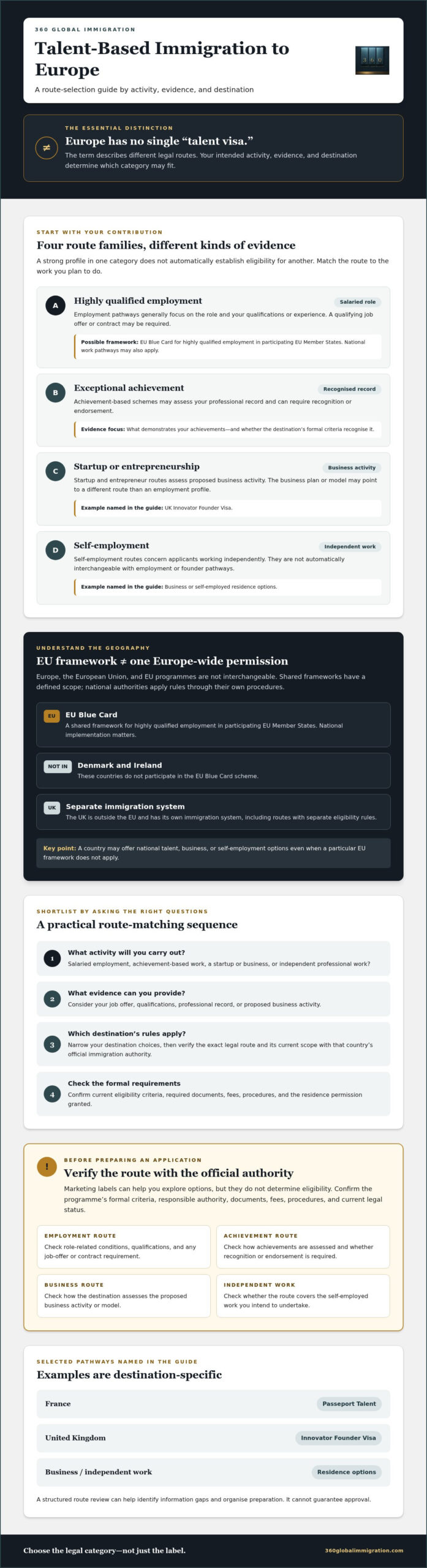
How to Shortlist a Route and Prepare a Reliable Application
A clear process helps turn a broad interest in Talent based immigration to Europe into a practical application plan. Keep two tasks separate: first assess whether a route appears to fit your circumstances, then prepare the application in the format the responsible authority requires. Careful preparation can reduce avoidable gaps, but neither an eligibility assessment nor a document review guarantees a positive decision.
Build a route shortlist from your work and evidence
- 1. Define your activity. Record whether you plan to take employed work, pursue recognised professional activity, establish a startup, or work independently. Note your employer or business structure, qualifications, experience, and intended role.
- 2. Choose destinations to investigate. Select countries that fit your professional and personal plans. Don’t rank them by reputation alone. Their route categories and requirements may differ.
- 3. Match routes to your profile. Compare each programme’s formal criteria with evidence you can provide. An employment route may focus on the role and employer, while a business route may assess the proposed activity under its own rules.
- 4. Remove mismatches. Set aside routes that don’t permit your intended activity or whose stated criteria your evidence doesn’t appear to address. Treat this as an initial screen, not a final eligibility decision.
- 5. Organise evidence. Build a route-specific document list and track what you have, what you need, and what must be confirmed with the authority.
Check documents, authorities, and changing requirements
Use the destination’s official immigration authority and any other competent authority responsible for the route. Confirm the current forms, supporting documents, submission channel, and rules for translations or authentication. Check whether your specific programme requires an endorsement, employer involvement, business plan, qualification assessment, or another form of evidence. Don’t assume a requirement applies, or is waived, based on a different country’s process.
Before filing, verify the route’s eligibility criteria, permitted activity, required evidence, forms, translation or authentication rules, submission channel, and responsible authority. If you’re applying from the UAE, confirm which official channel handles applications based on your place of residence.
Keep a dated requirements tracker with the source for each item and the date you checked it. Recheck official guidance before submission in case instructions have changed. Avoid relying on an old checklist or unofficial summary for fees or processing periods. Confirm those details directly with the relevant authority if they matter to your plans.
If you’d like structured support assessing route fit and organising application preparation, discuss your European immigration options with 360 Global Immigration. Guidance can help identify information gaps, but eligibility and decisions remain with the relevant authorities.
Plan Your European Talent Immigration Strategy with Specialist Guidance
Your next move is straightforward: define how you intend to contribute, shortlist destinations that suit your plans, then verify each route’s current rules with the relevant official authority. This keeps the focus on your actual profile, whether you’re pursuing employment, professional recognition, a startup, or self-employment.
Specialist guidance can help you compare route criteria with your qualifications, work plans, and available evidence. It can also help identify information gaps and organise document preparation for the pathway you’re considering. This is separate from a government eligibility decision. Only the relevant authority can decide an application, and requirements may change.
What immigration consultancy can, and cannot, do
360 Global Immigration advises on selected talent, startup, business, and self-employed pathways, including France Passeport Talent, the UK Innovator Founder Visa, the Netherlands Self Employed Visa, business residence options in Cyprus and Ireland, and the Denmark Startup Visa. These routes aren’t all talent visas, and each has its own purpose and criteria. Advice should be tailored to your profile and selected jurisdiction, with current requirements checked against official sources.
A consultant can support route assessment, document planning, and application preparation. They can’t guarantee that you meet the legal requirements or that an authority will approve your application. They also don’t replace the government’s role in assessing evidence and making a decision.
Choose a clear next step for your European plans
Before seeking advice, gather a concise profile: your qualifications and experience, intended activity, preferred destinations, any employer or business details, and the questions you need answered. This helps focus a discussion on relevant pathways instead of comparing programmes that don’t match your plans.
Depending on your contribution model and destination, a focused review could consider France, the UK, the Netherlands, Cyprus, Ireland, or Denmark. The aim is to clarify which routes merit closer investigation and what to verify next, not to promise a particular outcome.
Discuss your European immigration options with 360 Global Immigration.
Take the Next Step with a Clear European Immigration Plan
The right pathway depends on what you plan to do, not simply on which programme is called a talent visa. Talent based immigration to Europe spans distinct employment, talent, startup, business, and self-employed routes. Compare your profile and intended activity with the current rules for each destination.
Before moving forward, shortlist countries, identify the route category that fits your plans, and confirm eligibility criteria and documents with the relevant official authority. A structured review can help you identify information gaps and organise application preparation, but government authorities make the final decisions.
360 Global Immigration advises on selected talent, startup, business, and self-employed residence applications. Its listed pathways include France Passeport Talent and the UK Innovator Founder Visa, alongside other destination-specific options. The appropriate scope depends on your profile and chosen route.
Gather your qualifications, work or business details, destination preferences, and questions. Then discuss your European immigration options with 360 Global Immigration to explore a suitable next step. With a focused plan and current information, you can approach your European move with greater clarity and confidence.
Frequently Asked Questions
Is there one talent visa that lets me live and work anywhere in Europe?
No. There’s no single talent visa granting the right to live and work across every European country. The EU Blue Card is a shared framework for participating EU Member States, but national rules still apply. Countries also offer separate talent, startup, business, and self-employment pathways. The UK has its own immigration system. Check the specific destination’s official rules and the permission a route grants before making plans.
Can I apply for an EU Blue Card without a university degree?
Possibly, depending on the country, occupation, and your professional experience. The EU framework allows certain routes to recognise relevant experience in place of higher education in specified circumstances. For example, Germany’s rules provide a route for some IT specialists without a degree who have at least three years of relevant professional experience, subject to other requirements. Confirm current conditions with the destination’s official immigration authority before relying on this option.
What is the difference between the EU Blue Card and a national talent visa?
The EU Blue Card is a shared framework for highly qualified employment in participating EU countries, implemented through each country’s rules. A national talent visa is created and governed by an individual country and may assess a different basis, such as professional achievements or a defined talent category. Their eligibility criteria, work conditions, and rights aren’t automatically equivalent. Compare the formal rules of the exact destination and programme you’re considering.
Can a founder use a talent visa to move to Europe?
A founder may qualify for a route designed for entrepreneurship or startups, but that doesn’t necessarily make it a talent visa. For example, the UK Innovator Founder Visa and Denmark Startup Visa are business-led pathways with their own criteria. A founder should examine the proposed venture and the programme’s requirements rather than assume professional achievements alone qualify. Check current official guidance, including whether business plans or other evidence are required.
Does the EU Blue Card apply in the UK, Ireland, and Denmark?
No. The UK is outside the European Union and has its own immigration routes. Ireland and Denmark are EU Member States but don’t participate in the EU Blue Card scheme. Each has separate national immigration options, and eligibility depends on the specific route. If you’re comparing these destinations, verify the current programme scope and requirements on the relevant government website rather than assuming Blue Card rules apply.
Do I need a job offer for talent-based immigration to Europe?
Not for every pathway. An employment-based route, including an applicable EU Blue Card route, may require a qualifying job offer or employment contract. A talent route may assess professional recognition or achievements, while startup and self-employment pathways focus on business or independent activity. Talent based immigration to Europe covers these different categories, so identify your intended work arrangement first and confirm whether the specific destination requires an offer.
How do I choose the right European immigration route for my profile?
Start by defining your planned activity: employed work, recognised professional contribution, launching a startup, or self-employment. Then shortlist destinations and compare each route’s formal criteria with evidence you can provide, such as qualifications, experience, achievements, or business information. Verify current documents, application procedures, and permitted activities with official authorities. A specialist can help assess fit and organise preparation, but the relevant government authority makes the decision.