
What does it take to qualify for Cyprus permanent residency through business? For founders, the answer involves more than investing capital or buying property. A genuine, operating company must meet the programme’s requirements, and the applicant must also satisfy personal eligibility criteria.
The rules can be complex, particularly when permanent residency, temporary business residence and work rights are confused. Under the business investment route, applicants must invest at least €300,000 in the share capital of a Cyprus-registered company. The company must have genuine local activity and employ at least five people. These conditions are only part of the application: personal eligibility and well-prepared supporting documents matter too.
This guide sets out a practical 2026 roadmap, covering company structure, financial criteria, family applications, compliance obligations and common filing risks. It also explains what residency does and does not provide, including the difference between a residence permit and freedom of movement across the EU. You’ll find context on Cyprus’s 15% corporate tax rate, effective January 1, 2026, and its progress toward Schengen membership, to help you assess the opportunity with realistic expectations.
Key Takeaways
- Compare the business investment route with property investment and temporary residence to identify which pathway fits your plans.
- Prepare for financial and anti-money-laundering checks by organizing clear evidence of your income and the source of your funds.
- Understand how Cyprus permanent residency through business connects company planning with personal eligibility before committing to an investment.
- Plan the application stages, from company structuring to the residency submission, and check which company approvals apply to your case.
- Find out what ongoing compliance may involve and how professional guidance can help you manage the process.
The 2026 Landscape of Cyprus Permanent Residency Through Business
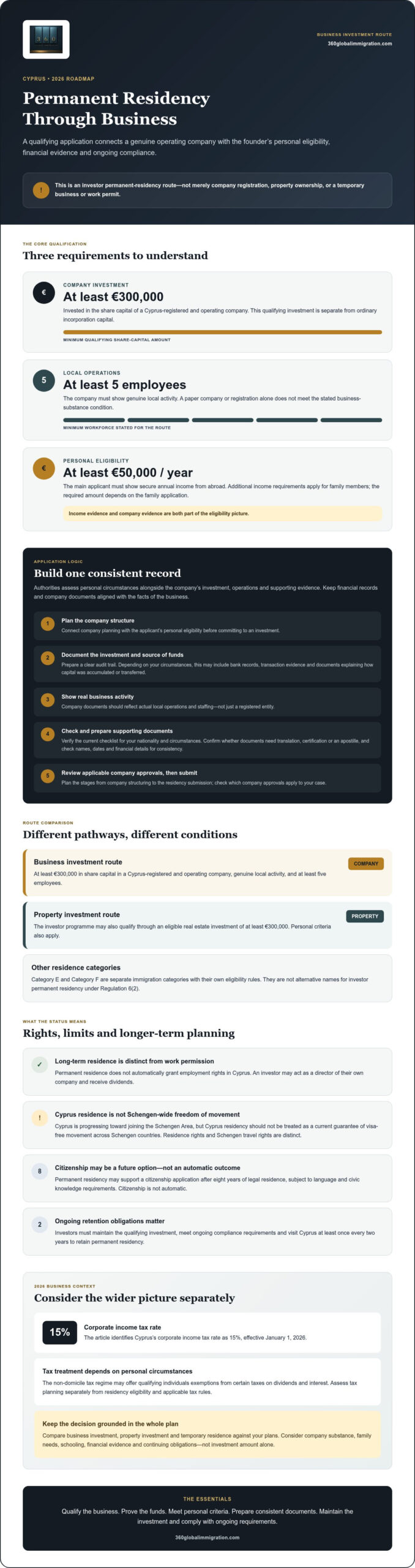
For founders, Cyprus permanent residency through business is a corporate investment route, not simply company registration or a temporary permit to work. Under the investor pathway governed primarily by Regulation 6(2) of the Aliens and Immigration Regulations, applicants may qualify by investing at least €300,000 in the share capital of a Cyprus-registered and operating company. The business must have genuine local activity and employ at least five people.
This differs from the property route, which may also qualify under the investor programme through an eligible real estate investment of at least €300,000. Both routes require applicants to meet personal criteria, including secure annual income from abroad of at least €50,000 for the main applicant, with additional income requirements for family members. The general concept of permanent residency describes a right to reside indefinitely, but eligibility in Cyprus depends on the specific route and its conditions.
Cyprus may appeal to international founders seeking a European business environment, a 15% corporate income tax rate as of January 1, 2026, and a base for family relocation. The non-domicile tax regime may offer qualifying individuals exemptions from certain taxes on dividends and interest. These benefits depend on personal circumstances and applicable tax rules, so assess tax planning separately from residency eligibility.
Schengen status also needs a clear-eyed view. Cyprus is progressing toward joining the Schengen Area, but residency in Cyprus should not be treated as a current guarantee of visa-free movement across Schengen countries. Cyprus residence rights and Schengen travel rights are distinct. Check the rules that apply to your nationality and travel plans.
Strategic Advantages for International Entrepreneurs
A qualifying business investment can align residency planning with real operations, while Cyprus’s tax framework and non-dom regime may support a founder’s wider financial strategy. The company must be more than a paper structure: assess its local activity, staffing and ongoing obligations. Families should also consider residence rights alongside practical priorities such as schooling and long-term stability. Founders exploring European business residency options more broadly may also want to review Ireland startup entrepreneur scheme help to compare how different programmes assess high-potential ventures and founder eligibility.
Permanent vs. Temporary Business Residency
Category E and Category F are separate immigration categories, not alternative names for investor permanent residency under Regulation 6(2). They have their own eligibility rules and should not be confused with a temporary business or work-related permit. Permanent residence offers a different long-term status, but it does not automatically grant employment rights in Cyprus. An investor may act as a director of their own company and receive dividends.
Permanent residency may support a future citizenship application after eight years of legal residence, subject to language and civic knowledge requirements. Citizenship is not automatic. Investors must also maintain the qualifying investment, meet ongoing compliance requirements and visit Cyprus at least once every two years to retain permanent residency.
Eligibility Criteria for the Business-Driven PR Pathway
Eligibility depends on more than registering a company. For the investor route, immigration authorities assess the applicant’s personal circumstances alongside the company’s investment, operations and supporting evidence. Treat the application as a connected record: financial documents should support the stated source of funds, while company documents should reflect the business as it actually operates.
Before submitting, check the current document checklist for your nationality and circumstances. Requirements can differ by document type and issuing country, so confirm whether records need translation, certification or an apostille. Check that names, dates and financial details are consistent across the application to reduce avoidable queries.
Financial Commitment and Investment Evidence
The investor route requires at least €300,000 in share capital for a Cyprus-registered and operating company. This qualifying investment is separate from ordinary incorporation capital. Applicants must also show secure annual income from abroad, with the required amount adjusted for a spouse and dependent children.
Prepare a clear audit trail for the funds. Depending on your circumstances, this may include bank records, transaction evidence and documents explaining how the capital was accumulated or transferred. The aim is to make the origin and movement of funds understandable, not simply to show that money is available. Keep company records aligned with the evidence in the personal application.
Company Status and Applicant Checks
A company supporting an investor application must demonstrate genuine activity and physical presence in Cyprus, as well as meet the applicable staffing criterion. Cyprus permits full foreign ownership, but the criteria described here do not establish a separate minimum ownership percentage for this route. They also do not confirm specific board or local-secretary composition rules, so verify these details before finalizing the structure.
The “Company of Foreign Interest” designation is a separate company-status matter and should not be treated as automatic proof of residency eligibility. Confirm whether it applies to your case and what documentation is required. Check the precise criminal-record certificate requirements with the relevant authority rather than making assumptions. Valid health insurance is part of ongoing compliance, and applicants should verify what evidence is needed at the application stage. For guidance on the Cyprus Business Residence Visa, 360 Global Immigration can help founders organize the process and identify points that need confirmation.
A Step-by-Step Guide to the Application Process
A well-planned application for Cyprus permanent residency through business connects two workstreams: establishing a qualifying company and preparing the investor’s residence application. The order matters. Company registration alone does not satisfy the residency criteria, and a residence dossier may be weakened if its financial evidence does not match the company’s structure and activity.
Use this sequence as a planning framework. Confirm current requirements with the relevant Cyprus authorities or a qualified professional before committing funds, since document requirements and procedures can depend on your circumstances. For an overview of the investment route, review the Cyprus Residence by Investment program.
Four Phases from Company Setup to Decision
- Phase 1: Structure and register the company. Choose a structure that fits the proposed business, define ownership and governance, and plan for genuine operations in Cyprus. Incorporation is separate from meeting the residency investment threshold. Company incorporation is estimated at 5 to 10 working days, but this is not the total residency processing time.
- Phase 2: Check the Company of Foreign Interest designation. Confirm whether the company must obtain this designation for the proposed route and what evidence the relevant authority requires. Registration or a certificate alone does not grant permanent residence; the investor and company must still meet the applicable criteria.
- Phase 3: Prepare and submit the PR dossier. Assemble the investor’s identity, income and source-of-funds evidence alongside company documents showing the qualifying investment, local activity and staffing. Submit the application through the applicable process and retain copies of the full file.
- Phase 4: Complete biometrics and await a decision. Follow instructions from the Civil Registry and Migration Department (CRMD), including appointment details and requirements for each family member. Biometrics and submission do not guarantee approval. Wait for the formal decision and follow any further instructions.
Build a Consistent, Reviewable Dossier
Start with evidence supporting the central claims: who owns the company, where the investment funds came from, how the applicant meets the income requirement, and what the business will do in Cyprus. A business plan should explain the company’s proposed activities and operational presence clearly, rather than rely on unsupported promises about economic impact. Include company and financial records, identity documents, and any criminal-record or health-insurance documents required for your case.
Foreign documents may need translation, certification or an apostille, depending on their origin and the authority’s instructions. Check names, dates and figures across every document. Inconsistencies, missing pages, unclear fund transfers or expired certificates can prompt follow-up requests and delay review.
Plan Around Review, Not Assumed Timelines
A processing timeframe for a business-based permanent-residence decision is not specified here. Keep company incorporation time separate from CRMD review, and avoid making relocation plans around an assumed approval date. A professional adviser can help coordinate the company and application workstreams. 360 Global Immigration provides guidance through its Cyprus Business Residence Visa service.
Establishing Substance and Operational Compliance
For Cyprus permanent residency through business, the company must be more than a registered name. The investor route requires genuine physical presence and business activity in Cyprus, along with at least five employees. Operational substance is therefore part of the residency strategy, not simply a tax-planning consideration.
The company’s day-to-day footprint should make sense for its stated activities. A virtual address or mail-forwarding arrangement alone may not demonstrate that a business is genuinely operating in Cyprus. The criteria described here do not define a universal office size or prescribe specific evidence such as utility bills. Confirm the current requirements for your case rather than treating any one document as sufficient proof.
Make the Company’s Physical Presence Verifiable
Choose premises that are credible for the business’s actual operations. Keep the lease or other occupancy records, evidence of business activity, employee records and company documentation organized and consistent. Utility bills may help support the picture of active premises, but they are not a substitute for meeting the substantive requirement. A mismatch between the business plan, office arrangements and actual operations can invite questions.
The company must employ at least five people. The criteria described here do not specify that these employees must be local or EU nationals, so verify any separate employment or company-registration rules before recruiting. Retain clear records of the company’s staffing and ongoing activity, and ensure they remain consistent with the information in the application.
Maintain Compliance After Approval
Approval does not end the responsibility. Investors must provide annual documentation to show that they maintain the investment and hold valid health insurance. Keep investment records and insurance documents current, and maintain corporate accounts and tax filings as applicable to the company. A specific annual audit is not identified here as a separate immigration requirement, so confirm accounting and audit obligations with a qualified Cyprus professional.
Each permanent resident must visit Cyprus at least once every two years to maintain the permit. Plan and record visits carefully, especially when family members travel separately. Keep track of residence-card expiry dates and follow the relevant instructions for renewals or changes to family-member details. Do not assume that one family member’s status automatically updates another’s.
Category E is a distinct immigration category, not another name for investor permanent residency. Corporate substance may be relevant to a business-based application, but it does not by itself establish eligibility under Category E. Check the requirements for the specific pathway you intend to use instead of treating a company’s operational footprint as a substitute for the correct residence status.
To assess how your company’s premises, staffing and records fit the business-residence process, explore Cyprus Business Residence Visa support.
Professional Guidance for Your Cyprus Relocation
Business investment, company operations and immigration paperwork need to work together. For founders considering Cyprus permanent residency through business, a specialist adviser can help clarify which requirements apply, identify information gaps and coordinate the administrative work involved in a Cyprus Business Residence application. This can be useful when a founder is managing an existing business and a potential relocation at the same time.
360 Global Immigration provides consultancy for business residency applications, including the Cyprus Business Residence Visa. Its guidance can help clients understand the steps, organize relevant information and keep track of what needs attention. Professional consultancy is separate from government charges, which applicants should budget for separately.
Guidance for International Founders
International residents based in the UAE may need to coordinate records and business decisions across jurisdictions. Keep Cyprus requirements at the center of the planning process and ask practical questions early: Is the proposed company activity credible? Can the investment and income be documented? Do the business plan and supporting records tell a consistent story? Founders based in the UAE who are also weighing other European destinations should review the business residency pathways for UAE residents to compare how nationality, business model and intended role affect eligibility across different programmes.
Advice should reflect the applicant’s circumstances. A founder building a new company may need to consider a different structure from an owner expanding an established operation. The right approach depends on the business model, investment plan, family needs and applicable eligibility rules. No adviser can replace the decision-making authority of Cyprus officials, so look for clear explanations of requirements and realistic management of the process, not promises of approval.
Plan the Move in Stages
Start by assessing your business and personal eligibility. Gather a clear picture of ownership, investment funds, income, company activity and the family members included in your plans. Then map the corporate and residence steps, identify documents that may need additional preparation, and confirm which requirements must be checked with Cyprus authorities or qualified local professionals.
Relocation planning extends beyond submitting forms. Founders should consider how to maintain company activity, meet ongoing residence obligations and coordinate family members’ applications. Immigration consultancy can guide the Cyprus Business Residence process, but do not assume it includes unrelated services such as travel bookings or coverage of government fees. Define the support you need before proceeding.
For a focused overview of the pathway and planning considerations, read the Cyprus Residency for Business Owners: 2026 Guide. Use it as a starting point to prepare informed questions and assess your next steps carefully.
Build Your Cyprus Business Residency Plan with Confidence
Securing Cyprus permanent residency through business takes more than incorporating a company. A sound plan aligns the qualifying investment and personal eligibility with genuine business activity, clear supporting evidence and attention to ongoing obligations.
Keep the key distinctions in view: permanent residency is not the same as a temporary business permit, and neither company registration nor a residence application guarantees approval. Requirements and travel rights must also be assessed separately. A well-organized plan helps you make informed decisions for your business and family before committing to the process.
360 Global Immigration provides guidance on the Cyprus Business Residence Visa for founders managing business and immigration requirements. Its consultancy can help organize the administrative process and clarify the steps ahead.
Contact 360 Global Immigration to discuss your Cyprus Business Residence application and next steps.
Frequently Asked Questions
Can I get Cyprus permanent residency if I start a new business in 2026?
Yes, a new business may qualify if it meets the investor pathway’s company and investment conditions. The company must be registered and operating in Cyprus, have genuine physical presence and business activity, employ at least five people, and receive at least €300,000 in qualifying share-capital investment. You must also meet personal eligibility criteria, including the required income and source-of-funds tests. Incorporation alone does not secure permanent residency.
What is the minimum investment for Cyprus residency through business?
The minimum qualifying business investment is €300,000 in the share capital of a company registered and operating in Cyprus. This is distinct from the amount commonly used to set up a private limited company, which does not itself satisfy the investor threshold. The investment funds must be proven to come from abroad. Applicants must also meet the separate annual income requirement and document the source of their funds.
How long does the business residency process take for non-EU citizens?
A confirmed processing timeframe for the permanent residency application is not provided in the 2026 information here, so avoid relying on a fixed end-to-end estimate. Company incorporation is estimated at 5 to 10 working days, but that is only one part of the process. Preparation, submission, government review and biometrics are separate stages. Confirm current timelines with the relevant Cyprus authorities before making relocation or business commitments.
Do I need to live in Cyprus full-time to keep my permanent residency?
No. The stated maintenance rule does not require full-time residence, but each permanent resident must visit Cyprus at least once every two years to maintain the permit. Keep records of visits and track each family member’s travel separately. Investors must also provide annual documentation showing that they maintain the qualifying investment and hold valid health insurance. Confirm any additional obligations that apply to your specific permit.
Can my family be included in my Cyprus business residency application?
Family members may be included, subject to the applicable eligibility and documentation requirements. The main applicant must demonstrate secure annual income of at least €50,000 from abroad, with an additional €15,000 required for a spouse and €10,000 for each dependent child. Prepare supporting records for every applicant and check the current rules for dependants, including any age-related conditions, before submitting the family’s applications.
What is a ‘Company of Foreign Interest’ in Cyprus?
A Company of Foreign Interest is a company designation relevant to certain business and residence procedures in Cyprus. It should not be confused with permanent residency or assumed to replace the investor route’s requirements for investment, genuine local activity and staffing. Verify the current criteria for obtaining the designation with the relevant Cyprus authority, as its full qualification rules and documentation checklist are not set out here.
Is there a language requirement for Cyprus permanent residency through business?
The 2026 criteria described here do not specify a language test for the investor permanent residency application. Language and civic knowledge requirements are identified for a potential citizenship application after eight years of legal residence, subject to the applicable rules. Permanent residency and citizenship are separate statuses, so do not treat the citizenship criteria as automatic conditions for the initial business-based residence application. Verify the requirements for your exact pathway before applying.
What happens if my business residency application is rejected?
If an application is rejected, review the formal decision and any reasons or instructions provided by the authorities. A specific appeal period or guaranteed right to resubmit is not set out here, so check the applicable procedure promptly with a qualified Cyprus immigration professional. Before taking further action, identify whether the issue concerns eligibility, company substance, source-of-funds evidence or missing documents, and address it through the proper process.