
The most attractive destination may not be the best fit for your venture. Business residency pathways for UAE residents vary according to your nationality, business model and intended role. Choosing a country before checking its route requirements can create avoidable uncertainty.
It’s also easy to confuse permission to live in a country with permission to establish a business or work there. These may involve separate requirements. A founder, self-employed applicant and investor may each need to assess a different route, even when considering the same destination.
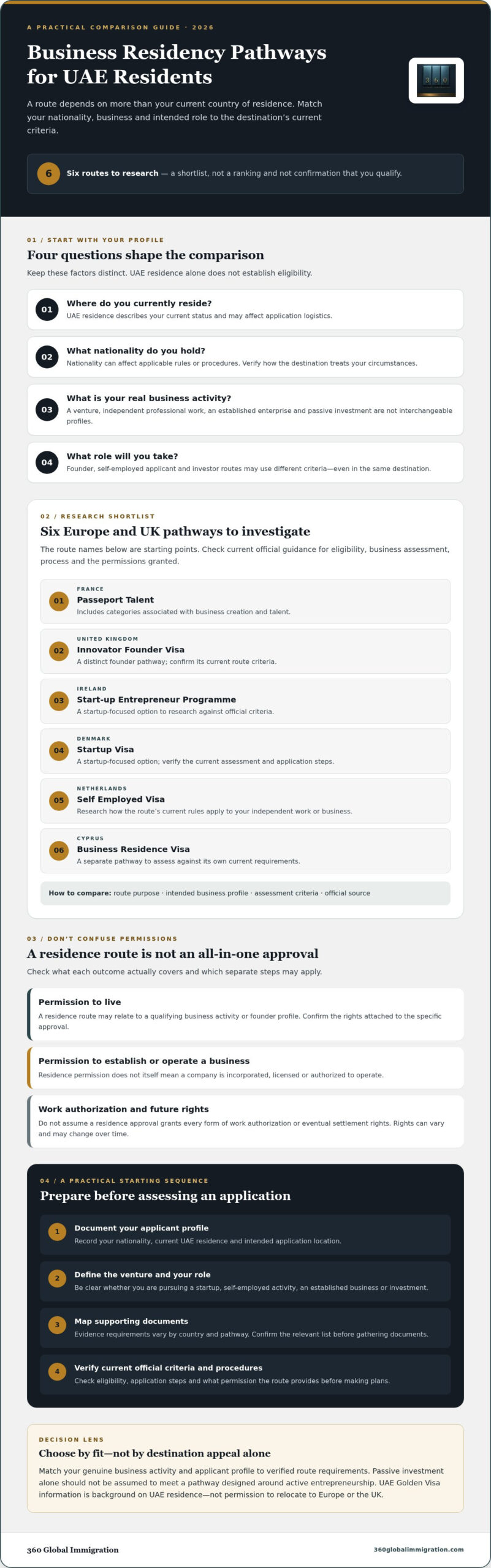
This 2026 guide compares business and founder pathways across Europe and the UK, including France’s Passeport Talent, the UK Innovator Founder Visa and the Netherlands Self Employed Visa. It outlines broad differences and what to verify before deciding which option merits a closer eligibility review. You’ll also find a practical starting point for documenting your nationality, venture, role and supporting documents, then checking current route criteria and application procedures through official sources.
Key Takeaways
- Business residency pathways for UAE residents depend on more than where you live. Assess your nationality, founder profile and business eligibility separately.
- Use the six listed Europe and UK routes as a research shortlist, not a ranking or confirmation that you qualify.
- Compare each route by its purpose, intended business profile, assessment criteria and official source, then verify current 2026 requirements.
- Define your business and intended role before gathering evidence. Document requirements vary by country and pathway.
- Use your applicant profile, genuine business fit and verified destination requirements to decide whether to continue researching or seek a tailored review.
What business residency pathways for UAE residents actually cover
Business residency pathways for UAE residents are immigration routes that connect permission to live in another country with a qualifying business activity or founder profile. They are outbound options, not the same as forming a company in the UAE or obtaining a UAE residence visa. The route’s purpose matters: an innovative startup founder, a self-employed professional and an established business owner may face different criteria.
Keep four questions separate: where you currently reside, what nationality you hold, whether the destination accepts an application in your circumstances, and whether your business fits the route. UAE residence alone doesn’t establish eligibility. It may affect application logistics, while nationality can affect the rules or procedure that apply. Confirm both with the relevant destination authority before making plans.
Also distinguish immigration permission from business and work permissions. A residence route may require or relate to a business, but that doesn’t automatically mean a company has been incorporated, licensed or authorized to operate. Nor should you assume that residence permission grants every form of work authorization or eventual settlement rights. Check what each approval covers, what separate steps may be required, and whether rights can change over time.
Investor routes are another category to distinguish from founder pathways. For global context, Immigrant investor programs describes residence-by-investment schemes, sometimes called “golden visas,” and includes the UAE. That context doesn’t determine the criteria for an outbound route. In particular, don’t assume that passive investment alone meets the requirements of a pathway designed around active entrepreneurship.
Does being a UAE resident determine which route you can apply for?
No. UAE residence describes your current status, not a guarantee that you can apply for or qualify under a destination’s business route. Your nationality, the location from which you apply and the destination’s current procedures may also matter. Check the official authority’s rules for your circumstances, including whether your UAE residence status affects application logistics.
Which business and founder profiles may need to compare routes?
Start with what you actually do. An innovative startup founder may need to assess routes framed around a venture. A self-employed professional should look for criteria relevant to independent work, while an established business owner may need a route suited to an existing enterprise. Match the route’s stated purpose to your real activity, rather than reshaping your profile around a label. Verify route-specific rules, especially if your plan is primarily passive investment.
This distinction is the foundation for comparing destinations: first identify your role and business activity, then assess how each route defines an eligible applicant and what permissions it provides.
Six business residency pathways to research from the UAE
This is a research shortlist, not a ranking or a promise that every route fits every applicant. The names below identify pathways to investigate, but official labels, status and 2026 criteria can change. Before relying on a route, check the destination authority’s current guidance, including who can apply, how the business is assessed and what permissions the outcome provides. The UAE Government’s information on the official UAE Golden Visa program is useful background, but it describes UAE residence, not permission to relocate to Europe or the UK.
Founder and startup routes in France, the UK, Ireland and Denmark
These pathways aren’t interchangeable. France’s Passeport Talent includes categories associated with business creation and talent, while the UK Innovator Founder Visa is a distinct founder route. Ireland’s Start-up Entrepreneur Programme and Denmark’s Startup Visa are startup-focused options to research. Check each authority’s current rules for business eligibility, assessment or endorsement steps, and the applicant’s role. For a France-specific overview, see the France Passeport Talent business creator guide. Ireland’s route is commonly referred to as the Start-up Entrepreneur Programme. Review the Ireland Start-up Entrepreneur Programme guide alongside official criteria.
Self-employed and business-residence routes in the Netherlands and Cyprus
The Netherlands Self Employed Visa and the Cyprus Business Residence Visa are separate pathways, not alternate names for a single European visa. Their eligibility tests, business assessments and application processes may differ, so confirm the formal route name and responsible authority before comparing them. The Netherlands self-employed visa requirements guide and Cyprus residency for business owners guide offer route-specific starting points. Confirm details against current official sources.
Across all six options, begin with your actual business model and intended role, then check whether the route’s purpose aligns. A founder developing a startup, an independent professional selling services and an owner expanding an established company may need to investigate different criteria. Don’t assume investment alone qualifies for a founder pathway. Compare current requirements before committing to a business plan or application strategy. To organize research across these options, review 360 Global Immigration’s business and talent residency pathway support.
How to compare business residency pathways without choosing by country alone
There isn’t one universally easiest or best destination for every UAE resident. Compare each route against your actual role, venture and plans, then verify details that can change, including eligibility, application procedure and ongoing conditions. Use the table as a screening tool, not a substitute for current official guidance.
| Route | Route purpose | Business profile to examine | Key assessment areas | Official source to verify |
|---|---|---|---|---|
| France Passeport Talent | Talent or business-related residence categories | Founder or business creator, depending on category | Applicable category, qualifying activity and evidence required | Current French immigration authority guidance; confirm category and process |
| UK Innovator Founder Visa | Founder-focused route | Applicant founding and developing a business | Current business criteria, assessment or endorsement steps, and applicant role | UK government visa guidance; confirm current requirements |
| Netherlands Self Employed Visa | Self-employment route | Professional operating independently | Business assessment method, supporting evidence and residence conditions | Official Dutch immigration authority guidance; verify current criteria |
| Cyprus Business Residence Visa | Business-related residence route | Business owner or applicant establishing business activity | Formal route name, applicant requirements and business conditions | Relevant official Cyprus immigration authority; confirm route and process |
| Ireland Business Residence Visa | Business-related route; confirm the applicable program | Founder or entrepreneur, if eligible under the current program | Program status, business criteria and assessment procedure | Irish government program guidance; verify current name and criteria |
| Denmark Startup Visa | Startup-focused route | Founder developing a startup venture | Current startup definition, assessment requirements and ongoing conditions | Official Danish authority guidance; confirm current process |
Match the route to your business model and personal role
First clarify whether you’ll found, operate, invest in or freelance through the business. Then consider the venture’s maturity, commercial plan and available evidence. These are useful comparison points, not universal thresholds. Terms such as “innovation,” “entrepreneurship” and “self-employment” can have route-specific meanings, so check the official definition rather than relying on everyday usage.
Compare practical obligations as well as initial eligibility
Before shortlisting, review what the route may require after approval, including permitted business activity, residence conditions and ongoing compliance. Compare family inclusion, renewal and settlement implications only where current official sources explain them. Immigration criteria also differ from tax, company and relocation considerations. For broader context on the UAE’s own residence by investment program, consult the cited overview, but don’t treat it as guidance on another country’s route.
The strongest route fit depends on the applicant, the venture and the destination’s current rules. For a structured review of the listed business and talent pathways, you can explore 360 Global Immigration’s residency pathway support.
What UAE residents can prepare before assessing an application
A well-organized starting point helps you identify which business residency pathways for UAE residents merit closer review. Work in sequence: define the venture and your role, shortlist relevant routes, check each destination’s official rules, gather evidence requested for those routes, then seek a tailored review if questions remain. This is a preparation framework, not a universal document checklist. Requirements vary by country, pathway and applicant.
Build a clear business and applicant profile
Write a concise summary of what the business does, its stage of development, ownership structure and your responsibilities. Explain what activity you intend to carry out in the destination country. Then compare that profile with the route’s stated purpose. A mismatch, such as a plan focused on passive ownership when a route is designed for active founders, is a reason to verify suitability before investing time in an application.
Depending on the route, useful material to organize for review may include a business plan, financial records, evidence of ownership or business activity, qualifications and documents supporting your proposed role. These are examples to discuss, not documents every applicant must submit. Check the destination authority’s current instructions for the specific application before treating any item as required.
Check official rules before relying on a checklist
Use the relevant government authority as your primary source for current eligibility criteria, forms, procedures and document instructions. UAE residence and nationality may affect different aspects of the process: residence status could be relevant to submission logistics, while nationality may affect applicable rules or procedure. Don’t assume either factor determines the other. Verify how both apply to your case.
Track route-specific document details against official instructions. For each item, note whether it must be current on a particular date, translated, certified or presented in a specified format. Check that names, dates, business details and role descriptions are consistent across forms and supporting evidence. If an instruction is unclear or appears to conflict with another source, seek confirmation from the responsible authority before proceeding.
Once you have a defined business profile and shortlist, professional review can help organize the route comparison and identify questions to resolve before application preparation. For guidance on assessing the listed founder and business pathways, request a tailored pathway review.
Choosing a pathway and planning your next steps
Bring your decision down to three checks: your applicant profile, a genuine fit between your business and the route, and the destination’s current requirements. Business residency pathways for UAE residents aren’t interchangeable. An option that looks promising on paper still needs to match your role, venture and circumstances under the rules in force when you apply.
Create a focused shortlist before committing to one destination
Select a small number of routes that appear aligned with what you plan to do and how you’ll participate in the business. For each, record unanswered questions, such as how the authority defines an eligible founder, what evidence it expects, which procedures apply to your circumstances, and what conditions may continue after approval. Verify those points through official sources before making decisions that depend on them.
If the official criteria are clear and your profile appears to match, you may be able to continue researching independently. Take more care if your ownership structure is complex, your business activity could fit more than one route, your nationality or UAE residence status raises procedural questions, or key evidence is incomplete. Don’t choose based only on perceived speed or simplicity, or an assumed likelihood of approval. Those impressions aren’t a substitute for route-specific criteria.
Get tailored guidance for the route you want to explore
A professional review can help you assess whether a route appears consistent with your applicant profile and business, identify evidence gaps, and organize procedural questions to confirm with the relevant authority. 360 Global Immigration supports applications across its listed business and talent residency pathways, including options in France, the UK, the Netherlands, Cyprus, Ireland and Denmark. This guidance can help structure your research and preparation, but it can’t replace a government decision or guarantee eligibility, residence or approval.
Before seeking guidance, bring your shortlist and note what you’ve confirmed, what remains uncertain, and how you intend to operate the business. This helps focus the discussion and distinguish questions about immigration criteria from matters that may require separate corporate, tax or relocation advice.
To discuss which route may merit closer review, explore business and talent residency guidance and ask about route fit and current requirements.
Make your next move with a clear route in mind
The right pathway starts with three checks: your applicant profile, whether your genuine business activity fits the route, and what the destination’s current rules require. Business residency pathways for UAE residents aren’t selected by country alone. A focused shortlist and careful review of official criteria can help you identify which options deserve closer attention.
Before moving forward, organize your business information and note unanswered questions about eligibility, evidence or procedure. If your profile involves complex ownership, several possible routes or uncertainty about how nationality and UAE residence affect the application process, tailored guidance can help clarify what to verify next.
360 Global Immigration supports several named business and founder residency pathways across Europe and the UK, with professional guidance for specialized immigration applications. This support can help organize route research and application preparation, but eligibility and approval remain subject to the relevant authorities’ decisions.
Explore business and talent residency guidance to discuss which route may fit your circumstances. A considered shortlist and current information can help you take your next step with greater confidence.
Frequently Asked Questions
Is UAE residence enough to qualify for a European business visa?
No. UAE residence alone doesn’t establish eligibility for a European business visa or guarantee approval. It may affect where or how you submit an application, while your nationality, business profile and chosen route can affect eligibility and procedure. Requirements vary by destination and can change. Check the relevant government authority’s current instructions for your circumstances before deciding where to apply or preparing an application.
Which business residency pathway is best for UAE residents?
There’s no universally best option. The right route depends on your role, business model, intended destination and the pathway’s current criteria. Compare founder, startup, self-employed and business-residence options against verified requirements, not country reputation alone. For example, a startup founder and a professional planning to work independently may need to assess different route types. A qualified review can help identify questions or evidence gaps, but the relevant authority decides each application.
Can I apply for a business residency pathway while living in the UAE?
You may be able to apply while living in the UAE, but the accepted application location and procedure depend on the destination, route and your circumstances. Check official instructions for where you can submit, how appointments are handled and whether your residence status affects the process. Don’t assume the same procedure applies across countries or nationalities. Confirm these details before making travel or application plans.
What documents are usually needed for a business residency application?
There’s no universal document list. Depending on the route, applicants may need identity and residence records, business information, financial or professional evidence, and other supporting documents specified by the destination authority. Treat these as possible categories, not a checklist. Verify the current requirements for your chosen pathway, including document validity, translation and certification rules. Check that details are consistent across forms and supporting records before submission.
How much does a business residency application cost?
Costs vary by destination, pathway, applicant circumstances and the services involved. Government charges and professional consultancy fees are separate, and government fees aren’t necessarily included in consultancy support. Check the destination authority’s current fee schedule and ask for a clear explanation of any advisory service scope before proceeding. Avoid relying on old online figures or assuming costs for one route apply to another. Confirm any charges relevant to your application directly.
Can a business residency visa lead to permanent residency or citizenship?
Some routes may offer renewal or longer-term residence options, but these depend on the country’s law and your continued compliance with applicable conditions. Citizenship is a separate legal status and shouldn’t be treated as automatic. Before making long-term plans, verify the destination’s current rules for residence, renewal, settlement and naturalisation through official sources. A visa’s initial terms don’t necessarily establish what future status you may qualify for.
Do I need to set up a company before applying for a founder or business visa?
Not necessarily. The required sequence depends on the destination and specific pathway: some routes may assess a proposed venture, while others may require evidence of business activity at a particular stage. Confirm the official process before incorporating a company or moving business operations. Company formation and immigration permission are separate matters, and setting up a business doesn’t by itself establish eligibility for a residence route or permission to work.