Could a business that looks promising on paper still fall short of Ireland’s startup criteria? That’s why Ireland startup entrepreneur scheme help should start with checking fit, not filling in forms. As of September 2026, applications are submitted electronically to the Irish Immigration Service. Confirm the latest notices and requirements before relying on older online guidance.
If you’re unsure whether your idea qualifies, that uncertainty is understandable. The Start-up Entrepreneur Programme is designed for high-potential ventures with an innovative product or service aimed at international markets, not every new or small business. Your plan needs to make a credible case for growth, including the potential to create jobs and reach substantial sales in Ireland.
This guide explains how the programme works, what to verify about its current status and eligibility, and how to support your plans with evidence about the business, funding and founder’s background. It also covers practical application preparation and where professional guidance may help you organize your case against current official requirements.
Key Takeaways
- Understand how STEP differs from ordinary business registration and standard work routes, and check its current application status through official Irish sources.
- Assess whether your founder background, business model, market rationale and growth plans match the programme’s current criteria.
- Compare Ireland’s route with other founder pathways by looking at eligibility evidence and business fit, rather than assuming one option is right for everyone.
- Use Ireland startup entrepreneur scheme help to organize application evidence, then check every detail against current official forms and instructions.
- Professional guidance can help structure your case, but you remain responsible for accurate information and meeting official requirements.
Ireland’s Start-up Entrepreneur Programme in 2026
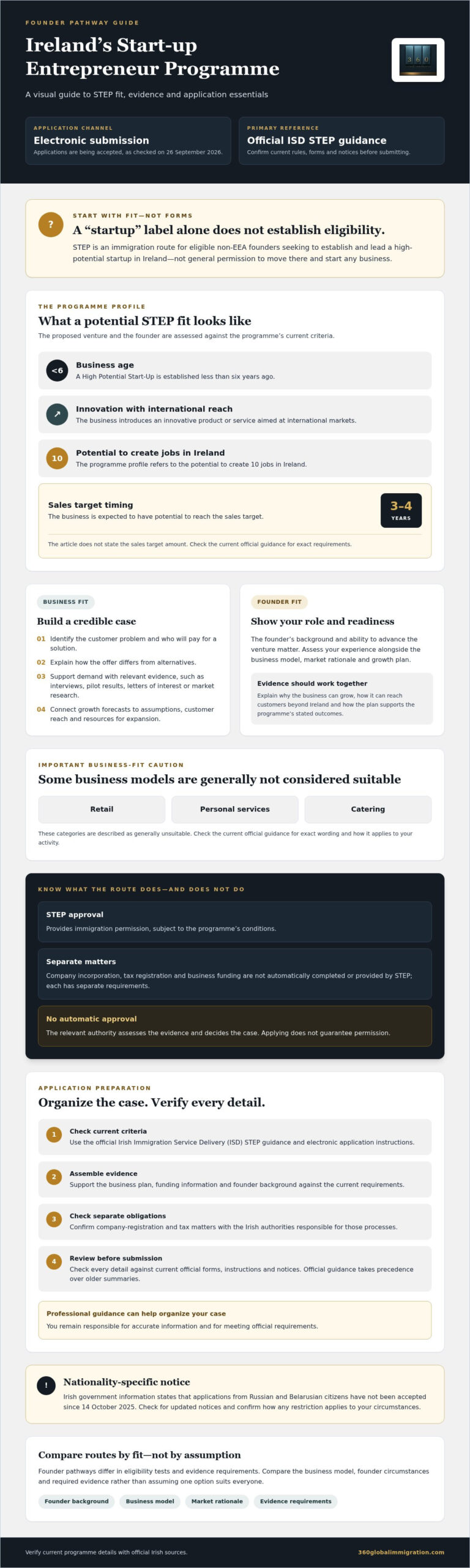
The Start-up Entrepreneur Programme (STEP) is an Irish immigration route for eligible non-EEA founders who want to establish and lead a high-potential startup in Ireland. It is not general permission to move to Ireland and start any kind of business. The proposed venture must meet the programme’s criteria, and the founder’s application is subject to official assessment.
As of 26 September 2026, Irish Immigration Service Delivery (ISD) identifies electronic submission as the application route, and STEP applications are being accepted. Use ISD’s official STEP guidance as your primary reference. Irish government information states that applications from Russian and Belarusian citizens have not been accepted since 14 October 2025. Check for updated notices and confirm how any restriction applies to your circumstances.
What does STEP offer founders, and what does it not do?
STEP assesses whether a founder and proposed business fit Ireland’s high-potential startup profile. The business is expected to introduce an innovative product or service to international markets and demonstrate credible growth potential, including the capacity to create jobs and generate sales. A generic business idea alone does not establish eligibility. Your role and ability to advance the venture matter too.
Approval provides immigration permission subject to the programme’s conditions. It does not automatically incorporate a company, complete tax registration or provide business funding. Those are separate matters with their own requirements. Applying also does not guarantee permission: the relevant authority evaluates the evidence and decides the case.
The term startup visa is used broadly across countries, but routes differ in their eligibility tests and evidence requirements. Wikipedia offers general context on the term, not authoritative guidance on Irish rules.
Which Irish authorities publish or administer the current rules?
Start with the official STEP guidance published by Immigration Service Delivery, the Irish immigration service, and its electronic application instructions. These are the appropriate sources for current programme status, forms and immigration requirements. Check company registration and tax matters with the Irish authorities responsible for those separate processes.
Verification date: 26 September 2026. The application channel and status above reflect information checked on that date. Before submitting, confirm the latest official instructions, eligibility criteria, funding evidence requirements and any nationality-specific notices. This matters especially if you have relied on older articles or summaries. Requirements can change, and official guidance takes precedence.
Who May Fit Ireland STEP? Assess the Founder, Business, and Evidence
A “startup” label does not establish eligibility. STEP is intended for a particular kind of venture and founder, so compare your circumstances with current official criteria. Do not assume that a new company, freelance activity or self-employed business will qualify. The Official STEP Application Guidelines should guide your assessment, including the latest requirements for the applicant, business and funding.
The official programme profile focuses on a High Potential Start-Up: a business established less than six years ago that introduces an innovative product or service to international markets, with potential to create 10 jobs in Ireland and reach the sales target within three to four years. Retail, personal services and catering businesses are generally not considered suitable. Check the current guidance for exact wording and how it applies to your activity.
How can founders test whether their business concept is a credible fit?
Build a clear case: identify the customer problem, explain who will pay for a solution, show how your offer differs from alternatives, and support demand with evidence. Depending on your business, that evidence could include customer interviews, pilot results, letters of interest or market research. None of these guarantees approval, but they can show whether the plan is based on more than an idea.
Connect each growth forecast to its assumptions. Explain how you’ll reach customers beyond Ireland, what resources expansion requires, and how the venture could support the programme’s stated job and sales ambitions. If you cite a numerical funding or sales threshold, confirm its current value and evidence requirements in official guidance. Avoid relying on an old article or an unsupported projection.
What founder and business documents may support an assessment?
Prepare a working evidence file, then compare it with the current application instructions. Depending on the official requirements and your circumstances, relevant material may include:
- Founder evidence: identity documents, a CV or professional history, and information about your ownership, responsibilities and active role in the venture.
- Business evidence: a business plan, product or service details, market research, customer validation, competitor analysis and a practical development plan.
- Financial evidence: records supporting the source, availability and intended use of funding, in the form required by current rules.
Keep claims consistent across your plan and supporting documents. If your forecast depends on international sales, for example, name the target markets and explain how you plan to reach customers. Ireland startup entrepreneur scheme help can bring your evidence into a coherent case. 360 Global Immigration also provides Ireland Business Residence Visa assistance. Check any document checklist against official instructions, which take precedence.
How Does Ireland STEP Compare With Other Founder Immigration Routes?
A founder route should match both the venture and the founder’s role. Ireland’s STEP is designed for a high-potential startup with international-market ambitions. France Passeport Talent includes a business-creator pathway, while the UK Innovator Founder route uses an endorsement-based assessment. These labels are a starting point, not enough to determine eligibility. UAE-based founders comparing multiple destinations may find it useful to review the business residency pathways for UAE residents before deciding which route merits a closer eligibility review.
Use the Official Start-up Entrepreneur Programme (STEP) Guidelines for Ireland’s current criteria. For France and the UK, check the latest official government guidance and relevant application or endorsement instructions before comparing requirements.
| Route | What to examine | Verify before acting |
|---|---|---|
| Ireland STEP | Whether the venture fits the high-potential, innovative and international-growth profile, and whether the founder will lead it. | Current eligibility, evidence and application instructions in official STEP guidance. |
| France Passeport Talent | Whether the business-creator pathway fits the proposed activity and founder’s circumstances. | Current category criteria, required evidence and application process in French government guidance. |
| UK Innovator Founder | Whether the business and founder meet the route’s current requirements, including its endorsement-based assessment. | Current endorsement criteria, approved bodies and visa instructions in UK government guidance. |
When might another founder pathway deserve consideration?
France may merit comparison if its business-creator route appears closer to your venture’s structure and plans. Review France Passeport Talent business-creator guidance for the relevant category and evidence rules. The UK may warrant a closer look if you can address its endorsement-based assessment. Confirm the current criteria and endorsement process through official UK sources before preparing an application.
How should founders compare routes without relying on headline claims?
Compare the actual tests, not the marketing: the type of business each route targets, the founder’s expected role, the plan and evidence required, and whether applications are currently being accepted. Also distinguish immigration permission from company incorporation, residence rights and any later permission stage. A visa decision does not complete business registration or tax obligations.
Processing times and headline funding figures can change. Check official sources after confirming that a route is active and relevant. Ireland startup entrepreneur scheme help can make the comparison more structured by organizing your facts against published criteria. An independent consultancy may help clarify route options and prepare evidence, but government authorities make the decisions.
How to Prepare an Ireland STEP Application: Evidence and Common Risks
A disciplined process helps turn a business proposal into a clear, supportable application. Start with current Irish Immigration Service Delivery (ISD) guidance, not an old checklist or informal summary. Confirm that the programme is accepting applications, then check the latest eligibility criteria, forms, submission channel, document specifications and funding evidence rules. Official instructions take precedence over general advice.
What should a founder organize before drafting the application?
Build the file in sequence. First, verify the current rules and identify which requirements apply to you. Next, gather accurate records that may be required, such as identity documents, professional background, company and ownership information, and funding evidence. Confirm acceptable formats and any translation or certification requirements in the current instructions.
Then develop the business plan around evidence, not broad claims. For each key assertion, record its source, the assumptions behind it and the steps needed to deliver it. If you project customer growth, explain the target market, how you’ll reach customers and what supports the forecast. Set out practical milestones, responsibilities and resource needs, and make sure they align with your funding information and proposed timeline.
Which avoidable preparation errors create uncertainty?
Unsupported market-size figures, vague descriptions of innovation and financial projections based on inconsistent assumptions can make a plan difficult to assess. Mismatches between forms, company records and supporting documents can do the same. Check names, dates, ownership details and figures across the full file. If a document needs translation, follow the official specification rather than assuming an informal translation will be accepted.
Never alter, omit or present evidence in a misleading way. If a record is unavailable or a genuine gap needs explanation, identify it early and ask an appropriate adviser how to address it accurately. Use a final checklist based on current official requirements, and retain copies of what you submit.
A strong STEP application makes each material claim traceable to consistent evidence, realistic assumptions and a credible plan for execution. This helps the decision-maker understand how the founder, venture and supporting documents fit together, but cannot guarantee a particular outcome.
For structured assistance organizing your case against current requirements, request Ireland Business Residence Visa application support from 360 Global Immigration. The consultancy is independent of Irish authorities. Applicants remain responsible for the accuracy of their information and compliance with official instructions.
Where Ireland Startup Entrepreneur Scheme Help Fits Into Your Next Steps
Professional support can help you compare your founder profile and business proposal with published STEP criteria, organize supporting documents and identify questions to clarify before applying. It can also help make the business plan and application evidence consistent and readable. This is preparation support, not a substitute for official rules or a government decision.
You remain responsible for the accuracy of your information, the completeness of your application and compliance with the latest Irish requirements. Check official guidance independently, particularly before making financial or relocation commitments. Ireland startup entrepreneur scheme help is most useful when it clarifies your case and next steps, rather than promising an outcome.
What should you ask an immigration consultant before engaging support?
Ask how the adviser assesses whether STEP may fit your business and founder role, and how they check for changes to official requirements. Clarify what the service covers, what remains your responsibility, how document review or preparation is handled, and which timelines depend on you or on official processing.
Request a clear explanation of consultancy fees and any applicable government charges as separate items. A professional adviser can help organize and present your case, but cannot control the decision. Treat a promise of guaranteed approval or claims of special influence over immigration authorities as a reason to pause and verify.
What are the practical next steps for a prospective applicant?
Start by confirming STEP’s current application status and obtaining the latest criteria, forms and document instructions from Irish government sources. Then prepare a short founder profile and startup summary: your role, the problem your business addresses, its intended market and the evidence you already have. List unresolved eligibility questions rather than filling gaps with assumptions.
This preparation makes an initial discussion more focused. 360 Global Immigration is an independent consultancy that provides Ireland Business Residence Visa assistance, including guidance for business and startup immigration pathways. If you’re considering professional support, discuss your circumstances and clarify the proposed scope before deciding whether to proceed. Any application must still follow current official requirements, and approval remains a decision for the relevant Irish authorities.
Take the Next Step With a Clearer Founder Case
Confirm the current STEP requirements, assess whether your venture fits the programme’s intended profile, and make sure each important claim in your application is supported by consistent evidence. Comparing other founder routes can also help you focus on the option that best matches your business and role.
Ireland startup entrepreneur scheme help can bring structure to that assessment, but it cannot replace official guidance or guarantee a decision. 360 Global Immigration is an independent consultancy that supports business and startup immigration pathways, with Ireland Business Residence Visa assistance among its offerings.
If you’d like professional support reviewing your options and organizing your next steps, discuss your Ireland business residence options with 360 Global Immigration. A well-evidenced plan and a clear understanding of the requirements can help you prepare for the process.
Frequently Asked Questions
Is Ireland’s Start-up Entrepreneur Programme open to applications in 2026?
Yes. As of September 2026, STEP applications are being accepted electronically through Ireland’s Immigration Service Delivery (ISD). Check the current official STEP guidance and application instructions before preparing a submission, since status and requirements can change. Irish government information also says applications from Russian and Belarusian citizens have not been accepted since 14 October 2025. Confirm the latest notices relevant to your nationality.
Who can apply for Ireland’s Start-up Entrepreneur Programme?
STEP is intended for non-EEA nationals proposing to establish and lead a qualifying high-potential startup in Ireland. Applicants must meet the programme’s current requirements, including its good-character requirement, and show that the proposed business fits the stated profile. Being a founder or entrepreneur alone is not enough. Review the official criteria for your circumstances, including any nationality-specific notices, before deciding whether to apply.
What type of business qualifies for Ireland STEP?
The programme targets a High Potential Start-Up introducing a new or innovative product or service to international markets. The venture must be less than six years old and show potential to create jobs and achieve the programme’s stated sales goal within the specified timeframe. Retail, personal services and catering businesses are generally not eligible. Support the case for innovation, market demand and growth with credible evidence in the business plan.
How much funding does Ireland STEP require?
STEP requires a minimum funding level for a single founder, with additional funding required for each co-founder applying under the same business. The funds must be secured before applying and fully available to the business. The official threshold is stated in euros. If you’re budgeting from the UAE, check the current amount in ISD guidance and calculate its AED equivalent using a current exchange rate before making commitments.
Can I apply for Ireland STEP if my business is already established?
Possibly, if the venture still meets the programme’s criteria. The stated high-potential startup profile includes a business age limit, as well as requirements concerning innovation, international markets and growth potential. An established company is not automatically excluded, but its age, activities, ownership and development plans matter. Check how current rules define the relevant business and compare your circumstances with official guidance before preparing an application.
What documents are needed for an Ireland STEP application?
Follow the current ISD application instructions for required documents and formats. Depending on the rules and your circumstances, you may need identity and professional-background records, company and ownership information, a business plan, market evidence, financial information and proof of funding. Support each material claim with consistent evidence. Check translation and document-format requirements directly in the official instructions, as a general checklist may not cover your case.
Does getting help with an Ireland STEP application guarantee approval?
No. Ireland startup entrepreneur scheme help may assist with assessing route fit, organizing documents and presenting your case clearly, but only the relevant Irish authorities decide the application. You remain responsible for truthful, accurate information and following current official requirements. 360 Global Immigration is an independent consultancy offering Ireland Business Residence Visa assistance and guidance for business and startup immigration pathways; it cannot guarantee an outcome or control a government decision. Contact 360 Global Immigration to discuss your Ireland business residence options.