
A promising startup can lose momentum when its founder’s immigration route, business plan, and hiring schedule don’t align. Professional immigration advice for startups helps bring these decisions together before a mismatch creates an application obstacle or disrupts business plans.
Choosing a destination is only part of the challenge. Founders also need to understand how their circumstances, the company’s stage, and the available evidence fit the relevant pathway. For entrepreneurs in the UAE considering the UK or Europe, that may mean assessing options such as the UK Innovator Founder Visa, France Passeport Talent, or Denmark Startup Visa against the business’s objectives.
This guide explains when startup-specific advice can help, what useful guidance should cover, and which questions to resolve before selecting a route or preparing documents. It also looks at coordinating founder relocation, talent mobility, hiring plans, and application preparation. With a clearer view of the moving parts, you can build an immigration plan that supports your startup’s next stage.
Key Takeaways
- Professional immigration advice for startups connects business objectives, founder circumstances, destination, and application preparation in one practical plan.
- Assess the startup’s stage, business model, founder profile, and team plans before exploring immigration routes.
- Compare pathways by intended activity, applicant profile, business context, and evidence to investigate, rather than relying on assumptions.
- Plan application preparation step by step, recognizing that requirements and procedures differ by destination and route.
- Specialist guidance can help clarify pathway questions and organize an application strategy for founders and talent.
Professional immigration advice for startups: what it covers and when it helps
Professional immigration advice for startups is tailored guidance that connects a company’s plans and people with a destination’s immigration pathways, application requirements, and supporting evidence. It helps founders identify what to resolve before choosing a route or preparing an application. It cannot determine eligibility or guarantee an outcome: government authorities make decisions on applications.
General information can describe a pathway and point to published requirements. Tailored consultancy guidance considers how the founder’s circumstances, business activities, destination, and plans fit together, then identifies questions to investigate. This matters because the same route can raise different questions for different applicants, and requirements can change. Advice supports preparation; it doesn’t grant immigration status or work authorization.
For a startup, mobility decisions can affect more than one person. A founder’s relocation may influence when business activities can begin, while an international hire raises separate questions about the individual’s role, destination, and application evidence. If these issues are considered only after expansion plans are fixed, the business may need to revisit assumptions or timelines.
When should a startup seek immigration advice?
Start before a founder relocates, the company commits to an expansion date, or a hiring plan depends on an international team member. Early guidance can surface information gaps, such as unclear business objectives, missing details about the founder’s circumstances, or uncertainty about evidence for a potential route. This gives the startup time to investigate before application preparation begins. Timing and requirements depend on the destination, route, and individual circumstances.
Who may need a startup immigration plan?
A founder may need to understand how personal circumstances and intended business activities relate to a potential route. A business owner planning to establish or expand operations should consider how the company’s stage and objectives inform that assessment. A prospective international team member has a distinct profile and proposed role, so their questions shouldn’t automatically be treated as identical to the founder’s.
The company’s stage helps focus the discussion. An early-stage business may still be clarifying its model and where the founder intends to operate; a growing company may be coordinating several people with an expansion plan. For entrepreneurs in the UAE considering the UK or Europe, illustrative options include the UK Innovator Founder Visa, France Passeport Talent, and Denmark Startup Visa. These names are starting points for destination-specific research, not evidence that a particular applicant qualifies.
Professional immigration advice for startups can bring these separate questions into a coherent planning process. The aim is to clarify what must be assessed and prepared, while immigration decisions remain with the relevant authorities.
How immigration advice connects your startup’s stage, people, and destination
A useful assessment considers five connected factors: the business model, company development stage, founder profile, team plans, and destination. Looking at them together turns a broad ambition, such as expanding from the UAE into Europe, into specific questions: who may relocate, what they intend to do, and which pathways merit closer review.
- Business model: What does the venture do, and where does it plan to operate?
- Development stage: Is the business shaping its model, beginning operations, or planning expansion?
- People: Who needs to move, and what will each person do?
- Destination: Which country aligns with the business objectives and needs further investigation?
Keep business readiness separate from immigration criteria. A clear commercial plan can help explain the venture, but it doesn’t replace the personal and route-specific requirements an applicant must assess. Likewise, a founder’s experience or circumstances don’t establish that the business is ready for a particular market. Professional immigration advice for startups helps organize these strands without treating one as a substitute for another.
Start with the founder and the business model
Summarize the venture’s current activities, intended direction, and the founder’s responsibilities. Then note personal circumstances relevant to the assessment, including the founder’s role and relocation objectives. The UK Innovator Founder Visa and France Passeport Talent are distinct country-specific pathways, not interchangeable labels. Compare them using destination-specific criteria and current rules, rather than name recognition alone.
For a wider view of talent-oriented options across the region, explore this guide to secure European residency for entrepreneurs. If your research extends beyond Europe, the USCIS overview of the EB-2 National Interest Waiver illustrates how another destination has its own category and assessment framework.
Map team needs and destination priorities
Separate the founder’s relocation objective from future hiring plans. A founder may focus on establishing or leading the venture, while an employee’s assessment concerns that person’s profile, proposed role, and destination. Immigration guidance can help clarify these questions and prepare an application; it doesn’t recruit employees or itself provide work authorization.
Compare destinations against the company’s objectives, planned activities, and the people involved rather than looking for a universally best option. A structured comparison can show where more information is needed before setting an expansion schedule. For broader practical considerations, see the UAE to Europe business relocation guide. When your priorities are clearer, 360 Global Immigration’s UK and European immigration guidance can help organize the next questions around business and talent-based residency pathways.
How to assess an immigration pathway without choosing on assumptions
A route’s name or reputation isn’t enough to show that it fits your startup. Check whether current official criteria align with the applicant’s circumstances, intended activities, business context, and available evidence. A familiar or fast-sounding option may still be unsuitable, so compare the facts before building an application plan.
Questions to resolve before comparing routes
Begin with the essentials: who would apply, where they intend to live, and what they plan to do there. Clarify the venture’s current status, the applicant’s proposed role, and which documents or other evidence are available for review. If a key fact is unresolved, record it as a question to investigate rather than assuming the answer. Requirements and procedures vary by destination and can change, so assess each option against current official guidance.
| Comparison point | Questions to investigate |
|---|---|
| Destination | Where does the applicant plan to live, and which country’s current rules apply? |
| Intended activity | Will the applicant establish, lead, or work in the business, and what activities are planned? |
| Applicant profile | Who will apply, and which personal circumstances may be relevant to the route? |
| Business context | What is the venture’s stage, model, and proposed activity in that destination? |
| Evidence to investigate | What information supports the application, and what gaps still need attention? |
This framework keeps business readiness and personal circumstances visible without confusing either with immigration criteria. A well-developed venture doesn’t automatically establish an applicant’s eligibility, and a founder’s experience alone doesn’t answer every question about the business or proposed activity. Professional immigration advice for startups can help organize the assessment, while the relevant authority remains responsible for deciding an application.
How UK and European examples differ in purpose
The UK Innovator Founder Visa and Denmark Startup Visa are distinct pathways governed by their own destination-specific frameworks. France Passeport Talent and the Netherlands Self-Employed Visa are further examples that require separate, route-specific review. Don’t treat these names as interchangeable or infer eligibility from a brief description. Review current criteria and procedures through official sources before deciding what evidence to prepare.
For more focused UK context, see the UK Innovator Founder Visa endorsement bodies guide. A structured review can turn unresolved details into clear questions and a more considered comparison. Explore immigration guidance for startup founders for support organizing your UK or European pathway assessment.
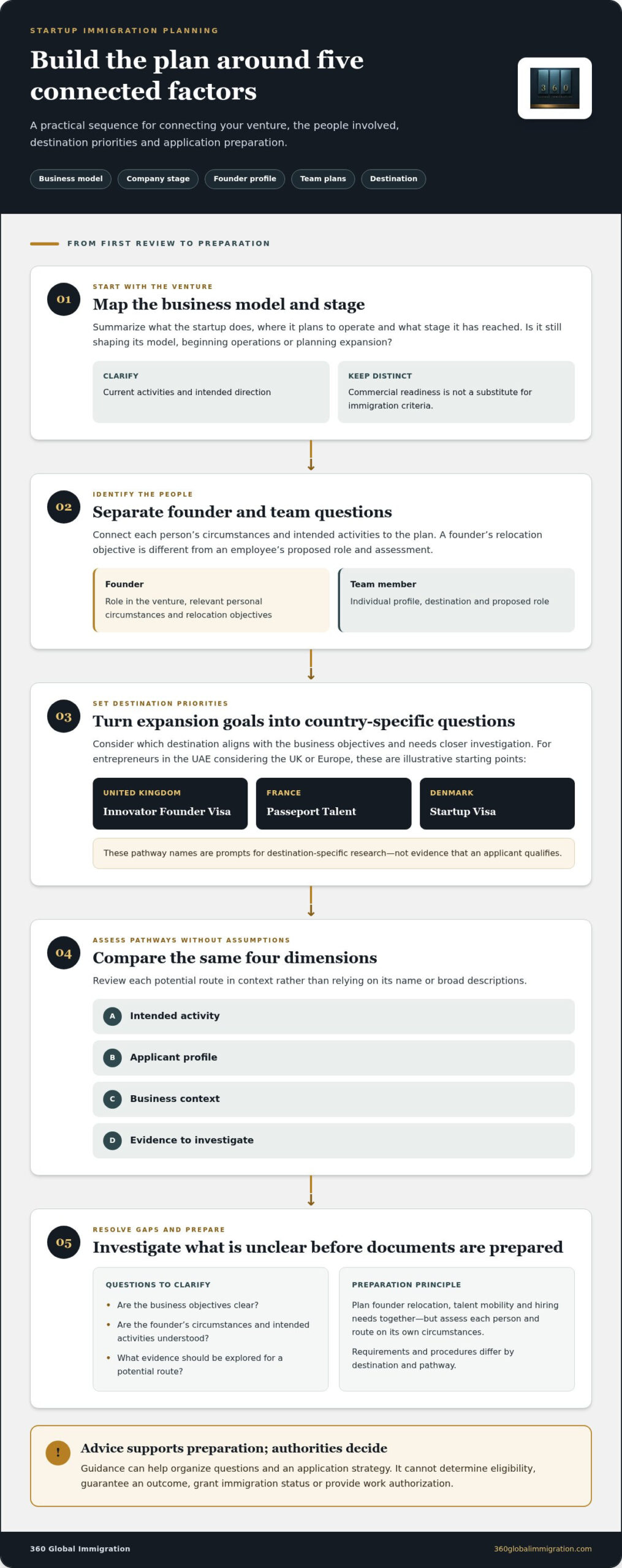
A practical startup immigration advice process from first review to preparation
A structured process turns a founder’s relocation or expansion objective into clear questions, route research, and application preparation. Professional immigration advice for startups is most useful when the business plan, applicant details, and supporting evidence are reviewed together, rather than assembled separately at the last moment.
Prepare for an initial immigration assessment
Before an assessment, prepare a concise overview of the venture, the founder’s role, the intended destination, and the timing the business has in mind. Organize relevant company and personal information already available, but don’t assume every route or applicant calls for the same documents. Note uncertainties and describe any prior application history accurately. A clear starting picture makes it easier to identify what needs further review.
Turn assessment findings into an organized plan
Map each finding to a question, evidence to investigate, or practical next action. This helps the startup see where its business narrative and the applicant’s information need clarification before documents are prepared. Keep the business description, proposed activities, role, and personal application details consistent across materials. Inconsistencies can raise questions that are easier to address during planning than after an application has been assembled.
A practical sequence can look like this:
- Clarify objectives: Record who plans to move, the intended activity, destination, and business purpose.
- Review the circumstances: Organize relevant information about the venture, founder, and any team members involved.
- Assess possible pathways: Compare the facts with current, destination-specific criteria instead of choosing by name or assumption.
- Plan the evidence: Identify what information may be needed, what is already available, and what remains unclear.
- Prepare for submission: Follow the relevant route’s current forms, document requirements, and procedures.
This is a planning framework, not a universal document checklist. Requirements and procedures vary by country, pathway, and applicant circumstances. An early review can surface mismatches, such as a proposed business activity described inconsistently across company information and the applicant’s materials. Record each issue with its corresponding question and next step; don’t fill gaps with assumptions.
Consultancy guidance can support assessment and application preparation, but submission requirements and immigration decisions remain with the relevant authorities. Review destination-specific pathway information as part of your preparation, then explore immigration guidance for founders and businesses to organize your startup’s UK or European application questions.
How specialist immigration guidance can support startup decisions
Startup mobility decisions sit at the intersection of business priorities and individual circumstances. Specialist guidance can bring those threads into a clear assessment: what the founder or applicant plans to do, which destination is under consideration, and what pathway questions need to be resolved before application preparation advances.
360 Global Immigration focuses on business and talent-based residency applications across the UK and Europe. The consultancy provides guidance for pathways such as the UK Innovator Founder Visa, France Passeport Talent, and Denmark Startup Visa. This support helps organize the assessment and application preparation; it doesn’t promise a particular immigration outcome. The relevant authorities decide applications.
What tailored support can help a startup organize
Professional immigration advice for startups connects a founder’s objectives and business context with a structured review of relevant pathways. Guidance can help identify questions that need attention, organize supporting information, and make application preparation more coherent. The process concerns immigration applications; it doesn’t provide job placement or arrange flights and hotels. Keeping these responsibilities distinct helps founders plan mobility alongside recruitment and travel logistics.
Choose a clear next step for your startup
Before moving into application preparation, write down four points: your intended destination, the applicant’s role, the startup’s current stage, and the immediate question you need answered. For example, a founder assessing a UK move may need to focus on the business pathway and their own circumstances, while an expansion plan involving another country calls for a separate destination-specific review. These notes provide a practical starting point without assuming one route fits every person or business.
Then review the relevant UK or European pathway guide and compare its current information with your plans. Identify what the route covers, which details remain uncertain, and what supporting information may need attention. Requirements differ by destination and pathway, so use the guide to frame questions rather than treat it as a universal checklist.
With a clearer picture of your destination, applicant, and business priorities, you can take the next step. Explore 360 Global Immigration’s services for UK and European business and talent residency applications to consider tailored guidance for your startup’s plans.
Build your startup’s mobility plan with confidence
A coherent immigration plan starts with the right questions: who needs to move, what they intend to do, which destination supports the business objectives, and what evidence may be needed. Professional immigration advice for startups connects these decisions and helps identify information gaps before application preparation begins. Pathway requirements differ, and the relevant authorities decide each application, so guidance can support preparation but can’t guarantee an outcome.
360 Global Immigration focuses on business and talent-based residency applications across the UK and Europe, including pathways such as the UK Innovator Founder Visa, France Passeport Talent, and Denmark Startup Visa. Start by clarifying your destination, applicant role, business stage, and immediate questions, then explore the relevant pathway in more detail.
Explore tailored business and talent immigration guidance and take a clear, considered next step for your startup’s plans.
Frequently Asked Questions
When should a startup founder seek professional immigration advice?
Seek advice before committing to a relocation date, expansion plan, or hiring decision that depends on someone moving internationally. Professional immigration advice for startups can help identify which details need assessment and what information may be missing before application preparation begins. Start with the founder’s role, business objectives, intended destination, and proposed timing. The appropriate route and preparation schedule depend on current destination-specific requirements and the individual’s circumstances.
Can a startup get immigration advice before choosing a country?
Yes. An initial assessment can help a startup clarify its priorities before settling on a destination. Consider where the founder intends to live, what activities they plan to carry out, the venture’s development stage, and whether future team mobility matters. For example, if expanding into Canada is on the table, consulting legal practitioners like Szekely Law can clarify local criteria early on. This creates a more informed basis for comparing destinations and identifying questions for further review. It doesn’t establish eligibility or replace checking the current criteria for each potential pathway.
What information should a startup prepare for an immigration assessment?
Prepare a concise description of the business model, current activities, development stage, and intended direction. Include the founder’s role, who may need to relocate, the target destination, and the timing the business is considering. Organize available company and personal information, but don’t assume every applicant needs the same documents. Note uncertainties and describe any prior application history accurately so these details can be included in the assessment.
Can professional immigration advice guarantee a startup visa approval?
No. An immigration consultancy can help assess a proposed pathway, organize application information, and guide preparation, but can’t guarantee approval. The relevant government authority considers the application and makes the decision under its current rules. A careful review may identify gaps or inconsistencies before submission, but it doesn’t control how an authority assesses the facts. Treat guidance as support for preparation, not a promise of a particular outcome.
What is the difference between immigration advice for founders and employees?
Founder-focused advice considers the individual’s role in the venture, business objectives, intended activities, and personal circumstances. An employee’s assessment starts with that person’s profile, proposed role, destination, and the route relevant to their circumstances. A startup may therefore need to assess its founder and prospective international team members separately, even if both plans relate to the same expansion. Immigration consultancy supports applications; it doesn’t provide job placement.
Does a startup need immigration advice before relocating its business?
Immigration advice isn’t a substitute for broader relocation planning, but seeking it before committing to a move can help clarify founder and team mobility questions. Review the destination, intended business activities, people involved, and relevant pathways while plans are still developing. This can surface information gaps before they affect application preparation or business assumptions. Requirements depend on the country, route, and each applicant’s circumstances.
Can an immigration consultant help compare UK and European startup pathways?
Yes. A specialist consultancy can organize a comparison around the destination, intended activity, applicant’s circumstances, business context, and evidence to investigate. 360 Global Immigration focuses on business and talent-based residency applications across the UK and Europe, with guidance for pathways such as the UK Innovator Founder Visa, France Passeport Talent, and Denmark Startup Visa. These are distinct routes, so current official criteria should guide any assessment, and authorities decide applications.