
What if the most familiar European business visa isn’t the right fit for your plans? To secure European residency for entrepreneurs, start by matching your business model, experience, and destination to a suitable pathway. Requirements differ by country, and incomplete or inconsistent documents can complicate an application, so it helps to assess the route before making business or relocation commitments.
This 2026 guide compares relevant options and explains how to prepare for the stages ahead. You’ll learn what to consider when assessing pathways such as France’s Passeport Talent, the Netherlands Self Employed Visa, and Denmark’s Startup Visa. Eligibility rules and application procedures can change, so compare your circumstances with current official guidance rather than relying on broad online claims.
360 Global Immigration supports entrepreneurs and professionals with route assessment, eligibility review, document preparation, and application coordination. The process starts with your profile and business goals, then maps out relevant pathways and the evidence needed to prepare an application. Government authorities make the final decisions, so no adviser can promise approval.
Key Takeaways
- Secure European residency for entrepreneurs by matching a lawful pathway to your founder profile, business model, and destination plans.
- Compare six business and talent residency pathways across France, the UK, the Netherlands, Cyprus, Ireland, and Denmark.
- Use a readiness checklist to organise identity records, business evidence, financial documents, and route-specific materials.
- Understand the usual application stages, while allowing for differences in procedures, processing times, and post-approval obligations.
- Structured route assessment and application guidance can help you prepare with clarity, but approval is never guaranteed.
What Secure European Residency Means for an Entrepreneur
For a founder, secure residency does not mean a guaranteed result. It means identifying a lawful pathway that fits your business and personal plans, preparing an application that addresses the relevant criteria, and making decisions with realistic expectations. The phrase Secure European residency for entrepreneurs describes a careful process, not a guaranteed outcome. Eligibility and approval depend on the destination country’s current rules and the decisions of its authorities.
That distinction matters for founders in the UAE weighing a move. You may plan to operate a company in a new market, establish a local presence, relocate full-time, or move with family. Each priority can affect which route is relevant and what you need to establish before applying. Begin with your intended activities and circumstances, not the assumption that one visa can meet every goal.
Professional support can help assess route fit, organise evidence, and coordinate an application. It can improve the clarity and preparation of an application, but it cannot guarantee that a government will grant residency.
What entrepreneurs should expect from a residency pathway
Residency routes differ in purpose, eligibility criteria, evidence requirements, and the rights they provide. A pathway for an innovative startup may assess a founder and venture differently from one intended for a self-employed professional. Before making commitments, establish what the specific permission allows and what it requires you to do.
Keep separate questions separate: permission to reside does not automatically establish permission to conduct every business activity, determine your tax position, or confer citizenship. The EU Long-term Resident Status is distinct from an initial national business-residency route. Use current official country guidance to verify applicable rights, conditions, and obligations.
- Check whether the route matches your intended role as a founder or self-employed professional.
- Confirm which business activities the residence permission covers and whether other approvals may apply.
- Understand renewal conditions and continuing obligations before making long-term plans.
Why pathway fit matters more than a broad promise
A route should make sense on its own terms. Consider whether you will lead the venture, provide independent services, or build a startup, and whether your business plan supports the pathway’s stated purpose. Then weigh practical factors such as where you need to be based, whether relocation is essential, and how your family’s plans fit the move.
For example, a founder intending to manage an operating business from the destination should examine the route’s expectations for their role and venture. A self-employed consultant with clients in different markets may have different priorities. These are starting points for comparison, not eligibility conclusions. Current country rules and the details of your case matter.
There is no universally best country for every entrepreneur. A useful route assessment connects your profile, business model, destination, and family considerations to the relevant criteria. This gives you a practical basis for comparing options and preparing evidence, while the responsible authority makes the final decision.
Which European Business Residency Pathway Fits Your Plans?
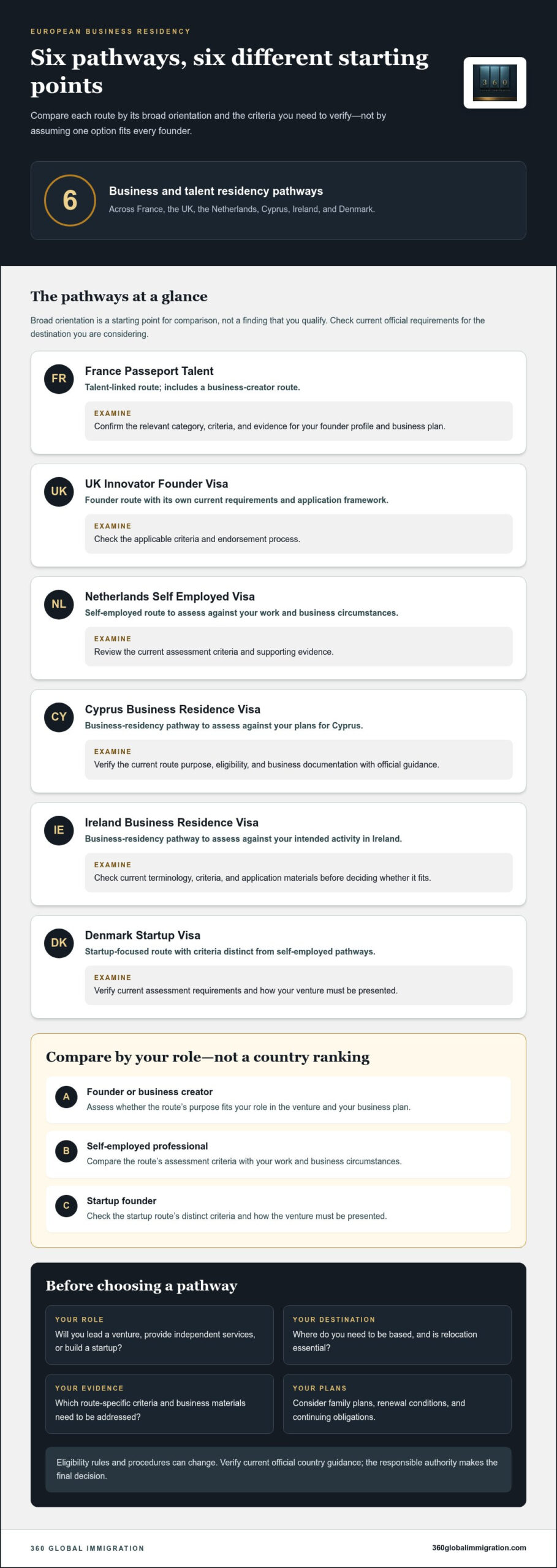
Start by comparing your role in the business, rather than by looking for a country ranking. The six pathways below provide a framework based on their stated route names and broad orientation, not a finding that you qualify. Eligibility criteria, terminology, and application steps can change. Compare your circumstances with the destination’s current official requirements before relying on a route.
| Pathway | Broad orientation | What to examine |
|---|---|---|
| France Passeport Talent | A talent-linked pathway that includes a business-creator route. | Confirm the relevant category, criteria, and evidence for your founder profile and business plan. The France Passeport Talent business creator guide provides a focused country-specific starting point. |
| UK Innovator Founder Visa | A founder route with its own current requirements and application framework. | Check the applicable criteria and endorsement process. The UK Innovator Founder endorsement guide explains the endorsement element. |
| Netherlands Self Employed Visa | A self-employed route to assess against your work and business circumstances. | Review the current assessment criteria and supporting evidence in the Netherlands self-employed visa requirements guide. |
| Cyprus Business Residence Visa | A business-residency pathway to assess against your plans for Cyprus. | Verify the current route purpose, eligibility, and business documentation with official guidance. |
| Ireland Business Residence Visa | A business-residency pathway to assess against your intended activity in Ireland. | Check current terminology, criteria, and application materials before deciding it fits. |
| Denmark Startup Visa | A startup-focused route with distinct criteria from self-employed pathways. | Verify the current assessment requirements and how your venture must be presented. |
Compare founder, startup, and self-employed routes
These categories raise different questions. A startup-focused route, such as Denmark’s, should be assessed against its current startup criteria and your venture’s stage. For a self-employed pathway such as the Netherlands route, examine how the authorities assess independent business activity. France’s Passeport Talent includes a business-creator category, while the UK Innovator Founder route has its own criteria. Do not assume that evidence prepared for one route will meet another route’s requirements.
Match the route to your business and destination priorities
Are you launching a venture, actively operating an existing company, or continuing independent work from a new base? Match that role to the route’s stated purpose, then consider where you need to live and how central relocation is to your business plan. The official EU Residence Rights Overview provides general context, but it does not replace country-specific rules for non-EU applicants. A structured route assessment can help narrow the options. 360 Global Immigration’s residency guidance supports founders in assessing pathways and preparing applications.
How to Assess Your Residency Application Readiness
Organise your application file around the route’s current requirements, not a generic checklist found online. First identify the exact pathway and review its official guidance. The examples below are illustrative: required documents, formats, translations, validity periods, and submission methods vary by route and can change.
Use this readiness checklist to structure your initial review:
- Identity records: List the identity and civil-status documents requested for you and, where relevant, accompanying family members. Check that names and personal details are consistent across records.
- Business evidence: Collect relevant company, ownership, activity, and business-plan materials that explain what the business does and what role you will perform.
- Financial documentation: Identify the financial evidence specified for the route and note which records support the figures or statements in your application.
- Route-specific materials: Record any additional forms, professional records, supporting statements, or other items named in the current official checklist.
For an applicant in the UAE, make an inventory of where each record is held and whether it needs an updated copy or a particular format. A document prepared for one country’s process may not meet another country’s requirements.
Organise the founder and business evidence
Build a simple evidence map: describe your professional experience, your role in the proposed or existing business, and the activity you intend to carry out in the destination country. Match each key statement in your application to supporting records where appropriate. This helps keep your business plan, forms, company information, and professional history aligned without adding unsupported claims.
- Use one consistent version of the business name, activity description, and ownership details.
- Check that dates in forms and supporting records tell a coherent timeline.
- Keep financial explanations consistent with the records submitted to support them.
Consistency makes an application easier to follow because its forms, explanations, and supporting evidence align. For example, different dates for your role as founder or shifting descriptions of the business across documents may prompt questions that a careful review could identify in advance.
Identify gaps before submission
Compare your file with the selected route’s current official requirements, item by item. Mark each item as ready, missing, unclear, expired, or inconsistent. Resolve gaps before submission where possible, and keep a brief note explaining any discrepancy that needs context. This is a practical preparation step, not a prediction of how an authority will decide.
The professional immigration advice for startups guide provides a broader preparation framework. Structured eligibility review and document coordination can also help organise a complex file. If you’re preparing to Secure European residency for entrepreneurs, 360 Global Immigration’s application guidance supports a tailored review of your pathway and supporting materials.
What the European Residency Application Process Involves
Although each country and pathway has its own procedure, an entrepreneur’s application generally moves through four stages: route assessment, evidence preparation, submission, and follow-up with the relevant authority. Use this as a planning framework, not a universal checklist. Forms, appointment requirements, interviews, processing times, and post-approval obligations depend on the specific route and current rules.
For founders applying from the UAE, careful coordination helps keep the application aligned with the business plan and personal circumstances. You remain responsible for providing accurate information, reviewing documents, and responding to requests within any applicable timeframe. Professional guidance can help organise this work, but it cannot determine the government’s decision.
From route assessment to a prepared application
Start by comparing your experience, business activity, role, and relocation plans with the pathway’s stated purpose. Once you select a route, organise forms and supporting records according to its current official requirements. A tailored assessment and structured document review can help identify missing evidence or inconsistencies before submission. The steps still depend on the route you choose.
- Assess the route: Compare your profile and business plans with current eligibility information from the relevant authority.
- Prepare the evidence: Arrange forms and supporting records in the required format, and present a clear, consistent account.
- Submit as directed: Follow route-specific instructions for submission, appointments, and required supporting materials.
- Monitor communications: Keep your contact details accessible and review messages from the authority so you can respond to requests appropriately.
Avoid building a relocation schedule around an assumed decision date. Processing times can differ by country, application type, and individual circumstances. The UAE to Europe business relocation guide connects application planning with wider move considerations.
After submission: decisions and next responsibilities
After submission, the competent authority reviews the application and makes the decision. Depending on the route and case, it may request additional information or arrange another step. Keep copies of submitted materials, monitor official communications, and provide truthful, consistent responses to any request. An adviser can support coordination but cannot replace the authority or promise its decision.
If your application is approved, read the decision and accompanying official guidance carefully. Conditions, renewal requirements, residence expectations, and business-related obligations depend on the specific permission. Verify these details with current official sources before making long-term plans. Approval under one route does not automatically establish rights under another.
To Secure European residency for entrepreneurs with a well-managed process, align the route, evidence, and follow-up from the outset. Residency application guidance can help structure your next steps.
How 360 Global Immigration Supports Entrepreneurs Seeking European Residency
For founders planning a business move from the UAE, clarity starts with a pathway that reflects both the applicant’s profile and the venture’s plans. 360 Global Immigration supports entrepreneurs and professionals with business and talent residency pathways in Europe and the UK, including France Passeport Talent, the UK Innovator Founder Visa, Netherlands Self Employed Visa, Cyprus Business Residence Visa, Ireland Business Residence Visa, and Denmark Startup Visa.
These options are not interchangeable. The consultancy begins with a tailored route assessment that considers the founder’s experience, intended role, business model, destination priorities, and relocation plans. Structured guidance then supports eligibility review, document preparation, and application coordination, helping you understand what information is needed and how the application stages connect.
What structured application support can address
A clear process can make a complex application easier to manage. Support includes organising case details, aligning forms with supporting records, identifying gaps that need attention, and coordinating application materials against the selected route’s requirements. You remain central to the work: accurate information, timely document input, and careful review of the final materials are essential.
- Route assessment: Review your circumstances and business plans against the pathway’s relevant criteria.
- Document preparation: Organise the required records and check that information is consistent across forms and supporting evidence.
- Application coordination: Structure submission preparation and clarify your next steps as the process progresses.
These services support preparation and coordination; they do not replace the decision-making authority. The relevant government body assesses the application and decides whether to grant permission. Consultancy fees and government fees are separate, and applicants should account for each according to the applicable process. No adviser can guarantee residency or a particular decision.
Take the next step with a clear residency strategy
A useful first discussion centres on your business profile, intended role, preferred destination, relocation objectives, and the stage of your venture. These details focus the assessment on relevant pathways while recognising that suitability and requirements depend on individual circumstances and current country rules.
If you’re preparing to Secure European residency for entrepreneurs, a measured plan can turn a broad goal into practical preparation. Set out your business activity and intended move, then use the assessment to identify route questions and supporting evidence that need attention. The aim is informed progress, not an unsupported promise of approval.
360 Global Immigration’s residency assessment provides tailored guidance to discuss your plans and map out a considered next step.
Turn Your Residency Plans Into a Clear Next Step
Your next move does not need to be a final decision about where to relocate. Start by setting out what you want the business to achieve, the role you’ll play, your preferred destination, and any family considerations that shape your timing. This brief can focus the next conversation and surface questions that deserve careful attention.
To Secure European residency for entrepreneurs, build your strategy around a route that fits your circumstances and evidence you can prepare with confidence. 360 Global Immigration provides guidance to entrepreneurs, founders, and self-employed applicants across its European and UK business and talent residency pathways. Requirements differ, and government authorities make the final decisions, so a considered assessment is a practical place to begin.
Discuss your European residency plans with 360 Global Immigration and take a measured step toward your next chapter.
Frequently Asked Questions
Can an entrepreneur obtain European residency by starting a business?
Yes, some countries offer residency pathways for eligible founders or business owners, but simply registering or launching a company does not automatically grant residence. The relevant route may assess your role, business activity, experience, or plan against its current criteria. Before committing funds or setting a launch date, identify the applicable pathway and compare its requirements with your business stage and personal circumstances. Approval remains a decision for the responsible authority.
Which European country is best for entrepreneurs seeking residency?
There is no single best country for every founder. A business that needs you physically present in a particular market may point to a different destination from a venture that can operate across borders. Consider where your customers, partners, and day-to-day responsibilities are based, alongside the route’s current criteria and your family’s priorities. Compare specific pathways using official guidance rather than relying on general country rankings or promotional claims.
Does European business residency guarantee permanent residency?
No. A business or founder residence permit does not by itself guarantee permanent residence or citizenship. Each country sets its own rules for maintaining status and applying for longer-term permission, and eligibility may depend on circumstances over time. Keep a record of permit conditions and verify the relevant country’s current rules before making long-term plans. Treat future residence as a separate possibility to assess, not an automatic result of initial approval.
Do I need to establish my company before applying for an entrepreneur visa?
Not necessarily. Some pathways may consider a proposed venture, while others may require evidence of an existing business or defined professional activity. The distinction depends on the specific route and its current instructions. If you are preparing to launch, check what evidence the application accepts about your business plan. If you already own a company, identify which company records are relevant. Verify timing requirements before incorporating or changing business arrangements.
Can my family join me if I receive business residency in Europe?
Possibly, but family eligibility and application procedures vary by country and residence route. A spouse or child may need a separate application, supporting identity or relationship records, or evidence that meets the destination’s requirements. Do not assume that a founder’s permission automatically covers relatives. Before planning a joint move, review official guidance for each family member’s eligibility, application timing, and any conditions that could affect travel or residence.
What happens if my residency application is refused?
A refusal means the authority has not granted that application; it does not establish whether another route or a future application is possible. Read the decision carefully to understand the stated reasons and any deadline or review option that applies. Procedures differ, so do not assume you can appeal or immediately reapply. Keep the decision and submitted file together, then assess the next step against current official rules and your circumstances.
How can I avoid mistakes in an entrepreneur residency application?
Use a final review that goes beyond checking whether every file is attached. Compare names, dates, ownership details, and business descriptions across forms and records, and make sure each statement is supported. Keep a dated copy of the official checklist you used and track document versions so outdated drafts are not submitted by mistake. Follow route-specific instructions for translations, certification, and document format, since requirements differ by application.