
France’s self-employed route doesn’t remove the tax question: freelancers working there should plan for French income tax. The right self-employed visa in France depends on whether you’re starting a business, continuing a liberal profession or qualifying for a talent permit. French income-tax rates on self-employed earnings range from 0% to 45%, depending on total income.
It’s understandable to want a clear picture before committing to a move, especially when visa costs, paperwork and tax obligations all affect your plans. This guide explains the main routes, the application process and the costs to include in your budget.
You’ll also learn how French tax may apply when you invoice US clients, and how self-employed permission differs from permission to take salaried work. These points can help you assess which route fits your plans and prepare for the next steps with greater confidence.
Key Takeaways
- Identify which self-employed residence route aligns with your work, business plans and eligibility before preparing an application.
- Plan for visa fees and post-arrival formalities, and organise the required documents before submitting through France-Visas and the relevant consulate.
- Understand how your permit relates to invoicing US clients and why permission for self-employed work is distinct from salaried employment.
- For a business-founder talent route, assess the project’s investment and qualification criteria; France Passeport Talent guidance can help clarify the application path.
How Much Does the France Freelancer Visa Cost?
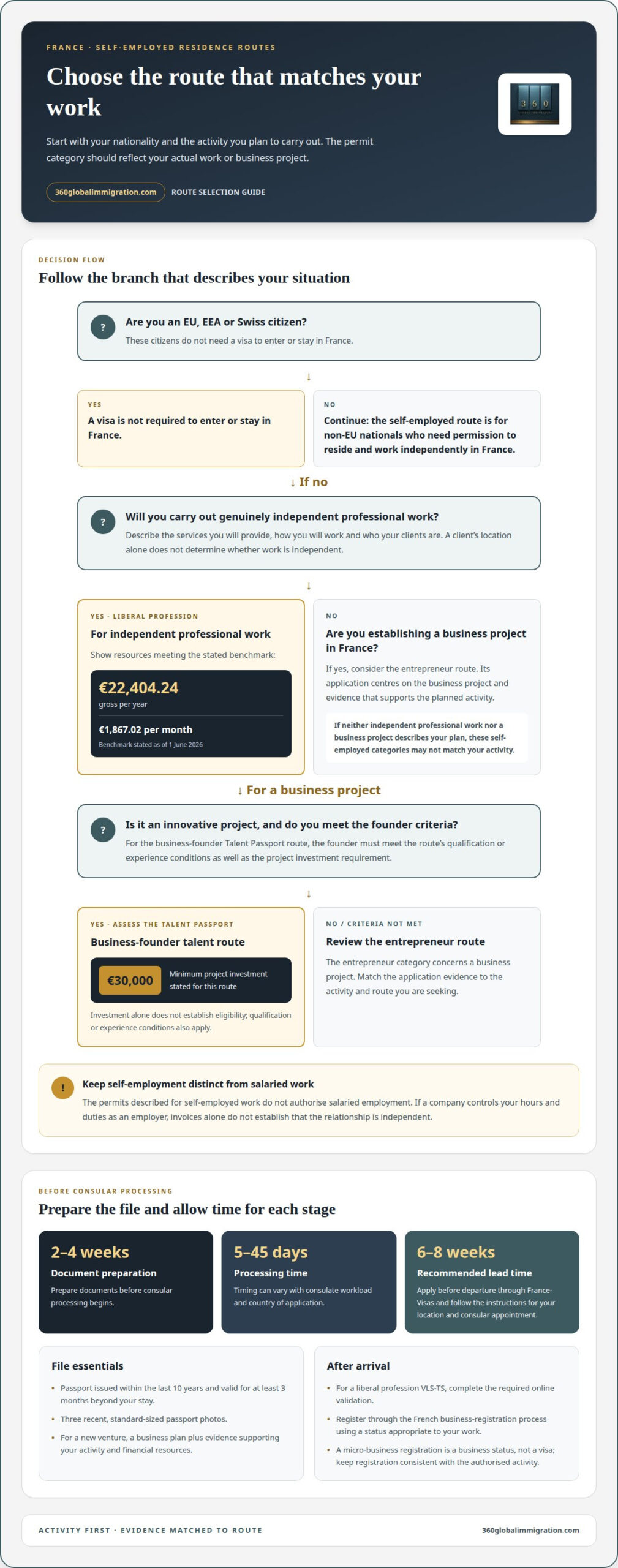
A self-employed visa in France involves separate application and post-arrival charges. Processing typically takes 5 to 45 days, while preparing documents can take 2-4 weeks. Include both stages in your schedule, since file preparation happens before consular processing begins.
- Choose the permit that matches your activity. A liberal profession application suits an independent professional; an entrepreneur route concerns a business project. This choice shapes the evidence required and the arrival formalities. Describe your services, clients and intended work clearly. For a self-employed visa in France, the permit category should match the activity you plan to carry out.
- Prepare a complete document file. Include your passport, a business plan for a new venture, evidence supporting your activity and financial resources, and the documents required for your chosen route. Your passport must have been issued within the last 10 years and remain valid for at least 3 months beyond your stay. The listed documents also include three recent, standard-sized passport photos. Keep your project description consistent across the application materials.
- Submit the application with time to spare. Apply through France-Visas and follow the instructions for your application location and consular appointment. Applying 6 to 8 weeks before departure is recommended. The 5-to-45-day processing period can vary with consulate workload and country of application, so allow time for preparation separately.
- Budget for separate official charges. The initial long-stay visa, the residence permit and post-arrival validation may each involve a charge. These are distinct parts of the process, so don’t plan around the visa fee alone. The applicable cost depends on the permit and validation requirements for your route.
- Validate your visa, then register your activity. For a liberal profession VLS-TS, complete the required online validation after arriving in France. Then register through the French business-registration process, choosing a status appropriate to your work. A micro-business registration is a business status, not a visa. Keep your registration consistent with the activity authorised by your self-employed visa in France.
Can I invoice US clients on a French liberal profession visa?
Yes, if your work is genuinely independent and falls within the activity authorised by your French residence permit. The permits described here don’t authorise salaried work, so distinguish freelance invoicing from employment before choosing a route.
- Match the permit to your professional activity. The liberal profession route concerns independent professional work, while a business-founder route concerns creating a business. Describe the services you’ll provide, how you’ll work and who your clients are. A US client’s location doesn’t make independent work salaried employment; the actual working arrangement matters.
- Establish whether you need a visa. The French self-employed route applies to non-EU nationals who need permission to reside and work independently in France. EU, EEA and Swiss citizens don’t need a visa to enter or stay in France. Your nationality and planned activity therefore shape the residence application.
- Demonstrate eligibility for the liberal profession route. Applicants must show resources meeting the relevant minimum benchmark. For this activity, the stated benchmark is €22,404.24 gross per year, equivalent to €1,867.02 per month, as of 1 June 2026. Present evidence connecting your experience, services and expected income to the activity described in your application.
- Keep self-employment separate from employment. A residence permit for self-employed work doesn’t authorise salaried work. If a US company controls your hours and duties as an employer, invoices alone don’t establish that the relationship is independent. Describe your working arrangement accurately in the application.
- Plan for longer-term residence separately. Holders of specified self-employed or business-founder permits may qualify for EU long-term residence after five years of uninterrupted EU stay, provided the last two years were continuously in France. A refusal can follow if the application doesn’t establish the route’s activity, eligibility or resources. For a business-founder route, review relevant French residence options before deciding.
France’s entrepreneur/liberal profession visa category
Choose the French route that reflects your work: an independent profession or a business venture. This distinction shapes the evidence and eligibility criteria for your application for a self employed visa in France.
-
Understand the Entrepreneur and Liberal Profession Visa
Identify whether you’ll practise a liberal profession or establish an entrepreneur activity in France. The liberal profession route is for independent professional work, while an entrepreneur application centres on a business project. Set out your services, experience, income and planned activity consistently. Don’t describe a new venture as an established profession if your supporting documents show otherwise.
-
Compare the Entrepreneur Visa and Talent Card
Assess the talent route separately if you’re founding a business with an innovative project. According to the French Ministry of the Interior, a business founder applying for France’s Talent Passport permit must invest at least €30,000 in the project. The founder must also meet the route’s qualification or experience conditions, so investment alone doesn’t establish eligibility.
- Match your evidence to the category. For a business-founder application, the stated qualification standard is a diploma equivalent to at least a Master’s degree or professional experience of at least five years at that level. An innovative project may also qualify through a stated recognition route if it received public innovation support within the last five years. Organise your evidence around the criteria that support your application.
- Check the activity and permit period. The French multiyear self-employed permits described here are valid for four years and renewable; the freelancer visa is valid for one year and renewable. An entrepreneur application must also show that the proposed business complies with French safety, health and public order laws. Choose the category that fits your actual activity, not simply the permit duration you prefer.
- Confirm the financial basis of your application. Self-employed applicants must demonstrate resources at least equivalent to the French legal minimum wage. Explain how your planned activity will support those resources, using evidence suited to your profession or business model. Keep projected income, qualifications and your project description aligned throughout the application, so the documents support the same professional plan.
Applying through France-Visas and a consulate
Use France-Visas to prepare your application, then follow the consulate’s submission process. Allow time for document preparation, consular processing and arrival formalities.
- Select the visa category that matches your activity. On France-Visas, identify the long-stay route that corresponds to your planned independent profession or business in France. Keep your description consistent with the activity and evidence in your application. A mismatch between the selected category and your stated work can make the file harder to assess.
- Complete the France-Visas application carefully. Enter your personal details and intended activity as requested, then prepare the documents for the route you selected. For a business project, make sure the business plan describes the same activity as the application. Review the completed form and supporting material together before moving to consular submission.
- Plan the consulate stage around realistic processing time. French consulate processing for an Entrepreneur Visa typically takes 2-8 weeks. The full Entrepreneur / Liberal Profession Visa process typically takes 2-3 months from start to finish. Begin at least 3-4 months before your planned move, allowing room for preparation and the consulate’s decision.
- Submit through the designated consular process. Follow the instructions connected to your France-Visas application for submitting documents and completing any required appointment. Keep your application details and supporting evidence aligned. The consulate assesses the file against the visa category and proposed activity, so explain clearly how your documents support your plan.
- Complete the steps after a decision. Once you obtain the visa, follow its conditions for entering France and completing the required arrival formalities. A visa is tied to its stated purpose, so begin only the activity it authorises. If your route is a talent permit, get guidance on your France talent application before submission.
360 Global Immigration: France Passeport Talent
360 Global Immigration can guide applicants considering the France Passeport Talent route by helping clarify how this option relates to a business-founder project. Turn to this support when you’re weighing the talent card against the entrepreneur or profession libérale route, or organising your application around the project’s eligibility criteria.
The right route depends on your activity, qualifications, project and supporting evidence. A clear assessment can help you understand which criteria your documents need to address before you proceed. If your plans involve another country, 360 Global Immigration also supports the Netherlands Self Employed Visa, UK Innovator Founder Visa and Cyprus Business Residence Visa.
For tailored guidance on the France Passeport Talent pathway, contact 360 Global Immigration.
Turn your France plans into a clear next step
Before committing to a move, shape your professional plans into a coherent application strategy. Decide how you’ll describe your work, organise the evidence that supports it and plan how your French activity fits your wider client relationships. A well-defined route for a self-employed visa in France can help keep those decisions aligned from the outset.
360 Global Immigration offers guidance on France Passeport Talent, alongside the UK Innovator Founder Visa and Netherlands Self Employed Visa. If your plans involve more than one destination, understanding how each route fits your business objectives can help you focus your preparation and make informed choices.
For guidance on your options and the next steps, contact 360 Global Immigration. A considered plan can make your move feel more manageable and bring your professional goals into focus.
Frequently Asked Questions
Do freelancers and self-employed people pay taxes in France?
Yes. Self-employed earnings in France are subject to income tax, with rates ranging from 0% to 45%, depending on total income. Your tax position also depends on your residence and personal circumstances. Keep records of business income and expenses so you can organise your tax reporting around your activity.
Do I need to register my business before I apply for the visa?
Not necessarily. The application focuses on the activity you plan to carry out and the evidence supporting that project. You can prepare your visa application around a proposed activity, then register the business after arriving in France. Treat these as separate steps: business registration doesn’t replace the visa or residence permission required to live and work there.
How long does it take to receive the visa?
Allow time for both document preparation and consular processing. An Entrepreneur Visa application typically takes 2-8 weeks at the consulate, while the full Entrepreneur / Liberal Profession Visa process typically takes 2-3 months. Preparation time varies with how quickly you can assemble evidence for your activity, business plan and resources. Build those stages into your planned move rather than counting only consular processing.
How much does it cost?
Budget for separate French charges covering the long-stay visa, the residence permit and any required post-arrival validation. The combined amount depends on the permit issued and its applicable validation charge, so the visa fee alone doesn’t represent the full cost. Plan separately for practical moving and business expenses, which aren’t included in the French visa charges.
Is there an income requirement, and is it gross or net SMIC?
Yes. For a profession libérale application, the stated resource benchmark is based on gross SMIC, not net income. Applicants must demonstrate resources that meet the relevant minimum; the evidence should connect expected earnings to the proposed independent activity. Present income documents alongside a clear explanation of your work, so the application shows how your professional activity supports your stay in France.
What Does It Allow You to Do?
A self-employed residence permit allows you to carry out the independent activity authorised under your French route. For example, a freelancer may provide services and invoice clients, including US clients, when that work matches the permitted activity. These permits don’t authorise salaried employment. If a company controls your work as an employer, invoicing it doesn’t by itself make the arrangement self-employed.