
What if Denmark assesses your startup before it considers your residence application? That’s the key distinction behind the Denmark startup visa for international founders: first, an expert panel reviews whether your business idea is suitable. Only after approval can you apply to the Danish Agency for International Recruitment and Integration (SIRI) for a residence and work permit. Understanding these separate decisions helps you prepare for each stage and avoid treating business approval as permission to relocate.
If you’re unsure whether your venture is innovative enough or what evidence will make its potential clear, you’re not alone. Denmark’s pathway focuses on businesses with innovation and growth potential, and founders must take an active role in running the venture. A strong business concept matters, but it does not replace the separate residence permit requirements.
This guide explains how the two stages work, what may make a startup eligible, and how to organize your business plan and supporting documents. You’ll also learn which personal requirements to assess and which details, including current criteria, fees, and permit conditions, to confirm through official Danish sources before applying. Use the guidance to evaluate your venture, identify gaps, and prepare each stage methodically.
Key Takeaways
- Use the Denmark startup visa for international founders self-assessment to examine your venture’s innovation, growth potential, market opportunity, and your role in the business.
- Keep venture eligibility separate from personal immigration requirements, and verify current criteria and document checklists through official Danish sources.
- Build a consistent application file by aligning your business plan, founder details, supporting business evidence, and personal documents.
- Follow the official application sequence and be prepared to respond if authorities request further information.
- Before making relocation plans, review the written decisions and confirm that you meet the stated residence permit requirements.
What Is Denmark’s Startup Visa for International Founders?
The Denmark startup visa for international founders is a pathway for qualifying entrepreneurs who want to develop an eligible startup in Denmark. Known as the Start-up Denmark scheme, it separates assessment of the business idea from the decision on the founder’s right to live and work in the country. That distinction matters: even a promising venture must be followed by a separate application that meets the relevant immigration requirements.
At a glance: This is a startup pathway for founders building a venture that meets the scheme’s criteria. It is not a general job-search route, a substitute for ordinary employment permission, or permission to visit Denmark for business activities. Each route has its own purpose and conditions, which applicants should confirm through official guidance.
Who Is the Denmark Startup Visa Designed For?
The route may suit an international entrepreneur who will actively establish or operate a venture, rather than someone who invests or holds shares without a substantial role. Both the business concept and the founder’s contribution matter. Startup Denmark’s expert panel assesses whether the idea fits the scheme, while the residence application considers the founder’s immigration eligibility.
A newly registered company, freelance practice, or self-employed activity does not qualify automatically. Consider whether you can explain what the venture offers, who it serves, how it could develop, and why your involvement is needed to build it. These are preparation questions, not an official eligibility test, so check the current criteria before applying.
How Startup Assessment Differs from Residence Permission
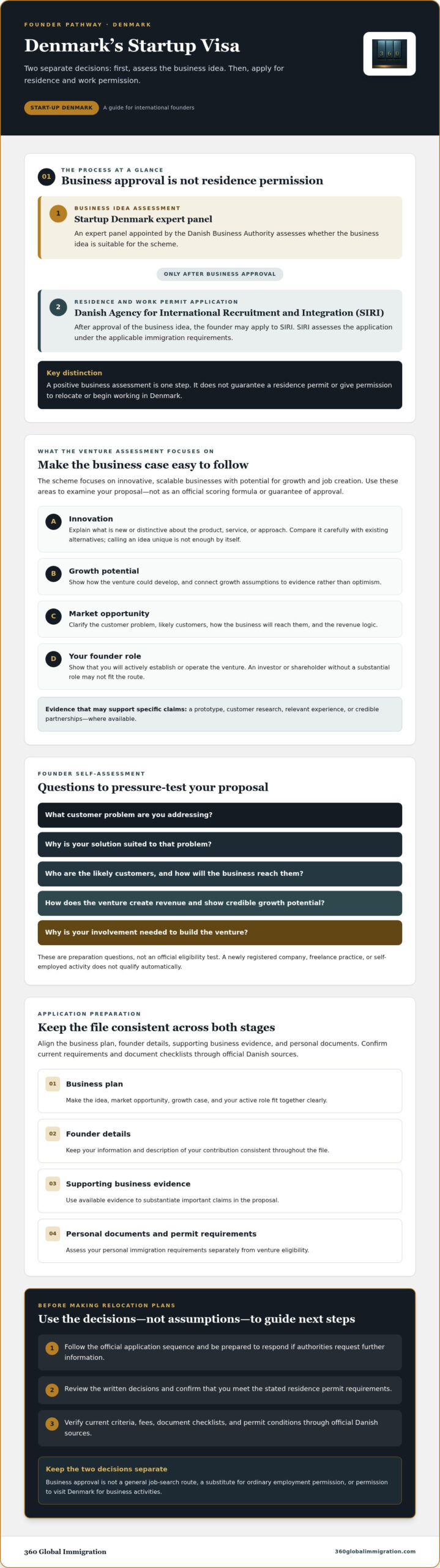
The process has two distinct decisions. First, an expert panel appointed by the Danish Business Authority assesses the business idea through Startup Denmark. If the venture is approved, the founder may then apply to the Danish Agency for International Recruitment and Integration (SIRI) for a residence and work permit. SIRI assesses that application under the applicable immigration requirements.
Business approval does not guarantee a residence permit. The Danish Immigration Service offers broader context on Denmark’s immigration administration, but SIRI is the authority identified for processing the Start-up Denmark residence application. Keep the two stages separate when planning: a positive business assessment is one step, not permission to relocate or begin working in Denmark.
How Denmark Assesses a Startup: Innovation, Growth, and Founder Role
Startup Denmark assesses a venture’s potential, not simply whether you have registered a company or prepared a polished business plan. The scheme focuses on innovative, scalable businesses with potential for growth and job creation. There is no scoring formula provided here, so use the questions below to sharpen your proposal, not as an official checklist or prediction of approval.
For the Denmark startup visa for international founders, make the connection between the idea, its commercial opportunity, and your role easy to follow. Support important claims with evidence: explain what makes the solution meaningfully different, who may need it, and how the venture could develop.
What Makes a Business Proposal Credible?
Test the proposal from a decision-maker’s perspective. What customer problem are you addressing, and why is your solution suited to it? Who are the likely customers, how will the business reach them, and what is the revenue logic? Show how growth assumptions follow from evidence rather than optimism. Where available, a prototype, customer research, relevant experience, or credible partnerships can support specific claims.
Calling an idea unique does not establish that it is innovative. Explain what is new or distinctive about the product, service, or approach, and compare it carefully with existing alternatives. Then link that distinction to a credible opportunity to grow. The official Start-up Denmark scheme guidance is the right reference for checking current requirements, as assessment criteria and practices can change.
Does Every Founder or Business Type Qualify?
No broad label can settle the question. Eligibility depends on the current scheme criteria and the merits of the specific venture. Avoid assuming that a particular sector automatically qualifies or is excluded unless current official guidance says so. A conventional business plan alone may not establish fit for a startup programme. The proposal needs to show why the venture is innovative and how it could scale.
Your capability and contribution also need to be clear. Describe relevant experience, responsibilities, and the work you will personally undertake to establish and develop the business. If several people are involved, specify your role rather than relying on a general statement that you are a founder. Check that the plan and supporting evidence present a consistent account.
Before investing time in a full submission, compare your idea with the official guidance and identify evidence gaps. If you need help organizing eligibility questions and application materials, you can review Denmark Startup Visa application support and consider whether professional guidance suits your circumstances.
Is Your Venture a Fit? Test the Denmark Startup Visa Criteria
Use this self-assessment to identify strengths and gaps before preparing an application. It is a planning tool, not an official eligibility decision or a substitute for current assessment criteria. For the Denmark startup visa for international founders, venture fit and personal immigration eligibility are separate questions. A strong business case does not, by itself, establish that you meet residence permit requirements.
Questions to Ask About Your Startup Before Applying
Answer these questions with specific details and evidence, not just confident claims:
- Customer problem: Can you describe who has the problem, what it is, and why your proposed solution matters?
- Innovation and differentiation: Can you explain what is distinctive about your approach and support that explanation with a considered comparison to existing alternatives?
- Market and business model: What evidence supports demand, your target market, and the way the venture could generate revenue?
- Growth assumptions: Can you show how the business might scale and explain the evidence behind your assumptions?
- Founder contribution: Can each founder describe their responsibilities and active contribution to developing the venture?
Look for gaps between what you claim and what your materials demonstrate. For example, vague differentiation, growth projections without supporting rationale, unclear founder responsibilities, or inconsistent details across documents can make the proposal harder to assess. Check the latest Official Danish Government Startup Visa Information before relying on this framework, since criteria and procedures may change.
Review your personal circumstances separately. Confirm the current residence application requirements for your situation, including relevant documents and conditions, through official Danish sources. This prevents you from treating venture suitability as a substitute for immigration eligibility.
When Another Business Pathway May Be More Relevant
The Danish startup route is not interchangeable with permission based on employment, freelance activity, or investment. If your business model or plans do not appear to align with the startup scheme, compare the actual criteria for other countries and routes rather than assuming one pathway can be substituted for another.
Founders comparing options can review the country-specific UK Innovator Founder Visa endorsement bodies, France Passeport Talent business creator guidance, and Netherlands self-employed visa requirements. Each route has its own assessment framework. Compare the relevant official requirements with your venture and personal circumstances before deciding where to focus your preparation.
How International Founders Can Prepare a Denmark Startup Visa Application
A well-organized application helps decision-makers follow the same story across your venture proposal, supporting evidence, and personal documents. Prepare in sequence: verify current rules, assess your venture’s fit, assemble consistent evidence, submit through the required official channels, and respond to any requests. The Denmark startup visa for international founders involves distinct business assessment and residence application stages, so confirm which documents apply to each.
Build a Consistent Business and Evidence File
Start with the business plan, then check every supporting document against its claims. Market research should relate to the customers you identify; financial assumptions should match the revenue model; and your description of founder responsibilities should reflect the role you intend to perform. Keep records organized so you can locate the evidence behind each important statement.
A generic template can leave gaps if it does not reflect your actual venture. Tailor the material to explain the customer problem, proposed solution, commercial logic, and development plans. Gather relevant business evidence, such as customer research, prototype information, or partnership records where available. Separately, prepare documents that establish founder identity and address the personal requirements on the current official checklist.
Before finalizing the file, check requirements for translations, certification, file format, and document submission. These details can depend on current instructions. Do not assume that a document accepted for another application will meet this scheme’s requirements.
Check the Official Application Sequence
Before submitting, confirm whether the venture assessment must be completed before applying to SIRI for residence and work permission. Review the latest Start-up Denmark guidance on the official portal for the current sequence, submission channels, supporting documents, and any appointment or biometric steps. Requirements can change, as can fees and processing times, so avoid relying on old checklists or estimates.
Use a dated checklist to track what you have verified, what remains outstanding, and which version of the official instructions you consulted. Save copies of submitted materials and note any deadlines stated in correspondence. If authorities request more information, answer the specific questions and keep your explanation consistent with the application.
After a decision, read the written notice carefully and follow its instructions. Startup assessment approval is not residence authorization, so make relocation plans only when the required permission has been granted. If you’d like support organizing eligibility questions and application documents, discuss your Denmark Startup Visa application with 360 Global Immigration.
After Startup Approval: Residence Decisions and Practical Next Steps
A positive startup assessment is an important milestone, but it is not permission to live or work in Denmark. You must complete the separate residence and work permit application with the Danish Agency for International Recruitment and Integration (SIRI), which assesses your immigration eligibility. Treat the written decisions as separate instructions, and do not make relocation plans on the basis of the business assessment alone.
What to Confirm Before Making Relocation Plans
When you receive a decision, read it carefully and check the validity period, conditions, and any follow-up steps that apply to your case. Current Start-up Denmark guidance states that an initial permit may be granted for up to two years and extended for up to three years at a time. An extension is not automatic, so confirm the applicable requirements and timing through SIRI’s official Start-up Denmark information and your written notice.
Check your permissions before acting. Under the scheme, the permit holder is allowed to work in the business for which the permit was granted. Starting another business or taking a salaried job requires a new permit. Current guidance also allows the permit holder’s family to accompany them, but confirm each family member’s application requirements and conditions separately before making plans.
Do not assume that startup approval, a pending residence application, or a planned move authorizes travel, work, or business activity. Confirm the relevant permission and its effective dates before taking those steps. If family members will accompany you, verify their documentation and permissions through current official instructions as well.
When Professional Application Support Can Help
The Denmark startup visa for international founders involves connected decisions and supporting records. Professional application support can help you organize documents, identify inconsistencies between your business materials and personal details, and understand which process stage comes next. It can also help you prepare questions to verify with the relevant authorities.
Only the competent Danish authorities decide whether a startup proposal or residence application is approved. Support can help you prepare a clearer, more complete file, but it cannot guarantee an outcome. If you would like help organizing your application preparation, Discuss your Denmark startup visa application with 360 Global Immigration.
Prepare Your Denmark Startup Application with Confidence
The Denmark startup visa for international founders involves two distinct assessments: whether the venture fits the startup scheme and whether the founder meets the requirements for residence and work permission. Treating these as separate stages helps you prepare the right evidence for each decision.
Before applying, test whether your business case clearly explains its innovation, commercial potential, and your active role. Then check the latest official Danish criteria and organize consistent supporting documents. A positive startup assessment is a milestone, not a guarantee of residence permission, so review each written decision before making relocation plans.
360 Global Immigration supports business and talent-based residency applications, including the Denmark Startup Visa pathway. If you’d like help organizing eligibility questions and application materials, discuss your Denmark startup visa application.
Careful preparation can make a complex process clearer. Take it one decision at a time, and move forward only when you have confirmed the requirements for that stage.
Frequently Asked Questions
What is the Denmark Startup Visa for international founders?
It’s a pathway for qualifying entrepreneurs seeking to develop an eligible startup in Denmark. The Start-up Denmark process first assesses the business idea through an expert panel; a founder can then apply separately for a residence and work permit through SIRI. The Denmark startup visa for international founders is intended for active founders, not passive investors seeking permission to live in Denmark solely because they hold shares in a business.
Who is eligible for Denmark’s Startup Visa?
Founders may qualify if their business proposal meets the scheme’s current criteria and they will play an active role in establishing or operating the venture. The assessment focuses on the business idea, including its innovation and growth potential, while the residence application has separate personal requirements. A new company, freelance activity, or self-employed business does not qualify automatically. Check the current official criteria and residence conditions before applying.
Does Startup Denmark approval automatically give me a residence permit?
No. Approval of the business idea is not a residence permit and does not guarantee that SIRI will approve your residence and work application. After a positive startup assessment, you must apply through the relevant immigration process and meet its requirements. Read each written decision carefully, including any conditions or follow-up steps. Do not assume you are authorized to relocate or work until the required residence permission has been granted.
Can more than one founder apply for the Denmark Startup Visa?
More than one founder may be involved in a startup, but each person should confirm how the current scheme applies to their role and application. The business proposal and each founder’s active contribution matter; being a shareholder alone does not establish eligibility. Explain each person’s responsibilities clearly and verify whether separate residence applications or supporting documents are required. Check the latest Startup Denmark guidance before relying on assumptions about co-founder applications.
How long does the Denmark Startup Visa application take?
Allow time for both stages. The business idea assessment by the expert panel takes approximately four to eight weeks. After that approval, SIRI’s normal processing time for a residence application is two months, but it can take up to four months if further information is needed. These are published estimates, not guarantees. Check current processing information before making plans, and respond promptly if the authorities request additional details.
Can my family accompany me under Denmark’s Startup Visa route?
Yes, current Start-up Denmark guidance allows the permit holder’s family to accompany them to Denmark. Family members’ permissions and application requirements should be checked separately, since the founder’s business approval alone does not establish their residence status. Before making plans, confirm the current rules, required documents, and any conditions for accompanying family members through official Danish sources. Review the written decisions before arranging relocation.
What documents should founders prepare for a Denmark Startup Visa application?
Prepare a business plan that explains the venture, its market and business model, and each founder’s role. Gather relevant evidence supporting the proposal, along with founder identity documents and personal materials required for the residence application. The exact checklist, translations, certification, and submission format can change, so verify them for both stages through SIRI’s official Start-up Denmark guidance before submitting.