
If you’re searching for expert business visa rejection help in the UAE, it’s understandable to want a quick answer. Before submitting another application, read the refusal notice and identify the specific grounds stated. A new application that leaves those concerns unanswered may repeat the same weaknesses.
A refusal can make it unclear what went wrong or whether your plans fit the visa route you chose. The notice and the destination authority’s rules determine what response options may be available. An appeal or reapplication should not be assumed. A business visit visa also serves a different purpose from a longer-term business residence pathway.
This guide explains how to review a refusal, distinguish process-based options from common assumptions, and decide what evidence or route may be relevant. It also outlines how immigration guidance from 360 Global Immigration can help you organise your circumstances and clarify whether your plans call for visit visa support or business residence guidance for Europe or the UK. The aim is a clear next step, not a promise of approval.
Key Takeaways
- Use the refusal notice to identify the authority’s stated concern; don’t assume a general explanation applies to your case.
- Compare each concern with the evidence submitted to spot gaps, inconsistencies, or information that may need updating.
- Business visa rejection help Dubai starts with organising the facts and considering next steps in light of the relevant process and your circumstances.
- Before reapplying or exploring another response, confirm which options apply to your specific visa route rather than relying on general assumptions.
- Clarify whether your objective calls for professional visit visa support or guidance on a longer-term business or talent-based residency pathway.
Business visa refusal: what the decision tells you, and what it does not
A refusal can be unsettling, especially when a business trip or relocation depends on the outcome. Its significance depends on the destination, the visa category and the wording of the decision. A short business visit and a move to establish or develop a business may involve different immigration routes, even if both are casually called “business visas.”
A visa refusal means that a particular application was not granted; it does not, by itself, establish a permanent bar to every future application. This is a general distinction, not a guarantee about what happens next. The destination’s rules, the decision notice and the authority’s process determine whether a review, appeal or new application may be available. Don’t assume that any one option applies in every case.
A general introduction to visa types and their purpose is available in Understanding Visa Basics. Use it for background, not instead of the instructions from the authority that decided your application.
Start with the exact application and decision
Begin with the application record, not guesses or informal explanations. Note the destination, the visa category shown on the application, the application date and the decision-making authority. Then read the refusal notice carefully. Separate what it expressly states from what you infer or what someone may have told you verbally.
Keep the submitted application, supporting documents, correspondence and decision together. Reviewing the exact file helps you assess the application as it was considered, rather than relying on memory or a draft that was never submitted. If the notice identifies a specific concern, record its wording accurately. A brief statement may relate to one issue, not mean that the entire business plan was rejected.
Business visit or business residence: why the distinction matters
Start by defining your objective. A temporary professional visit may involve meetings or other permitted short-term activities. A longer-term move to build, operate or develop a business points to a residence pathway. For entrepreneurs planning corporate setup in the UAE, Expert Plus Businessmen Services offers specialized assistance with company formation and commercial licensing. These are broad descriptions, not permission to undertake a specific activity. The destination’s rules define what each category allows.
Everyday labels can blur important differences. “Business visa” might mean a visit application in one conversation and a business or talent-based residence route in another. Identify the formal category on your application before considering next steps. If your objective is a temporary professional trip, the professional visit visa application guide provides relevant context.
For Business visa rejection help Dubai, begin with the route actually applied for, not simply the applicant’s business purpose. 360 Global Immigration supports professional visit visa applications and provides guidance on business and talent-based residence pathways for Europe and the UK. The destination, formal category and stated purpose help identify the type of application guidance that fits your plans.
Why business visa applications are refused: assess the stated grounds
A refusal can prompt guesses: perhaps the business plan lacked detail, the applicant’s finances raised a concern, or the authority doubted the purpose of travel. These may be areas to examine, but they do not explain an individual decision unless the notice says so. Start with the stated grounds. Treat assumptions, informal comments and general online advice as unverified until they are supported by the decision or official guidance.
Possible concerns may relate to the declared purpose, supporting evidence, consistency between answers and documents, or whether the selected category fits the planned activity. These are review prompts, not universal refusal rules. A useful refusal review maps every stated ground to the evidence relevant to it. This helps distinguish a documented issue from something you only suspect.
Evidence, consistency, and the declared purpose
Review the application as a complete account. Do the form answers, invitation or business correspondence, and supporting documents describe the same purpose and timeline? For example, if an application describes a brief meeting but the supporting materials suggest plans for a longer business move, examine that difference closely. This is an example of a possible inconsistency, not a prediction about how an authority will decide.
Check whether the activities described align with the selected category. A document may help explain one point, but no single item guarantees that a refusal will be reversed. For a visit intended to explore business opportunities, the official business opportunity visit visa guidance explains the requirements and process for that specific service. It does not establish the grounds for a different application or destination.
For a focused review, make two columns: copy each ground from the notice into the first, then list the relevant application answers and documents in the second. Mark what directly addresses the concern, what appears inconsistent and what remains unanswered. Keep assumptions separate from the authority’s stated reasons.
When the chosen pathway may not match the plan
A short business visit and a founder’s longer-term residence objective require different assessments. A visit concerns a temporary purpose under the destination’s rules; a longer-term move involves considering a business or talent-based residence pathway. A refusal on a visit application does not, by itself, establish which residence options may suit the applicant. Nor should you select another category simply to try again.
Before considering another pathway, clarify the real objective and review the destination’s current criteria and official guidance. For plans involving a move to build or develop a business in Europe, the European business relocation guide to secure residency for entrepreneurs offers relevant planning context. Business visa rejection help Dubai should start with the stated grounds and the route applied for, then consider whether the evidence or pathway needs a fresh assessment.
360 Global Immigration provides guidance on relevant visit and business residence pathways. For a tailored discussion, explore 360 Global Immigration’s immigration guidance.
Business visa refusal myths: what not to assume before acting
A refusal can make the next step feel urgent, but acting on assumptions may lead you away from the process that applies. Three assumptions are especially risky: that one refusal ends every future possibility, that resubmitting the same application is enough, or that a consultant can guarantee a different decision. None should replace a careful reading of the notice and the destination authority’s current guidance.
Does one refusal mean you can never apply again?
Myth: one refusal automatically means every future application will be refused. A refusal concerns a particular application and decision. On its own, it does not tell you what will happen with every future application. Future options depend on the destination’s rules, the facts of the case and any separate restriction the authority expressly identifies.
Read the notice for the decision’s actual wording. If it states a restriction or another consequence beyond refusing the application, treat that as a separate issue and verify what it means through current official guidance. Don’t infer a permanent bar from the word “refused,” but don’t dismiss explicit wording either. Distinguish what the authority decided from what you fear it might mean.
Before taking action, verify the process for the exact destination and category. Procedures differ, and general advice about one country or visa type may not apply to another. If the notice is unclear, note the specific passage and seek qualified guidance on how it relates to the applicable process.
Is reapplying always better than challenging a decision?
Myth: a new application is automatically the best response. A new submission may be worth considering in some circumstances, but repeating the same information without addressing a stated concern may leave the central issue unresolved. Equally, don’t assume that a review, reconsideration or appeal is available just because another applicant used that route.
Compare options only after checking whether the destination provides a relevant procedure for your decision and whether it applies to your case. Availability, eligibility and any deadline depend on the destination and process. Start with the notice and current official instructions. Don’t rely on an appeal right or timeline described for a different visa category.
If you prepare a new application, identify what has materially changed or how the original concern is now answered. Depending on the notice and applicable rules, that might involve correcting an error, clarifying the stated purpose or providing relevant updated evidence. New documents should address the issue, not simply make the file larger.
Can a consultant guarantee a different outcome?
Myth: professional help can promise approval or bypass the authority’s process. No consultant can control an immigration authority’s decision. Professional guidance can help organise the facts, clarify your objective and consider relevant application pathways, while keeping expectations grounded in the actual process. For Business visa rejection help Dubai, the aim is a considered next step, not a guaranteed result.
Before agreeing on a next step, ask what process or pathway it relates to, which concerns it addresses and what remains uncertain. This keeps the plan focused and distinguishes practical guidance from claims that no responsible adviser can make.
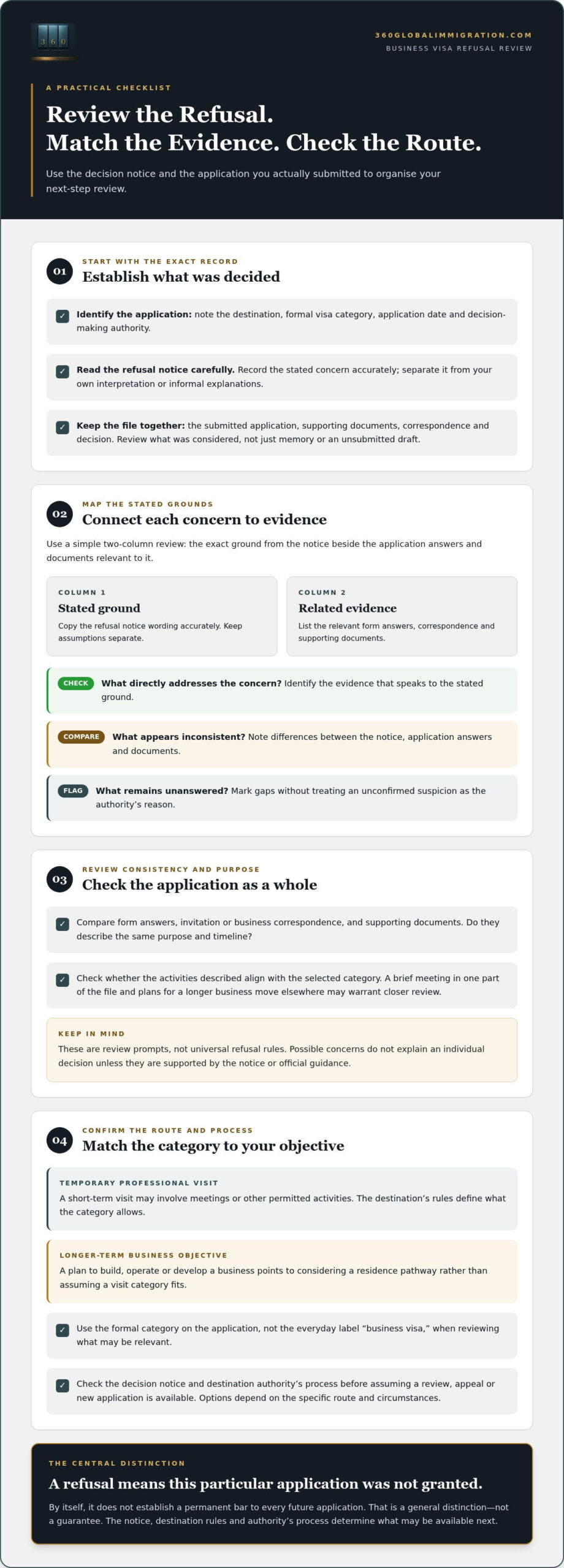
A practical review plan after a business visa refusal
A structured review turns a refusal into a set of questions you can assess, rather than a reason to resubmit documents without a plan. Work through these steps in order, and verify procedural details against the destination authority’s current guidance before choosing how to respond.
- Pause. Avoid rushing into another application or assuming a particular response is available. Keep the notice and complete application record.
- Identify the route. Confirm the destination, exact visa category, application date and decision-making authority. A visit application and a business residence application require different assessments.
- Read the notice. Record each stated ground as written. Keep your interpretation separate from the authority’s wording.
- Map the evidence. Connect each ground to the answers and documents already submitted. Note any genuine gap, inconsistency or factual error.
- Assess options. Check whether the destination permits a review, reapplication or another route for this decision. Compare the relevant requirements using current official information.
Build a refusal-to-evidence map
Use a simple table to organise the review. Copy the decision’s wording accurately, then identify the materials that relate to each concern. The examples below are prompts only. They are not universal refusal grounds or a substitute for the wording in your notice.
| Stated concern | Evidence already submitted | Review or update to consider |
|---|---|---|
| Purpose of the proposed visit is unclear | Application answers, invitation or business correspondence | Check that the stated activity and supporting explanation are consistent |
| Information appears inconsistent | Relevant form fields and supporting documents | Identify the exact discrepancy; verify whether it is a factual error or requires clarification |
| Evidence does not address a stated point | Documents submitted in connection with that point | Confirm from official guidance what evidence is relevant, if any update is appropriate |
Don’t broaden a specific concern into an allegation the authority did not make. Mark uncertain facts for verification against official destination guidance. Also distinguish a correction from a change in circumstances: correcting a wrongly entered date is not the same as providing new evidence, and neither automatically changes the objective from a temporary visit to a longer-term business move.
Compare the possible next steps carefully
Assess reapplication, review or a different immigration route only if the destination’s rules make that option available for your circumstances. Compare the route’s fit with your objective, the evidence it calls for, the applicable process and any timing stated in official instructions. Don’t assume a new country or category offers a workaround, or that requirements are interchangeable across routes.
Business visa rejection help Dubai is most useful when it leads to a documented, case-specific plan. If you’re assessing professional support, the business immigration expert selection guide can help you consider what a structured review should cover. For guidance on relevant visit or business residence pathways, discuss your application circumstances with 360 Global Immigration.
How 360 Global Immigration can support a considered next step
A refusal leaves two practical questions: what did the authority decide, and does your original immigration objective still fit the route you chose? 360 Global Immigration helps clarify the application objective and identify which business, talent-based or visit visa guidance may be relevant. The aim is to help you choose a considered next step, not to presume the answer.
A temporary professional visit and a longer-term move to build or develop a business are different objectives. Considering them in the same way can obscure what you are seeking and which pathway deserves attention. Business visa rejection help Dubai can begin with the refusal context, then connect your plans to the relevant type of application guidance.
Match the advice to the real business objective
For a temporary professional visit, focus on the purpose of travel, the category applied for and the decision notice. Visit visa support addresses the visit application context. It does not turn a short-term travel purpose into a residence plan, and any response to a refusal must follow the applicable destination process.
If your objective is relocation, the assessment shifts to business or talent-based residence pathways and the destination’s current rules. Depending on your circumstances and plans, relevant options may include France Passeport Talent or the UK Innovator Founder Visa. These are distinct pathways, not interchangeable alternatives or automatic solutions to a refused visit application. Consider their current criteria and terminology in light of your actual objective. The talent-based immigration guide provides broader context for considering a talent-focused plan in Europe.
A focused discussion can organise your case around practical questions:
- What did the refusal notice state, and what remains an assumption?
- Was the application for a temporary visit or a longer-term business move?
- Which documents and facts relate to the stated concern?
- Which pathway, if any, aligns with your objective and the destination’s current process?
These questions keep the review grounded in the application record and your plans. They also help distinguish a correction to an application from a decision to pursue a different immigration objective.
Move forward with clarity, not guarantees
Tailored immigration guidance can help organise your documents, clarify your application context and consider relevant pathways. It can help identify which points need further examination and which official information should guide a possible next step. It cannot control an immigration decision or replace the destination authority’s process. The authority remains responsible for deciding the application.
You don’t need to settle every question before seeking guidance. Bring the refusal notice, the application record and a clear description of your business objective to a discussion. Discuss your business visa circumstances with 360 Global Immigration for a considered conversation about relevant guidance.
Turn the decision into a clear next step
A refusal doesn’t have to determine the direction of your plans. Use it as a prompt to make your next decision deliberately: clarify what you want to achieve, keep the authority’s decision in view, and choose a way forward that fits your objective and the applicable process. That is the starting point for useful Business visa rejection help Dubai.
Your next step may be to verify a detail, refine your application strategy or explore whether a different pathway better reflects your plans. Professional guidance can help you consider the relevant process and application context without promising a particular decision. The authority remains responsible for the outcome.
If you’re ready to move from uncertainty to a considered plan, start a conversation about your next immigration step. Share your circumstances and business objective with 360 Global Immigration to discuss relevant visit visa or business residence guidance.
Frequently Asked Questions
Does a business visa refusal mean I can never apply again?
No. A refusal does not automatically prevent every later application. Its effect depends on the destination’s rules and whether the notice identifies a separate restriction or condition. Keep the decision with your submitted application file, then verify current official guidance for the exact category before making plans. Business visa rejection help Dubai should begin with the actual decision, not broad online claims, so you can separate what’s known from what needs checking.
Can I apply again immediately after a business visa refusal?
There’s no universal answer about when another application can be submitted. Don’t assume you can apply immediately or that every destination requires a fixed waiting period. Check the authority’s current instructions for the specific category and decision. Then consider whether a new application would address the stated concern or simply repeat the same information. Being able to submit an application and being ready to submit one are different questions.
What documents should I review after a business visa refusal?
Start with the notice and the exact version of your application, including submitted forms and supporting evidence. Add relevant correspondence with the authority so the record reflects what was filed and when. If you have multiple drafts, label the submitted version clearly to avoid reviewing the wrong one. Then compare the documents with the decision’s wording. Any additional evidence should relate to the specific concern and be appropriate under the destination’s guidance.
Should I appeal a business visa refusal or submit a new application?
Neither option is universally right or available. First establish whether the decision notice and current official instructions provide a review procedure, permit a new application or describe another response. Then consider what each route requires and whether it fits your objective. Record any stated deadline or procedural instruction exactly as written, and verify it with the authority. Don’t rely on a process or timeline described for a different visa category.
Can an immigration consultant guarantee approval after a refusal?
No. An immigration consultant cannot guarantee an authority’s decision or bypass its process. Professional support may help organise your application history, clarify your objective and consider relevant pathways. Be cautious of anyone promising a guaranteed visa or claiming special influence over a decision. A sound discussion focuses on the work involved, the applicable process and what remains uncertain, not a promised outcome.
Is a business visit visa the same as a business residence visa?
No. A business visit generally relates to a temporary trip, while business residence concerns living in another country under a relevant immigration pathway. Attending meetings and relocating to establish or develop a business are different objectives to assess. The destination determines permitted activities and requirements. Before choosing a category, write down what you plan to do and for how long, then compare that purpose with the destination’s official guidance.