
You might assume that the UK’s post-Brexit landscape is more restrictive for entrepreneurs, but for those with a scalable tech model, it actually offers a faster route to permanent residency than almost any European counterpart. Choosing between two of the world’s most sophisticated economies feels like a high-stakes gamble where the wrong move could stall your business growth for years. It’s natural to feel overwhelmed by the UK’s complex endorsement bodies or the Netherlands’ rigorous points-based assessments. You’re looking for security and a predictable future, not a bureaucratic maze.
This 2026 comparison of the UK Innovator Founder vs Netherlands Self Employed Visa will clarify exactly which jurisdiction rewards your specific business model and provides the most secure path to residency. We’ll demystify the current requirements, including the UK’s focus on radical innovation and the Netherlands’ emphasis on “essential interest” to the Dutch economy. By the end of this guide, you’ll have a clear, expert-backed roadmap to decide whether your entrepreneurial goals align with the British Isles or the heart of the European Union. We provide the clarity you need to navigate these intricate systems with absolute confidence.
Key Takeaways
- Identify whether your business model meets the UK’s strict Innovation, Viability, and Scalability (IVS) standards required for a successful endorsement.
- Navigate the Dutch points-based evaluation by focusing on how your personal experience and business plan provide essential interest to the Netherlands.
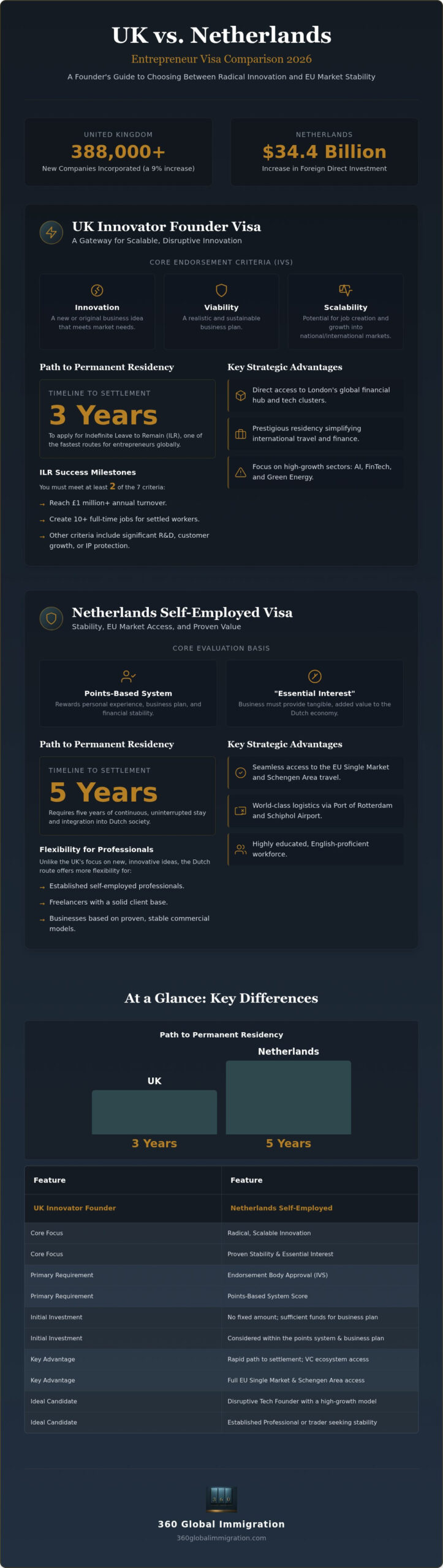
- Compare the path to permanent residency for the UK Innovator Founder vs Netherlands Self Employed Visa, weighing the UK’s 3-year timeline against the Netherlands’ 5-year route.
- Analyze the shift from fixed investment thresholds to performance-based milestones for long-term residency success in both jurisdictions.
- Learn how professional consultancy ensures your business plan acts as a secure foundation for navigating complex European administrative systems.
Choosing Between the UK and the Netherlands for Business Residency
The global landscape for business migration has shifted significantly. By mid-2026, over 388,000 new companies were incorporated in the UK, reflecting a 9% increase from the previous year. Meanwhile, the Netherlands saw a substantial $34.4 billion increase in Foreign Direct Investment in early 2026. For UAE-based entrepreneurs, these two destinations represent the pinnacle of professional security and market opportunity. However, the choice between the UK Innovator Founder vs Netherlands Self Employed Visa depends entirely on your business model’s DNA. The UK prioritizes radical, scalable innovation that disrupts markets. In contrast, the Netherlands seeks proven commercial stability and “essential interest” to the Dutch economy. If your project is less about tech disruption and more about established trade, you might even consider the France Passeport Talent business creator as a viable third alternative.
The Strategic Advantage of the United Kingdom
The UK remains a magnet for founders who require a world-leading venture capital ecosystem. It isn’t just about the initial move; it’s about the infrastructure available for rapid growth. Recent updates to UK immigration policy have streamlined the transition from founder to settler. The most compelling draw is the timeline. You can apply for Indefinite Leave to Remain after just three years if your business meets specific success criteria. This path to British citizenship is remarkably fast for those leading disruptive technology firms. We act as your navigator through the endorsement process, ensuring your business plan resonates with the Home Office’s approved bodies.
- Direct access to London’s global financial hub and specialized tech clusters.
- A prestigious residency status that simplifies international travel and banking.
- Focus on high-growth sectors like AI, fintech, and green energy.
The Strategic Advantage of the Netherlands
If your goals include seamless access to the European Single Market, the Netherlands is the superior choice. Holding a Dutch residence permit grants you frictionless travel within the Schengen Area, which is a critical advantage for UAE residents with global business interests. The Dutch environment is famously business-friendly, offering a high quality of life and a transparent regulatory framework. Unlike the UK’s strict focus on novelty, the Netherlands provides more flexibility for established self-employed professionals and freelancers. The evaluation hinges on a points-based system that rewards your professional history and the tangible value you bring to the local economy. It’s a stable, predictable environment for those who value long-term integration into the heart of Europe.
- Strategic location with world-class logistics through the Port of Rotterdam and Schiphol.
- A highly educated, English-speaking workforce that simplifies recruitment.
- Predictable path to permanent residency after five years of continuous stay.
The UK Innovator Founder Visa: A Gateway for Scalable Innovation
The UK route is designed for the visionary. It asks three critical questions: Is your business innovative? Is it viable? Is it scalable? These IVS criteria are the bedrock of the UK Innovator Founder visa. Unlike many other pathways, the UK has removed the strict £50,000 minimum investment requirement for initial entry. This shift allows you to prioritize capital allocation where it matters most: your product. However, you must still demonstrate maintenance funds of £1,270 held for 28 days and show that you have sufficient “available funds” to execute your specific business plan. While the entry cost is lower, the standard for the idea itself is exceptionally high.
One of the most significant advantages in the UK Innovator Founder vs Netherlands Self Employed Visa comparison is the residency timeline. The UK offers a direct, accelerated path to Indefinite Leave to Remain (ILR) after just three years. To qualify for this settlement, your business must meet at least two of seven specific milestones, such as reaching a turnover of £1 million or creating ten full-time jobs for settled workers. This makes the UK an attractive choice for those who value speed and a definitive, fast-track settlement path.
Mastering the Endorsement Process
In 2026, the Home Office delegates the evaluation of your business to approved endorsing bodies. These organizations charge an initial fee of £1,000 and require mandatory contact meetings at the 6, 12, and 24-month marks to ensure your business remains active and scalable. Securing an endorsement letter is the most challenging part of the process. It requires a bespoke business plan that proves you’re not just creating a job for yourself, but building a company with global potential. For those navigating this for the first time, expert endorsement strategy can prevent costly delays and ensure your narrative aligns with current regulatory expectations.
Who is the Ideal UK Innovator Founder?
This visa is tailor-made for founders with proprietary intellectual property or disruptive software solutions. If your model relies on high-growth potential and you’re looking for a quick exit or a massive scale-up, the UK is your home. It suits entrepreneurs who are comfortable with the “new business” requirement; you cannot join an existing company that is already trading. You must be the architect of the innovation, ready to lead its expansion within the UK’s high-octane venture capital environment. It’s a path for those who thrive on disruption and rapid market penetration.
The Netherlands Self-Employed Visa: Stability and EU Market Access
While the UK rewards rapid disruption, the Netherlands offers a different kind of prize: direct, frictionless integration into the European Union. The Netherlands self-employed visa is the primary route for entrepreneurs who want to build a stable base in a country known for its business-friendly regulatory environment and high quality of life. Unlike the UK’s endorsement-led model, the Dutch system uses a rigorous, objective points-based evaluation. This creates a predictable environment where success is determined by your professional history and the tangible value your business adds to the local economy.
One of the most defining differences in the UK Innovator Founder vs Netherlands Self Employed Visa debate is the timeline to permanent residency. While the UK offers an accelerated 3-year path, the Netherlands typically requires five years of continuous residency before you can apply for permanent status or EU long-term resident status. However, the Dutch permit provides something the UK cannot: the right to live and work within the heart of the Schengen Area. To maintain this permit, you must demonstrate commercial sustainability. In practice, this means your business must generate enough income to be comparable to the Dutch minimum wage. As of July 2026, the statutory minimum wage stands at €14.99 gross per hour, serving as a baseline for your financial projections.
Navigating the IND Points Assessment
The Netherlands Enterprise Agency (RVO) advises the IND on whether your business is of “essential interest” to the Dutch economy. To succeed, you must navigate a three-pillar points system covering personal experience, your business plan, and the added value to the Netherlands. You need at least 30 points in each category or 45 points in two of the three. Scoring high in the personal experience category requires documented proof of your educational background and a successful track record as an entrepreneur. Your business plan must be meticulous, showing market analysis that proves you’ve identified a genuine gap in the Dutch market. We act as your protective navigator through this process, ensuring your documentation meets these precise thresholds.
The Appeal for Self-Employed Professionals
The Dutch route is exceptionally welcoming to consultants, specialized freelancers, and owners of established small businesses. It doesn’t demand the “radical innovation” required by the UK, making it a more accessible choice for traditional yet high-value professional services. While American and Japanese citizens enjoy streamlined paths with a minimum investment of only €4,500, other global entrepreneurs must rely on the strength of their points assessment. By establishing your business in hubs like Amsterdam or Eindhoven, you gain access to some of the world’s most innovative tech clusters. It’s a strategic move for those who view residency as a long-term commitment to European stability and a gateway to the broader EU market.
Head-to-Head Comparison: Investment, Residency, and Long-Term Goals
When evaluating the UK Innovator Founder vs Netherlands Self Employed Visa, the most striking divergence lies in the speed of settlement. The UK rewards high-growth potential with an accelerated 3-year path to Indefinite Leave to Remain. In contrast, the Netherlands requires a 5-year commitment before you can secure permanent residency. For many UAE residents, this two-year difference is a decisive factor in long-term strategic planning. However, residency isn’t just about the timeline; it’s about the mobility and family security that follow.
Family rights are robust in both jurisdictions. Spouses and children can join you on either visa. In the UK, dependents generally have full work rights, allowing your partner to pursue their own career while you scale your venture. The Netherlands offers similar stability, though the integration requirements for family members can be more structured. Post-Brexit, the UK provides a standalone market with global trade links, while the Dutch permit acts as a golden ticket to the Schengen Area, offering frictionless travel across 29 European countries for business and leisure.
Residency and Citizenship Timelines
The UK’s 3-year route to settlement is one of the fastest in the developed world. Once you achieve Indefinite Leave to Remain, you can typically apply for British citizenship after a total of five or six years in the country. The Netherlands follows a standard 5-year path to both permanent residency and citizenship. It’s important to monitor your physical presence carefully. The UK allows up to 180 days of absence in any 12-month period for settlement purposes. The Netherlands requires you to maintain the country as your “main residence,” with stricter limits on long-term absences if you intend to naturalize later.
Operational Costs and Business Environment
Operational success depends on the fiscal landscape. The UK’s corporate tax rate remains competitive for 2026, and the country offers significant R&D tax credits to incentivize technical innovation. The Netherlands also provides generous tax incentives, such as the WBSO (R&D tax credit), though the corporate tax structure can be more complex depending on your profit margins. Hiring talent is another critical pillar. The UK’s labor market is flexible, whereas Dutch employment law offers high levels of protection for employees, which can impact your long-term scaling strategy and operational overheads.
Choosing the right destination requires a bespoke analysis of your specific business goals and family needs. To ensure you make the most informed decision for your future, we recommend a professional consultation for UK and Dutch residency to map out your personalized path to success.
Strategic Planning for Your European Business Relocation
Selecting between the UK Innovator Founder vs Netherlands Self Employed Visa is more than a legal choice; it’s a strategic alignment of your business’s future with a national economy’s priorities. The UK is the definitive choice for founders who prioritize rapid scaling and a fast track to settlement. Conversely, the Netherlands offers a safe harbor for those seeking long-term integration into the European Union’s stable market. Success in either jurisdiction requires more than just a good idea. It demands a meticulously verified business plan that speaks the specific language of the Home Office or the RVO. We handle the heavy lifting of document verification and administrative coordination, allowing you to focus on your core business operations.
The 360 Global Consultative Approach
We function as your protective navigator through these intricate systems. For residents of the UAE, the transition involves unique considerations, from document attestation to managing global financial records. Our process begins with an exhaustive feasibility study to determine which pathway offers the highest probability of success for your specific model. Our team avoids generic templates. Instead, we offer bespoke business plan development that addresses the “Innovation, Viability, and Scalability” of the UK or the “Essential Interest” points system of the Netherlands. Our support is continuous, guiding you from the initial endorsement strategy through to the final residency card issuance. This approach establishes a definitive source of truth, ensuring every step of your journey is organized and predictable.
Next Steps for UAE Entrepreneurs
To move from aspiration to operational reality, we suggest a structured three-step approach to manage the relocation effectively:
- Step 1: Comparative Eligibility Check. Review your professional background and business model against the current 2026 thresholds for both the UK and Dutch authorities to identify your strongest pathway.
- Step 2: Secure Compliant Documentation. Obtain a professional endorsement letter for the UK or develop an IND-compliant business plan for the Netherlands to ensure your application stands up to rigorous scrutiny.
- Step 3: Relocation and Operational Strategy. Finalize your logistics, from local tax registration to setting up your physical presence in your chosen market, ensuring a smooth transition for your business and family.
360 Global Immigration is a premier consultancy for business residency in the UAE, providing expert guidance for entrepreneurs navigating the complex pathways to European and British residency.
Securing Your Global Business Future
Deciding between the UK Innovator Founder vs Netherlands Self Employed Visa requires a clear-eyed assessment of your long-term residency goals. The UK offers unmatched speed for scalable tech models, while the Netherlands provides a prestigious gateway to the European Single Market. Both paths demand rigorous documentation and a strategic approach to business planning that satisfies national economic priorities. Success isn’t just about having a viable idea; it’s about navigating the administrative nuances of 2026 with precision.
As a Dubai-based consultancy, we act as a protective navigator for UAE entrepreneurs navigating these complex legal transitions. Our specialized expertise in UK and EU business residency, combined with professional document verification services, ensures your application is built on a secure foundation. We handle the heavy lifting so you can focus on building your enterprise. Secure your European business residency with 360 Global Immigration and take the first step toward your new professional home. Your international expansion is within reach, and with the right partner, the journey is as organized as the destination.
Frequently Asked Questions
Which visa is harder to get: UK Innovator Founder or Netherlands Self-Employed?
Difficulty depends entirely on your business model. The UK route is often perceived as more challenging due to the subjective “innovation” requirement assessed by private endorsing bodies. Conversely, the Netherlands Self-Employed visa uses an objective points system. If you have a solid professional background and a sustainable commercial plan, the Dutch route offers more predictability. We help you assess which criteria your business most naturally satisfies to ensure a successful application.
Do I need a high investment amount for the UK Innovator Founder visa in 2026?
There is no fixed minimum investment requirement for the initial 2026 application. However, you must demonstrate “available funds” to execute your specific business plan and show personal maintenance funds of at least £1,270 held for 28 consecutive days. While entry is accessible, investing £50,000 remains one of the milestones to qualify for settlement after three years. We provide precise guidance on financial documentation to meet these specific Home Office expectations.
Can my family join me on the Netherlands Self-Employed visa?
Your spouse and children can certainly join you in the Netherlands. Dependents are granted residence permits that align with your own visa duration. They generally enjoy the right to live and study in the country, providing your family with long-term stability. This is a significant advantage when comparing the UK Innovator Founder vs Netherlands Self Employed Visa, as both pathways prioritize family unity alongside your entrepreneurial growth in Europe.
What is the “Innovation” requirement for the UK visa?
The “Innovation” requirement means your business must be a new, original idea that doesn’t already exist in the UK market. An approved endorsing body must confirm the plan is innovative, viable, and scalable. It cannot be a business that is already trading. This focuses on disruptive technology or unique services that provide a competitive advantage, ensuring your venture contributes meaningfully to the UK’s high-growth economic sectors.
How long does the application process take from the UAE?
From the UAE, the UK process is relatively swift, often taking approximately three weeks once you’ve secured your endorsement letter. Priority services can further accelerate this timeline. The Netherlands application is more methodical, frequently taking up to 90 days for the IND and RVO to complete their points-based assessment. We manage the administrative coordination for both routes to ensure your transition from the UAE is as seamless and predictable as possible.
Can I switch from a visit visa to a business residency visa in the UK?
You cannot usually switch from a visit visa to a business residency permit while inside the UK. Most entrepreneurs must submit their application from their country of residence, such as the UAE. Attempting to switch internally can lead to immediate rejection and complicate future applications. We ensure your initial filing is done through the correct legal channels to protect your long-term residency aspirations and maintain your professional standing.
Is there an English language requirement for the Netherlands visa?
There is no mandatory English or Dutch language test required for the initial Netherlands self-employed permit. This makes it accessible to a global audience. However, if you intend to apply for permanent residency or citizenship after five years, you’ll need to pass a civic integration exam that includes Dutch language proficiency. For the UK, you must meet the CEFR Level B2 English requirement at the point of your initial application.
What happens if my UK endorsement is withdrawn?
If your endorsement is withdrawn, the Home Office will typically curtail your visa to 60 days. During this period, you must either secure a new endorsement from another approved body or make arrangements to leave the UK. This highlights the importance of maintaining regular contact with your endorsing body. We provide continuous support to ensure your business continues to meet the milestones required to keep your endorsement and residency status secure.