
Scalability must be evidenced, not simply promised. A persuasive case should explain how the venture can grow beyond its initial market and sustain that growth.
It’s understandable to focus on whether an idea is innovative. The challenge is also proving that it can become a viable business with room to grow. A persuasive case connects market opportunity to practical evidence, such as customer demand, a credible growth model, plans for job creation and the resources to deliver them.
This article explains what the visa assesses and how scalability fits into the application. You’ll learn what evidence can support a growth case, how to describe expansion into UK and international markets, and why projections are stronger when their reasoning is clear. The aim is to show what your business can realistically grow into, not just what it hopes to become.
Key Takeaways
- Build a growth case that links customer demand, operating capacity and financial projections rather than relying on ambition alone.
- Show how the venture’s hiring plans can develop into sustained, skilled employment in the UK.
- Use clear progress measures to demonstrate how the business is advancing against its growth plan over time.
- Explain how the business can reach customers beyond its initial market, with a credible approach to expansion and compliance.
Section A: What is the Innovator Founder Visa?
The UK Innovator Founder Visa is for founders developing an innovative UK business with credible growth prospects. To gain endorsement, show that the business is innovative, viable and scalable. Having funding alone is not enough.
Innovation, Viability and Scalability Criteria
Innovation, viability and scalability are the three core criteria assessed for a new business. Your evidence should connect the idea to a workable business and a credible route to expansion.
Innovation means explaining what is distinctive about your offer and how it addresses a market need. Viability concerns whether your skills, resources and financial model support delivery. Scalability means showing how the business can grow, create skilled jobs and reach national or international markets. There is no minimum investment requirement, though access to £50,000 can strengthen an application.
Founder Application and Business Plan
The process starts with an endorsement application to an endorsing body, followed by the visa application. Your business plan should set out the product, target customers, market opportunity and operating model, alongside three-year financial projections that explain how the UK business can become profitable.
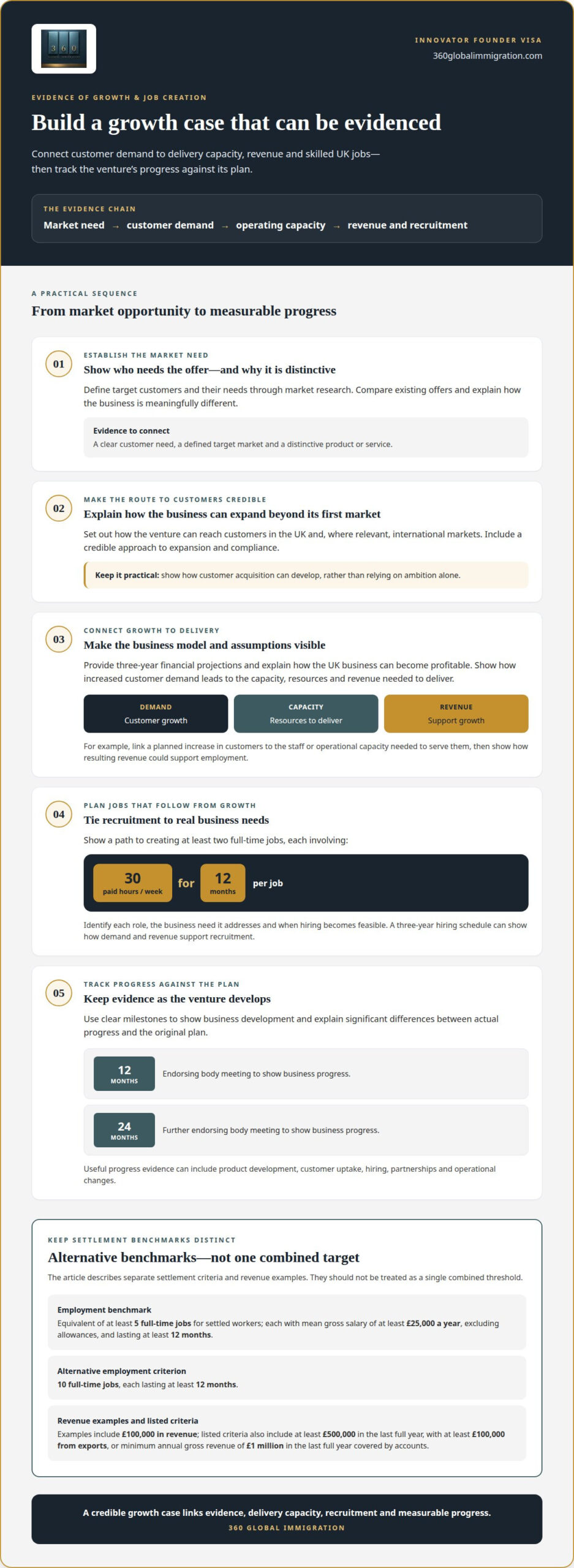
To demonstrate scalability, explain how customer demand can lead to increased capacity, revenue and recruitment. Define the target market and customer need through market research. Compare existing offers and show how yours is meaningfully different. Weak evidence, unclear financial assumptions or an idea that does not meet the criteria can lead to endorsement refusal. Incomplete or ineligible visa applications can also be refused.
Compared with the former Start-up route, the Innovator Founder route requires endorsement and is designed around an innovative business with growth potential; the Start-up Visa has been closed to new applicants since July 2023. Applying from outside the UK costs £1,357 per person, according to the UK Home Office.
After approval, endorsing body reviews provide structured opportunities to show progress. According to the UK Home Office, Innovator Founder visa holders in the UK must meet with their endorsing body after 12 months and 24 months to show business progress. Prepare evidence that connects milestones to the original plan, such as product development, customer uptake or hiring.
Evidence of potential for growth and job creation
A credible growth case shows how business activity can generate UK jobs and revenue. Connect hiring milestones to the venture’s development across the three-year planning horizon.
Full-Time Employment and Job Creation
Job creation evidence explains how the business can develop sustained, full-time roles as it grows. Applicants should demonstrate a path to creating at least two full-time jobs, each involving 30 paid hours per week for 12 months.
Make the plan practical: identify the roles, the business need each role addresses and when recruitment becomes feasible. A three-year hiring schedule can show how customer demand and revenue would support each position. Demonstrate a realistic ability to create skilled UK employment, rather than listing job titles without a delivery plan.
Job Creation and Revenue Thresholds
Revenue and employment are separate ways to demonstrate business progress, and settlement benchmarks include alternative criteria. One benchmark is creating the equivalent of at least five full-time jobs for settled workers, each with a mean gross salary of at least £25,000 a year, excluding allowances, lasting at least 12 months.
Another listed criterion is creating 10 full-time jobs, each lasting at least 12 months. Revenue benchmarks also vary: examples include £100,000 in revenue, while listed criteria include at least £500,000 in the last full year, with at least £100,000 from exports, or minimum annual gross revenue of £1 million in the last full year covered by accounts. These are distinct benchmarks, not one combined threshold.
For endorsement, explain the commercial link between growth and hiring. Show how customer acquisition, delivery capacity and revenue assumptions support planned recruitment. Set out the roles and timing, then explain how the venture can remain financially viable as its team expands.
Make the assumptions behind your projections visible. For example, link a planned increase in customers to the staff or operational capacity required to serve them, then show how the resulting revenue could support employment. This helps the reader assess whether job creation follows from the business model or is simply an unsupported promise. For founders seeking guidance on commercial planning and operational execution, business growth advisory services like growingorganisations.co.nz can help translate high-level expansion targets into structured, actionable delivery plans.
UK Innovator Founder Visa scalability requirements
Scalability remains relevant after approval, as endorsing bodies review progress against the venture’s plans. Set realistic milestones, connect them to the resources available and show how they support business development, while meeting the visa’s separate immigration requirements.
According to the UK Home Office, Innovator Founder visa holders in the UK must meet with their endorsing body after 12 months and 24 months to show business progress. These meetings make it important to track evidence as the venture develops, such as product milestones, customer activity, partnerships and operational changes. Explain significant differences between actual progress and the original plan.
Investment rules distinguish the visa application from later settlement criteria. The route has no minimum investment requirement for the initial application; the former £50,000 minimum was removed on 13 April 2023. However, settlement includes a separate criterion based on investment that has been actively spent furthering the business. A funding plan should therefore explain how available capital supports delivery and growth, rather than treating investment alone as proof of scalability.
Settlement may be available after 3 years, according to the UK Home Office, subject to meeting the relevant criteria. One settlement criterion assesses whether the business appears sustainable for the following 12 months, considering its assets and expected income against current and planned expenses. A fresh endorsement must be issued within three months of the ILR application.
Continuous residence also matters when applying for settlement. Applicants must have spent no more than 180 days outside the UK in any 12-month period during the qualifying period. Plan travel records alongside business evidence, since each addresses a different part of the settlement assessment.
English and maintenance requirements apply separately from business growth. Applicants must demonstrate English ability at B2 across reading, writing, speaking and listening. Where maintenance funds are required, they must be held for 28 consecutive days, and supporting evidence must be dated within the 31 days before the visa application. Meeting these criteria helps keep the immigration case aligned with the venture’s commercial plan.
Expansion into national and international markets
UK-specific evidence can include customer validation, a regional rollout plan and a clear route into national or international markets. Link these opportunities to operational capacity, revenue and job creation instead of presenting expansion as an unsupported ambition.
For a UK regional rollout, explain which customer groups the venture will serve and how it will reach them. Evidence might include pilot results, customer enquiries, sales activity or partnerships that support demand. Then show how the business could serve additional locations, including the staffing, distribution or technology needed. Make each stage and its commercial rationale clear.
International growth requires the same disciplined logic. Identify the target market, customer need and route to sales, then explain how the company will adapt its offer and operations. Address legal, tax and compliance considerations in cross-border plans, including GDPR where relevant. If the business depends on core software or technology, explain how its rights and ownership support expansion into those markets.
Export activity can also feature in settlement evidence. One listed benchmark is annual gross revenue of at least £100,000, with at least 10% from exports. A separate settlement benchmark may also take account of revenue generated through exports. Treat these as distinct benchmarks, not targets every applicant must meet for initial endorsement.
For a persuasive case, connect market selection to evidence. Customer feedback can support demand, a defined sales channel can explain how you will reach customers, and delivery plans can show how the venture will serve them in the UK and abroad. Explain assumptions and risks, such as market-entry costs or regulatory differences, and how the business will respond. This makes international growth a reasoned part of the plan, not a promise of success or indefinite leave.
For tailored guidance with your UK Innovator Founder Visa application and growth case, discuss your UK visa plans.
360 Global Immigration: UK Innovator Founder Visa
360 Global Immigration guides founders pursuing the UK Innovator Founder Visa through the application pathway and the preparation of a clear, evidence-led case. This support is relevant when you’re shaping a business plan, organizing endorsement evidence or aligning growth, hiring and market-expansion plans.
A well-structured application connects the business idea to its commercial potential and explains how the venture can develop in the UK. Professional immigration guidance can help you present these elements coherently, using evidence that reflects your business model and plans as a founder.
If you’re considering this route from the UAE, contact 360 Global Immigration to discuss your UK Innovator Founder Visa plans.
Turn your growth case into a clear next step
Your scalability case can support more than an application. Use it as a working framework for decisions: record expectations, track actual progress and explain how new evidence changes the growth plan. This helps keep your commercial direction and immigration evidence aligned as the venture develops.
Before moving forward, check that every claim in your UK innovator founder visa scalability proof is backed by evidence and linked to a realistic business decision. A clear account of market demand, operating capacity and growth assumptions gives your plans structure and makes gaps easier to address.
If you’re preparing an application from the UAE, 360 Global Immigration can help you assess and organize your UK Innovator Founder Visa case. Contact 360 Global Immigration to discuss your next step and move ahead with greater clarity.
Frequently Asked Questions
Does the Innovator Founder route lead to settlement?
Yes, an Innovator Founder visa holder may apply for settlement after 3 years, according to the UK Home Office. Settlement is a separate application, with its own business and residence criteria. A founder preparing to apply should distinguish evidence supporting the original endorsement from evidence showing the business meets a settlement benchmark. A fresh endorsement issued within three months of the ILR application is also required.
What are the eligibility requirements?
Applicants need an endorsement for a qualifying business, must meet the route’s personal requirements and must satisfy the visa application criteria. The business must meet innovation, viability and scalability standards. Prepare evidence for both the proposal and your role in delivering it, such as relevant experience, a clear explanation of the business model and financial assumptions that align with planned activity.
Who are the endorsing bodies?
Four UK-approved endorsing bodies assess applications under the Innovator Founder route. They review business proposals against the route’s criteria and provide the endorsement needed for a visa application. Their assessment is separate from the Home Office’s immigration decision. Present a coherent business case and address the requirements of the endorsing body handling your application.
What are the UK Innovator Founder visa eligibility requirements?
Applicants must be at least 18 and meet the stated total of 70 points. They must demonstrate English ability at B2 across reading, writing, speaking and listening. The points requirement includes 50 points under either the new-business criteria or the same-business criteria; applicants cannot claim points under both. The business must also meet the relevant endorsement criteria before the visa application can proceed.
How does an endorsing body assess whether a business idea is innovative, viable and scalable?
An endorsing body considers whether the idea offers a distinctive proposition, whether the founder can deliver it and whether the business can grow. Present your UK Innovator Founder Visa scalability proof as a connected case: customer need supports the product, your capabilities support delivery, and the operating model supports expansion. Explain the assumptions behind your financial projections and how the venture could develop sustainably.
What evidence proves scalability for a UK Innovator Founder visa endorsement?
Strong UK Innovator Founder Visa scalability proof connects market demand to a credible growth route. Evidence may include customer research, pilot results, early sales, retention data, acquisition-channel assumptions and projections showing how revenue could support delivery capacity. Explain how the business can reach wider markets, and ground hiring or technology plans in the resources and timing needed to deliver them.