A single misstep in your UK business visitor visa requirements documentation isn’t just a travel delay; it’s a potential permanent red flag on your global immigration record. In an era where the Home Office utilizes advanced digital borders and strict civil penalties, the margin for error has vanished. You likely feel the weight of this complexity, worrying that a misunderstood “intent to work” clause or a minor oversight in your 180-day calculation could jeopardize your professional standing.
We’re here to act as your protective navigator through these intricate systems. This guide promises to transform your application process into a seamless, high-end experience by providing total clarity on the latest 2026 standards. You’ll gain a sophisticated understanding of legal boundaries, from the £135 standard fee to the expanded permitted activities taking effect this October. We’ll preview the essential document hierarchy, clarify the nuances of the 180-day rule, and show you how to align this trip with your long-term residency aspirations. By the end of this professional guide, you’ll have the confidence to manage your UK travel with absolute precision and security.
Key Takeaways
- Learn how to correctly classify your professional trip under the Standard Visitor route to avoid the common pitfalls of “intent to work” rejections.
- Define your permitted activities with precision, ensuring your participation in meetings, negotiations, or the new 2026 workshop expansions stays within legal boundaries.
- Master the UK business visitor visa requirements by building a robust evidence portfolio that demonstrates financial self-sufficiency and strong professional ties.
- Navigate the 2026 digital application roadmap with ease, so you’re prepared for biometric enrollment and the latest fee structures.
- Discover how to align your current business travel with long-term residency objectives, creating a bridge toward future talent-based visa pathways.
Understanding the UK Standard Visitor Visa for Business Professionals
The UK Standard Visitor visa serves as the mandatory framework for any professional entering the country for short term commercial purposes. Unlike a standard holiday, business travel carries a higher evidentiary burden. Meeting the UK business visitor visa requirements involves proving that your activities remain within strictly defined “permitted” categories. This distinction is vital; the Home Office looks for specific indicators that you’re a genuine visitor and not an individual attempting to bypass the more rigorous work visa routes. You aren’t just visiting; you’re engaging with a global economy while maintaining your primary professional base abroad.
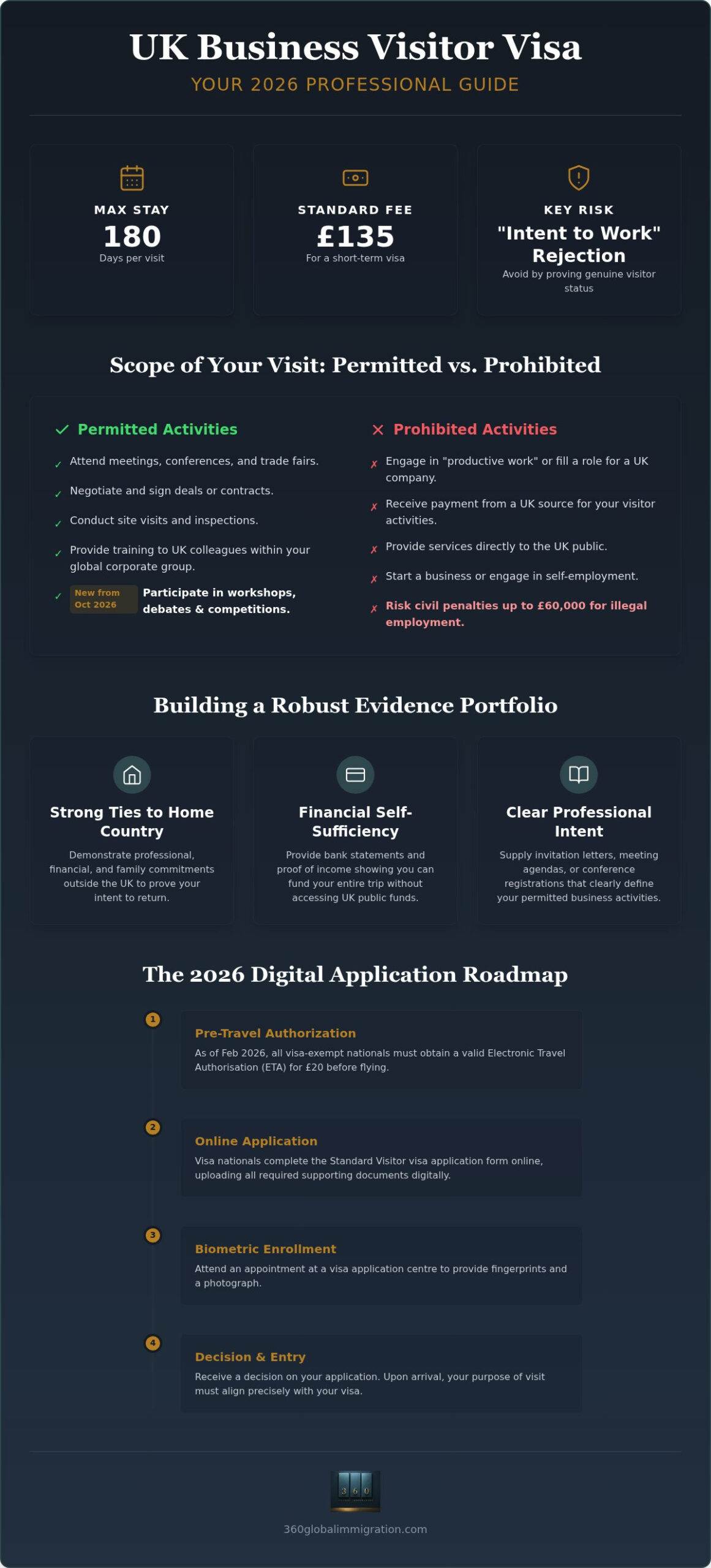
Managing the 180-day rule is a cornerstone of compliant travel. You can typically stay for up to six months, but frequent visits often trigger concerns about de facto residency. If your pattern of travel suggests you’re living in the UK through successive visits, you risk entry refusal at the border. Distinguishing between visitor status and “working” status is equally critical. Prohibited activities include taking a role with a UK firm or providing services directly to the UK public. Crossing this line can lead to severe consequences, including the updated civil penalties that now reach up to £60,000 per worker for illegal employment.
The Legal Framework of Business Visitation
The governing rules for your stay are found in the Immigration Rules Appendix Visitor. This framework has evolved significantly as part of the broader UK immigration policy, which consolidated various visitor categories into a single route. The most scrutinized aspect of any application is your “intent to return.” You must demonstrate strong ties to your home country to alleviate any suspicion of overstaying. 360 Global Immigration acts as your protective navigator here, ensuring your evidence portfolio is unassailable and your professional intent is clearly articulated.
Who Qualifies as a Business Visitor?
Eligibility extends to entrepreneurs, corporate executives, and tech founders. If you’re investigating the UK Innovator Founder Visa, a visitor stay is often the first step to scout locations or meet with endorsing bodies. Clear distinctions exist between visa nationals, who need entry clearance before flying, and non-visa nationals. As of February 2026, all visa-exempt visitors must hold a valid Electronic Travel Authorisation (ETA) before boarding. This £20 digital authorization ensures every professional entry is pre-screened, maintaining the integrity of the border while facilitating legitimate business growth. Mastering these UK business visitor visa requirements ensures your entry is professional, compliant, and successful.
Permitted Business Activities: Defining the Scope of Your Visit
Understanding the precise boundaries of your stay is the most effective way to ensure compliance with UK business visitor visa requirements. While the visa allows for significant professional engagement, it isn’t a substitute for a work permit. You’re permitted to attend meetings, conferences, and trade fairs as part of your standard itinerary. From October 8, 2026, the list of permitted activities expands to include workshops, debates, and skills competitions. This change reflects a more modern approach to professional exchange, allowing you to participate in high-level knowledge sharing without a full work visa. You can also negotiate and sign contracts or perform site inspections to prepare for future business expansion.
For professionals in multinational firms, intra-corporate activities are a key benefit. You can share skills and provide training to UK colleagues, provided it remains within your global corporate group. This allows for seamless integration of international standards and internal protocols. However, you must always maintain your primary place of employment outside the UK, ensuring your visit remains temporary and focused on specific, non-productive tasks.
What You Specifically Cannot Do
The line between visiting and working is sharp. You must not engage in “productive work,” which includes fulfilling a role that a UK worker would typically perform. Self-employment or receiving payment from a UK source for your visitor activities is strictly prohibited. The updated illegal working Code of Practice, effective October 1, 2026, reinforces these boundaries by increasing scrutiny on contractors and online matching services. Work placements, internships, and direct sales to the public are also off-limits. If you’re unsure about a specific activity, consulting with an expert visitor visa advisor can prevent costly entry refusals.
Activities for Prospective Entrepreneurs
Founders and entrepreneurs have a unique set of permissions designed to facilitate investment. You can scout locations, meet potential business partners, and pitch to UK-based investors to secure funding. The official UK government guidelines clarify that these activities must be purely exploratory. In 2026, the “scouting” boundary for founders is strictly defined as the period of market research and relationship building prior to the actual establishment of a UK entity or the commencement of trade. This allows you to lay the groundwork for your venture while remaining fully compliant with your visitor status.
Mandatory Requirements: Financial Standing and Professional Ties
Securing a positive decision hinges on your ability to prove financial independence. The Home Office requires clear evidence that you can support yourself without recourse to UK public funds. When addressing UK business visitor visa requirements, we advocate for a “Safe Harbor” approach to documentation. This strategy involves presenting a meticulously organized portfolio that anticipates and resolves potential concerns before a caseworker can raise them. It’s about creating an unassailable narrative of professional stability. If a third party, such as your employer or a UK host, is funding the trip, they must provide a formal undertaking of support alongside their own financial credentials to ensure the burden of cost is clearly covered.
Financial Evidence for High-Net-Worth Individuals
Standard bank statements often fail to capture the full scope of an entrepreneur’s wealth. For high-net-worth individuals, presenting investment portfolios, dividend vouchers, and corporate liquidity reports adds a layer of sophisticated credibility. You must document income from international sources with absolute precision, using certified translations for any non-English tax certificates. A common pitfall is the presence of large, unexplained deposits. Caseworkers often view these as “funds parking,” a practice that leads to immediate rejection. We ensure every transaction in your history is transparent, justifiable, and aligned with your declared income levels.
Professional and Social Ties
The “Genuine Visitor” test is the most subjective hurdle in the application process. You must prove that your life is firmly rooted outside the UK. An employment letter is your primary tool here. It should detail your specific role, annual compensation, and the exact date you’re expected to resume duties. This proves your absence is temporary and authorized. Business owners should provide evidence of ongoing operations, such as recent tax filings or VAT registrations, to demonstrate that the company requires their return to function. Secondary trust builders, including property titles or family records, further reinforce your intent to leave the UK. This multi-layered evidence creates a safe harbor for your application, protecting your professional reputation and ensuring your UK business visitor visa requirements are met with total clarity.
The Application Roadmap: From Submission to Decision in 2026
The transition to a fully digital immigration system has fundamentally altered how you meet UK business visitor visa requirements. Accuracy is your primary defense. The VAF1A online form requires a meticulous approach to data entry, as even minor discrepancies between your passport and application can trigger a manual review. This digital-first environment demands consistency across every field, from your travel history to your professional declarations. Once submitted, your data becomes part of a permanent record. We ensure this record is flawless, reflecting the high-level professional identity you’ve built.
Navigating the 2026 biometric enrollment process is the next critical milestone. You’ll need to visit a visa application centre to provide digital fingerprints and a facial image. This data is then linked to your digital identity, facilitating a smoother entry at the border. By late 2026, the UK will have largely completed its shift toward eVisas. This means you’ll likely receive a digital status rather than a physical sticker in your passport. This transition enhances security and eliminates the risk of lost travel documents, providing a more reliable experience for frequent business travelers.
Step-by-Step Submission Guide
Completing the digital application with professional precision is the foundation of a successful entry. You must book your appointment at a visa application centre immediately after submission to secure your preferred travel dates. The document upload process is equally vital. You must ensure every scan is clear, legible, and compliant with Home Office specifications. We recommend a structured folder system to manage your “Safe Harbor” evidence, ensuring that financial records and employment letters are correctly categorized. This methodical approach reduces the likelihood of caseworker confusion and accelerates the review process.
Managing Timelines and Urgency
Timing your application is a strategic decision. While the standard processing time for applications made outside the UK remains 3 weeks, high-stakes business often requires a faster resolution. In 2026, the Priority Visa service is available for £500, providing a decision within 5 working days. For the most urgent needs, the Super Priority service offers a decision by the end of the next working day for a fee of £1,000. These services are essential when contract negotiations or site visits are time-sensitive. If you’re facing a complex travel schedule, you can secure expert visit visa support to manage these timelines with absolute confidence. We handle the logistical heavy lifting, allowing you to focus on your professional objectives while we ensure your UK business visitor visa requirements are processed with maximum efficiency.
Securing Your Professional Future with 360 Global Immigration
Professional consultancy transforms a standard application into a strategic business asset. When your commercial objectives depend on a successful entry, meeting the UK business visitor visa requirements is simply the baseline. Our role at 360 Global Immigration is to act as your protective navigator, ensuring that every short-term visit serves your broader professional trajectory. We understand that a successful trip to London often precedes a more permanent move, such as the UK Innovator Founder Visa or even exploring the France Passeport Talent for those with pan-European ambitions. By aligning your current travel with these future goals, we prevent the misconceptions regarding intent that often lead to visa rejections.
Our high-end concierge model is designed for individuals who value efficiency and meticulousness. We handle the heavy lifting of document collection and activity alignment so you can focus on the success of your business meetings. This sophisticated dependability is why global professionals trust us as their safe harbor during complex legal transitions. We don’t just process visas; we manage your professional reputation at the border, providing a steady hand through every stage of the 2026 digital application roadmap.
Bespoke Support for Global Professionals
Corporate structures vary, and a one-size-fits-all checklist is insufficient for high-stakes entry. We provide customized document checklists tailored to your specific role, whether you’re a tech founder or a corporate executive. Our experts conduct a rigorous review of your business plans and professional invitation letters to ensure they meet the highest standards of clarity and legal compliance. This level of comprehensive care alleviates the inherent stress of the application process, providing you with absolute security that your UK business visitor visa requirements are fully satisfied before submission.
Transitioning to Business Residency
A business visit is frequently the tactical first step toward long-term residency. You might use your time in the UK to finalize an Innovator Founder endorsement or scout locations for a new venture. If your professional goals extend beyond the UK, we also offer guidance on the Netherlands Self Employed Visa or Denmark Startup pathways. Each of these routes requires a seasoned guide through intricate immigration systems. To ensure your journey is planned with precision, you should contact our expert consultants for a professional assessment to map out your global mobility strategy and secure your professional future.
Navigating the Future of Your UK Professional Journey
Successfully managing your professional entry requires more than just meeting the basic UK business visitor visa requirements; it demands a strategic alignment of your commercial activities with the Home Office’s evolving digital framework. You’ve learned how to leverage the “Safe Harbor” approach for documentation, navigate the 2026 expansion of permitted activities, and prepare for the transition to a fully digital eVisa system. These steps ensure your trip is not only compliant but also serves as a secure foundation for your future residency goals.
The complexity of these systems shouldn’t be a barrier to your professional progress. 360 Global Immigration offers a high-end concierge model that handles the administrative burden, allowing you to focus on your corporate objectives. As a dedicated navigator for high-stakes legal transitions, we provide comprehensive care and expertise in complex talent-based residency. We’re committed to your success and stand ready to guide you through every intricate requirement with absolute precision.
Secure your UK business entry with expert guidance from 360 Global Immigration. Your professional journey in the UK is a significant opportunity for growth, and we’re here to ensure your path remains clear, professional, and successful.
Frequently Asked Questions
How long can I stay in the UK on a business visitor visa in 2026?
You can typically stay in the UK for up to six months on a Standard Visitor visa. This duration applies whether you’re visiting for meetings, conferences, or scouting business locations. It’s vital to remember that frequent or successive visits shouldn’t result in you effectively living in the UK. We recommend keeping detailed records of your stay to ensure you remain compliant with the 180-day guidelines during your professional travels.
Can I switch from a business visitor visa to a work visa while in the UK?
You generally cannot switch from a visitor status to a work visa while you’re still inside the UK. Most professional routes, including the UK Innovator Founder Visa, require you to depart and submit a fresh application from your home country or a country where you have residency. This rule maintains the integrity of the visitor route. Attempting to bypass this can lead to future entry refusals and immigration complications.
What is the difference between a business visitor and a creative visitor?
Both categories now fall under the unified Standard Visitor route, but their permitted activities differ significantly. A business visitor focuses on meetings, negotiations, and site visits. A creative visitor is an artist, entertainer, or musician coming for specific performances or competitions. While the visa is technically the same, your supporting evidence must explicitly match the specific professional activities you intend to undertake to meet the UK business visitor visa requirements.
Do I need a UK business visitor visa if I am a non-visa national?
Non-visa nationals don’t require a formal visa for stays under six months, but as of 2026, you must hold a valid Electronic Travel Authorisation (ETA). This digital permit costs £20 and must be secured before you board your flight. Even without a physical visa sticker, you’re still subject to the same eligibility rules and must be prepared to demonstrate your professional intent and financial self-sufficiency at the border.
Can I attend a job interview in the UK on a business visitor visa?
Yes, attending a job interview is a permitted activity under the Standard Visitor rules. You can also negotiate contracts and scout for business opportunities. However, you cannot start work or take up a position until you have secured the appropriate work authorization. It’s essential to clearly state your interview schedule if questioned at the border to prove that your visit is temporary and your intent is compliant with visitor regulations.
What happens if my UK business visitor visa application is rejected?
A rejection becomes a permanent part of your UK immigration history and must be declared in all future applications. You usually won’t have a right of appeal or administrative review unless there’s a human rights claim. The best course of action is to submit a new application that directly addresses the reasons for the initial refusal. We provide expert analysis of refusal letters to help you build a stronger, more robust evidence portfolio.
Can I bring my family with me on a business visitor visa?
You cannot include family members as dependents on your own application. Each person, including children, must submit their own individual application and meet the relevant eligibility criteria. While they can travel with you for the duration of your business trip, they’ll be classified as tourists. You must prove you have sufficient funds to cover the costs for everyone without relying on UK public funds or employment income.
How much money do I need to show for a UK business visitor visa?
There is no fixed minimum balance required by the Home Office. Instead, you must demonstrate that you have enough funds to cover your travel, accommodation, and daily expenses for the duration of your stay. This amount should be proportionate to your lifestyle and the length of your visit. Providing six months of bank statements or investment portfolios helps satisfy the UK business visitor visa requirements by proving your financial self-sufficiency.