
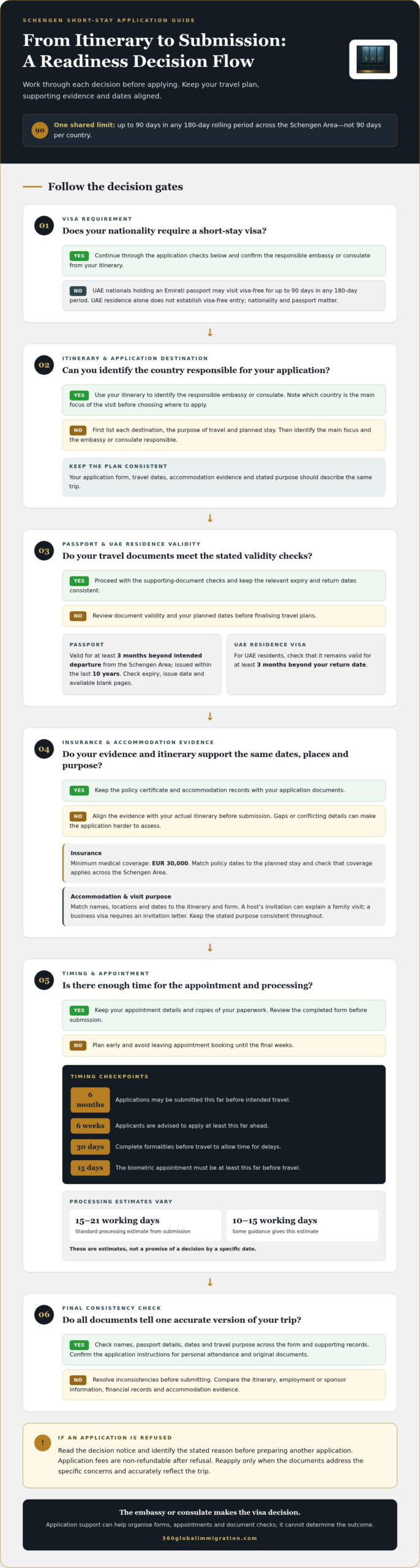
The 90-day limit applies across the Schengen Area, not separately to each country. According to the European Union, a short-stay Schengen visa permits a stay of up to 90 days in any 180-day rolling period. For UAE-based applicants who need a visa, Schengen visa assistance can help make the application process clearer and more organised.
It’s understandable to focus first on whether you need a visa and which documents to prepare. The application also involves practical decisions about travel insurance, accommodation evidence, timing and possible refusal. If you use schengen visa assistance, remember that the assistance charge is separate from visa-related fees.
This guide explains the main application terms, the evidence commonly required and how to distinguish the charges involved. It also clarifies what application support can help with and what remains the decision of the relevant embassy or consulate.
Key Takeaways
- Understand how the short-stay limit applies across the Schengen Area before planning time in multiple countries.
- Prepare insurance and accommodation evidence that supports your itinerary and the purpose of your visit.
- Organise your documents and appointment early, and know which parts of the application require your personal attendance.
- Compare the role of application support with visa fees, and understand what a service charge covers before you proceed.
Application terms, conditions and refusal guidance
Start with your itinerary: list each destination, the purpose of travel and your planned stay. Use it to identify the embassy or consulate responsible for your application. For example, note which country is the main focus of the visit before choosing where to apply. Keep the itinerary consistent with your application form and supporting documents. Differences between travel dates, accommodation evidence and your stated purpose can make the application harder to assess.
No. The relevant embassy or consulate alone decides whether to approve a visa. An agent can help prepare an application, but cannot determine its outcome.
Plan early. Applications may be submitted up to 6 months before intended travel, and applicants are advised to apply at least 6 weeks ahead. Complete formalities up to 30 days before travel to allow time for delays. Processing estimates vary: standard processing takes 15 to 21 working days from submission, while some guidance gives 10 to 15 working days. These periods are not a promise of a decision by a specific date. A biometric appointment must be at least 15 days before travel, so avoid leaving appointment booking until the final weeks.
Prepare the form and appointment in a clear order. First, check that names, passport details, dates and travel purpose match across all documents. Then arrange the appointment and review the completed form before submission. Appointment assistance, form-filling support and document verification can help identify omissions; for applicants managing complex personal records, document management consultants such as Dokumen24 provide structured support with official civil registration and immigration paperwork. Check the application instructions to confirm whether you need to attend in person or submit original documents. Keep copies of your paperwork and note the appointment details.
Before submitting, check that each document supports the same travel plan. Compare the itinerary, employment or sponsor information, financial records and accommodation evidence for consistent dates and details. If your application is refused, read the decision notice carefully and identify the stated reason before preparing another application. Application fees are non-refundable after refusal. Reapply only when the documents address the specific concerns and accurately reflect your trip. Changing details without supporting evidence can create further inconsistencies.
What is a Schengen Visa?
A Schengen short-stay visa permits a stay of up to 90 days within any 180-day rolling period across the Schengen Area combined, according to the European Union. It covers short visits, such as tourism or family trips, across the area under one stay limit. Time spent in different Schengen countries counts toward the same allowance.
Passport checks are essential before you plan travel. According to the European Union, your passport must remain valid for at least 3 months beyond your intended departure date from the Schengen Area. It must also have been issued within the last 10 years. Check the issue date, expiry date and available blank pages before preparing your application.
For UAE residents, check the validity of your UAE residence visa alongside your passport. The residence visa should remain valid for at least 3 months beyond your return date. UAE nationals holding an Emirati passport may enter the Schengen Area without a visa for up to 90 days within any 180-day period, according to the European Union. Residence in the UAE alone does not establish visa-free entry; nationality and passport determine that requirement.
If you are a UAE resident who needs a visa, follow these steps: identify the country responsible for your application based on your itinerary, complete its application form, prepare supporting documents and insurance, then book an appointment. Attend in person for biometrics and submit the required original documents. Keep your dates and travel purpose consistent across the form and supporting evidence.
Insurance is another key document. Schengen travel insurance must provide minimum medical coverage of EUR 30,000, according to the European Union. Match the policy dates to the planned stay and check that its coverage applies across the Schengen Area. A policy that leaves gaps in the travel period may not support the itinerary you present.
Before booking, compare your passport expiry date, UAE residence validity and planned return date. Even a small date mismatch can affect whether the documents support the same trip. For example, if your return date is close to your residence visa expiry, review both dates before finalising your travel plans.
Travel insurance and accommodation evidence
Build your insurance and accommodation documents around the same itinerary. Schengen travel insurance must provide minimum medical coverage of EUR 30,000, according to the European Union. Check that the policy dates cover the planned stay and that its terms apply to the destinations shown in your travel plan. Keep the policy certificate available with your application documents.
Make your accommodation evidence easy to follow for every planned stop. Match reservation names, locations and dates to your itinerary and application form. If your plan includes stays in two cities, for example, show where you intend to stay in each. If a friend or relative will host you, an invitation letter can explain the visit. Use consistent dates in the letter, itinerary and application.
State your actual travel purpose and prepare evidence to support it. A tourism visit should have a coherent sightseeing itinerary; a family visit can include an invitation from your host. For example, couples planning a destination celebration or portrait shoot across European cities with teams like Shutterink Photography should present a standard tourist itinerary backed by confirmed lodging and transport. A business visa requires an invitation letter. Keep the purpose consistent across the form, accommodation evidence and any invitation. Documents describing different reasons for travel can prompt avoidable questions.
Keep application preparation separate from travel bookings. A flight or hotel booking service arranges reservations, but does not replace insurance, accommodation evidence or a complete application. Organise your supporting records by destination and date, and do not present tentative plans as confirmed arrangements. Keep copies of reservation details and policy documents so you can compare them before submission.
Before submitting, make a final consistency check: compare the insurance dates with the itinerary, confirm that each accommodation detail matches your travel dates, and check that invitation letters describe the same visit purpose. If your itinerary changes, update the relevant documents together. This helps your application present one clear account of the proposed trip, rather than conflicting details across separate records.
Schengen visa assistance service charge
Separate the assistance charge from the visa fee when comparing application support. The visa fee relates to the application process; an assistance charge covers services such as appointment coordination, form completion or document review. These are separate costs, so ask for a clear breakdown of the work included. A quote should explain which tasks are covered and whether urgent handling carries an additional charge.
The cost depends on your case and is provided after a quote request. Factors include the assistance required, the complexity of your documents and whether you request urgent handling. For example, an applicant needing both form support and document verification may require a different scope from someone seeking appointment assistance alone. Compare the listed tasks, not just the headline charge.
Review the payment terms before proceeding. Visa application fees and service fees are non-refundable if your application is rejected. Paying for assistance does not determine the embassy’s decision or remove the risk of losing fees after refusal. Keep receipts and written service terms with your application records, and distinguish payments for assistance from those for the visa application.
Before choosing a service, confirm whether it includes appointment assistance, a consistency check of your form and a review of supporting documents. Clarify any additional charge for urgent service. A clearly defined scope helps you understand what the support covers and what remains your responsibility, including attending the appointment and providing original documents.
For a UAE applicant, the clearest comparison is a written breakdown of service tasks, separate visa-related charges and any urgency surcharge. Avoid treating a service charge as an approval fee; no intermediary can decide the outcome. If you want help organising your visit visa application, discuss your application preparation and identify the assistance relevant to your case.
360 Global Immigration: France Passeport Talent
360 Global Immigration offers Visit Visa Services for people preparing short-term travel applications, with support suited to the applicant’s circumstances and documents. For applicants whose plans involve a longer-term professional move, the France Passeport Talent may be a relevant pathway to explore instead of a short-stay visit visa.
The distinction matters: a Schengen visit application concerns temporary travel, while France Passeport Talent relates to a talent-based residence route. 360 Global Immigration also offers the UK Innovator Founder Visa, Netherlands Self Employed Visa and Cyprus Business Residence Visa. Consider these options when your goal is business or professional residence rather than a short visit. Choosing the right route starts with defining your purpose, destination and intended status, then preparing for the requirements attached to that pathway.
For guidance on Visit Visa Services or a suitable residence pathway, contact 360 Global Immigration or visit 360globalimmigration.com.
Choose your next step with clarity
Your next step depends on the purpose of your plans. A temporary visit and a longer-term professional relocation involve different routes, so define your intended outcome first. This helps you focus on the appropriate application process and avoid preparing documents for a pathway that does not match your plans.
Thoughtful schengen visa assistance can make application preparation more organised, but it cannot determine the embassy’s decision. Keep your own records of the information submitted and steps completed so you can track the process with greater confidence.
If your plans extend beyond short-term travel, consider whether a business or talent-based residence pathway better reflects your goals. For guidance on the next step that fits your circumstances, contact 360 Global Immigration. A clear plan starts with the purpose of your journey, and you can move forward one considered step at a time.
Frequently Asked Questions
Which Embassy Do I Apply Through?
Apply through the embassy or consulate responsible for the country that anchors your visit. Use your itinerary to identify the relevant mission. For a trip to France, for example, ensure that the dates and purpose in your application align with the France portion of your plans. Don’t choose a mission solely because its appointment seems convenient. Your application should reflect your actual travel plans.
What documents are required for a Schengen visa application from the UAE?
Prepare your passport, completed application form, UAE residence evidence, travel itinerary, accommodation details, insurance and financial records. An attested bank statement should cover six months and be no more than one week old when submitted. Employees can prepare a recent employer NOC; owners and partners can include a trade licence copy and self-introduction letter. The supporting documents required depend on your employment status and trip purpose.
Which Schengen embassy or consulate should I apply to for a multi-country trip?
For an itinerary covering several countries, identify the mission for the country that is the main focus of your visit. Map your planned stays, activities and invitations across each destination before choosing. For example, if a business meeting shapes your trip, state that purpose clearly and align the related stay and documents. Keep the itinerary consistent rather than choosing a mission only for appointment convenience.
How much does a Schengen visa cost, including UAE visa centre service fees?
The total may include a visa application fee, a visa-centre service fee and, if you use one, a separate assistance charge. These are distinct payments, so review each line item and what it covers before paying. Visa fees and assistance service fees are non-refundable if the application is rejected. The final amount depends on the application and support selected, so do not assume one charge represents the full total.
How long does Schengen visa processing take for UAE applicants?
Processing estimates differ: standard guidance gives 15 to 21 working days from submission, while FAQ guidance gives 10 to 15 working days. The period is counted from when the embassy or consulate receives the application. Country timelines and embassy workload affect the process. Allow time for the appointment and document preparation as well, since those steps take place before the application enters processing.
How early can I apply for a Schengen visa before travelling?
You can submit a Schengen visa application up to 6 months before your intended travel date. For a more practical schedule, applicants are advised to apply at least 6 weeks before travel. That allows time to prepare documents and attend an appointment without leaving everything until departure is close. Set your schedule around the intended travel date, appointment timing and the relevant mission’s process.