
A request for a Schengen business visa multiple entry from Dubai is not automatically stronger because your work may involve repeat trips to Europe. The responsible authority assesses each application. A clear travel pattern supported by relevant documents is more useful than the request alone.
Your passport nationality generally determines whether you need a visa for a short stay, while your UAE residence helps determine where you submit an application. Visa validity, the permitted number of entries, and the 90-days-in-any-180-day stay limit are separate conditions. Keep them distinct when planning your travel.
This 2026 guide explains how to identify the right application authority for your main destination, prepare a business visa application from the UAE, and support a multiple-entry request with relevant evidence, such as an invitation and a credible schedule of repeat visits. It also covers ways to keep documents consistent and explain your travel purpose clearly. 360 Global Immigration provides professional guidance to help organize visit visa applications, without assuming a particular decision, validity period, or number of entries.
Key Takeaways
- Check visa requirements against the traveller’s nationality, then identify the destination-specific application process for UAE residents.
- Match the requested entry type to the actual business itinerary, and use relevant documents to explain any need for repeat travel.
- Organize the application around a clear travel purpose and consistent supporting evidence.
- Follow the responsible authority’s current checklist for appointments, submission steps, and required documents.
- Professional guidance can help you prepare a well-organized application, but it cannot guarantee a decision, validity period, or number of entries.
Who needs a Schengen business visa for repeat trips from the UAE?
Your passport nationality, not your UAE residence permit alone, generally determines whether you need a short-stay Schengen visa. A UAE resident travelling for meetings, trade fairs, negotiations, or other permitted business activities may need a visa, depending on nationality and travel plans. UAE citizens are generally visa-exempt for short stays, while many expatriate residents need a visa. Before planning an application, check current official guidance for the passport you’ll travel on.
A short-stay Schengen visa is for temporary visits within the Schengen Area, which comprises 29 countries as of 2026. For a business trip, it covers a temporary visit for an eligible professional purpose, rather than establishing a right to work or reside in a destination. Permitted activities and visa requirements can depend on the traveller’s circumstances, so confirm the rules that apply to the planned trip.
Does UAE residence mean you need a Schengen visa?
No. UAE residence shows where you live, but it doesn’t by itself decide whether you’re visa-exempt. That question is based mainly on the nationality shown in your travel document. Two colleagues living in the UAE could therefore face different requirements if they hold different passports.
Before preparing documents, use current official Schengen or destination-country guidance to check the short-stay requirements for your passport nationality. If you hold more than one nationality, verify which travel document you’ll use for the journey and application.
What does multiple entry mean for business travel?
A multiple-entry visa allows its holder to enter the Schengen Area more than once during the visa’s validity period, subject to its conditions and checks at the border. It may suit a documented schedule involving separate meetings in Europe, with a return to the UAE between visits. It doesn’t guarantee admission on any particular trip.
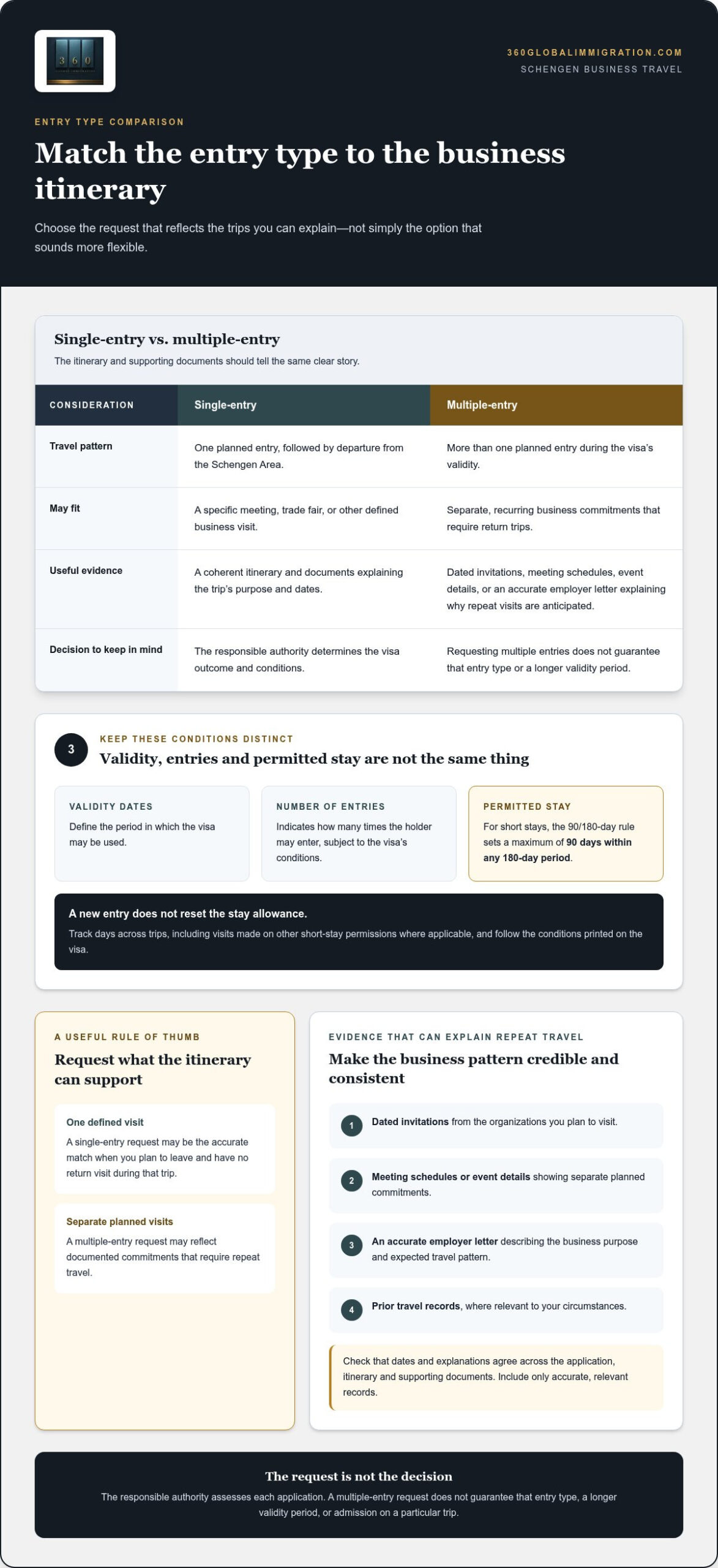
Keep three details distinct: the visa’s validity dates define the period in which it may be used; the number of entries indicates how many times the holder may enter; and the permitted stay limits time spent in the area. For short stays, the 90/180-day rule sets a maximum of 90 days within any 180-day period. A new entry doesn’t reset that allowance. Track days across trips, including visits made on other short-stay permissions where applicable, and follow the conditions printed on the visa.
A visa is not an unconditional right to enter. Border officials may check that the traveller meets applicable entry conditions and can explain the trip’s purpose. A valid visa doesn’t remove those checks, and a multiple-entry decision should never be treated as guaranteed. Start by checking whether your nationality requires a visa, then match your planned visits to the entry type and stay limits you’re applying under.
Single-entry or multiple-entry: what should your business travel pattern support?
Choose the entry type that reflects the trips you can explain, not simply the one that sounds more flexible. A defined visit with one departure from the Schengen Area may fit a single-entry request. If documented commitments require separate visits, a multiple-entry request may better reflect the itinerary. The European Commission’s EU Visa Policy for Schengen sets out the shared visa-policy framework, while the responsible authority assesses each application under the applicable rules.
| Consideration | Single-entry | Multiple-entry |
|---|---|---|
| Travel pattern | One planned entry, followed by departure from the Schengen Area. | More than one planned entry during the visa’s validity. |
| Purpose it may fit | A specific meeting, trade fair, or other defined business visit. | Separate, recurring business commitments that require return trips. |
| Useful supporting evidence | A coherent itinerary and documents explaining the purpose and dates of the trip. | Dated invitations, meeting schedules, event details, or an accurate employer letter showing why repeat visits are anticipated. |
| Decision to keep in mind | The authority determines the visa outcome and conditions. | Requesting multiple entries does not guarantee that entry type or a longer validity period. |
When could a single-entry request fit the itinerary?
A single-entry request can suit a traveller attending one scheduled event or visiting a business partner, then leaving the Schengen Area without plans to return during that trip. Present the dates, destination sequence, and business purpose consistently. It isn’t a lesser option; it may be the most accurate match for a limited, clearly defined itinerary.
What can support a multiple-entry business request?
Build the request around credible commitments, not a general statement that you travel often. An invitation with dates for an upcoming meeting may explain one visit, while a separate confirmed event or recurring schedule could help explain why another trip is anticipated. Include only records that are accurate and relevant to your circumstances.
Useful evidence may include dated invitations from the organizations you’ll visit, event registration or schedules, an employer letter describing the business purpose and expected travel pattern, and prior travel records where relevant. Check that dates and explanations agree across the application, itinerary, and supporting documents. Don’t present tentative plans as confirmed commitments.
Frequent travel alone doesn’t automatically qualify an applicant for multiple entries or longer visa validity. The responsible authority makes the decision under current requirements. A practical preparation step is to map each anticipated visit to a specific business commitment and supporting document. 360 Global Immigration provides professional guidance to help organize visit visa applications and bring the purpose and supporting evidence together.
How to apply for a Schengen business visa from the UAE
Start by identifying the right destination authority, then follow that country’s current instructions from form completion through submission. Appointment systems, accepted submission channels, document requirements, and processing periods can differ by destination and may change. Use the official instructions for the responsible authority rather than assuming one process applies throughout the Schengen Area.
- Map the business itinerary. List each country, the purpose of each visit, and the dates or expected duration of your stay. Make sure the business commitments match the travel plan.
- Identify the main destination. Apply through the country where you’ll spend the most time. If you’ll spend an equal amount of time in multiple countries, the first country you plan to enter generally determines where to apply.
- Find the responsible authority’s official guidance. Use the destination country’s official government or consular website to confirm the application route and current document checklist.
- Complete the required application steps. Follow the authority’s instructions for the form, supporting records, appointment, and any biometric requirements that apply to you.
- Submit as directed and retain records. Keep copies of your application and supporting documents, along with any appointment or submission confirmation. Follow the authority’s instructions for tracking or collecting your passport.
Choose the correct Schengen destination authority
The main destination depends on the substance of your itinerary, not simply the country where your plane first lands. If you enter through one country but spend most of the trip attending meetings in another, the country of the longer stay is generally the relevant authority. If stays are equal, use the planned first-entry country. Confirm the rule and responsible mission through official destination-country guidance before submitting.
For a business itinerary spanning several countries, make the schedule easy to follow. Show where each meeting or event takes place and how long you expect to remain in each destination. If plans change before you apply, update the itinerary so it reflects the trip you genuinely intend to make.
Prepare for appointment and application submission
Once you’ve identified the authority, check its current instructions for appointment booking, application forms, biometrics, document format, and submission location. Some destinations use an appointed third-party application centre to receive applications, while others set out a different channel. A centre may handle submission, but the consular authority remains responsible for assessing the application.
Appointment availability and processing periods can change and aren’t guaranteed. Avoid relying on a general timeline or an old checklist when planning business travel. Review the official instructions again before your appointment, attend or submit as directed, and keep your application reference and copies of the documents provided. This sequence helps ensure the selected authority, travel purpose, and submission route match.
Build a consistent business visa application with relevant evidence
A strong application is more than a stack of documents. It should tell one coherent story: who you are, why you’re travelling, which business commitments require the trip or repeat visits, and how the plans fit your circumstances. The destination authority’s current checklist takes precedence over generic online lists because requirements and submission rules can vary.
Use the checklist to sort your evidence into clear categories:
- Identity and residence: Travel document details and any UAE residence evidence requested by the responsible authority. Check that names, passport numbers, and personal details match throughout.
- Travel purpose: A concise explanation of the business activities, planned destinations, and travel dates, supported by a realistic itinerary.
- Business commitments: Relevant invitations, event details, meeting schedules, or employer or company information that accurately supports the stated purpose.
- Finances: The financial records specified in the destination-specific checklist, with explanations for details that could otherwise seem unclear.
- Insurance: Applicable travel medical insurance evidence in the form and scope required by the responsible authority.
Not every item applies to every applicant. Treat this outline as a guide, not a universal checklist, and don’t add documents simply to make the file look larger. Choose evidence that directly supports your circumstances and follow the official instructions for the destination handling your application.
Document the business purpose and repeat visits
For each proposed visit, connect the dates to a specific business activity. An invitation may explain a meeting; an event registration or schedule may support attendance at a trade fair; an employer letter may describe the traveller’s role and expected business travel. These are examples, not automatic requirements. Include them only when they’re accurate, relevant, and requested or accepted under the responsible authority’s current instructions.
If repeated trips are part of the plan, explain the reason for each one. A general statement about future business opportunities is less informative than dated commitments that align with the proposed itinerary. Don’t describe tentative meetings as confirmed or claim recurring obligations that your evidence cannot support.
Check consistency before submission
Review the application as a single record. Compare passport details, form answers, invitation information, employer or company details, travel dates, and itinerary. If a meeting date changes, update every document that refers to it. Explain any material gap or discrepancy plainly rather than leaving the authority to reconcile conflicting details.
Before attending an appointment or submitting documents, check the destination-specific checklist again for current requirements, formats, and submission instructions. A careful final review can help catch avoidable weaknesses, such as unsupported claims, inconsistent dates, or an unexplained gap in the travel plan. Make sure the stated purpose and evidence fit together without overstating the case.
For structured help organizing a visit visa application and its supporting evidence, explore professional visit visa application guidance from 360 Global Immigration. A carefully prepared file supports a more orderly application, but no document set can guarantee a particular decision or entry type.
Get professional guidance for your Schengen business visa application
Preparing a business visa application can feel demanding when the itinerary, evidence, and destination-specific instructions all need to align. 360 Global Immigration provides professional visit visa guidance to help travellers in the UAE organize application information and present their plans clearly. The support focuses on preparation, not on influencing the consulate’s assessment or promising a visa, validity period, or number of entries.
For a multiple-entry business visa request, explain the travel pattern with evidence that fits your circumstances. A careful review can help identify missing information or inconsistencies before submission, while the responsible authority’s current instructions remain the reference for required documents and procedures.
What structured application support can help organize
Professional guidance can help bring the application’s main elements into a coherent order. This may include clarifying the stated business purpose, checking that the itinerary reflects the planned visits, and reviewing whether supporting documents tell a consistent story. Each application is different, so focus on relevant information rather than adding paperwork without a clear purpose.
A well-organized explanation makes the intended travel easier to understand: what business activity is planned, where and when it will take place, and why the proposed trip pattern makes sense. For repeat visits, the explanation should correspond with the commitments and records available. Guidance can help you present that information clearly, but it cannot determine the outcome. The consulate or other responsible authority assesses the application independently under current rules.
Consultancy services and official charges are separate. Government visa fees are not included in consultancy support. Travel bookings, such as flights or accommodation, are also separate arrangements.
Take the next step with a clear application plan
Before beginning, prepare a short outline of your passport nationality, the business purpose of the trip, the countries and dates involved, and whether you anticipate one visit or separate trips. Note which commitments are confirmed and which remain tentative. This gives you a practical starting point for organizing the application and identifying the destination-specific instructions that apply.
Requirements, appointment procedures, and decisions remain with the responsible authorities and can vary by destination. Keep their latest checklist and submission guidance central to your preparation. With the travel purpose and supporting information arranged clearly, you can approach the process with realistic expectations.
For professional guidance organizing your visit visa application, Explore professional visit visa support and begin a tailored discussion about your travel purpose and anticipated trip pattern.
Prepare your next step with confidence
Before moving forward, turn your intended travel into a working plan. Note what remains uncertain, such as which business commitments are confirmed or how separate visits fit together. This gives you a focused starting point for organizing the application instead of trying to resolve every detail at once.
If you’re considering a multiple-entry Schengen business visa, keep your plans realistic and your expectations measured. A clear preparation process can help you present your circumstances in an organized way, while the responsible authority retains control over the application decision and visa conditions.
360 Global Immigration offers professional visit visa support, alongside guidance in business and talent-based immigration. Explore tailored assistance for your application and take the next step with a clearer plan: Explore professional visit visa support.
Thoughtful preparation and professional guidance can help you approach the process with greater clarity.
Frequently Asked Questions
Do I need a Schengen visa if I live in the UAE?
Not necessarily. Your passport nationality generally determines whether you need a short-stay visa, not UAE residence by itself. UAE citizens are visa-exempt for short stays, while many expatriate residents need to apply. Two UAE residents with different nationalities may therefore have different requirements for the same business itinerary. Check current official guidance for the passport you’ll use, including any conditions that apply to your circumstances.
Can I request a multiple-entry Schengen business visa for my first application?
Yes. You can request multiple entries in a first application, but the consulate decides whether to grant them. Explain why separate trips are needed and support the request with relevant evidence, such as confirmed invitations for different dates. A first-time applicant may have less prior visa history to demonstrate travel patterns, but that alone doesn’t determine the outcome. A request doesn’t establish entitlement to longer visa validity.
How long can I stay in the Schengen Area with a multiple-entry visa?
A short-stay visa allows a maximum of 90 days in any 180-day period, even if it permits multiple entries. Count all days spent in the area across your trips; leaving and returning doesn’t restart the allowance. Also check the visa’s printed validity dates and permitted duration of stay, since these are separate limits. Plan each visit within the conditions shown on your visa and applicable short-stay rules.
What documents support a multiple-entry Schengen business visa application?
Use the responsible authority’s current checklist as your definitive guide. Depending on the destination and your circumstances, evidence may include your passport, application form, travel medical insurance, proof of funds, an invitation from the company you’ll visit, and a letter explaining the trip’s purpose. For repeat travel, dated commitments can help explain the pattern. Ensure names, dates, and business details match across documents, and don’t present tentative plans as confirmed.
Which Schengen country should I apply to for a business trip?
Apply through the country where you’ll spend the most time. If your planned stays are equal across multiple countries, the first country you intend to enter generally determines the responsible destination. Landing in one country before travelling to the country where most meetings take place doesn’t by itself make the arrival country your main destination. Check that country’s official application instructions before selecting an appointment route.
How long does a Schengen business visa application take from the UAE?
Standard processing is 15 calendar days from the date the consulate accepts the application. It can take up to 45 days if additional checks are needed, and in exceptional cases up to 60 days. These periods don’t include time spent waiting for an appointment, and they aren’t guaranteed timelines. Check the destination authority’s current guidance and allow time for any country-specific submission steps before fixing business travel plans.
Does a multiple-entry Schengen visa guarantee entry on every trip?
No. A valid multiple-entry visa allows you to present yourself for entry during its validity, but it doesn’t guarantee admission each time. Border officials may assess whether you meet applicable entry conditions and ask about the purpose and circumstances of a visit. Keep relevant business information and travel details accessible, and follow the visa’s conditions throughout your trip. The visa decision and border entry decision are distinct matters.