
A substantial bank balance alone may not make a self-employed visa application convincing. Proof of funds for a European self-employed visa has no single Europe-wide threshold: the evidence depends on the destination, your household, and how your business is expected to support you. A statement may not tell the full story unless it shows that the funds are accessible and connected to your plans.
It is natural to focus first on the amount, especially if you plan to move with family. But how you document your finances matters too. Credit cards, regular income, client contracts, and bank statements each serve a different purpose in showing your resources and ongoing work.
This article explains how financial requirements can vary, what to consider when applying with dependants, and how to present evidence of funds and business income. It also explains why a strong application links accessible money to credible plans for earning a living in your chosen country.
Key Takeaways
- Compare the destination country’s financial criteria with your household’s needs; family size and the business’s living-cost plan can affect the evidence required.
- Build a clear picture of accessible funds with both personal and business statements when income flows through separate accounts.
- Use contracts and invoices to show that the business is active and earning, rather than relying on a trade licence alone.
- Make regular income and available savings easy to follow by connecting bank activity with the work that generates it.
Monthly subsistence minimums for applicants and families
Proof of funds for European self-employed visa applications has no single Europe-wide monthly minimum. The required evidence depends on the destination, household size, living costs, and how the business supports your residence. Germany’s self-employment checklist asks applicants to itemize operating funds and potential living expenses. It also requests liquidity planning and a business forecast for each of the first three years.
Monthly subsistence requirements can vary by household member. A child aged 6-15 is listed at 3,050 CZK monthly; a student dependent aged 15-26, at 3,490 CZK. These figures show how family composition affects the calculation.
Portugal, Spain, France, Germany, and the Netherlands do not share one threshold. Requirements depend on the route and how applicants demonstrate financial means; Germany’s checklist separates business capital from living provisions. Applicants aged 45 or older must provide evidence of adequate retirement benefits, which may include personal assets, acquired pension rights, or operating assets. A sound proof of funds for European self-employed visa application should reflect the destination’s criteria and the applicant’s full household situation.
Self-employed and business-residence pathways are available in countries including France, the Netherlands, Cyprus, Ireland, Germany, and the Czech Republic. UAE residents should distinguish the visa application centre’s role in receiving documents from the authority’s assessment of the application. Keep travel funds separate from the resources presented for your business and residence.
Application fees and other costs vary by destination, permit type, and route. Budget for the relevant application process and document preparation, without counting travel money as business capital.
Common weaknesses include unexplained deposits, unclear ownership or origin of funds, and relying on a trade licence alone. Strengthen your application by linking statements, contracts, and forecasts, then explaining how the funds will be accessible in Europe. Consistent documents make your financial picture easier to assess.
Portugal, Spain, France, and the Netherlands assess financial means according to the relevant route, rather than a shared monthly threshold. Germany also has route-specific requirements and distinguishes business capital from living expenses, asking applicants to plan for both.
Do credit cards count as proof of funds?
A credit card limit shows borrowing capacity, not money already available in your account. Treat it as supplementary evidence, not a replacement for accessible savings or documented business income. For a self-employed applicant, bank statements give a clearer record of funds, account ownership, and financial activity than a card limit alone.
For Schengen visa applications from the UAE, self-employed applicants are advised to provide the last six months of both business and personal bank statements. Keep accounts separate where possible, and submit both sets if business income passes through one account and household spending through another. This helps the embassy trace how revenue reaches you and whether funds remain available.
There is no single holding period for every European self-employed visa. A consistent history of statements is more informative than a balance that appears shortly before you apply. If a large deposit appears, provide documents showing its origin and ownership. For Czech visa renewals, begin gathering documents at least three months before expiry.
You do not automatically need to transfer funds to a European bank account or convert them into euros to document them. Statements from UAE accounts can show balances in their original currency; make the account holder, currency, and available balance clear. The destination authority assesses whether the evidence demonstrates access to funds and supports your planned business and residence.
Link your statements to the liquidity planning in your business plan: identify expected income, operating costs, and personal living needs. Germany’s self-employment checklist includes liquid funds, tangible assets or goods, affiliated loans or third-party funds, and venture capital among its capital-budget categories. Its requested business forecast covers each of the first three years, so projections should align with the financial records and contracts you provide.
For country-specific planning, organize financial evidence alongside your business route through self-employed visa application planning.
Contracts, invoices, and proof of ongoing work
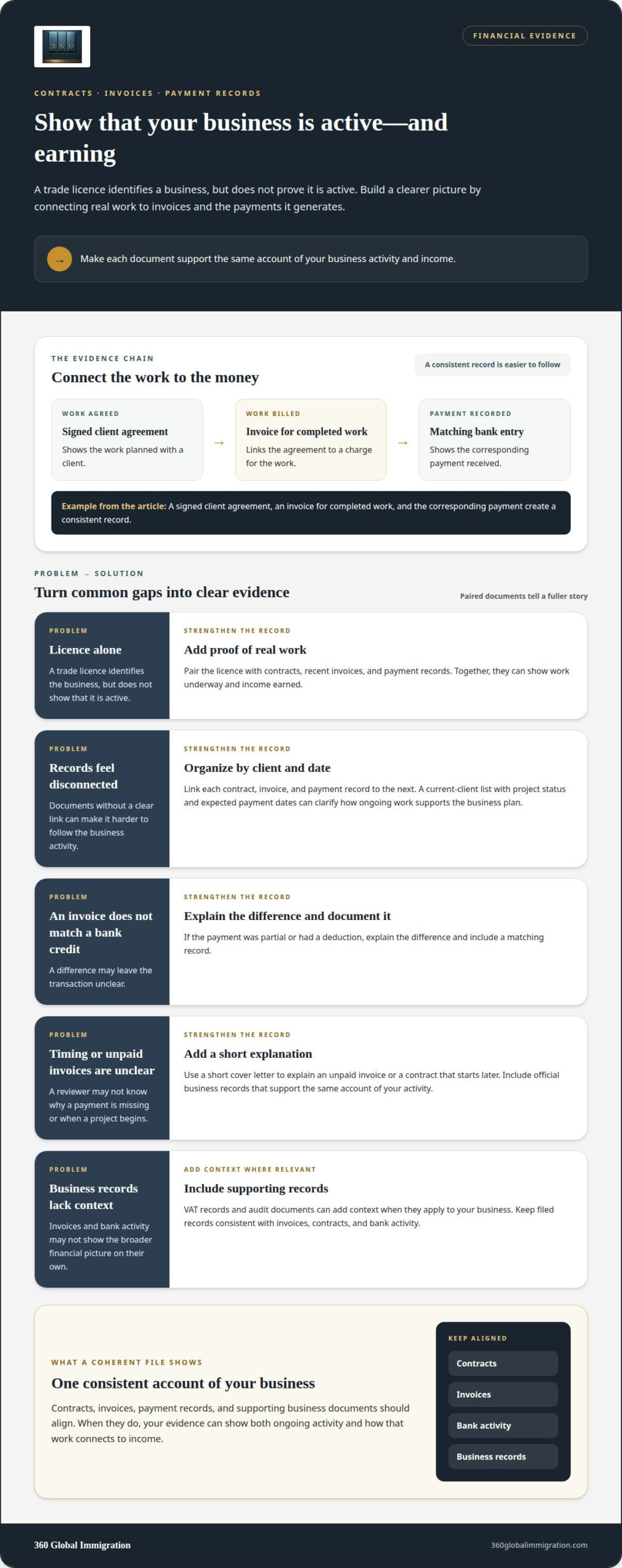
A trade licence identifies a business but does not prove it is active. Contracts, recent invoices, and payment records can show work underway and income earned. Where possible, pair each contract with matching invoices or bank entries. For example, a signed client agreement, an invoice for completed work, and the corresponding payment create a consistent record for the consulate.
Organize records by client and date, linking each document to the next. A short cover letter can explain an unpaid invoice or a contract that starts later. Include official business records that support the same account of your activity. A list of current clients, project status, and expected payment dates can clarify how ongoing work supports your business plan.
VAT records and audit documents can add context when they apply to your business. Keep filed records consistent with invoices, contracts, and bank activity. If an invoice total differs from a bank credit, explain the difference, such as a partial payment or deduction, and include a matching record. A trade licence supported by clear transaction evidence is stronger than a licence alone.
Business costs also affect the funds available for living and operations. For a self-employed Czech business visa holder, estimated mandatory social insurance contributions are about 4,759 CZK per month in 2025. Estimated public health insurance contributions are about 3,143 CZK per month in 2025. These commitments belong in the financial picture alongside expected revenue, rather than being treated as disposable income.
Make your evidence easy to assess by labelling contracts, invoices, VAT records, and payment entries consistently. If the records show a gap, add a concise explanation and supporting document. The goal is a sufficient, coherent account of active work, expected income, and regular obligations, not a pile of unrelated papers.
Bank statements and proof of regular income
Bank statements show whether business income becomes funds you can use. For self-employed Schengen visa applicants, a UAE-market recommendation is a personal balance of AED 20,000-30,000. Treat this as a planning reference, not a universal threshold: the destination, permit route, household, and evidence of recurring earnings all shape the financial picture.
Read statements alongside invoices, contracts, and business records. A client payment in a business account should match an invoice or contract, and transfers to your personal account should also be clear. If a large deposit appears, include a document explaining its origin. An unexplained lump sum may not satisfy an embassy, even if the closing balance looks substantial.
Regular income matters because a single balance captures only one point in time. Use dated statements and matching records to show how work generates payments and whether they recur. If a sponsor supports your application, their livelihood and relationship to you also matter. A sponsor letter can explain how the funds were accumulated; an employed sponsor may also provide a payslip.
For a Czech household example, the annual available income or savings figure is roughly 472,000 CZK. The example shows why family finances should be assessed across a full year, rather than through one month’s deposits. The UAE has no personal income tax, so organize the available business and banking records to explain income clearly.
Keep your financial records consistent: reported income, account activity, invoices, and forecast figures should align. A different balance or irregular payment pattern may need context, such as a delayed client payment or a one-off project. This links accessible funds to the actual circumstances of your business and intended residence.
For tailored support organizing financial evidence for a European business-residence application, discuss your visa application.
360 Global Immigration: France Passeport Talent
360 Global Immigration helps applicants assess the France Passeport Talent route and prepare for a business-residence application. Turn to the team when you need to understand how your financial records, business plans, and professional profile fit the route before assembling your application.
If your plans point elsewhere, its offerings also include the UK Innovator Founder Visa, Netherlands Self Employed Visa, and Cyprus Business Residence Visa. The right pathway depends on your intended activity and destination, so compare the route’s requirements with your business model and the evidence you can provide.
For guidance on the France Passeport Talent route and your next steps, contact 360 Global Immigration or visit 360globalimmigration.com.
Make your next move with a clear financial plan
Before choosing a route, align your business model, destination, and financial evidence. Map each expected income source to supporting records, then identify how your planned activity fits the residence pathway. This creates a coherent financial narrative rather than a collection of unrelated documents. Proof of funds for a European self-employed visa should reflect the structure of your work and the country where you plan to establish it.
360 Global Immigration supports applicants pursuing France Passeport Talent, the UK Innovator Founder Visa, and the Netherlands Self Employed Visa. If your plans are still taking shape, professional guidance can help you assess which route fits your business goals and prepare for the application process. Individual requirements can vary by route and circumstances.
Contact 360 Global Immigration to discuss your next step. A considered plan can help you move forward with greater clarity and confidence.
Frequently Asked Questions
Can you be refused even if you have enough money?
Yes. A sufficient balance does not resolve questions about where the funds came from, who owns them, or whether they support your proposed business and residence plans. For example, a large unexplained deposit can make your financial record unclear. You must also meet the visa route’s other requirements, so your financial evidence should be consistent with your business plan and supporting documents.
How do I show income if it varies month to month?
Show the pattern across your records, not just your highest-earning month. For example, match payments from a seasonal project to the relevant contract, invoices, and account entries. Briefly explain gaps or unusually high receipts, using records to support your explanation. A business forecast can then show how irregular client work is expected to contribute to future income and ongoing expenses.
What Documents Work Best?
Use documents that answer different questions: bank records show balances and transactions, contracts show agreed work, and invoices connect completed work to amounts billed. A business plan explains how funds support operations, while a forecast sets out expected financial activity. Keep names, dates, amounts, and business details consistent throughout your application. If a transaction needs context, include a short explanation and its supporting record.
What proof of funds is required for European self-employed visas by country?
Requirements vary by country and visa route, so there is no single European amount or document set. Germany’s checklist examines business capital and living provisions, while the Czech Republic uses household subsistence categories. Portugal, Spain, France, and the Netherlands each assess applicants under their own routes. Compare the evidence for your intended activity, household, and destination rather than relying on another country’s benchmark.
How do European countries calculate minimum income or savings requirements for self-employed visa applicants?
Assessments may distinguish personal living resources from business operating capital. Household size affects subsistence calculations, while a business plan and forecast explain planned costs and expected income. For example, funds allocated to equipment or operating expenses should not also be presented as available for household needs. Provide a clear budget that separates these purposes and shows how each figure relates to your business plan.
Can self-employed visa applicants use savings, business income, or a sponsor as proof of funds?
Depending on the route’s requirements, applicants may present personal savings, business income, or sponsor evidence. A sponsor’s documents should explain their livelihood, the origin of the funds, and their relationship to the applicant. Show who owns the money and how it is accessible to you. Business income is clearer when linked to the work and payments that generated it.