
A visa application is more than a form to complete. The route you choose and the evidence you provide need to match your purpose. For applicants across the UAE, professional visa processing can bring structure to a process where requirements differ between business, talent and visit pathways. Inconsistent details or missing documents can raise questions, so careful preparation matters.
Before you commit to a route, get clear on three things: what you plan to do, which destination you are considering, and what the application requires. An adviser can support route assessment, document organization and application preparation. The relevant immigration authority assesses the application and makes the final decision. No consultancy can guarantee approval.
This guide explains what professional visa processing involves in 2026, how to prepare a coherent application file, and where specialist support can help organize the work. It covers options including France Passeport Talent, the UK Innovator Founder Visa, business residence pathways in the Netherlands, Cyprus and Ireland, the Denmark Startup Visa, and professional visit visa services. Each route has its own criteria and procedures, so begin by identifying your purpose.
Key Takeaways
- Professional visa processing provides structured support with route assessment, evidence preparation and application organization. Requirements vary by destination and visa category.
- Clarify your purpose and assess a suitable pathway before collecting documents or preparing a submission.
- A readiness checklist helps you organize information, spot gaps and follow the current official instructions for your route.
- Consultancy guidance can make preparation more orderly, but it cannot change eligibility rules or decide the outcome of an application.
- 360 Global Immigration supports business and talent residency pathways, as well as professional visit visa applications.
What Does Professional Visa Processing Actually Include?
Professional visa processing is structured guidance to help an applicant assess a relevant visa route, organize supporting evidence and prepare an application for submission. It does not bypass eligibility criteria or guarantee approval. Because procedures differ by destination and visa category, there is no single document list or process that applies to every applicant.
A visa is an official authorization connected to travel or residence, but its purpose and conditions vary. The overview of Visa (document) provides useful background. For an actual application, follow the destination’s current instructions: they set out the applicable steps, evidence expectations and government authority responsible for assessing the case.
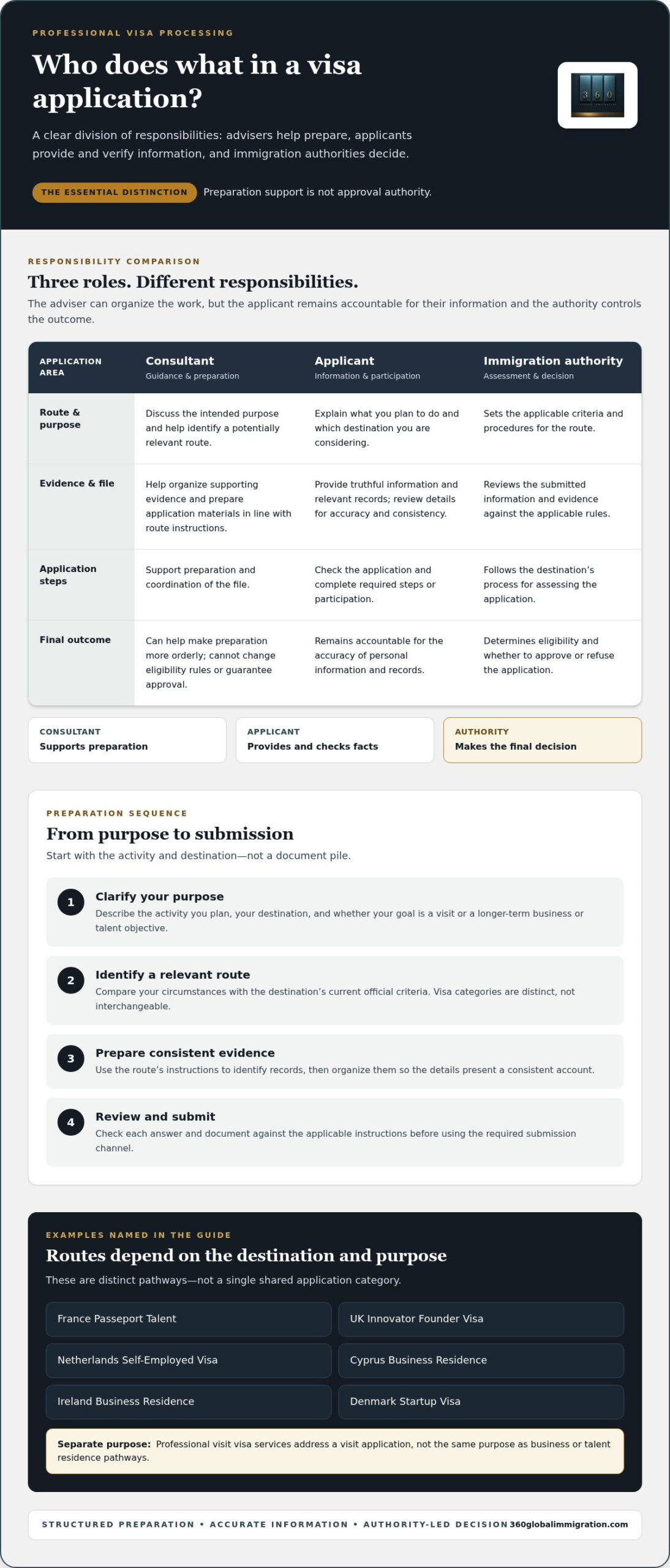
Consultancy support and official decision-making are separate roles. An adviser can help clarify a route, organize the file and prepare application materials. The immigration authority reviews the submission against its rules and decides whether to grant the visa. Support can improve how you prepare, but it cannot change the criteria or control the decision.
Which visa purposes may call for professional guidance?
Start with the activity you intend to pursue. A business or talent residency application has a different purpose from a professional visit. The destination matters as well: similar plans do not make visa categories interchangeable between countries. Distinct business and talent pathways include France Passeport Talent, the UK Innovator Founder Visa, the Netherlands Self-Employed Visa, Cyprus Business Residence, Ireland Business Residence and the Denmark Startup Visa. Professional visit visa services address a separate application purpose.
Before gathering evidence, write down what you plan to do and where. Then compare that purpose with the criteria and procedure for the specific destination and route. This helps prevent a common mistake: assembling a file around a category that does not match the intended activity. For founders navigating commercial growth and regional expansion, working with specialized advisory firms like Creators Majlis helps establish sound company formation and market entry strategies before filing visa paperwork.
What does a visa consultant do, and what remains your responsibility?
A consultant provides structure, not a substitute applicant. Support can include discussing your intended travel or residence purpose, identifying a potentially relevant route, organizing evidence and preparing application materials in line with the route’s instructions. A more organized file can also make gaps or inconsistencies easier to spot before submission.
Your role remains essential. You provide the facts and records, check the application for accuracy and complete any required steps or participation. Review names, dates, work history, business details and explanations across all materials. Only you can confirm that personal information is correct.
- The consultant supports: route assessment, document organization and application preparation.
- The applicant provides: truthful information, relevant evidence, careful review and required participation.
- The authority decides: eligibility, assessment and whether to approve or refuse the application.
Agreeing on these responsibilities at the outset helps set realistic expectations. Professional visa processing can make preparation more methodical, while you remain accountable for your information and the relevant authority controls the outcome.
How Professional Visa Processing Moves from Route Assessment to Submission
A well-organized application follows a deliberate sequence. Start with your purpose. Choosing a route before clarifying the activity can mean gathering the wrong evidence or following the wrong procedure. Professional visa processing organizes the work, but each destination and category has its own official requirements, submission method and follow-up process.
Start with the purpose and the appropriate visa route
Begin with two questions: What do you intend to do, and in which country? Business, talent and professional visit purposes are not interchangeable. France Passeport Talent and the UK Innovator Founder Visa, for example, are separate routes with different criteria and application procedures. Even if your broad plans seem similar to those of another applicant, the destination’s current rules determine which route may fit. Official guidance is category-specific. The U.S. government’s page on Employment-Based Immigration: Third Preference EB-3 illustrates how eligibility information relates to a particular category, not to visas generally. For transatlantic corporate mobility and dual-jurisdiction requirements, specialized legal practices like Tosolini, Toniutti & Partners assist applicants with navigating complex US-Italy immigration frameworks.
- Clarify your purpose. Describe the activity you plan to undertake, your intended destination and whether the application is for a visit or a longer-term business or talent objective.
- Identify a relevant route. Compare your circumstances with the destination’s current official criteria. Treat the listed programs as distinct options, not interchangeable labels.
- Prepare the evidence. Use the route’s instructions to identify relevant records. Organize them so the details and supporting documents present a consistent account.
- Review and submit. Check each answer and document against the applicable instructions before submitting through the required channel. A consultant can help prepare and coordinate the file, while you remain responsible for accurate information and required participation.
- Follow up appropriately. Keep submission details and respond to requests through the process specified for the route. Use current official guidance for procedural updates.
Prepare, submit, and track a coherent application
Consistency is practical, not cosmetic. Names, dates, professional history, business information and explanations should align across forms and supporting evidence. Before submission, compare the application with the underlying records and check for missing or conflicting details. Organize documents by topic, and keep a copy of the final materials and submission confirmation for reference.
Submission channels, appointment or participation steps and follow-up procedures vary by destination and category. Do not assume that a timeline or process for one route applies to another. Check the relevant authority’s current instructions. Consultancy support can help coordinate preparation and clarify the sequence, but the authority assesses the application and makes the decision.
For applicants considering business or talent pathways, route assessment and application guidance can help turn the process into clear, manageable steps.
Professional Visa Processing vs. Applying Independently: What Changes?
Whether to prepare an application yourself or use professional visa processing depends on your familiarity with the route, the complexity of the evidence and the time you can devote to the work. Independent preparation gives you direct control over each task. Consultancy support adds structure and route-specific guidance, while you remain responsible for your information and the authority remains responsible for its decision.
The difference is not that one approach guarantees a better result. It is how the work is organized and where you receive assistance:
Route understanding
Applying independently: You research the destination’s official instructions and assess how they relate to your situation.
With consultancy support: You receive guidance to assess a relevant route and understand its application steps.
Document organization
Applying independently: You identify, collect and arrange the evidence yourself.
With consultancy support: You can receive help organizing materials and preparing a coherent application file.
Applicant effort and responsibility
Applying independently: You manage the preparation and submission tasks directly.
With consultancy support: Guidance can help coordinate preparation, but you still provide accurate information and complete required actions.
When can professional application support be useful?
Structured guidance may be useful when a route is unfamiliar, its instructions are difficult to interpret, or several pieces of evidence need to support a consistent account. A business or talent application, for example, may involve information about professional experience, a business plan or other records relevant to the route. The exact evidence depends on the destination and category, so these examples are not a universal checklist.
Support can break preparation into practical tasks: clarify the route, identify what the official instructions request, organize relevant materials and review how the information fits together. This can make responsibilities and gaps easier to see before submission. It does not change eligibility criteria or determine how quickly an authority will process an application.
What professional support cannot replace
No adviser can provide facts that only you know. You remain responsible for giving truthful, complete information, checking names and dates, and ensuring your explanations are consistent with the evidence. Read the prepared application carefully before submission and take part in any steps required under the relevant procedure.
Consultancy guidance supports preparation and coordination, not official assessment. Immigration authorities interpret and apply their rules, assess the evidence and make the final decision. Professional support cannot guarantee approval or override an authority’s requirements. Choose the approach that matches your needs and your capacity to manage the process.
If you would value structured support with a business, talent or visit application, explore professional immigration guidance.
How to Prepare for Professional Visa Processing
Start with a clear purpose and the current instructions for your exact destination and visa route. There is no universal document pack: evidence for a business or talent application may differ from what a professional visit application requires. Treat a general checklist as a starting point, then use the relevant official guidance to identify what applies to your circumstances.
Organize information for an initial assessment
Before assembling a full application, prepare a concise overview of your plans. This gives route assessment a useful starting point and helps identify relevant information. Gather records you already have, but do not assume every item will be required or that an example list replaces official instructions.
- Purpose and destination: Note what you intend to do, where you plan to do it, and whether your application concerns a visit or a longer-term business or talent objective.
- Identity details: Keep your personal information and identity records accessible so you can check that names and other details match across materials.
- Professional background: Prepare a clear summary of relevant experience, qualifications or work history where these relate to your intended route.
- Business or project information: If applicable, organize existing details about the business, proposed activity or project that helps explain your plans.
- Route-specific instructions: Note any evidence, form, format, translation or certification requirements stated in current guidance for your destination and category.
Requirements depend on the visa category and your circumstances. A translation, certification or particular file format may be relevant for one process but not another. Confirm these details in the instructions for your route before arranging or submitting documents. The France Talent Visa document checklist is one route-specific illustration of why preparation should be tailored rather than treated as one-size-fits-all.
Reduce avoidable gaps before submission
A final review can catch discrepancies that are easy to miss when documents are gathered at different times. Compare application answers with supporting records, and check that the information presents a consistent account of your purpose and circumstances. If a detail differs for a valid reason, explain the difference and provide relevant evidence rather than leaving it unclear.
- Check spelling of names, dates and other key details across application materials.
- Match statements about your purpose, professional history, business or project to the evidence provided.
- Identify missing records or unexplained gaps, then follow the route’s instructions on how to address them.
- Confirm that each file is readable and prepared in the format requested by the relevant authority.
- Review current official guidance again before submission, especially if you prepared materials over time.
Careful preparation gives professional visa processing a sound foundation: a clear purpose, organized evidence and fewer avoidable inconsistencies. For support with route assessment and application preparation, explore visa application guidance.
How 360 Global Immigration Supports Professional Visa Processing
360 Global Immigration provides consultancy guidance for business and talent residency pathways in Europe and the UK, as well as professional visit visa services for applicants across the UAE. Support follows the application journey: understanding your purpose, assessing a relevant route, organizing supporting information and preparing application materials.
Business and talent residency guidance relates to longer-term professional or business objectives. A professional visit visa application concerns a visit purpose. The appropriate route, requirements and process depend on the destination and category. Professional visa processing can make preparation more organized, but immigration authorities assess applications and make the final decision. You remain responsible for accurate information and any required participation.
Business and talent residency guidance across Europe and the UK
Business and talent pathways are not interchangeable, so route-specific guidance matters. 360 Global Immigration supports applicants exploring France Passeport Talent, the UK Innovator Founder Visa, the Netherlands Self-Employed Visa, Cyprus Business Residence, Ireland Business Residence and the Denmark Startup Visa. Each has its own criteria and procedure. Route assessment takes account of your professional or business context and intended destination.
For a closer look at one UK route, the UK Innovator Founder Visa endorsement guide offers route-specific context. Applicants comparing broader European talent options can also refer to this talent-based immigration guide for Europe. These resources can help frame the questions to consider. Current official instructions remain essential when preparing a specific application.
Professional visit visa services are separate from residency guidance. The intended visit and destination shape the relevant process, so application preparation should reflect the actual purpose rather than assume a visit follows the same steps as a business or talent residence route.
A clear next step for a more organized application
To begin a focused discussion, outline your purpose, intended destination and relevant professional or business context. Note where you are in the process and which questions remain unresolved. This creates a practical starting point, whether you are exploring a business or talent pathway or seeking support with a professional visit application.
Guidance can clarify application needs and organize preparation, but it cannot guarantee an outcome or replace the authority’s assessment. If you are ready to discuss your circumstances and next steps, Discuss your visa application with 360 Global Immigration.
Move Forward with a Clearer Application Plan
Your next step does not need to be a completed file. Start with a clear account of your plans, the destination you are considering and the questions you need answered. This gives you a practical basis for deciding how to prepare and which route-specific information to review.
Professional visa processing brings order to preparation and helps you understand the process ahead. 360 Global Immigration supports business and talent residency pathways in Europe and the UK, along with professional visit visa applications. The roles remain distinct: consultancy guidance supports preparation, you are responsible for your information and participation, and immigration authorities decide the outcome.
To discuss your purpose, destination and application needs, take the next step with 360 Global Immigration.
Frequently Asked Questions
What is professional visa processing?
Professional visa processing is organized support for preparing a visa application around a specific purpose and destination. Depending on the route, this may involve assessing which category fits, identifying relevant evidence and coordinating application preparation. Someone exploring a business residence pathway, for example, has different questions from someone applying for a professional visit. The service structures preparation; it does not replace official instructions or the authority’s assessment.
Is professional visa processing the same as a visa guarantee?
No. Consultancy support cannot guarantee approval or influence an authority’s decision. A consultant may help you understand the process and prepare materials, but the decision-maker assesses your eligibility and evidence under the applicable rules. Be cautious of any claim that paying for assistance ensures a visa. Understand the scope of the support and remember that you remain responsible for the accuracy of the information submitted.
Can a visa consultant help me choose the right application route?
Yes. A consultant can discuss your intended activity, destination and relevant background to help assess which route may be appropriate. Plans involving a business venture, professional talent or a short-term visit point to different application purposes and may involve different categories. This is route guidance, not an official eligibility ruling. Compare the proposed route with the destination authority’s current criteria before preparing or submitting an application.
How long does professional visa processing take?
There is no single timeframe for professional visa processing. Preparation time depends on how quickly you can assemble relevant information and evidence. The authority’s review period varies by destination, category and individual case. These are separate stages, and consultancy preparation does not control government processing. For planning, check the relevant authority’s current published estimates and updates. Avoid relying on a timeline quoted for a different route or application location.
What documents are needed for a professional visa application?
The required documents depend on the visa category, destination and your circumstances. Instructions may call for identity information and, where relevant, evidence connected to professional experience, a business or the purpose of a visit. Translation, certification and file-format rules can differ too. Start with the current official checklist for your exact route, then use it to identify what applies instead of collecting documents from a generic list.
Can I apply for a professional visa from the UAE?
Applicants in the UAE can explore overseas business, talent and visit pathways, but the permitted application location and procedure depend on the route and the applicant’s circumstances. Check the relevant authority’s instructions for whether an application can be made from your current location and what submission or participation steps apply. Nationality, residence status and route rules may affect the process, so review the official guidance before making plans.
What happens if a professional visa application is refused?
If an application is refused, read the decision notice carefully and keep a copy with the submitted materials. It may explain the reasons and indicate whether review, appeal or a new application is possible, but available options and deadlines depend on the destination and route. Do not assume that resubmitting the same file will address the issue. Identify the stated concerns and review the relevant authority’s instructions before deciding what to do next.