
The most suitable residency route isn’t always the most obvious one. Personalized immigration planning starts by connecting your destination, career or business goals, and available evidence, rather than squeezing your circumstances into a generic checklist.
If you’re unsure which country or pathway fits your plans, or how to turn years of professional and personal records into a coherent application, that uncertainty is understandable. Requirements can change, and gaps in preparation can complicate an application. A clear plan helps you identify priorities, assess what you can document, and decide what to do next.
In this article, you’ll learn how to build a practical shortlist of routes, organize evidence around your profile, and set preparation priorities. For UAE residents exploring business or talent-based options, France’s Passeport Talent, the UK Innovator Founder Visa, and the Netherlands Self-Employed Visa are examples of distinct pathways to compare against your circumstances. We’ll also cover how to review your plan when your goals or immigration requirements change, and where professional application guidance can help you organize your next steps.
Key Takeaways
- Shape personalized immigration planning around your objectives, profile, and evidence instead of relying on a generic checklist.
- Separate essential relocation goals from preferences such as timing or business continuity to clarify what your plan needs to prioritize.
- Compare pathways using consistent criteria, while recognizing that routes such as France Passeport Talent and the UK Innovator Founder Visa serve different purposes.
- Turn your chosen direction into manageable preparation workstreams, supported by a document register that tracks sources, status, and next actions.
- Explore professional application guidance for relevant business and talent-based residency pathways across Europe and the UK.
What Personalized Immigration Planning Means for a Cross-Border Move
A cross-border move involves more than choosing a country and finding a visa category. Your professional record, business plans, personal priorities, and preferred timing can all affect which routes deserve closer consideration. Personalized immigration planning connects your objectives and profile with relevant immigration pathways, the evidence to prepare, and practical next steps. It gives your decisions a clear rationale instead of treating each form or document as a task in isolation.
A folder of records can help you stay organized, but it won’t show which records support a particular objective or where important gaps remain. An isolated visa search can identify route names without explaining how they relate to your circumstances. A useful plan connects these threads. The broad concept of Immigration covers different forms of movement across borders, but your planning needs to focus on the route and requirements relevant to your situation.
Consider business, professional, and personal factors together. A founder may be weighing where to develop a venture and how a move could affect existing commitments. A professional may have a strong career history but need to assess how it relates to a talent-based route. Personal priorities help clarify which trade-offs are acceptable. A plan can guide preparation and support informed choices, but it cannot control a government decision or promise approval.
How a tailored immigration plan differs from a checklist
A checklist tracks actions: collect a record, review a form, or prepare a supporting document. Planning explains why each action matters, how it relates to your objective, and what should happen next. The same career history, for example, may be relevant in different ways depending on the pathway being considered. Assess its relevance against that route’s current requirements instead of assuming it will carry the same weight everywhere. A plan organizes preparation, while the relevant government body makes the decision.
When founders and professionals benefit from planning
Planning is useful before you commit to an application strategy. A founder comparing destinations, a self-employed professional researching residency routes, or a talent-based applicant with a varied career may need to resolve several questions first. Which priorities are essential? What evidence already exists? What needs further research? Answering these questions early helps distinguish a promising direction from one that simply sounds appealing, without assuming eligibility or a particular outcome.
For example, France Passeport Talent and the UK Innovator Founder Visa are distinct pathways, not interchangeable labels for the same goal. Their relevance depends on how your objectives and profile relate to each route’s current criteria. For applicants in the UAE, a structured assessment can turn broad ambitions into a reasoned shortlist, identify questions to address, and create a foundation for organized preparation. Review the details as your circumstances or relevant requirements change.
Build Your Immigration Plan Around Goals, Profile, and Evidence
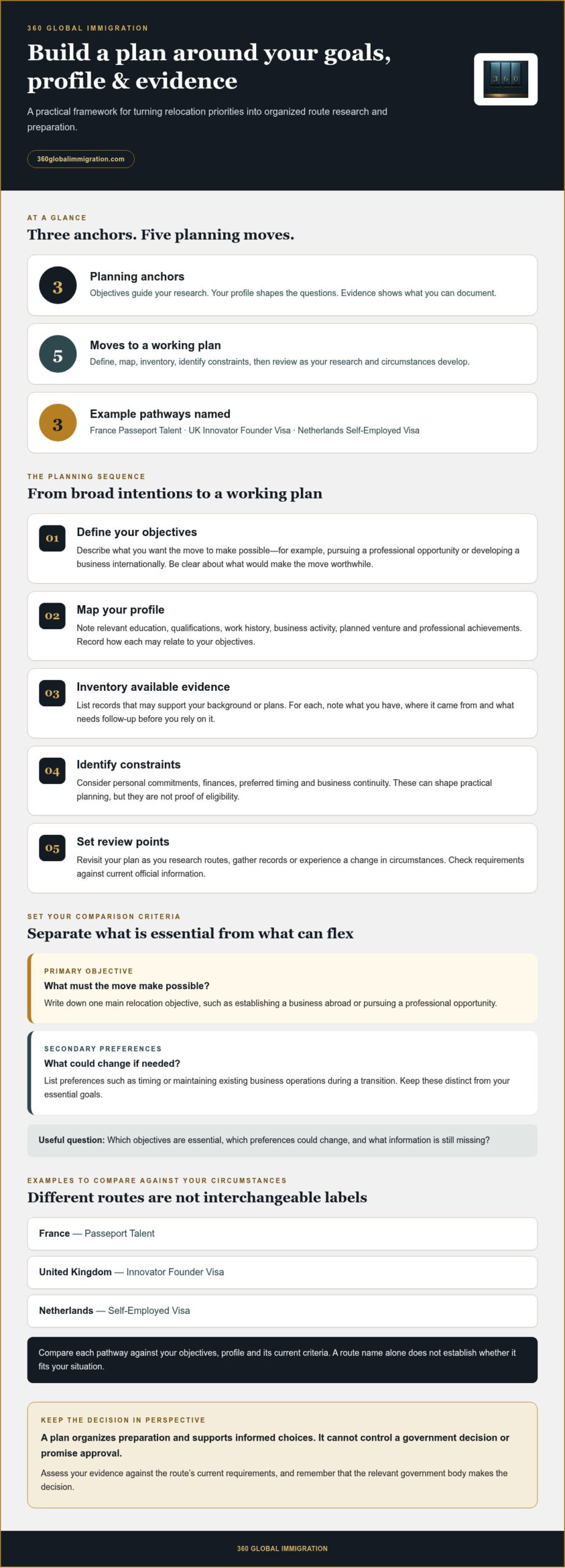
A practical plan begins with your priorities, not a route name. In personalized immigration planning, objectives guide what to research, your profile shapes the questions to ask, and your evidence shows what you can document. Separate essential goals from preferences: a specific professional or business objective may be central, while a preferred move date or continuity arrangement may be flexible.
Use this sequence to turn broad intentions into a working plan:
- Define your objectives. Describe what you want the move to make possible, such as pursuing a professional opportunity or developing a business internationally. Be specific about what would make the move worthwhile.
- Map your profile. Record relevant education, qualifications, work history, business activity, planned venture, and professional achievements. Note how each may relate to your objectives.
- Inventory available evidence. List records that help substantiate your background or plans. Identify what you have, where it came from, and what needs follow-up before you rely on it.
- Identify constraints. Consider personal commitments, finances, preferred timing, and business continuity. These factors can influence practical planning, but they shouldn’t be mistaken for proof of eligibility.
- Set review points. Revisit the plan as you research potential routes, gather records, or experience a change in circumstances. Check requirements against current official information.
Turn personal and professional priorities into planning criteria
Write down one primary relocation objective, then list secondary preferences separately. For example, a founder may prioritize establishing a business abroad but prefer to maintain existing operations during the transition. Record education, roles, business plans, and achievements alongside family, financial, and timing considerations. This gives you a fuller picture for route research without assuming any one factor determines eligibility.
Use these notes to set practical comparison criteria: which objectives are essential, which preferences could change, and what information is missing? Separating priorities from preferences can prevent a flexible preference from narrowing your research too early, while keeping critical personal or business needs visible as you assess pathways.
Create an evidence inventory before choosing a route
Organize records into useful groups, such as identity, qualifications, business activity, and professional history. For each item, note its source and date, then flag anything missing, outdated, inconsistent, or difficult to obtain. This turns a scattered collection into a working inventory and helps you plan follow-up. Evidence is most useful when it is mapped to a defined immigration objective, because its relevance depends on the route being assessed.
An inventory is a planning tool, not a substitute for current, route-specific evidence requirements. Once your goals and profile are recorded, professional guidance can help focus your research into relevant business or talent-based pathways. Applicants in the UAE considering options across Europe or the UK can explore immigration application guidance as they organize their next steps.
Compare Immigration Pathways Without Relying on One-Size-Fits-All Advice
A useful comparison starts with your objectives, not a ranking of destinations. A route that sounds attractive may not align with your business model, professional background, evidence, or practical priorities. Personalized immigration planning helps you assess options against the same criteria, making differences easier to see and keeping your research focused.
Build a comparison table for each route you’re considering. Keep entries factual and note questions that need verification against official guidance:
- Purpose: What type of activity or applicant profile is the route intended to address?
- Profile fit: How does your experience, business activity, or professional record relate to that purpose?
- Evidence to research: What does official guidance say applicants need to provide, and what do you already have?
- Practical considerations: How might preparation, business continuity, timing preferences, and personal commitments affect your planning?
Compare route purpose with your business or professional profile
Start by asking whether a route is organized around a business, self-employment, startup, or talent profile. These broad categories can direct your research, but a route’s general purpose doesn’t establish that a particular person qualifies. France Passeport Talent and the UK Innovator Founder Visa, for example, are distinct options to assess against their own current criteria. For route-specific context, consult this France Passeport Talent business creator guide.
Use the same comparison method for other routes that may warrant research, including the Netherlands Self-Employed Visa, Cyprus Business Residence Visa, Ireland Business Residence Visa, and Denmark Startup Visa. Treat these as options to investigate, not as recommendations or findings about your eligibility. Similarly, for candidates looking at passive income or remote residency pathways across Europe, obtaining Portugal D7 visa assistance can help clarify route-specific financial and documentation requirements. Write down why each might merit further research, then compare that reason with your objectives and professional or business background.
Assess evidence, constraints, and trade-offs side by side
For each shortlisted route, record what official sources say about relevant evidence, what you can document now, and what needs clarification. Add practical questions about application preparation, business continuity, and personal priorities. These factors help you understand the work and trade-offs involved without assuming that a route will suit you.
Keep confirmed information separate from open questions. Program rules and application guidance can change, so verify current requirements with official sources before making decisions or preparing a submission. These examples are not eligibility findings, and a side-by-side comparison can guide research but cannot predict a government decision. For additional UK pathway context, see the UK Innovator Founder Visa endorsement guide.
Turn Your Immigration Strategy Into an Organized Preparation Plan
Once you have a direction to investigate, put the preparation in a clear sequence. Divide the work into four connected areas: route research, evidence gathering, application preparation, and review. This keeps research questions separate from document tasks and helps prevent drafting from getting ahead of what you know about the route.
Sequence research, evidence gathering, and application preparation
Set milestones according to dependencies, not estimated processing times. For example, review current route guidance before deciding which evidence is relevant, then resolve questions about that evidence before treating an application draft as ready for review. Assign an owner and a next action to each task, whether you’re coordinating records yourself or managing contributions from colleagues or family members. For applicants navigating the process without a consultant, self-service digital platforms like canadapathwaycoach.ca show how to organize evidence, track milestones, and prepare permanent residence submissions independently.
Use a single document register as the working record for your preparation. For each item, include:
- Document or question: Identify the record needed or the issue to resolve.
- Status: Mark whether it’s not started, in progress, received, or needs attention.
- Source and date: Record where the information came from and when it was obtained or checked.
- Next action and owner: State the practical follow-up and who is responsible for it.
Prioritize unresolved questions before drafting or submitting application materials. A question about which route requirements apply, for instance, can affect which records to gather and how to organize them. Order questions by impact and dependency: first clarify anything that could change the direction or scope of preparation, then address document gaps and administrative tasks. Keep assumptions visible instead of treating them as confirmed facts.
Review the plan when circumstances or rules change
A preparation plan should be reviewed, not filed away. Revisit it when your professional role, business activity, personal circumstances, or intended destination changes. Check relevant official guidance before acting on route information already recorded. Requirements or instructions may have changed since your last review, so date each check and distinguish current verified information from older notes that need another look.
Keep a short decision log alongside the register. Record the date, the information considered, the decision made, and any remaining questions. If you later revise the route under consideration or change the order of tasks, the reason will be clear. This makes handovers easier and keeps preparation aligned with your circumstances, rather than relying on memory or scattered messages.
For applicants in the UAE preparing for business or talent-based residency routes, professional application guidance can help organize research, evidence, and next steps around the direction you choose. Explore tailored immigration guidance to support a more structured preparation process.
Get Personalized Immigration Planning With a Clear Path to Next Steps
A carefully organized plan connects your objectives and professional or business profile with relevant application preparation. 360 Global Immigration provides professional guidance for applicants in the UAE exploring business and talent-based residency routes, including France Passeport Talent, the UK Innovator Founder Visa, Netherlands Self-Employed Visa, Cyprus Business Residence Visa, Ireland Business Residence Visa, and Denmark Startup Visa.
Personalized immigration planning can bring structure to a complex process: clarify the direction you’re considering, organize relevant information, and identify questions to address as you prepare. Professional guidance can support your application process, but it can’t guarantee an outcome. The relevant authorities assess applications and make decisions.
What professional application guidance can help you organize
Application preparation is easier to manage when your goals, background, and supporting information are considered together. Professional guidance can help you relate those elements to the pathway you’re exploring, organize complex application steps, and identify where further research or preparation is needed. The focus is on building a reasoned approach around your circumstances, not applying the same checklist to every case.
This structure can help if you’re balancing business plans with professional commitments or narrowing down possible routes. It gives you a clearer basis for deciding what to research and which questions to resolve before moving forward. Check route-specific requirements against current official guidance, since program rules and instructions may change.
Prepare for a focused first conversation
You don’t need to have every decision settled before discussing your plans. A short, organized overview can make the conversation more focused and help clarify practical next steps. Consider preparing:
- Your objective: Explain what you hope to achieve through a cross-border move and which destinations or routes you’re considering.
- Your background: Summarize relevant education, professional experience, achievements, and current or planned business activity.
- Your records: Bring an initial inventory of relevant documents, noting what you have and what may need follow-up.
- Your questions: List unresolved concerns about route research, evidence, preparation, or personal and business priorities.
Clear notes help turn broad ambitions into a practical discussion without requiring you to arrive with a finished application strategy. Professional guidance can help organize the issues to address and the preparation steps to consider. A focused conversation can clarify a path forward, but no adviser can promise a decision by immigration authorities.
If you’re ready to discuss your circumstances and possible business or talent-based residency routes, Discuss your immigration plans with 360 Global Immigration.
Make Your Next Move With Greater Clarity
Your next step doesn’t need to be a final commitment to one destination. Start by identifying the decision you need to make now, such as which pathway deserves closer research or which part of your profile needs stronger documentation. This gives your preparation a practical focus while leaving room to adapt as your circumstances and official requirements evolve.
For UAE residents considering business or talent-based residency, 360 Global Immigration provides professional application guidance for pathways across Europe and the UK. Personalized immigration planning can help you approach the process with a clearer sense of direction, while keeping expectations grounded: immigration authorities decide applications.
Bring your objectives, a brief outline of your professional or business background, and any questions you want to resolve. A focused discussion can help clarify what to explore next and how to organize your preparation. Explore your residency planning options and take the next step with greater confidence.
Frequently Asked Questions
Is personalized immigration planning worth it if I am still comparing destinations?
Yes. Starting personalized immigration planning while you compare destinations gives you a place to record what matters most, such as where your business can operate or which professional opportunities you want to pursue. You can also list unanswered questions and research them before making a commitment. Treat the preliminary plan as a working document because new information may change your priorities. It doesn’t establish eligibility or predict a decision.
Can I create an immigration plan before I have a complete business plan?
Yes. Start by documenting the business concept, intended activity, current stage, and decisions still open. This can help identify information or evidence to develop while you research possible routes. Requirements differ by pathway, and an unfinished business plan shouldn’t be treated as proof that you qualify. Date key assumptions, then revisit them as your concept develops and you learn more from relevant official guidance.
How often should I review my personalized immigration plan?
Review it when something material changes, such as a new business direction, a different professional objective, or a shift in personal circumstances. Revisit route-specific details before relying on them to take action instead of assuming the information remains current. There’s no single review interval that suits every situation. Record the date, what you checked, and any decisions made so you can see why your preparation changed and what still needs attention.
What happens if immigration requirements change after I start planning?
Revisit the assumptions behind your route and compare your preparation with current official guidance before taking the next step. A change may affect your plan differently depending on the pathway and your circumstances, so don’t rely on an old note or document checklist without reviewing its source and date. Update your records to show what changed, then seek appropriate application guidance if you need help understanding how to proceed.
Can personalized immigration planning include my family’s circumstances?
Yes. Record family considerations, such as shared priorities or practical needs connected with a move, as part of your broader planning. Whether family members can be included and how their applications are arranged depend on the specific route and current rules. Don’t assume arrangements under one program apply to another. Research the relevant official guidance before making decisions that affect your family’s relocation plans.
Does personalized immigration planning guarantee visa approval?
No. No planning approach can guarantee a government decision. Tailored preparation can help you organize your objectives, supporting information, and next actions, but it doesn’t control how an application is assessed. Eligibility and outcomes depend on applicable rules, your individual circumstances, and the deciding authority. A clear plan can bring structure to the process while keeping expectations realistic and leaving the final decision with the relevant authority.