
Eligibility involves more than owning a business. The Netherlands self-employed residence permit is for non-EU and non-EEA nationals who plan to establish and actively run a business in the country. The business must contribute to the Dutch economy. A Netherlands self-employed visa document checklist should therefore cover both your identity and your business case. Typical documents include a valid passport, a business plan, financial evidence and proof of relevant experience. The assessment considers your experience, business plan and the enterprise’s economic value.
It’s understandable to start by gathering paperwork, but a complete application also needs a clear, credible explanation of what the business will do and how it can succeed in the Dutch market. Documents work together best when they support one practical case, from your qualifications and client commitments to your forecasts and planned operations.
This guide explains what the permit allows, how authorities assess eligibility and economic benefit, and which documents can support an application. It also outlines what to include in a business plan and how to distinguish core documents from supporting evidence, helping you prepare before deciding on your next steps.
Key Takeaways
- The permit is for eligible non-EU and non-EEA entrepreneurs who will actively run a business in the Netherlands, not simply hold a passive investment.
- Economic benefit is assessed alongside your experience and business plan, so show how your venture can serve the Dutch market.
- A persuasive business plan connects your offer, target customers, financial forecasts and operating approach into one credible case.
- Prepare identity, experience and business evidence as a coherent application file, with required translations and legalisation handled appropriately.
What Is the Netherlands Self-Employed Visa?
The Netherlands self-employed residence permit allows eligible non-EU and non-EEA nationals to live and work in the country as independent entrepreneurs. Applicants must show that their business can contribute to the Dutch economy and that they will take an active role in its operations. EU/EEA and Swiss citizens do not need this permit to live and work in the Netherlands.
Applicants who need a provisional residence permit (MVV) generally apply for it and the residence permit together through the Entry and Residence Procedure (TEV). The Dutch Immigration and Naturalisation Service (IND) aims to decide within 90 days, while complex cases can take up to 6 months. Plan for the full process, including document preparation and any required appointment, rather than treating the decision period as the entire timeline.
For applicants living in the UAE, proof of legal residence can help establish where they are applying from. Include relevant UAE residence documents in your file. Contracts, client commitments or business records can also show social or economic ties connected to the enterprise. This evidence should support your account of your work and business activity, not replace the business case.
Foreign official documents submitted with a Netherlands residence permit application must be legalised and translated into Dutch, English, French or German. The translation must match the original document. An apostille may be one way to legalise a document where applicable, but the requirement is legalisation.
The IND application fee depends on the applicant category. The standard application fee applies, while long-term residents of another EU member state pay a separate, lower fee. Common refusal concerns include a weak business plan, insufficient evidence of financial means or experience, and a failure to demonstrate economic value or active involvement. If your application is refused, review the reasons in the decision and follow the objection or appeal route and deadline stated there.
Dutch self-employed residence permit and economic benefit assessment
For entrepreneurs outside the EU, EEA and Switzerland, eligibility depends on the business, the applicant’s circumstances and the enterprise’s value to the Netherlands. The assessment links permission to reside in the country with the proposed business’s contribution to the Dutch economy.
Eligibility and Economic Benefit Assessment
The self-employed residence permit assessment measures whether your experience and business can support a viable contribution to the Netherlands. Applicants need at least 90 points across personal experience, business plan quality and economic contribution.
The Immigration and Naturalisation Service (IND) requests advice from the Netherlands Enterprise Agency (RVO) when assessing an application. Your evidence should connect your expertise to market demand, investment, clients, potential job creation, and business innovation or specialist knowledge. Income and financial means matter too: the business model must be viable, and you must show that you can support yourself and the enterprise.
Permit Duration and Long-Term Residence
The Dutch self-employed residence permit is usually valid for up to 2 years, and an extension is needed to continue the same residence route after expiry. Apply for an extension if your permit expires within 3 months.
After five years of uninterrupted residence in the Netherlands, permit holders can apply for permanent residence. This requires a separate application. Keep records that demonstrate continuous residence and compliance with your permit conditions throughout that period.
Dutch-American and Dutch-Japanese Friendship Treaty permits provide distinct routes for eligible US and Japanese nationals establishing a business. These permits are valid for 2 years before renewal is required, and their treaty-specific conditions differ from the standard points assessment.
A residence permit is not an unrestricted work permit. The permit allows self-employed activity subject to its conditions, while passive ownership alone does not meet the expectation that applicants take an active role in the business. An existing enterprise may support an application if it demonstrates economic activity and contribution in the Netherlands.
For a structured review of how your circumstances fit the application route, explore Dutch residence permit guidance.
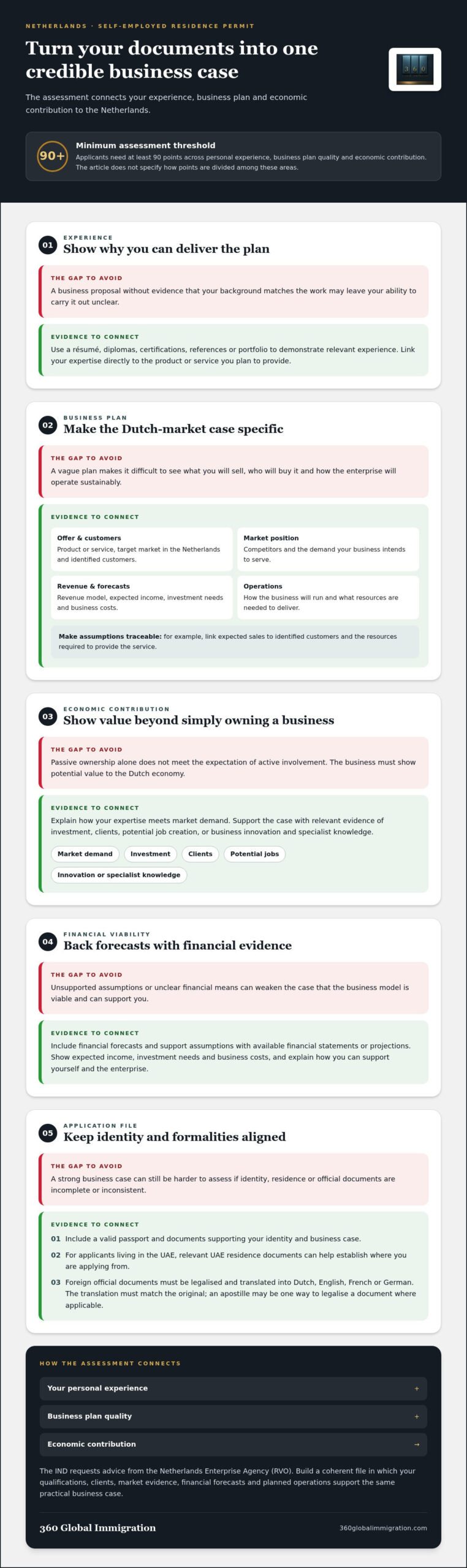
Business plan contents and supporting evidence
A strong application links the business plan to financial records, market evidence and documents explaining how the enterprise will operate in the Netherlands.
Business Plan and Financial Documents
The business plan should explain what you will sell, who will buy it and how the enterprise can operate sustainably. Dutch authorities use it to assess whether the business is viable and can support you financially.
Describe your product or service, target market in the Netherlands, competitors, revenue model and planned operations. Include financial forecasts showing expected income, investment needs and business costs, and support your assumptions with available financial statements or projections. For example, link expected sales to identified customers and the resources needed to deliver the service. Evidence such as a résumé, diplomas, certifications, references or a portfolio can show that you have the experience to carry out the plan.
RVO Assessment Criteria
The Netherlands Enterprise Agency (RVO) evaluates a self-employed applicant’s company using a points system. The assessment makes the quality of your supporting evidence important to demonstrating the business’s potential economic value.
The assessment considers your experience, the quality of the business plan and the enterprise’s economic contribution, including market demand, investment, clients, potential job creation, innovation or specialist expertise. Contracts and letters of intent can show client commitments. Explain what each agreement covers and how it supports projected revenue. A list of potential customers alone does not demonstrate the same level of commitment.
Foreign entrepreneurs commonly establish a Dutch BV or register as a sole trader, depending on their circumstances. Applicants must register with the Dutch Chamber of Commerce, known as the Kamer van Koophandel (KvK). Establishing a Dutch company is not always legally required before applying, so clearly distinguish planned registration from an existing company in your documents.
Keep your documents consistent. The services described in contracts should match the business plan, and financial projections should reflect the stated customer base and operating model. This coherence helps explain how the enterprise can contribute to the Dutch economy and support you. A residence permit does not itself establish permanent residence. These are separate immigration matters, with distinct requirements and duration considerations.
Eligibility to work as a self-employed entrepreneur
For non-EU, non-EEA and non-Swiss nationals, eligibility depends on the applicant’s active role and the business’s contribution to the Netherlands. Dutch immigration authorities assess whether you will operate the enterprise, rather than simply own it. A valid passport confirms your identity but does not show that the business meets the permit criteria.
The Netherlands self-employed residence permit assessment considers personal experience, the business plan and economic contribution. Applicants need at least 90 points across these areas. That threshold makes the evidence important: a résumé, diplomas, certifications, references or a portfolio can connect relevant experience to the services offered. The plan should also show how the enterprise addresses Dutch market demand and can operate as proposed.
Active involvement matters. Passive ownership alone is not sufficient, while an existing business may support an application if it demonstrates economic activity and contribution in the Netherlands. Records of Dutch clients or contracts, for example, can connect ongoing work to the local market. Your business plan and supporting documents should present a consistent account of your role, customers and operations.
You must also show that you can support yourself and the enterprise through a viable business model and financial evidence. There is no fixed minimum income requirement for this permit, but your forecasts should explain expected revenue and operating costs. During assessment, the Dutch Immigration and Naturalisation Service (IND) requests advice from the Netherlands Enterprise Agency (RVO), so provide evidence that supports the plan’s commercial logic and economic value.
Use the eligibility test as a practical filter: can you document relevant expertise, show active business responsibility and explain the venture’s Dutch contribution? If one element is weak, strengthen the evidence before applying rather than relying on ownership alone. Discuss your Dutch entrepreneur permit application with an adviser to understand how your profile and business evidence fit the route.
360 Global Immigration: France Passeport Talent
360 Global Immigration can guide applicants considering the Netherlands Self Employed Visa, helping them understand how their business plans and supporting documents relate to the residence route. This is a natural next step if you have reviewed the eligibility criteria and want professional guidance applying them to your circumstances.
The consultancy also supports the France Passeport Talent, UK Innovator Founder Visa and Cyprus Business Residence Visa. These are separate immigration pathways, so the right option depends on your destination and professional plans. For a Netherlands application, focus the discussion on your entrepreneurial role, evidence of economic contribution and the consistency of your supporting file.
Contact 360 Global Immigration to discuss your Netherlands self-employed visa application.
Make Your Next Move With Clarity
Your next step is to turn your intended business activity into a practical application strategy. Before assembling the Netherlands self-employed visa document checklist, consider whether your professional experience, commercial plans and intended role come together as one clear case. This helps you focus on relevant evidence instead of collecting documents without a clear purpose.
360 Global Immigration supports applicants pursuing the Netherlands Self Employed Visa, France Passeport Talent and UK Innovator Founder Visa. If you’re weighing a Netherlands application, professional guidance can help you organize your case and identify how its key elements fit together. The decision and supporting evidence remain specific to your circumstances.
Contact 360 Global Immigration to discuss your next step. A considered plan can make a complex process feel more manageable, and you can move forward with greater confidence.
Frequently Asked Questions
Do I need private health insurance to get the permit?
You need comprehensive health insurance covering your stay in the Netherlands. This is distinct from the requirement for a self-employed worker to take out Dutch health insurance within four months after arriving. Keep policy details and coverage dates available so they clearly relate to your intended stay. The required arrangements depend on your circumstances and when coverage begins.
How long does it take to receive the visa?
The Dutch Immigration and Naturalisation Service (IND) aims to decide on a self-employed residence permit application within 90 days. Complex cases can take up to 6 months, so avoid making business commitments that depend on a specific decision date. If you apply for both an MVV and residence permit through the Entry and Residence Procedure, plan around the full application process.
What are the requirements?
Applicants from outside the EU, EEA and Switzerland must show they will actively operate a business that contributes to the Dutch economy. The assessment requires at least 90 points across personal experience, business plan quality and economic contribution. You must also demonstrate that your business is viable and that you can support yourself and the enterprise. Passive ownership alone does not meet the active-role expectation.
What are the required documents for a Netherlands self-employed residence permit?
Use the Netherlands self-employed visa document checklist to organize a valid passport or other recognised travel document, the completed application and Appendix Antecedents Certificate, which declares past crimes or offences. Add business evidence, such as your plan, financial projections, contracts or letters of intent, and relevant company registration documents where applicable. A résumé, diplomas, references or portfolio can support your professional background.
What documents must non-EU applicants submit for a Dutch self-employed visa?
Non-EU applicants need identity documents and evidence supporting both their business and their eligibility. If applying from the UAE, include proof of lawful UAE residence to establish where you are applying from. Foreign official documents submitted with the application must be legalised and translated into Dutch, English, French or German. Keep each original with its translation so the document’s meaning and source are clear.
What business plan requirements apply to the Netherlands self-employed visa?
A Netherlands self-employed visa document checklist should pair business-plan evidence with financial projections and proof of market demand. Explain your product or service, target customers in the Netherlands, competitive position, revenue model and planned operations. Make your assumptions traceable: projected sales should relate to a defined customer base, while contracts or letters of intent can support expected demand. Describe the business’s economic contribution and your relevant expertise.