
A business visa permits entry or residence in another country for specified business activities, but it does not generally grant the right to work full time for an employer there. For UAE-based founders, migration consultants for entrepreneurs can help match the planned activity, business model and personal profile to a destination’s visa route. Permitted activities and residence conditions vary by country.
It’s understandable to focus first on the visa, but your destination and plans for establishing or running a business can determine which route fits. A promising idea alone may not meet a programme’s requirements: some routes assess innovation or economic contribution, while others focus on business experience, investment or self-employment.
This guide outlines business visa options, common eligibility factors, and the documents and application support involved. It also explains how to compare jurisdictions and legal structures, helping you make a more informed decision before committing to a route. Whether you’re developing a startup, expanding an existing company or planning to work independently, use this framework to assess your next steps from the UAE.
Key Takeaways
- Match the visa category to your plan: investing, launching an innovative startup, becoming self-employed, or joining a business partnership can involve different eligibility tests.
- Compare jurisdictions and legal structures against your business model, intended activities, and residence goals before deciding where to establish your venture.
- Prepare a country-specific application file, commonly including a valid passport, business credentials, travel itinerary, proof of funds, and a signed application form.
- Check language and criminal-record criteria alongside business requirements, as these can differ between visa routes and destinations.
- For the UK Innovator Founder route, review the endorsement, business progress, and maintenance-fund requirements before preparing your application.
Investor, startup, entrepreneur, property investment, and business partner visas
Business routes may cover investment, startup development, business ownership, property investment or a partnership. For a UAE-based founder, the first step is to match the planned activity to the destination’s visa criteria. Migration consultants for entrepreneurs can assess how your plans and profile align with potential routes.
Visa Options for Business Founders
Investor visas link residence to a monetary investment, often with a minimum amount. Entrepreneur routes focus on establishing or taking over a business, while startup programmes may assess innovation and economic growth. Property-based residence is usually tied to continued property ownership, and business partner routes may require proof of a financial stake.
Compare UAE entrepreneur routes, Golden Visa options and investor visas by their qualifying basis rather than treating them as interchangeable. An entrepreneur route centres on business activity; investment and Golden Visa pathways have separate criteria to assess against your circumstances.
A business visa may allow temporary residence and activities such as client meetings or conferences, but it does not authorize full-time employment for an employer in the destination country. Check that the permitted activities fit your actual business plan.
Eligibility and Business Experience
Eligibility depends on the destination and visa category. Startup applicants may need to show innovation and potential economic contribution; entrepreneur applicants may need to demonstrate business development and management potential. For the British Columbia entrepreneur route, applicants need at least 3 years of business-owner experience or at least 4 years of senior-management experience.
For UAE entrepreneur and startup options, assess the selected programme’s criteria instead of assuming one profile fits every route. Prepare evidence connecting your role, experience, proposed activity and business objectives. For example, if you’re taking over an operating company, explain your management responsibilities and development plans.
Business Plans and Expressions of Interest
A business plan should connect the proposed activity with your experience, target customers, operations and expected contribution. Where a programme uses an Expression of Interest, it can summarize your profile and proposal before a fuller application. Keep the documents consistent: business ownership, funding evidence and operational plans should tell the same story.
Whether you need UAE incorporation, a minimum investment or proof of funding depends on the route. Before establishing an overseas company, compare the destination’s visa criteria with your proposed ownership structure, funding plan and intended business activity.
Legal Support for Business Applications
International applications involve two connected questions: does the business structure support your plan, and does the visa category fit you? Migration consultants for entrepreneurs can assess destination-country eligibility, organize supporting evidence and identify gaps between the business plan and application. Look for a clear explanation of the route, required documents and filing sequence.
To reduce scam risks, avoid anyone promising guaranteed approval or pressuring you to pay before explaining the service and process. Review written terms, understand what work is included, and keep copies of submitted documents and payment records. These steps help you assess consultants for transparency and destination-specific knowledge.
Application documentation and filing support
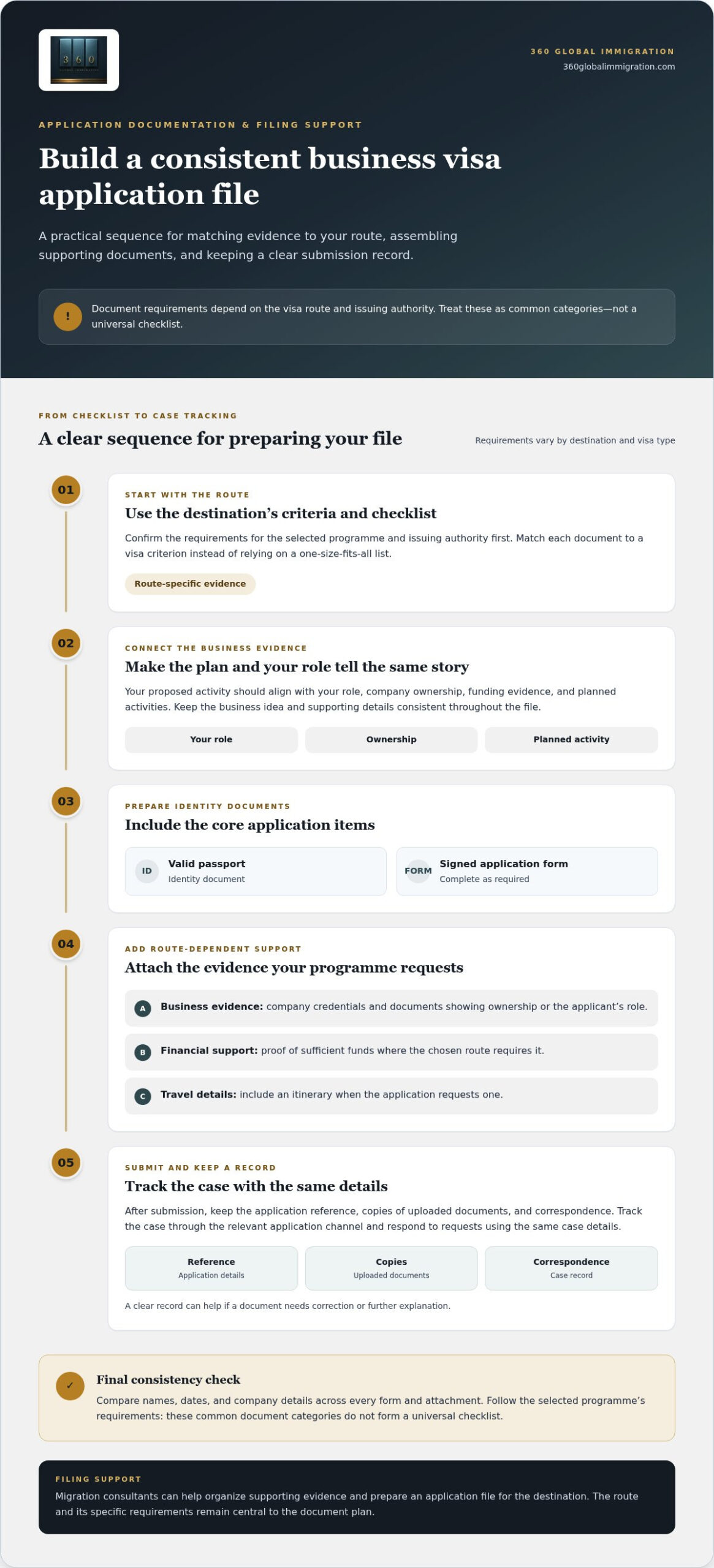
For a UAE entrepreneur visa application, requirements depend on the route and issuing authority. Common business visa documents include a valid passport, business credentials, travel itinerary, proof of sufficient funds and a signed application form. Migration consultants for entrepreneurs can help organize this evidence and prepare an application file for your destination.
Build a consistent application file
Start by matching each document to the visa criteria. Your business idea should align with your role, company ownership, funding evidence and planned activities. Use the destination’s checklist, then compare names, dates and company details across every form and attachment.
- Identity: Prepare a valid passport and signed application form.
- Business evidence: Gather company credentials and documents showing ownership or the applicant’s role.
- Financial support: Include proof of sufficient funds where the chosen route requires it.
- Travel details: Add the itinerary when the application requests one.
These are common document categories, not a universal UAE checklist. Follow the selected programme’s requirements, since eligibility and supporting evidence vary by destination and visa type.
Submission, tracking, and processing time
After submission, keep the application reference, copies of uploaded documents and correspondence. Track the case through the relevant application channel and respond to requests using the same case details. This creates a clear record if a document needs correction or further explanation.
Processing time depends on the route and application circumstances. A UK Innovator Founder visa decision made from outside the UK is usually issued within 3 weeks. This timeframe is specific to that route, not a forecast for UAE or other countries’ applications.
Family arrangements can also affect preparation. Eligibility for family members depends on the applicable visa process. Assemble each dependant’s supporting information with the principal applicant’s file, following the applicable process.
Consultant credentials and approvals
To assess whether a UAE immigration consultancy is licensed and reputable, request its licence details and service scope, then verify them with the relevant licensing authority. Review the written terms, document handling and filing steps. Avoid promises of guaranteed success or pressure to pay without clear terms.
Immigration services licensing across the United Arab Emirates can cover visa documentation, work permits and compliance support. Business licence applications and approvals are separate from a destination-country visa decision, so establish which process each service covers before filing. Migration consultants for entrepreneurs can clarify the application sequence and help prepare supporting documents.
For entrepreneurs comparing destination-specific application support, Cyprus Business Residence Visa guidance can help clarify the preparation involved for that route.
The page estimates that the UK Entrepreneur visa application process takes approximately one to two months, so applicants can use that estimate when planning document preparation without treating it as a guaranteed decision time. An E-2 applicant needs a business plan demonstrating the ability to generate a profit over the next five years. Keep the plan consistent with the application’s account of the business, the applicant’s role, and supporting evidence, and check that explanations and figures do not conflict across submitted materials. Allow time to review the complete file before filing and retain copies of the final documents.
Criminal record and English proficiency requirements
Criminal-record and language criteria depend on the destination and visa category. If you’re applying from the UAE, list requirements by country, then match each one to the principal applicant and any partner included in the application. For example, Canada’s British Columbia entrepreneur route sets a specific language threshold, while UK routes apply different rules.
Start with the visa requirements, not assumptions about a general immigration standard. Check whether the route asks for criminal-record evidence, language ability or both. Then record each requirement alongside the applicant it applies to. This helps distinguish the founder’s criteria from any separate conditions affecting a partner or dependant.
- Identify the route: Note the destination and visa category before arranging documents or a language test.
- Separate applicants: List the founder, partner, and dependants, then review each person’s stated criteria.
- Match evidence: Connect each criminal-record or language document to the relevant application requirement.
- Review validity: Follow the destination’s instructions for document format and submission.
For the UK Entrepreneur visa, applicants need a clean criminal record. English proficiency requirements can vary by visa route and application stage. These points are specific to that route, so don’t automatically apply them to another UK category or a different destination. Read the named visa rules carefully and keep the application consistent with the applicant’s history.
Language criteria can also differ by programme. Applicants to the British Columbia Provincial Nominee Program Entrepreneur Immigration Base Category must meet CLB 4 in English or French. Business visa applicants may submit IELTS or another language proficiency test score. A test result should be matched to the exact route’s requirements, rather than treated as universally accepted proof.
For practical preparation, create a checklist with separate columns for the visa, applicant, evidence and submission status. Record the required language and criminal-record documents, then compare them with the application instructions. This makes gaps visible before filing and helps keep the founder’s and partner’s records distinct.
Duration and extension rules also vary by category. The UK Home Office states that the Innovator Founder visa is granted for 3 years and can be extended. That period is specific to this route; applicants should review its extension criteria alongside the original eligibility rules. A visa’s stated duration alone does not explain what an extension application requires.
Keep a copy of each submitted test result and criminal-record document with the application record. If a route assesses a genuine business proposal alongside language or character criteria, organize evidence by requirement. This makes it easier to track outstanding items against the destination’s regulations.
UK Innovator Founder visa eligibility
For UAE-based founders, the UK Innovator Founder route is one international entrepreneur visa option. UAE business and investor residence routes are separate choices. Compare each route’s purpose and eligibility rather than treating residence categories as interchangeable.
The UK route requires an endorsement letter from an approved endorsing body before you apply. Your business proposal must meet the programme’s criteria, so clearly explain the idea, your role and planned development. The route has no fixed minimum investment requirement, but you must meet its other eligibility conditions.
For applications made from outside the UK, the UK Home Office requires applicants to hold at least £1,270 in their bank account for 28 consecutive days. Keep evidence of the funds and make sure the maintenance funds are not also counted as investment funds.
The UK Home Office states that the visa is granted for 3 years and can be extended. UK Innovator Founder visa holders meet their endorsing body after 12 and 24 months to demonstrate progress. Under current UK rules, holders may be able to apply for settlement after 3 years. Treat each milestone as part of the business plan, not simply as an immigration formality.
Application and endorsement fees are separate cost categories. The amount depends on the relevant application and endorsement requirements, so budget for both when planning. These are government and endorsing-body charges, not consultancy fees.
When comparing a UK Entrepreneur visa with the current Innovator Founder route, distinguish their names and eligibility frameworks. The available material for the former refers to a detailed business plan and investment funds, while the Innovator Founder route requires endorsement and has no fixed minimum investment. Confirm which route is current before relying on older entrepreneur visa guidance.
For comparison, the US L-1 route concerns transfer from a related company: an applicant must have worked for that company outside the United States for at least one year during the previous three years. The E-2 route requires citizenship of a country with an agreement with the United States; it may be extended without a stated limit while the company operates and remains profitable. These routes have different profiles and do not establish UAE residency.
UAE founders can assess business, investor and other residence pathways according to their activity and circumstances. Key factors include your intended role, ownership, funding and the rules attached to the selected route. Compare these criteria before choosing a destination or restructuring a company.
UAE-based entrepreneurs can consider business and investor residence routes, along with other pathways suited to their activity and circumstances. These are separate from the UK Innovator Founder and US routes.
Choosing a legal structure and jurisdiction
For a UAE-based founder, the jurisdiction and company structure should support your business plan and intended visa route. Compare where you’ll establish the company with where you want to live and operate. Setting up a UAE company and applying for overseas residence are separate decisions, even when both support an international business strategy.
In the UAE, founders commonly assess Free Zone, Mainland and LLC structures against their business goals. Start by comparing the company’s activities, ownership plan and expected customer markets. For example, if you plan to work with clients across several markets, map those activities before selecting a structure.
Use this sequence to narrow the decision:
- Define the activity: Describe the company’s actual services and planned operations.
- Set the market: Identify where customers, partners, and business opportunities are located.
- Compare structures: Assess Free Zone, Mainland, and LLC options against those goals.
- Align the visa: Check that the ownership and business role support the chosen destination’s application.
IFZA, Meydan and Shams are named Free Zone setup options, while Mainland setup is associated with DET. These names help frame the UAE comparison, but your decision should still reflect your activity and operating plan. A structure chosen only for convenience may not meet your longer-term business needs.
An LLC may require a memorandum of association, or MOA. Include this document in your setup planning, then compare its ownership details with your visa application. Inconsistent company and immigration records can raise avoidable questions during submission. Keep the business activity, ownership information and your role aligned across documents.
Your jurisdiction choice also affects your immigration strategy. If you’re considering a destination abroad, compare its visa criteria with your company’s actual structure, business plan and intended role. A self-employed applicant and a founder expanding an existing company, for instance, may need different evidence. Choose a route that fits both your plans and the destination’s requirements.
Before committing, prepare a short comparison table covering activity, ownership, market, visa route and required company documents. This makes trade-offs visible and gives advisers a clear basis for discussing options. It can also help prevent a mismatch between your UAE company structure and a later overseas opportunity.
For tailored guidance on aligning a destination with your business plans, discuss your international immigration strategy.
Keep your final comparison focused on the intended immigration services business and your goals, rather than treating any structure as automatic. Weigh Free Zone, Mainland and LLC options against your planned activity and ownership. The named Free Zone options are IFZA, Meydan and Shams; the authority named for Mainland setup is DET.
If you’re considering an LLC, include the MOA in your setup review, since it may be required when establishing an immigration services business. Use this alongside your structure choice to assess whether the proposed setup fits your goals and planned immigration route.
360 Global Immigration: France Passeport Talent
360 Global Immigration provides guidance to entrepreneurs considering the France Passeport Talent route. Turn to the firm when you’re comparing destination options or need support aligning your business profile and application with the relevant visa pathway.
For founders whose plans point elsewhere, the firm also supports applications for the UK Innovator Founder Visa, Netherlands Self Employed Visa, and Cyprus Business Residence Visa. Each route serves a different purpose, so the right starting point is your intended business activity, ownership role, and destination. Clear guidance can help you focus on the pathway that fits your plans and prepare for its specific application requirements.
Contact 360 Global Immigration to discuss your options, or visit 360globalimmigration.com.
Turn Your Business Plan Into a Clear Next Step
Your next step is to turn your priorities into a focused decision brief. Set out where you want to build, the work you plan to do, your role in the business and the documents you can provide. This gives migration consultants for entrepreneurs a practical basis for discussing suitable routes and keeps your immigration strategy connected to your business goals.
360 Global Immigration supports entrepreneurs considering the France Passeport Talent, UK Innovator Founder Visa, and Netherlands Self Employed Visa. The right route depends on how your plans align with each destination’s requirements, not simply on the appeal of a particular country. A considered discussion can help you clarify which pathway to explore and what preparation it involves.
When you’re ready to discuss your plans, contact 360 Global Immigration. With a clearer direction, you can take your next step with purpose and confidence.