
A long-term Schengen visa for business owners is not simply an extended business visitor visa. A standard Schengen business visa is a Type C short-stay visa, allowing a stay of up to 90 days in any 180-day period, according to the European Union. For stays of more than 90 days, a Type D visa is intended for the country that issues it.
It’s understandable to expect a long-term visa to allow unrestricted travel across Europe. The distinction matters: a Type D visa permits travel within the Schengen Area for up to 90 days in any 180-day period during its validity, but the longer stay is tied to the issuing country.
This guide explains what a Schengen business visa covers, how Type D status affects travel, and what business owners should know about eligibility and previous visa history. It also covers how an overstay may affect future applications and why the purpose and pattern of planned travel matter when considering a longer-term route.
Key Takeaways
- Distinguish a short business visit from a longer stay: the visa type and issuing country shape what you can do and where you can stay.
- Assess eligibility through the purpose of travel, supporting business and financial evidence, and ties to your country of residence.
- Review your previous visa history carefully, as overstays can affect future applications and travel plans.
- For repeated business trips, understand how prior multiple-entry visas and evidence of ongoing travel needs may influence eligibility for a longer-validity visa.
What is a Schengen business visa?
A Schengen business visa is a Type C short-stay visa. According to the European Union, it permits non-EU nationals to stay in the Schengen area for up to 90 days in any 180-day period. It can cover meetings, negotiations, trade fairs, training, and customer appointments, provided the activities don’t amount to productive participation. A Long-term Schengen visa for business owners involves a different question: whether the planned stay calls for a national visa.
For a business owner, evidence of profitability can help explain the purpose of travel and the ability to fund it. Business income certificates covering at least the previous year can show an established income pattern. Company registration certificates, tax returns, and business bank statements provide further context. Keep the figures and details consistent across these documents so the application presents a coherent picture of the business and its income.
For owners who prepare income certificates monthly, include the previous 12 certificates; quarterly records may show 4 certificates covering the last year. An official annual certificate can support internal records where available. Profitable business income can help demonstrate reasons to return to the country of residence and the means to pay for the trip.
The European Commission sets the adult Schengen visa fee at EUR 90. Reduced or exempt fees can depend on an applicant’s age or nationality, while a visa service centre may add a service charge. Standard processing takes 15 calendar days, but it can extend to 45 days if further documents or detailed review are needed.
Submit the visa application no earlier than 6 months before travel and no later than 15 days before departure. Apply through the consulate responsible for the country where you legally reside. Prepare the application, passport, business evidence, travel itinerary, and a letter explaining the visit’s purpose. Attend the appointment to submit documents and provide fingerprints when required.
Travel insurance must cover emergency medical care, hospitalisation, and repatriation, including in the event of death. Choose a policy suited to an extended trip that covers the full travel period and required destinations. For a Long-term Schengen visa for business owners, distinguish this insurance and application process from arrangements for a stay exceeding the short-stay limit.
An overstay can lead to refusal of future applications, an entry ban, or a fine. If a consulate refuses or cancels a visa, read the decision carefully and follow the appeal process and deadline stated in it.
Schengen travel permitted with a Type D visa
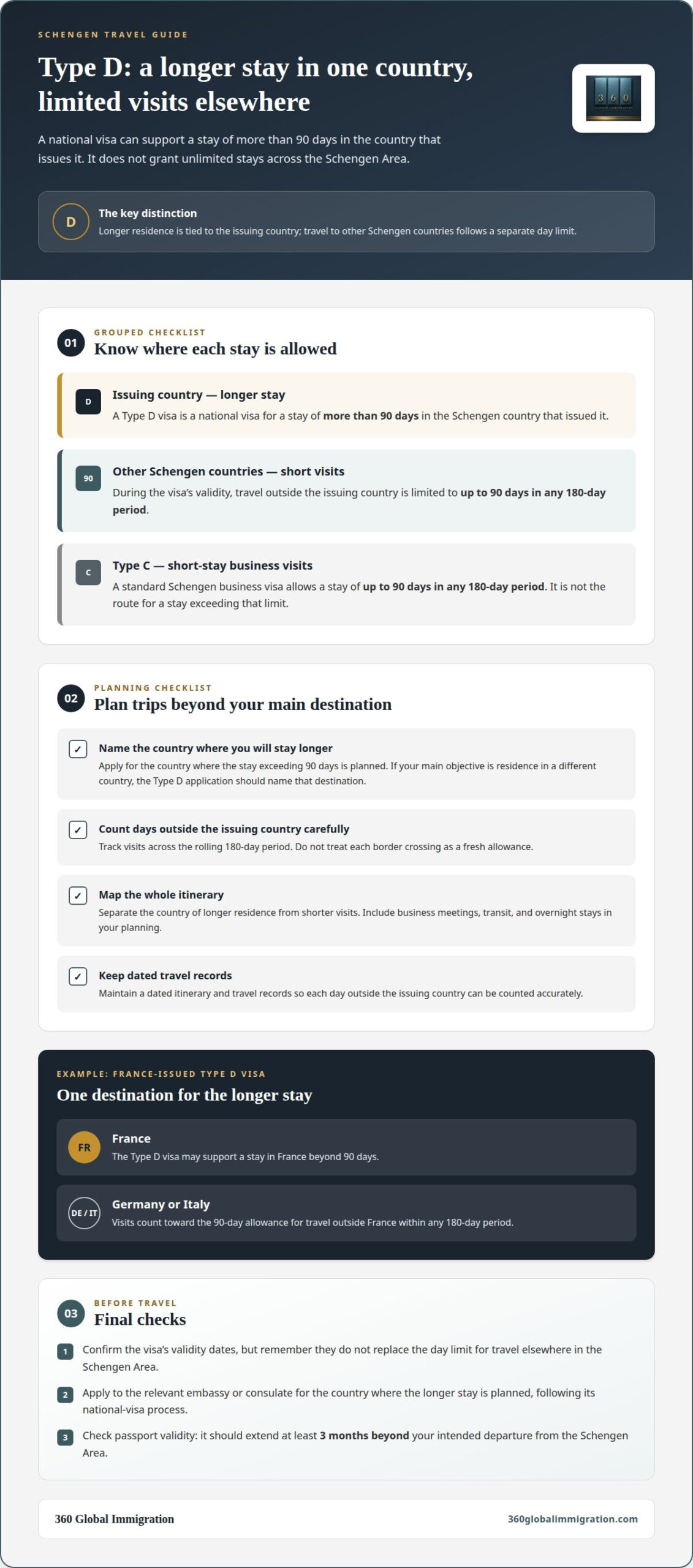
A Type D visa is a national visa for a stay of more than 90 days in the Schengen country that issues it. It supports a longer stay in that country, while travel to other Schengen Area countries follows a separate limit: up to 90 days in any 180-day period during the visa’s validity. The visa’s long duration does not create an unlimited right to stay across the region.
For example, a business owner with a Type D visa issued by France can plan a stay in France beyond 90 days. Visits to Germany or Italy during the visa’s validity count toward the 90-day allowance for travel outside the issuing country. Track those visits across the rolling 180-day period, rather than treating each border crossing as a fresh allowance.
The visa sticker and the permitted stay serve different purposes. The visa’s validity shows when it can be used, but does not replace the day limit for travel elsewhere in the Schengen Area. Plan business meetings, transit, and overnight stays with a clear distinction between the issuing country and other Schengen countries. For a multi-country itinerary, identify where you intend to spend the longer period and where you will make shorter visits.
During the application, select the country where the stay exceeding 90 days is planned. Submit the application form and supporting documents to the relevant embassy or consulate for that country, following its process for national visas. Passport validity also matters: the passport should remain valid for at least 3 months beyond the intended departure from the Schengen Area.
Before travelling, compare your intended residence and regional visits with the visa’s validity. Keep a dated itinerary and travel records so you can accurately count each day outside the issuing country. If your main objective is residence in a different country, the Type D application should name that destination. Short visits elsewhere are not a substitute for long-term residence.
Eligibility requirements and previous visa history
Eligibility for a Long-term Schengen visa for business owners depends on a credible purpose, suitable funding, and evidence supporting the planned stay. The application should link the proposed business activities to the destination. Company registration, tax records, and business income documents can help explain the enterprise’s operations and finances. Keep details consistent throughout the application.
Previous travel history can help demonstrate compliance with earlier visa conditions. An overstay can lead to future application refusals, entry bans, or fines. After an overstay, a renewed five-year Schengen visa cannot be issued. Accurately disclose any relevant previous refusals or cancellations, and provide a clear explanation if the application asks about them.
Explain how you will fund the trip and why you will return to your country of residence. Profitable business income can support both points. If your business operates in a country where you hold temporary or permanent residence, include a copy of your residence permit if applicable. Medical insurance and evidence linked to the stated business purpose can also help complete the application.
For a Long-term Schengen visa for business owners, the destination country and consulate determine the application route and document instructions. If you plan to visit multiple Schengen countries, apply through the country where you will spend the longest time. If your stays will be equal, apply through the first country you visit. The consulate responsible for your legal residence handles the submission.
Before applying, make sure your itinerary, invitations, business records, and financial evidence align. For example, a business owner travelling to France and Germany should identify the main destination by comparing the planned time in each country. Your nationality and legal residence can affect where you submit the application and which instructions apply. Clearly documenting the purpose helps the consulate assess whether the requested visa fits your proposed travel.
Can business owners get a multiple-entry Schengen visa valid for one to five years?
Yes, business owners can apply for a multiple-entry Schengen visa for repeated trips during its validity. The visa allows several visits, but it doesn’t extend the short-stay limit. Each stay remains subject to the 90-day limit in any 180-day period. A visa valid for several years offers flexibility between trips, not permission to live or work permanently in a Schengen country.
The Schengen Visa Code’s Article 24 governs requirements for a five-year multiple-entry visa. An applicant must have obtained and properly used a two-year multiple-entry visa within the preceding three years. Previous travel records therefore matter: they show whether the applicant followed the terms of earlier visas before seeking longer validity.
Explain why you need repeated entries over an extended period. A focused letter can outline the business purpose, expected travel pattern, and reasons for recurring visits. Invitations, business travel plans, or medical evidence can support the explanation where relevant. For example, invitations to recurring negotiations may clarify why a single trip would not meet the business need.
Consistency matters. The dates and purpose in your letter should match the invitations and proposed travel schedule. A request for five-year validity is better supported when the evidence explains the need across that period, rather than describing only one upcoming meeting. Prior visa use and a credible pattern of future travel are central considerations under the stated progression for five-year validity.
Before planning each visit, count days across the rolling 180-day period. A five-year visa still limits short stays to 90 days in any 180-day period. It does not authorize permanent employment in Germany or another Schengen country. Repeated business travel and long-term residence are different objectives, so choose the route that matches the intended stay. For a separate residence pathway, explore business residence visa options.
360 Global Immigration
360 Global Immigration helps business owners assess business and talent-based residence pathways in Europe and the UK when their plans extend beyond short-term Schengen visits. Its guidance covers options such as the France Passeport Talent, UK Innovator Founder Visa, Netherlands Self Employed Visa, and Cyprus Business Residence Visa. These are distinct pathways, so the right route depends on the destination and the applicant’s business plans.
If your goal is longer-term residence rather than repeated short business trips, consider whether one of these routes better matches your intended country and professional activity. 360 Global Immigration can guide you through the relevant pathway and its application requirements.
Contact 360 Global Immigration to discuss your business and residence plans.
Choose the route that fits your next move
The right route depends on whether your priority is short business travel or establishing a longer-term base in a particular country. A Long-term Schengen visa for business owners may not suit plans involving residence or building a business abroad. Before choosing an application route, consider how your intended destination, professional activity, and future plans fit together.
For business-led plans, France Passeport Talent, UK Innovator Founder Visa, and Netherlands Self Employed Visa are distinct pathways to consider. Each has its own purpose, so the best next step is to clarify where you intend to develop your business and what kind of activity you plan to undertake. That focus can help shape a more coherent immigration plan.
If you’re ready to discuss your business and destination plans, contact 360 Global Immigration. A clear direction can help you move forward with greater confidence.
Frequently Asked Questions
How long does the application take?
Standard processing takes 15 calendar days, and a detailed review or request for further documents can extend it to 45 days. Submit the application no earlier than 6 months before travel and no later than 15 days before departure. Build appointment scheduling and document preparation into your timeline, since these happen before processing begins.
How long can you stay?
A Type C Schengen business visa permits a stay of up to 90 days in any 180-day period. A Type D visa is for a longer stay in its issuing country, while travel elsewhere in the Schengen Area remains limited to 90 days in any 180-day period during its validity. These permissions are distinct from the visa’s overall validity.
How much does a visa cost?
The application fee depends on the applicant’s age and nationality, and a visa service centre may add a service charge. For applicants based in the UAE, the applicable fee depends on the application route and individual circumstances. When planning your budget, distinguish the application fee from any service-centre charge.
What documents are needed to apply?
Prepare a completed application form, passport, travel plan, and evidence explaining the business purpose. Support your application with a company registration certificate, tax return, business bank statements, and income certificates. Include a residence permit if applicable. An invitation or meeting details can clarify the trip, while insurance should cover emergency medical care, hospitalisation, and repatriation.
What is the maximum validity of a Schengen business visa for business owners?
A multiple-entry Schengen visa can be valid for up to five years. This allows repeated visits, but does not increase the permitted short-stay allowance. To qualify for a five-year visa, the applicant must have obtained and properly used a two-year multiple-entry visa within the preceding three years. Visa validity and permitted stay are separate measures.
What are the eligibility requirements for a long-term multiple-entry Schengen business visa?
Applicants need a credible reason for repeated trips, supported by a letter explaining why multiple entries are necessary over an extended period. Business invitations or travel plans can substantiate the request. Eligibility for a five-year multiple-entry visa also depends on having properly used a two-year multiple-entry visa within the preceding three years. Previous compliance and consistent supporting records matter.