Ireland’s startup visa success rate is best read as a historical benchmark: between 2014 and 2018, STEP approved 129 of 435 applications, approximately 30%. That figure describes those years, not a current annual rate. STEP is Ireland’s Start-up Entrepreneurs Programme for entrepreneurs proposing an innovative business.
It’s understandable to look for a clear percentage before committing time and resources. But the Ireland startup visa success rate alone can’t show whether a particular proposal meets the programme’s requirements. The business’s innovation, growth potential and ability to scale all matter.
This guide explains what STEP requires, how applications are assessed and why a compelling, scalable business plan is central to eligibility. It also clarifies what a refusal means: a refusal under STEP is final and cannot be reviewed or appealed. You’ll learn how to understand that outcome and assess your next steps against the programme’s criteria.
Key Takeaways
- Assess whether the venture can meet STEP’s growth benchmarks, not simply whether the idea is new.
- Show how the business can scale and why its founder has a meaningful decision-making role.
- Plan funding around the main applicant and any additional founders joining the same venture.
- After a refusal, use the decision to assess whether another residence pathway better matches your plans.
Ireland’s Start-up Entrepreneurs Programme (STEP)
Ireland introduced the Start-up Entrepreneur Programme in 2012 to help innovative entrepreneurs establish a business and live in Ireland full time. STEP is intended for non-EEA applicants proposing a business with strong growth potential, rather than a conventional route for opening any small business. An entrepreneur’s application is assessed on the proposal and supporting evidence, not a points score or degree requirement.
Applicants submit the application form, business proposal and supporting documents electronically. An independent evaluation committee of senior public and civil servants assesses proposals in quarterly batches and may request further information. Applications can be submitted at any time, but assessment follows the committee’s quarterly schedule. Processing takes an average of 3-4 months, so applicants should account for the assessment stage when planning a launch.
Ireland’s route differs from startup visas in the UK and other EU countries because eligibility rules and assessment processes vary by programme. STEP has no points system or degree requirement. Compare each route’s business and evidence requirements with your venture’s plans.
The STEP application fee is €350 and is non-refundable. No separate fee amount is given here for other programme charges; applicants should distinguish the application fee from costs involved in establishing and operating a business.
Permission comes with obligations: participants must establish the proposed venture, work on it full time, avoid other employment and avoid becoming a financial burden on the Irish State. The initial residence permission lasts two years. Eligible participants can renew, and STEP can support family members, including a spouse or partner and children under 18. Healthcare and education access are among the benefits described for participants. These conditions make preparation important: the business plan must explain how the venture will operate, while supporting documents must substantiate its funding and proposed activities. Startup challenges such as turning an innovative concept into a credible operating plan therefore affect both business readiness and the immigration assessment.
Innovative and scalable business criteria
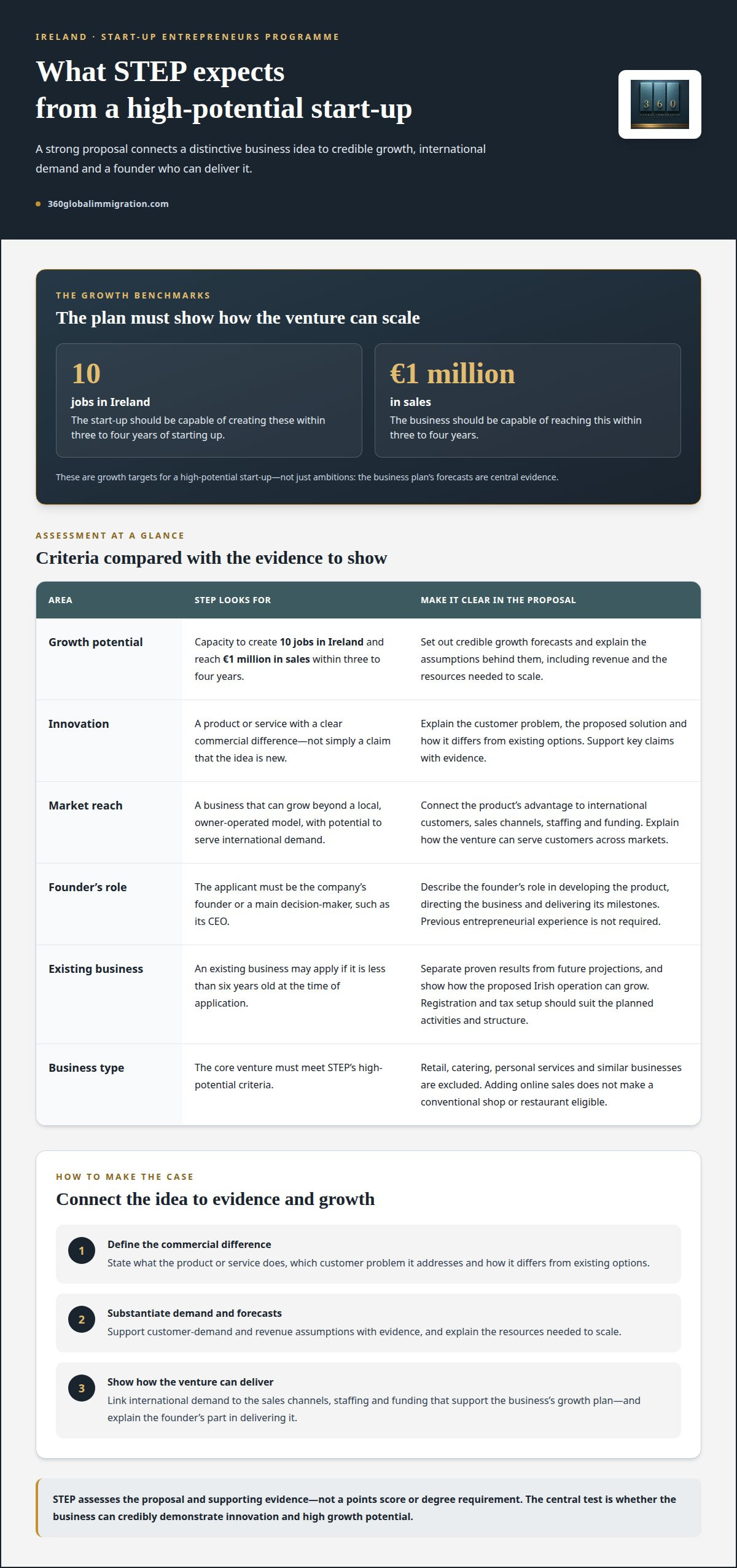
STEP assesses whether a venture can grow beyond a local, owner-operated business. A high-potential start-up should be capable of creating 10 jobs in Ireland within three to four years of starting up and reaching €1 million in sales within three to four years. These targets make the business plan’s growth forecasts central evidence, not optional ambitions.
Innovation needs a clear commercial explanation. Describe the product or service, the customer problem it addresses and how the proposed solution differs from existing options. Then connect that advantage to international demand, sales channels, staffing and funding. For example, a software venture should explain how it can serve customers across markets, rather than relying only on a claim that its technology is innovative.
The founder must be the company’s founder or a main decision-maker, such as its CEO. Previous entrepreneurial experience isn’t required; the assessment focuses on the business plan. Explain the founder’s role in developing the product, directing the venture and delivering its milestones. Support key claims with evidence, including customer demand, revenue assumptions and the resources needed to scale.
An existing business may apply if it is less than six years old at the time of application. Its plan should distinguish proven results from future projections and show how the proposed Irish operation can grow. Business registration and tax setup should also suit the planned activities and structure. Present these as practical steps in establishing the venture, not as proof of innovation or eligibility on their own.
Retail, catering, personal services and similar businesses are excluded from STEP. A conventional shop or restaurant therefore does not become eligible simply by adding an online sales channel. The core venture must meet STEP’s high-potential criteria. Applicants weighing another founder-led route can compare the UK Innovator Founder Visa against their business model and residence plans.
Refusal decisions and appeals
A refusal under Ireland’s Start-up Entrepreneur Programme is final and cannot be reviewed or appealed. That makes the decision letter important: read it carefully and identify which parts of the proposal or application it addresses. Separate the stated concerns from assumptions about investment, employment, the founder’s character or the product or service. A refusal does not allow you to continue with the proposed immigration plan.
Next, compare the decision with the evidence you submitted. For example, if the business plan projected international sales, consider whether the customer, revenue and delivery assumptions were supported. If funding was central to the proposal, distinguish documented funds from plans for future investment. These steps can help you understand the application’s strengths and gaps, but they do not provide a way to appeal or reopen the refused case.
- Record the outcome. Keep the refusal letter and the submitted application together, so the decision can be understood in context.
- Identify the affected plan. Note whether the decision concerns the venture, the founder’s role or the requested residence permission.
- Reassess the route. Consider whether another immigration basis fits the applicant’s circumstances and business plans.
A refused application does not itself establish eligibility for a different permission. Assess any alternative route against its own requirements before making further plans. A partner’s circumstances may also need separate consideration; don’t assume a partner receives permission through a STEP application that was refused.
If a venture later fails after STEP approval, the participant’s immigration status is reviewed and they must apply to remain in Ireland on another basis. This differs from an initial refusal, but underlines why business continuity and residence planning belong together. Assess a potential venture not only for its product, employment plans and investment, but also for how the founder would respond if the business changed direction. The refusal letter can inform a careful reassessment, but the final decision itself cannot be appealed.
What is the minimum funding required for an Ireland startup visa?
STEP applicants must have €50,000 in funding available. A high-potential start-up proposal requires €75,000 in funding. These are programme funding thresholds, separate from the non-refundable application fee described earlier. For an applicant planning from the UAE, the requirement is set in euros, so account for currency conversion when arranging funds.
Founders applying together must also account for the additional funding requirement: STEP requires €30,000 for each subsequent founder joining the same business. This applies in addition to the funding needed for the proposal. A business plan should explain how the funds support the venture’s launch and growth, rather than treating the threshold as a standalone figure.
Timing matters too. Funds must have been maintained for at least three months before the date of the letter. A last-minute transfer may therefore fail to meet the stated holding period. Organise supporting evidence so the available funding and its history are clear when the application is assessed.
- Set the applicable threshold. Distinguish the €50,000 general funding requirement from the €75,000 requirement for a high-potential start-up proposal.
- Include co-founders. Add the €30,000 requirement for each subsequent founder joining the same business.
- Show the funding timeline. Evidence should demonstrate that funds were maintained for the required three months before the letter’s date.
Funding is one part of the assessment, not a substitute for a credible proposal. The plan should connect available resources to operating needs, product development, hiring and projected sales. For example, explain how the proposed funding supports the milestones behind the business’s growth forecasts. A mismatch between the funds shown and the costs described can make the plan harder to assess.
For tailored guidance on presenting an Ireland business residence application, discuss your Ireland visa plans.
360 Global Immigration: Ireland Business Residence Visa
360 Global Immigration provides guidance on the Ireland Business Residence Visa for applicants assessing a business-based residence route. After reviewing STEP’s requirements, this can be a practical next step when you need to understand how your plans align with an Irish business residence pathway.
If your venture or circumstances point elsewhere, 360 Global Immigration also offers the Denmark Startup Visa, France Passeport Talent and UK Innovator Founder Visa. The relevant option depends on your business plans and intended destination, so consider the route that best fits before moving forward.
For guidance on your Ireland business residence plans, contact 360 Global Immigration.
Choose your next move with clarity
The Ireland startup visa success rate provides context, but shouldn’t determine your direction on its own. Align your business plans, founder role and residence goals with a route whose requirements suit your circumstances. If your plans change, reassess the destination and business model before committing to a new application.
For entrepreneurs considering other options, 360 Global Immigration also offers France Passeport Talent, the UK Innovator Founder Visa and the Netherlands Self Employed Visa. Each pathway relates to a different business or professional plan, so focus on the route that best matches your intended move.
Discuss your next immigration step with 360 Global Immigration, and move forward with a clearer plan.
Frequently Asked Questions
What is the Ireland Startup Visa?
Ireland’s Start-up Entrepreneur Programme, or STEP, is a residence route for non-EEA entrepreneurs proposing a high-potential business in Ireland. It is designed for founders who will establish and work on their venture full time, not for people seeking permission to take unrelated employment. The proposal must demonstrate innovation and potential for international growth, so a local business idea alone may not fit the programme.
Can I apply?
You may be eligible if you are a non-EEA entrepreneur with a qualifying business proposal and the required funding. Your role must be as the founder or a main decision-maker, such as CEO. For example, a founder leading an innovative product venture may fit the profile, while conventional retail or catering businesses are excluded. The committee assesses the proposal and supporting evidence.
What happens if my application is approved?
If the proposal is accepted, the successful applicant receives a letter granting permission to reside in Ireland. That permission is tied to establishing and working on the proposed business, so approval is not a general work authorisation for unrelated employment. Eligible family members include a spouse or partner and children under 18. Plan the move around the venture’s launch and your full-time role.
Do I need to prove that I am an experienced entrepreneur to apply?
No. Previous entrepreneurial experience is not a stated STEP requirement. The business plan is central to the assessment: it should explain the product, customer need, commercial model and growth case. A first-time founder can strengthen the proposal by showing relevant skills, clear responsibilities and evidence for key assumptions. For instance, explain how the founding team will develop the product and reach international customers.
How do I secure an Irish entrepreneur visa?
Prepare a STEP application form, a detailed business proposal and supporting documents, then submit them electronically. Make sure the materials tell a consistent story about the venture, your role and its funding. The evaluation committee may request more information, so keep the evidence organised and address the programme’s innovation and growth criteria directly. Approval depends on the assessment, not simply on completing the form.
What is the success or approval rate for Ireland’s Start-up Entrepreneur Programme (STEP)?
The Ireland startup visa success rate recorded in the historical figures is approximately 30%: STEP approved 129 of 435 applications received between 2014 and 2018. This is a combined rate for that period, not an individual applicant’s probability or a current-year figure. Use it as context only; the proposal’s fit, supporting evidence and growth potential are central to the committee’s assessment.