
Owning or investing in an Irish business isn’t, by itself, a route to residence. The Ireland business residence visa requirements depend first on whether your plans fit an available immigration pathway, particularly the Start-up Entrepreneur Programme (STEP), rather than simply on your ability to fund a business. Ireland’s Immigrant Investor Programme closed to new applications in 2023, making the distinction between active entrepreneurship and passive investment especially important.
If you’re unsure which route applies, that uncertainty is understandable. A promising business idea or investment alone may not meet the criteria, and outdated online summaries can make it harder to identify what officials currently require. A careful assessment of route fit can help you focus your preparation before committing to an application.
This 2026 guide explains STEP’s core eligibility criteria, including the high-potential start-up expectations, and outlines the evidence and practical preparation involved. It also highlights what to verify against current Irish government guidance, so you can decide whether STEP merits further consideration and approach the process with a clearer plan.
Key Takeaways
- The phrase “business residence visa” can refer to different goals, so identify the Irish route that matches your plans before preparing an application.
- Ireland business residence visa requirements involve more than the business idea: STEP considers the applicant, the proposed venture, and supporting evidence, including good character.
- Compare an innovative startup, ordinary employment, and expansion of an established business to clarify which route questions to research.
- Prepare a coherent application file by mapping each criterion to evidence, such as the form, business proposal, funding records, source-of-funds information, and character documents.
- Specialist guidance can help organise route assessment and application review, while the decision remains with Irish immigration authorities.
Ireland Business Residence Visa Requirements: Which Route Is Relevant?
“Business residence visa” is a useful search phrase, but it isn’t the name of one universal Irish immigration permission. The right route depends on what you intend to do in Ireland and the basis on which you seek to live there. For entrepreneurs proposing an innovative start-up, the Start-up Entrepreneur Programme (STEP) is the specific route to investigate. Irish authorities decide applications under the relevant programme or permission; business ownership alone doesn’t establish a right to reside.
A visa generally concerns permission to travel to a country, while residence permission concerns the legal basis for staying there. The two may be connected in an application, but they aren’t interchangeable. Your nationality, travel purpose and intended length of stay can affect which entry requirements apply, alongside the separate question of residence. The overview of Visa policy of Ireland provides context on Ireland’s visa arrangements and its relationship to the Schengen Area and Common Travel Area. For a decision, rely on current Irish government guidance.
What is the Start-up Entrepreneur Programme?
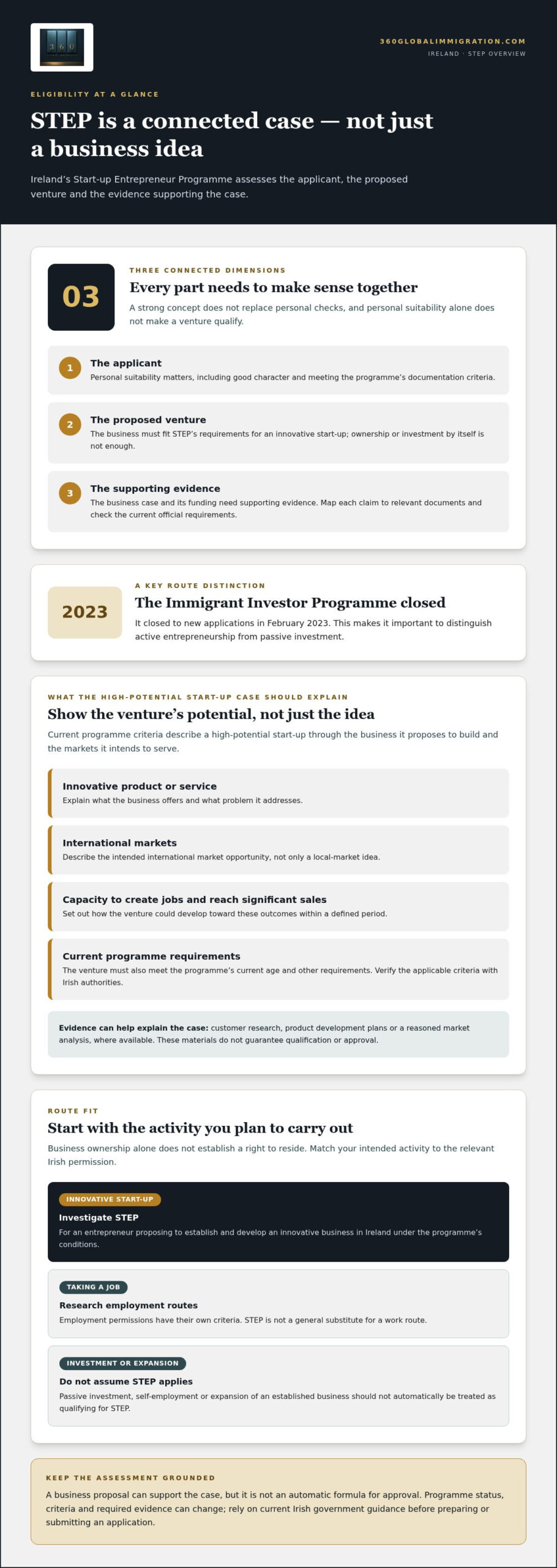
STEP is intended to enable qualifying entrepreneurs to establish an innovative business in Ireland and reside there under the programme’s conditions. Its business assessment is distinct from the applicant’s personal requirements: a proposal must be considered on its merits, while the applicant must also meet character and documentation criteria. A strong business concept does not replace those personal checks, and personal suitability alone does not make a venture qualify.
Programme status and applicable criteria can change. Before preparing or submitting an application, check the current STEP guidance published by Irish authorities, including its eligibility rules, required evidence and conditions of permission. This is particularly important if you’re relying on an older article or summary.
When is a business route different from a work visa?
Start with the activity you plan to carry out, not simply the fact that you own a company. A founder seeking to establish an innovative venture is assessing a different basis for residence from someone whose purpose is to take a job with an Irish employer. Employment routes have their own criteria; STEP is not a general substitute for an employment permission.
Likewise, self-employment, investment in a company or expansion of an established business shouldn’t automatically be treated as qualifying for STEP. The former Immigrant Investor Programme closed to new applications in February 2023, according to the programme information available for this guide. That makes it especially important to distinguish an active, qualifying start-up proposal from passive investment or routine commercial activity, then investigate the route that matches your actual plans.
For UAE-based applicants, a practical first step is to describe your intended role in Ireland in one clear sentence: will you establish and develop an innovative start-up, take employment, or expand an existing operation? Then compare that purpose with current official route guidance before investing time in an application file. This route-first assessment brings the Ireland business residence visa requirements into focus and helps prevent a common misstep: preparing documents for a pathway that does not match the proposed activity.
Ireland STEP Eligibility: Innovation, Funding, and Applicant Criteria
STEP eligibility is best assessed as a connected case, not a checklist of isolated boxes. The applicant’s character, the proposed venture’s fit with the programme, and the evidence supporting the business and its funding all matter. A weakness in one area can leave important questions unanswered, even when the other parts of the application look strong.
A promising business idea is not proof that the venture meets STEP criteria. Applicants need to explain what makes the proposal innovative, how it could develop in Ireland, and how the available evidence supports those claims. The Ireland business residence visa requirements should therefore be assessed against current official guidance, rather than inferred from business ownership or an appealing concept alone.
Does the proposed business meet the innovation requirement?
STEP is aimed at establishing an innovative business, not simply operating any business in Ireland. Current programme criteria describe a high-potential start-up as one with an innovative product or service intended for international markets and the capacity to create jobs and reach significant sales within a defined period. The venture must also meet the programme’s current age and other requirements.
Build the proposal around a clear commercial case. Explain the problem being addressed, who the target customers are, what the business will offer, and why the solution has potential beyond a local market. Support these points with relevant evidence, such as customer research, product development plans, or a reasoned market analysis, where available. These materials help make the proposal understandable; they don’t establish an automatic formula for approval or guarantee that a business will qualify.
How should applicants assess funding and personal eligibility?
Funding is a central part of the assessment. Irish guidance identifies the availability of funding and its source as relevant supporting evidence. The minimum funding threshold is time-sensitive, so verify the current amount, how it applies to additional founders, the acceptable evidence, and any source-of-funds requirements directly against the latest official STEP guidance before relying on a figure. Keep the explanation of where the funds came from consistent with the documents submitted.
From the UAE, organise financial records so the stated funds, their ownership and their origin can be followed clearly. The precise documents required depend on current instructions, so avoid assuming that one type of account statement or business record will satisfy every case. Check the official document list and resolve discrepancies before filing.
Applicant criteria matter separately from the business assessment. Official STEP information lists good character and no criminal convictions among the requirements. Read the current declarations carefully and provide accurate information and requested character documents. Don’t assume that a business plan can compensate for an issue in an applicant’s personal eligibility, or generalise the stated rule beyond the official wording.
A structured review can help connect the venture narrative, funding explanation and personal documents into one coherent file. 360 Global Immigration provides Ireland business residence application guidance to help applicants organise route assessment and preparation; the decision remains with Irish immigration authorities.
Is STEP the Right Ireland Business Residence Route for Your Plans?
Use your intended activity as the starting point for route research. STEP focuses on an innovative start-up proposal; an employment plan or an established company’s expansion raises different questions. The comparison below is a guide to what to investigate, not a decision on eligibility. Irish authorities assess applications under the current rules for each route.
| Plan | Route question to research | What to clarify |
|---|---|---|
| Propose an innovative start-up | Does the venture align with STEP’s current purpose and criteria? | What is innovative about the proposed business, and what evidence supports its market and growth case? |
| Take a job with an Irish employer | Which employment route applies to the role and applicant? | What permission and employer or role conditions apply under current official guidance? |
| Expand an established business | What route, if any, matches the applicant’s specific role and planned activity in Ireland? | Is the Irish proposal itself a qualifying start-up, or is the plan primarily an expansion of an existing operation? |
What if the plan is an established business rather than a startup?
Owning a company, investing in one, or planning to open a branch in Ireland does not by itself establish STEP eligibility or a right to reside. Examine the actual Irish venture against the programme’s innovation focus and current criteria. For example, describe what the proposed Irish operation will offer and how it differs from simply continuing an existing business model in a new location. Don’t assume the company’s age or success settles the route question.
How does Ireland compare with other business-residence options?
Compare jurisdictions by the business model each route is designed for, its eligibility basis, the evidence expected, and the activity you intend to carry out. A route built around launching an innovative venture may not suit an established-business owner whose priority is expansion. Likewise, a talent-based pathway may assess a different profile from an entrepreneur programme. Treat each country’s rules as distinct, rather than assuming residence criteria transfer between them.
For a separate jurisdiction comparison, review the Cyprus residency guide for business owners. If you’re weighing business plans against professional credentials or other talent-based routes, the Europe talent-based immigration guide can help frame that broader research.
Before committing to a route, write down your intended role, the business activity you’ll carry out, and the basis on which you expect to reside. Then compare those facts with current official guidance. This focused review helps you investigate the Ireland business residence visa requirements that are relevant to your circumstances, without treating company ownership as an automatic immigration entitlement.
How to Prepare an Ireland STEP Application File
A well-organised file makes it easier to see how the proposal, funding and applicant documents relate to the programme criteria. Treat preparation as a sequence, and use the current Irish government instructions as your authority for the application form, submission method, document specifications and fees. These details can change, so an older checklist should not be your final reference.
- Verify the route. Check that STEP is open and that the current criteria match your intended business activity and circumstances.
- Map each criterion. Create a working list of programme requirements and note which document or explanation will support each one. Flag gaps early.
- Assemble the evidence. The official materials identify an application form, business proposal, funding evidence, information about the source of funds, and character documents. Treat this as a core set, not an exhaustive checklist.
- Review consistency. Compare names, dates, figures and descriptions across the form, proposal and supporting records. Resolve differences and make sure the funding explanation matches the records.
- Submit as instructed. Follow the current official channel and filing requirements, then retain copies of the submitted materials and any acknowledgement.
What documents support the business proposal and funding?
Use the proposal to explain the market need, product or service, operating model and rationale for developing the business in Ireland. Connect claims to supporting material where available, and keep forecasts and descriptions consistent across the file.
Present evidence that funds are available separately from records explaining their origin. Before filing, check current rules for file formats, translation, certification and document recency. Requirements may differ by document type, so don’t assume a format accepted for one record applies to another.
How does the STEP application and evaluation process work?
Confirm the latest sequence on the official STEP page before acting. The information supplied for this guide describes submission of the application and supporting material, consideration by an evaluation committee, and an application outcome. Verify that these steps and the current submission channel still apply before filing; avoid relying on summaries that may describe an earlier process.
Processing time depends on current official procedures. Don’t plan travel, business commitments or relocation around an assumed decision date. Check current instructions for any application fee and payment method before submission. Government application fees are separate from consultancy assistance and are not covered by 360 Global Immigration.
Core evidence categories include the completed application form, business proposal, funding evidence, source-of-funds information and character documents, alongside any additional items required by current instructions. A tailored review can help organise those materials and identify inconsistencies before filing. For Ireland STEP application preparation guidance, 360 Global Immigration can support route assessment and evidence planning; Irish authorities make the decision, and no adviser can guarantee an outcome.
Plan Your Ireland Business Residence Application with Specialist Guidance
Preparing a STEP application involves more than collecting documents. You need to connect your proposed route, business case, funding information and personal records in a clear and consistent file. Specialist guidance can help structure that work, identify gaps and keep the preparation aligned with current instructions. It can’t replace official guidance or the decision made by Irish immigration authorities.
The Ireland business residence visa requirements may change, so confirm STEP’s current status, criteria, document instructions and submission process using official Irish government information before moving forward. Professional support cannot guarantee approval, influence an authority’s decision or remove the need to meet the programme’s requirements. Any government application fees are separate from consultancy services and are not covered by 360 Global Immigration.
What support can make a complex application more manageable?
A tailored review can help assess whether your proposed route matches your intended activity, clarify how the business case addresses STEP’s focus, and organise the supporting documentation. A structured file review can also surface inconsistencies, such as differing figures in a proposal and funding records, or missing documents that need attention before submission. This is practical preparation, not a promise of a particular decision.
For founders applying from the UAE, organise documents in a way that makes the relationship between the venture, available funds and applicant information easy to follow. Keep a record of which evidence supports each point in the business proposal, and note any questions that depend on the latest official requirements. This creates a more controlled review process and helps you address uncertainties before filing.
What should applicants do before moving forward?
Start with the current official STEP guidance. Verify the programme’s status and eligibility criteria, then use the latest instructions to confirm which documents, formats and submission steps apply. Avoid basing decisions on an old checklist or on assumptions drawn from a different country’s entrepreneur route.
Next, organise three core areas: your rationale for establishing the business in Ireland, evidence of funding and its source, and personal documentation requested by the programme. Check that the information is consistent across your materials, and set aside unresolved questions for review before submitting. Careful preparation can make the process clearer, but the application outcome remains the decision of the Irish authorities.
360 Global Immigration provides tailored Ireland business-residence guidance, including route assessment, evidence planning and application review. If you’re ready to discuss your circumstances and preparation needs, discuss Ireland business residence application support with the team. Their role is to help organise the process, not to guarantee approval or cover government fees.
Turn Your Ireland Plans into a Clear Next Step
Your next move is a planning decision, not simply a paperwork exercise. Before committing resources, define what success in Ireland would mean for your business and your role in it. Consider whether the market opportunity, operating plans and personal objectives align, and identify what you still need to learn before choosing a route. This helps turn the Ireland business residence visa requirements into part of a wider, informed decision about your future.
Where the route or evidence feels difficult to assess, specialist input can bring structure to your planning. 360 Global Immigration supports Ireland business-residence applications and specialises in complex business and talent-based residence pathways. Guidance can help you examine your circumstances and organise a considered way forward, while the final immigration decision remains with the relevant authorities.
If you’re ready to take the next step, discuss your Ireland business residence application with our specialists. A well-prepared plan can help you move ahead with greater clarity and confidence.
Frequently Asked Questions
How long does an Ireland STEP application take?
There isn’t a guaranteed processing time that applicants should rely on without checking current official guidance. STEP applications involve review of the proposal and supporting information, so avoid making relocation or business commitments based on an assumed decision date. Before submitting, look for the latest published processing information and any notices about delays. If no current estimate is provided, plan for uncertainty and wait for formal communication about your application.
What happens if an Ireland STEP application is refused?
If your application is refused, read the decision notice carefully and follow the instructions it provides. The reasons may indicate which parts of the case were not accepted or need clearer evidence. Don’t assume you can appeal or that submitting the same file again will change the outcome. Check current official guidance to establish whether review or a fresh application is available, and address the stated issues before taking further steps.
Can my spouse or dependants join me if my STEP application is approved?
Don’t assume that STEP approval automatically gives a spouse or dependant permission to enter or reside in Ireland. Family members may need to meet separate requirements, and the applicable process can depend on current Irish immigration rules and each person’s circumstances. Before making family relocation plans, check the official guidance on dependants, including whether they can apply with you or later and what supporting documents are required.
Does STEP approval automatically lead to permanent residence or citizenship?
No. STEP approval is not itself permanent residence or citizenship. The programme may provide a route toward longer-term residence after five years of legal residence, but reaching that point doesn’t make a further status automatic. Permanent residence and citizenship have separate rules and application processes. Before relying on a future pathway, check the current official requirements, including how your permission and residence history may be assessed.
Can an existing business qualify for Ireland STEP?
An established company’s ownership alone doesn’t establish STEP eligibility. The programme focuses on a qualifying start-up proposal, and current criteria include a business-age limit and high-potential requirements. An existing founder should examine the specific venture proposed for Ireland, rather than assume that expansion of a successful company will qualify. Compare the proposal with the current official criteria before investing in application preparation.
Is the STEP application fee refundable if an application is unsuccessful?
No. The STEP application fee is non-refundable, including if the application is unsuccessful. Check the current official instructions for the applicable fee and payment method before submitting, since fee details can change. The government application fee is separate from any consultancy service fee and is not covered by 360 Global Immigration. Budget for the application charge as a separate expense, regardless of the decision.