
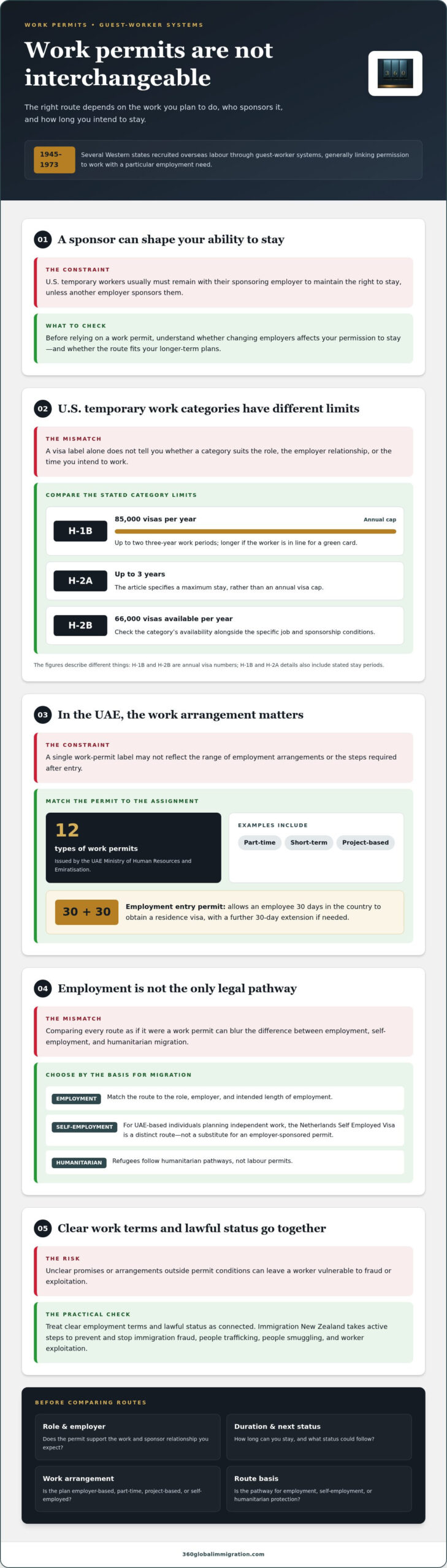
The right permit is the one that matches your intended outcome, whether you plan to work, build a business or pursue another legal residence pathway. A practical immigration strategy for individuals starts by aligning that goal with eligibility requirements and the conditions you’ll need to meet to maintain your status. In the UAE, the Ministry of Human Resources and Emiratisation issues 12 types of work permits, including options for part-time, short-term and project-based assignments.
It’s understandable to focus first on where you want to live or work. But choosing a route without considering its limits, documentation and compliance obligations can make your plan harder to sustain. A clear comparison helps you assess not only whether you qualify, but also whether a permit fits your professional plans and longer-term priorities.
This guide explains how work permits differ from entrepreneur and other legal pathways, what compliance means in practice, and how changing requirements can affect your choices. You’ll learn how to connect your personal goals to a suitable route, with a focus on options relevant to individuals planning from the United Arab Emirates.
Key Takeaways
- Start with the outcome you want, then compare permits by eligibility, work or business rights, and the conditions for keeping your status.
- Understand how employer sponsorship shapes a work permit before relying on it for your longer-term plans.
- Treat compliance as part of your strategy: changes in circumstances or immigration rules can affect whether a route remains suitable.
- Entrepreneur pathways are designed for different business profiles, so match the route to your role and venture rather than choosing by destination alone.
- Application steps and timing vary by country; prepare for the route’s specific evidence requirements and process before making commitments.
Work permits and guest-worker systems
Work permits connect a person’s employment to a country’s labour needs and immigration rules. Governments may use temporary routes when employers need workers for specific roles, sectors or projects. But work permits are not interchangeable: some depend on an employer sponsor, while others allow work under defined conditions. Refugees follow humanitarian pathways, not labour permits, so the basis for migration matters when comparing options.
Guest-worker systems have a longer history. Several Western states recruited overseas labour through these systems from 1945 to 1973. The model generally linked permission to work with a particular employment need. For an individual, the practical lesson is to identify whether a permit supports only a defined job or fits broader plans, such as changing employers, developing a business or staying beyond temporary work.
Temporary worker visa categories show how different the rules can be. In the United States, the H-1B category is capped at 85,000 visas per year. H-1B workers can stay for up to two three-year work periods, or longer if they are in line for a green card. H-2A workers can stay for up to three years, while the H-2B visa has 66,000 visas available per year.
These categories suit different work situations, so the visa label alone is not enough. Compare the role, employer sponsorship, duration and possible next status. U.S. temporary workers usually must remain with their sponsoring employer to maintain their right to stay, unless another employer sponsors them. This can affect job changes and makes the sponsor relationship central to an individual’s plan.
The UAE also offers varied work-permit arrangements. An employment entry permit allows an employee 30 days in the country to obtain a residence visa, and it can be extended for a further 30 days if needed. The UAE Ministry of Human Resources and Emiratisation issues 12 types of work permits, including options for part-time, short-term and project-based assignments. The work arrangement therefore helps determine which permit framework is relevant.
- Match the route to the role, employer and intended length of employment.
- Understand whether changing employers affects permission to stay.
- Separate temporary employment plans from humanitarian routes for refugees.
Worker protection matters, too. Immigration New Zealand takes active steps to prevent and stop immigration fraud, people trafficking, people smuggling and worker exploitation. When searching globally for work, treat clear employment terms and lawful status as connected issues. A permit should support the work you actually plan to do, not leave you reliant on unclear promises or arrangements outside its conditions.
For individuals based in the UAE who plan to work independently rather than for an employer, the Netherlands Self Employed Visa is a distinct route to consider. It is not a substitute for an employer-sponsored work permit. The key question is whether self-employment matches your work and residence goals.
Visa compliance and changing immigration requirements
A visa is permission under specific conditions, not a general right to live or work anywhere. Your status can depend on your purpose of entry, the activity you undertake and whether you continue to meet the program’s requirements. If you plan to remain abroad, consider compliance alongside eligibility and personal goals from the outset.
In the UAE, requirements can affect practical plans soon after arrival. A UAE Mission visa is issued for three months and can be extended once for a further three months. If its holder needs more time after that extension, they may need to leave the UAE and reapply. The permitted stay and next step are therefore important parts of planning, not details to leave until the last moment.
Residence applications also involve health and dependant considerations. Medical screening is mandatory for most UAE residence visa applications and renewals for expatriates aged 18 and above. Under the cited UAE sponsorship guidance, a resident may need monthly income of AED 4,000, or AED 3,000 if accommodation is provided, to sponsor eligible dependants. These conditions can shape household plans as well as an individual’s employment or investment choices.
Announcements have described a possible UAE Mission visa format lasting two years with multiple entries, but it remains subject to formal implementation by the relevant authorities. A proposed format should not be treated as the rule for a person’s current status. Follow the conditions attached to the visa actually issued, and assess changes against the applicable government requirements.
What are the tax, healthcare, and employment implications of immigrating as an individual? Tax obligations depend on the destination’s rules and your circumstances, while healthcare access and employment rights depend on the visa and local requirements. Assess these alongside the permit rather than assuming one immigration status automatically settles all three.
What are common reasons immigration applications are refused, and how can applicants reduce risk? Applications may be refused if evidence is incomplete, details conflict, eligibility criteria are not met, or the stated purpose does not fit the route. Reduce risk by choosing the correct category, checking that documents tell a consistent story, and following the relevant government department’s current instructions.
For a self-employed applicant, changing work plans can also affect whether the selected pathway remains appropriate. Keep records that support the stated activity and review obligations when circumstances change. A considered immigration pathway assessment can help connect compliance questions with the route’s purpose before commitments are made.
Entrepreneur and innovator immigration
Entrepreneur routes connect a person’s plans for a business with a destination’s immigration framework. They differ from employee permits because the applicant’s proposed venture, role and plans for operating abroad become central. For an individual based in the UAE, the first distinction is practical: are you seeking permission for employment, or a residence pathway built around self-employment or innovation?
Start with the business you intend to run, not a visa label. Describe its product or service, intended customers, operating model and your responsibilities. An independent consultant launching a practice, for example, has a different profile from a founder developing a new technology venture. Comparing these details helps connect your activity to a suitable route and identify credible supporting evidence.
Funding is only one part of the evidence. A grant, personal funds or another source of financing may help explain how a venture will begin, but funding alone does not describe the business or establish that a particular immigration route fits. Prepare a consistent account of the business plan, your experience, expected activities and financial assumptions. Each document should support the same real-world proposal.
Keep immigration permission distinct from business funding. A grant is not a visa, and an investment opportunity is not, by itself, permission to live or work in another country. Likewise, a forecast mentioning a million in potential sales cannot replace a clear explanation of the venture. Present projections as projections, identify their source and show how they relate to planned operations.
Compare routes by the role they expect you to perform and the venture they are designed to accommodate. An established self-employed professional may prioritize continuity of independent work. A founder building an innovative business may need to explain what is distinctive about the proposal and how they will lead it. The destination’s criteria determine which features matter, so tailor your evidence to that route rather than using one generic business plan everywhere.
- Define your business activity and personal role clearly.
- Connect funding evidence to realistic operating plans.
- Keep projections consistent with the proposal and their stated source.
- Separate business residence planning from employment or humanitarian migration.
Entrepreneur migration also differs from humanitarian protection. Refugees seeking safety may need a humanitarian pathway, not a business-based route. Crossing a border or pursuing an international business opportunity does not change the purpose of the application. Identify that purpose early, then make sure each part of your proposal supports it.
Before committing to relocation, map how the venture will continue after arrival: who will deliver the service, where customers will be based, and what your responsibilities will involve. For example, an independent professional should explain how client work fits the proposed self-employed activity. This alignment makes the business case easier to understand and ties the immigration plan to the work you actually intend to do.
Legal immigration pathways
Legal routes may be based on family, employment, humanitarian needs or another eligible purpose. Start your comparison with the outcome you seek: temporary residence, permanent residence or eventual citizenship.
Application Steps and Processing Times
Application steps and waiting periods differ by destination, route and the evidence required. A process may involve establishing eligibility, submitting documents and waiting for a decision. The difference matters because timing can shape work, family and relocation plans. As of April 2019, some family-preference applicants faced waits of more than 21 years for relatives from Mexico. That example shows how a route’s queue can affect planning.
Permanent Residency and Citizenship Pathways
Permanent residency generally provides ongoing residence status, while citizenship is a separate legal status with distinct rights. Routes and requirements differ across countries. In the United States, lawful permanent residents can apply for citizenship after five years, or after three years if married to a U.S. citizen. Compare residence rights, future eligibility and family circumstances before choosing a pathway, rather than treating permanent residence as automatic citizenship.
Factors Affecting Immigration Eligibility
Eligibility depends on the selected immigration system, and age, education, work experience, language ability and family relationships can matter differently across routes. Family migration accounts for about 40 percent of permanent immigration across OECD countries. In the United States, citizens can sponsor spouses, unmarried children under age 21 and parents without an annual numerical limit. For E-2 Treaty Investor visa holders, children lose their status at age 21, making age relevant to family planning.
Application Costs and Proof of Funds
Application fees, legal costs and proof-of-funds requirements depend on the destination and route. Government fees vary by application category, legal costs depend on the work involved, and fund requirements reflect the pathway’s financial criteria. The United States, for example, has family-sponsored and employment-based routes with distinct eligibility frameworks. Build a budget around the applicable application, supporting evidence and household needs, using AED for your UAE-based financial planning.
Some routes lead toward permanent residence, while others grant temporary residence tied to a purpose. The United States makes about 1 million green cards available annually; about two-thirds of legal immigration is based on family ties. It reserves 226,000 green cards each year for family-sponsored preference categories and makes 140,000 available each year for five employment-based categories. The Diversity Visa program allocates up to 50,000 visas annually, with a 7 percent country limit on preference visas. These structures show why eligibility and availability must be assessed by route.
How do immigration application steps and processing times differ by country?
Countries structure immigration applications around different routes, evidence and decision stages. If you live in the UAE and are comparing destinations, consider the route as well as the country: an employment application and a business-residence application may require different supporting records. Processing time depends on the relevant authority’s review, application completeness and any additional steps in that process.
Most applications follow a sequence: identify the route, prepare evidence, submit the application, respond to requests and receive a decision. The order and details vary. For example, someone applying based on employment should organize documents around the role and work arrangement, while a self-employed applicant should make the business activity and personal role clear. A mismatch between purpose and evidence can prompt avoidable questions.
Compare countries by their actual application steps, not a headline estimate. Record which documents you need to gather, whether translations or formal attestations are required, how to submit the application, and what may follow submission. These details help you understand the preparation needed before committing to a start date, accommodation or other relocation plans from the UAE.
You can control whether your application is complete. Use the destination’s application requirements as a checklist, then compare each item with the documents you have prepared. Check that names, dates, employment history and business details are consistent across forms and supporting records. For example, a difference between a job title on an application and an employer letter may need clarification, even when the underlying employment is genuine.
Processing time is not the same as preparation time. Gathering records, arranging translations and resolving inconsistencies happen before or alongside submission. After submission, a government department may assess the file or request further material. Since each route has its own process, allow time for both document preparation and review instead of treating an online estimate as your full relocation schedule.
For UAE-based applicants, compare destinations using the same planning questions:
- What is the application route and its stated purpose?
- Which records support your eligibility and intended activity?
- What submission and follow-up stages does the process involve?
- How will a delayed decision affect your planned move or work start?
A historical example shows why route and destination can shape timing. As of April 2019, some U.S. family-preference applicants waiting for relatives from Mexico faced waits of more than 21 years. That figure concerned a particular category and period, not every application. It illustrates why one country’s route-specific waiting information cannot be applied to another case.
Map your intended destination, route, documents and decision stages before setting relocation commitments. If you are comparing European or UK pathways, plan your visa application around the route that matches your goals.
360 Global Immigration: France Passeport Talent
360 Global Immigration helps individuals assess whether France Passeport Talent aligns with their professional or business residence goals. Turn to this pathway when France is your intended destination and you want to understand how your profile and plans relate to the route.
For other goals, 360 Global Immigration also guides applicants considering the UK Innovator Founder Visa, Netherlands Self Employed Visa and Cyprus Business Residence Visa. Each serves a different purpose, so the useful starting point is your intended activity and destination, not simply the visa name. A clear comparison can help you focus on a pathway that fits your plans and prepare for its application requirements.
To discuss which of these pathways may suit your goals, contact 360 Global Immigration.
Make Your Next Move With Clarity
Turn your preferred destination into a defined decision: identify the outcome you want, the activity you plan to pursue, and the evidence that supports your eligibility. This gives your immigration strategy for individuals a practical foundation and helps you focus on routes that align with your professional direction and personal priorities.
For applicants considering Europe or the UK, 360 Global Immigration offers the France Passeport Talent, UK Innovator Founder Visa and Netherlands Self Employed Visa. These pathways address different goals, from talent-based plans to innovation and independent work. A focused discussion can help you clarify which direction best fits the plan you are preparing, before you organize your next steps.
When you’re ready to discuss your options, contact 360 Global Immigration. A clear decision today can make your next stage of planning more purposeful and manageable.
Frequently Asked Questions
What does an individual immigration strategy include?
An individual immigration strategy connects your destination and intended outcome with a suitable route and practical application plan. It can also account for your career, business plans, family circumstances and future residence aims. For example, someone planning independent consulting should distinguish that goal from seeking an employer-sponsored role. A clear immigration strategy for individuals also considers how changing circumstances could affect the plan, helping you compare options before making major commitments.
Which countries offer the best immigration pathways for individuals?
No single country offers the best pathway for every individual; the right choice depends on your goals and profile. For example, France Passeport Talent may suit talent-based plans, while the UK Innovator Founder Visa relates to an innovation-focused business goal. The Netherlands Self Employed Visa, Cyprus Business Residence Visa, Ireland Business Residence Visa and Denmark Startup Visa address other business or self-employment interests. Compare each route’s purpose and eligibility, not destination reputation alone.
What are the main visa and residency options for skilled workers, entrepreneurs, students, and investors?
Common categories include skilled immigration and work permits for employment, entrepreneur or startup routes for founders, student visas for study, and investor pathways tied to investment criteria. These categories are not interchangeable: a student route is designed around study, while a self-employed route concerns independent business activity. For example, the UK Innovator Founder Visa and Netherlands Self Employed Visa suit different professional aims. Assess the activity you intend to pursue before comparing route names.
What eligibility criteria and documents are required for common immigration pathways?
Requirements depend on the country and route, but applicants commonly prepare identity records, education or work evidence, and documents supporting the purpose of travel or residence. A founder may need a coherent business proposal; an employee may need records supporting their role and experience. Family applications require relevant relationship evidence. Organize documents by eligibility criterion, keep dates and personal details consistent, and use the destination’s current checklist to identify route-specific requirements.