
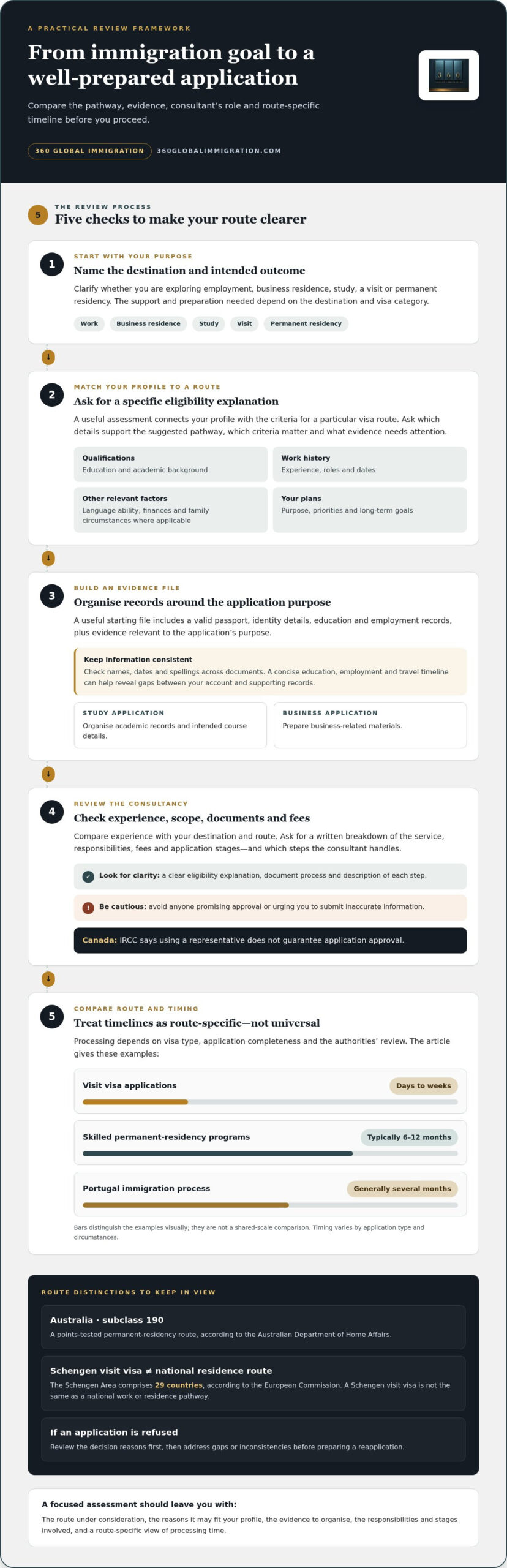
A strong immigration consultancy clearly explains how a destination and visa category align with your qualifications, plans, and documents. Compare its experience with the route you are considering, the clarity of its eligibility assessment, and how it explains each step. For Canadian applications, IRCC says using a representative does not guarantee approval.
Planning an international move can feel demanding: each destination has its own pathways, requirements, and application process. A careful comparison helps you focus on options that suit your goals rather than relying on broad promises.
This guide explains how to assess a consultant, understand the factors that affect eligibility, and compare residency, work, study, and visitor visa options across key destinations. You’ll also learn what consultancy support can involve and how to prepare for an informed next step.
Key Takeaways
- Assess a consultant by how clearly they explain their relevant experience, your application steps, and the limits of their role.
- Prepare your qualifications, work history, finances, and travel or study goals to make an eligibility discussion more focused.
- Compare destinations by the pathway that fits your purpose, rather than relying on broad country rankings or promises.
- Understand how residency, work, study, and visitor applications differ before deciding which route to explore.
- Use the article’s destination and credential comparisons to narrow your options and identify the support that best fits your plans.
How do I choose an immigration consultant in the UAE?
Compare an immigration consultancy by its destination-specific experience, written scope of work, document process, and clear explanation of fees. Ask how it assesses your profile and which application steps it handles. Avoid anyone promising approval or urging you to submit inaccurate information. IRCC says using a representative doesn’t guarantee application approval; this statement was accessed 24 July 2026.
In the UAE, consultants can help you assess visa pathways, prepare applications, organise supporting documents, and plan next steps for residency, work, study, or visits. The support you need depends on the destination and visa category. A visitor application, for example, requires a different preparation process from a permanent-residency application.
Document requirements depend on the route, but a useful starting file includes a valid passport, identity details, education and employment records, and evidence relevant to your application’s purpose. A student can organise academic records; a business applicant can prepare business-related materials. Keep names, dates, and spellings consistent across all documents.
Processing time also depends on the visa type, application completeness, and the authorities’ review. Visit visa applications can take days to weeks to process. Skilled permanent-residency programs typically take 6-12 months. Portugal’s immigration process generally takes several months, depending on the application type. Treat these as route-specific timelines, not a single estimate for every destination.
For Canada and Australia, compare pathways against your qualifications, work history, language profile, and long-term plans. Ask the consultant to explain which route fits those details and how application evidence supports it. Australia’s subclass 190 is a points-tested permanent-residency route, according to the Australian Department of Home Affairs.
For Europe, distinguish national residence routes from short-stay travel options. The Schengen Area comprises 29 countries, according to the European Commission, but a Schengen visit visa is not the same as a national work or residence pathway. If a refusal occurs, review the decision reasons first, then address gaps or inconsistencies before preparing a reapplication.
- Request a written breakdown of the service, responsibilities, and application stages.
- Match each document to a specific eligibility or application requirement.
- Compare the route’s purpose, evidence, and likely processing timeline before proceeding.
Settlement support should relate to your plans, such as organising application milestones or identifying practical steps after a decision. For a visitor application, Visit Visa Services can support the application process. Keep a clear record of submitted documents and correspondence so you can track each step.
Eligibility assessments and immigration consultations
An eligibility assessment connects your profile with the criteria for a specific visa route. Before discussing an application, prepare clear information about your purpose, qualifications, work history, and supporting evidence.
Eligibility and Pathway Assessments
A useful assessment starts by identifying your destination and intended outcome, such as employment, business residence, study, or a visit. The adviser can then compare your profile with the route’s relevant criteria, including education, experience, language ability, finances, and family circumstances where applicable. Ask for the reasoning behind each suggested pathway: which details support your fit, and which documents need attention? A clear comparison distinguishes a possible route from one that does not match your goals.
Bring a concise timeline of your education, employment, and travel history. For example, list job titles, dates, and responsibilities, then compare them with the evidence you can provide. This can reveal gaps between your account and records such as employment letters or academic documents. An assessment should also explain how missing, inconsistent, or outdated information could affect application preparation.
Eligibility is specific to each route, so do not treat one country’s criteria as a shortcut for another. A profile suited to business residence in the Netherlands may require a different evidence plan from a visitor application for Canada. Ask the adviser to identify the route under consideration, explain its purpose and main criteria, and outline the next application steps. This makes it easier to compare immigration services based on substance rather than broad claims.
Private Consultations and Points Calculators
A private consultation gives you space to discuss your circumstances, priorities, and concerns. Use the time to clarify the assessment, compare pathways, and identify the evidence required for your application. You should leave with practical next steps, such as organising work records or clarifying the purpose of travel, rather than just a general recommendation.
Points calculators can help organise information for a points-based route, but their results depend on accurate inputs and the criteria used. Treat a score as an initial screening tool, not a complete eligibility assessment. Ask which profile details affect the calculation, how supporting evidence relates to each answer, and whether another pathway may fit better. A calculator cannot resolve inconsistencies in documents or replace a careful review of the full application.
Before a consultation, prepare your passport details, education and employment history, intended destination, and a brief explanation of your plans. For a study route, include your intended course and academic background; for a work route, outline your occupation and experience. This information helps focus the eligibility check on relevant evidence. Keep a written record of agreed actions to track document preparation and application decisions.
If you are considering a visit, review your visa pathway options and organise your travel purpose, itinerary, and supporting records before preparing the application.
Immigration destinations including Canada, Australia, New Zealand, the UK, and the US
Compare destinations based on your intended outcome, the evidence you can provide, and the route’s conditions. Skilled workers, business founders, students, and visitors need different application strategies. The same professional profile can therefore lead to different options in Canada, Australia, New Zealand, the UK, or the US.
Canada offers over 100 immigration pathways for students, family members, business people, and skilled workers. Express Entry and the Provincial Nominee Program are distinct routes to assess against your qualifications, work history, and destination preferences. A provincial nomination links your plans to a participating province’s pathway. Compare each option’s criteria and document requirements instead of treating “Canada” as one application category.
Some Canadian work permit applications are supported by a Labour Market Impact Assessment, or LMIA. In that case, include the employer, role, and supporting records in your assessment. This differs from planning a permanent-residency pathway through Express Entry or a provincial program. Ask how each route fits your work history and intended outcome, then confirm that the proposed application category reflects those details.
Before paying someone to represent you on a Canadian matter, check whether the representative is registered with the College of Immigration and Citizenship Consultants, known as CICC. Match the person’s name and registration details to the advice being offered. A clear written scope should identify the representative, the work they will handle, and the documents they need. This gives you a practical basis for assessing Canadian immigration services.
Australia’s subclass 190 is a points-tested permanent-residency route, according to the Australian Department of Home Affairs. Australia’s subclass 491 is also identified as a points-tested permanent-residency route. Compare the route requirements with your qualifications and evidence before deciding which option to explore. In New Zealand, migrants may access medical insurance with a work visa valid for 2+ years, so include visa duration in your planning.
The UK is described as the world’s sixth-largest economy, but economic scale alone does not determine whether a visa route suits you. Compare your purpose and supporting evidence with the relevant work, study, business, or visitor route. For the US, first define whether your plan involves work, study, family, or a temporary visit. Then organise your profile and documents around that purpose rather than assuming another country’s pathway applies.
- Write down your intended outcome before comparing countries.
- Separate Canadian permanent-residency pathways from LMIA-supported work-permit applications.
- Check CICC registration when assessing Canadian representation.
- Compare Australia’s subclass 190 and 491 routes against your profile and evidence.
Permanent residency, work, study and visitor visas
Start by matching the visa category to your intended outcome. Permanent residency supports a longer-term plan, while work and study visas focus on a defined activity abroad. A visitor visa is for a temporary visit, not a substitute for permission to work or settle. Compare the purpose, eligibility criteria, documents, and likely next steps before choosing a route.
Skilled permanent-residency programs typically take 6-12 months to process. The application route, evidence, and review process affect how the timeline unfolds. Organise employment records, qualifications, and identity documents around the program’s criteria. A complete, consistent file makes your experience easier to assess; keep documentation 100% consistent across forms and supporting records.
Business owners should distinguish residency routes based on investment or business activity from skilled-worker pathways. The UAE Golden Visa advisory covers a 10-year residency option for investors, entrepreneurs, specialised talent, and outstanding students under ICP and GDRFA categories. For business expansion, applicants are shown a minimum bank balance requirement of AED 300K. Passive-income applicants are shown a minimum yearly passive-income requirement of AED 50000+. These categories have different qualifying bases, so identify which profile fits before preparing evidence.
Study applicants can organise academic records, intended course details, and evidence related to their study plans. Work visa applicants should map their occupation and experience to the route’s requirements. In either case, match each document to the criterion it supports. For example, connect an employment record to a stated role and dates rather than submitting paperwork without context.
Visitor visa applications have a different purpose and evidence pattern from permanent-residency cases. They can take days to weeks to process. Prepare a clear account of your visit, travel plans, and supporting records, then make sure the application presents a consistent purpose. A visitor route should not be treated as a work or settlement pathway.
Brazil residency support also starts with the intended basis for moving, such as work, study, business, or family circumstances. Those plans determine which documents are relevant and how the application should be organised. Set out your purpose, timeline, and supporting records before comparing Brazil with European destinations. Assess a European route under its own residence category rather than assuming it follows Brazil’s process.
- Separate temporary visit, study, and work purposes from permanent-residency goals.
- Match business-owner evidence to the specific residency category being considered.
- Organise documentation around each route’s criteria and intended outcome.
Consultant credentials and experience
Assess credentials against the destination and service you need, not a broad claim of expertise. Canada and Australia are the only two major destinations that license immigration representatives. For Canadian matters, check the representative’s CICC registration and confirm that the registered person is the one advising you. Destination-specific experience matters because application processes and evidence differ.
Ask consultants serving clients across the UAE to explain their experience with your intended route, such as a work visa, business residence, study, or citizenship pathway. Request a clear description of the tasks they will handle, the documents they will prepare, and what remains your responsibility. A written scope helps you understand the assistance provided and refer back to the agreed terms throughout the process.
Using an unlicensed or unqualified agent can expose you to inaccurate guidance, incomplete applications, missed requirements, and avoidable delays. It may also be harder to establish who prepared or submitted your documents. Before sharing sensitive records, identify the person responsible and get the service scope in writing.
Use a structured review rather than relying on confidence or marketing language. Ask about experience with your route, then see whether the explanation addresses your profile and intended outcome. For instance, an adviser discussing a skilled-worker pathway should explain how your work history and qualifications relate to it. Clear reasoning is more useful than a general promise of success.
- Verify identity: Match the adviser’s name to relevant registration details, such as CICC for Canadian representation.
- Confirm route knowledge: Ask how the adviser’s experience relates to your destination and visa category.
- Review the scope: Record which applications, documents, and communications the service covers.
- Keep control of records: Retain copies of forms, supporting evidence, and submitted correspondence.
For Canadian applications, IRCC’s guidance is clear: using a representative does not guarantee approval. Keep that boundary in mind when assessing an adviser’s claims. A responsible professional can explain the process, help organise evidence, and identify issues to address, but should not present a decision as certain.
Ask how the consultant handles a change in circumstances, a document request, or a refusal. For example, find out whether the agreed scope includes reviewing a refusal and explaining possible next steps. A reapplication should address the reasons given, rather than simply resubmitting unchanged materials. This discussion can show whether the proposed guidance is specific to your case.
Choose a professional whose experience, registration where relevant, and written process align with your destination. A careful review helps you understand the support offered and make informed decisions at each stage of the application.
360 Global Immigration: France Passeport Talent
360 Global Immigration helps applicants assess business-residency and talent-based routes for Europe and the UK. If your experience, professional plans, or business goals point toward France, its France Passeport Talent support can help you understand the pathway and prepare your application. The consultancy also assists with the UK Innovator Founder Visa, Netherlands Self Employed Visa, and Cyprus Business Residence Visa. These options suit different plans, so consider your intended destination and application purpose before choosing a route.
Turn to 360 Global Immigration when you’re ready to compare one of these pathways and organise the next steps around your profile. For a considered discussion of your plans, contact 360 Global Immigration.
Turn your plans into a clear next step
Your next step is to turn broad interest into a decision that fits your professional and personal priorities. First, identify what you want your move to make possible, then consider which destination and application route best supports that goal. A focused plan gives your preparation purpose and keeps each decision connected to the life you intend to build.
For applicants considering France Passeport Talent, the UK Innovator Founder Visa, or the Netherlands Self Employed Visa, the right immigration consultancy can help make the pathway and preparation process easier to understand. The value lies in clear guidance tailored to your plans, not a promise of a particular outcome.
When you’re ready to discuss your options, explore your next step with 360 Global Immigration. A considered decision today can help you move forward with greater clarity and confidence.
Frequently Asked Questions
Are immigration consultants worth it, or should I apply myself?
Professional assistance can be useful when your application involves several forms, complex evidence, or a previous refusal. Applying yourself may suit a straightforward case if you understand the instructions and can manage document preparation. For example, compare the time needed to organise employment records with the help included in a consultant’s written service scope. Choose based on the application’s complexity and the support you need.
Can a consultant speed up my visa application?
A consultant can help you prepare an organised application, but cannot control an immigration authority’s processing queue. Support may help you address missing documents or inconsistent details before submission. For example, matching employment dates across forms and reference letters can reduce avoidable follow-up. Ask which preparation tasks the service covers, and distinguish that support from any claim that an authority will decide faster.
Why do some consultants promise cheaper fees, faster results, or a guaranteed outcome?
A low advertised fee may cover a narrower scope than full application assistance, so compare what each quote includes. Treat claims of faster results or guaranteed approval carefully: consultants do not make immigration decisions. Ask for the service scope and payment terms in writing before sharing documents or paying. Clear terms help you compare offers without relying on slogans or pressure.
What services do immigration consultancies provide?
Services can include an initial consultation, visa application assistance, document verification, immigration strategies, and legal guidance. Appeals or waivers may also be relevant, depending on the case and agreed scope. For example, a visitor application may need a different level of document support from a business-residency application. Read the written service description to understand which tasks are handled and which remain your responsibility.
How do I choose a reputable immigration consultancy in the UAE?
Choose an immigration consultancy that explains its process, identifies who will handle your application, and provides clear written terms. Check destination-specific experience and ask how the adviser will communicate updates or document requests. For Canadian representation, verify whether the representative is registered with the College of Immigration and Citizenship Consultants. Compare the actual scope and guidance offered, not just the first advertised fee or a confident sales presentation.
What are the typical fees for immigration consultancy services in the UAE?
Fees depend on the case and are provided after a quote request. Cost factors include the destination, visa category, application complexity, number of applicants, and scope of assistance. Compare quotations by checking whether they cover consultations, document review, application preparation, and follow-up. Keep government charges separate from consultancy fees, and make sure the written terms explain what the quoted service includes before you proceed.
What is the step-by-step process for applying for a visa or residency through a consultancy?
First, describe your destination, purpose, and personal circumstances. The adviser then reviews your information and identifies a suitable application route. Next, organise the supporting records, review the forms for accuracy, and agree on responsibilities before submission. Keep copies of the final application and correspondence. After filing, respond to requests with consistent information and retain a record of every document provided.
Can an immigration consultancy guarantee visa approval?
No. Immigration authorities decide applications, and a consultancy cannot promise their decision. IRCC says using a representative does not guarantee approval of a Canadian application; this information was accessed 24 July 2026. A consultant can provide guidance, help prepare documents, and explain the application process. Treat claims of certain approval as a warning sign, and ask for an honest assessment of your circumstances instead.