A strong business idea alone isn’t enough to qualify for France’s Talent Passport Business Creation route. For entrepreneurs considering the France talent passport for entrepreneurs, the key financial threshold is at least €30,000 committed to the business, according to France’s Ministry of the Interior.
It’s understandable to focus first on investment, but eligibility also depends on the project’s viability, your professional background, and how clearly your application supports your plans in France. Meeting one requirement does not replace the need to present a credible, well-documented business creation project.
This guide explains the Business Creator route and how to assess your project against its core criteria. It also covers the documents and application stages to prepare, how permit duration and renewal work, and how the Entrepreneur visa differs from the Talent Passport. Understanding these distinctions can help you identify the route that best fits your plans and prepare with greater confidence.
Key Takeaways
- Assess whether your business plan demonstrates a viable project and a credible contribution to the French economy, not just access to investment.
- Understand how the proposed business project can affect the duration of your residence permit and what renewal depends on.
- Prepare supporting documents and plan each application stage to keep your move and business launch aligned.
- Distinguish the Business Creation Talent Passport from the Entrepreneur visa to identify the route that fits your plans.
Business plan and project viability
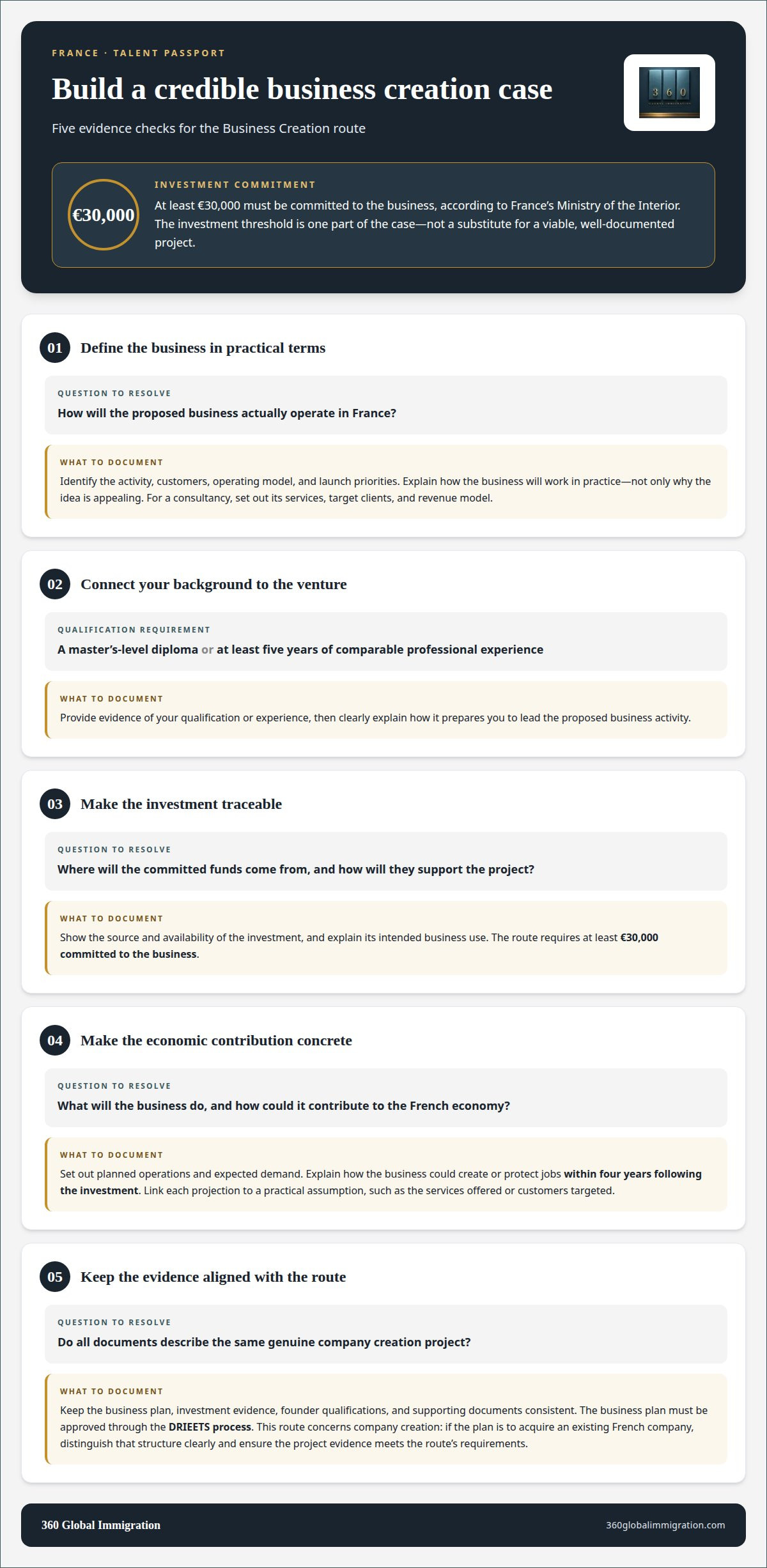
- Define your French business creation project before assembling immigration documents. Identify the activity, customers, operating model, and launch priorities in France. Your plan should explain how the business will work in practice, not just describe an appealing idea. For example, a consultancy should set out its services, target clients, and revenue model.
- Show that you meet the founder’s professional qualification requirement. Applicants need a master’s-level diploma or at least five years of comparable professional experience. Clearly link your qualification or experience to the proposed activity. If you hold an equivalent qualification, explain how it prepares you to lead the business.
- Document the investment commitment. The France Talent Passport Business Creation route requires at least €30,000 to be committed to the business, according to the French Ministry of the Interior. Explain how the funds will support the creation project, and organize evidence that shows their source, availability, and intended business use.
- Make the project’s economic contribution concrete. Set out planned operations, expected demand, and how the French business could create or protect jobs within four years following the investment. Connect each projection to a practical assumption, such as the services offered or customers targeted. A detailed, coherent project helps demonstrate its potential contribution to the country.
- Prepare evidence of a genuine and viable company creation project. Ensure the business plan, investment evidence, founder’s qualifications, and supporting documents all describe the same venture. The business plan must be approved through the DRIEETS process. If you plan to acquire an existing French company rather than create one, distinguish that plan clearly: this route concerns company creation, so the project structure and evidence must meet its requirements.
Residence permit validity and renewal
The Business Creation Talent Passport can cover a residence permit lasting 1 to 4 years, depending on the project. By comparison, the separate investor route requires €300,000 invested in a French business’s fixed assets, while the Entrepreneur visa lasts a maximum of one year.
Talent Passport holders must keep their business project consistent with the approved plan and meet the required financial means. Entrepreneur visa holders may renew annually if they have launched the business and can support themselves through it.
- Choose the residence route that matches your project. The Business Creation route is for establishing a French company. A separate Talent Passport route covers innovative economic projects and requires support from a recognized incubator or accelerator, as well as sufficient financial means.
- Plan for the permit duration stated for your project. The Business Creation residence permit can be issued for 1 to 4 years and is renewable. Keep the company activity and supporting business plan consistent with the project presented in your application.
- Coordinate the visa and residence permit stages. Apply for the long-stay visa before travelling, then submit the residence permit application online through ANEF within 2 months of arrival in France. An Entrepreneur visa issued as a VLS-TS must be validated online after arrival.
- Include family planning in your residence timeline. A spouse of a Business Creation Talent Passport holder can receive a Talent Passport for Family covering the remaining validity of the main permit. French residence permit holders may travel within the Schengen area for up to 90 days in any 180-day period.
- Treat longer-term residence as a separate pathway. After five years of residence, a person may be eligible to apply for permanent residence or French citizenship, subject to the applicable conditions. Neither is automatic: maintain the residence and business commitments attached to your permit throughout this period.
Application preparation and administrative support
Prepare identity, qualification, business-project, and funding documents for a complete application. The process includes a DRIEETS attestation, a long-stay visa application, and an online residence-permit filing.
-
Prepare the Required Documents with Professional Guidance
Provide your adviser with identity documents, evidence of a master’s-level qualification or comparable professional experience, and a detailed business plan. Include supporting documents for the committed investment and the project’s viability. If your spouse or children will accompany you, provide their relevant family documents for application planning.
Keep names, dates, and project details consistent across the file. A professional can organize the evidence and prepare the DRIEETS attestation application. The attestation is valid for 12 months, so coordinate its timing with the planned visa application and arrival in France.
-
Have a Professional Submit the Online Application
Ask the professional managing your case to coordinate the attestation, consulate visa stage, and online filing. Applicants may apply for a French long-stay visa no earlier than 3 months before planned arrival. The visa stage can take 2 to 8 weeks, while ANEF residence-permit processing can take 2 to 4 months.
After arriving in France, applicants should check the applicable residence-permit filing requirements and submit any required application through the appropriate channel. A professional can organize the sequence and track the file’s administrative progress, including prefecture processing. A prepared application may take 4 to 6 months end to end, so align travel and plans to work in France with these stages.
-
Understand Fees and Administrative Costs with Professional Guidance
Budget separately for government charges and professional assistance. Administrative expenses may include a long-stay visa fee, residence-card charges, and stamp duty. The applicable amount depends on the application stage and applicant category, including whether dependants need separate documents.
Request a clear breakdown distinguishing official charges from professional service fees. This helps you plan without confusing government payments with consultancy fees. Include any costs for dependent applications in your overall budget, and keep payment records with your documents.
Entrepreneur visa and Talent Passport legal frameworks
A spouse and minor children can join a Talent Passport holder from day one through the Talent-Famille route. The spouse receives a family residence permit valid for the main holder’s remaining permit period.
Refusals may follow when an applicant fails to meet qualification, funding, or project requirements. Applicants may file the listed appeals within 2 months of a refusal.
- Identify the legal route before submitting an application. France renamed “Passeport Talent” to “Talent” under Decree n° 2025-539, in force from 14 June 2025. The company-creation route’s official name is the multi-year “Talent project leader, company creation” residence card. This distinction helps separate company creation from other economic pathways.
- Match your qualifications to the route. Business Creation applicants need a master’s-level diploma or equivalent qualification, or at least five years of comparable professional experience. The separate innovative-project route requires sponsorship from a recognized incubator or accelerator, an applicant’s project considered innovative, and sufficient financial means.
- Distinguish company creation from investor status. The Business Creation route assesses a proposed new French business and its supporting project evidence. A separate Business Investor Talent Passport applies to investment in a French business’s fixed assets. The routes serve different plans, so your application must support the status you seek.
- Maintain consistency after arrival by keeping the company’s actual activity aligned with the business plan and approved route. Applicants must also show sufficient resources corresponding to France’s latest statutory minimum wage. French tax obligations may include tax on global earnings, depending on residency status and length of stay.
- Use the governing framework to understand the decision. French talent residence cards are governed by Articles L421-7 to L421-25 of the Code of Entry and Residence of Foreigners and Right of Asylum. For tailored help applying these route distinctions to your file, request France Talent Passport application support.
360 Global Immigration: France Passeport Talent
360 Global Immigration supports applicants pursuing France Passeport Talent, helping them assess the route, organize application documents, and prepare for the relevant visa and residence-permit stages. Its guidance can be useful when you need to align your business plan, qualification evidence, and investment documentation with the requirements for your proposed project.
For entrepreneurs based in the UAE, professional support can bring structure to a process involving several administrative stages. It also helps clarify whether the Business Creation route fits your plans before you proceed with an application.
If you’re ready to discuss your French business-residence plans, contact 360 Global Immigration.
Choose the next step with a clear plan
Use your next step to turn your French business ambitions into a considered immigration strategy. Think beyond the application itself: the destination should support your business direction, personal priorities, and longer-term plans. A focused discussion can help bring those priorities together before you commit to a route.
For entrepreneurs weighing different destinations, 360 Global Immigration offers France Passeport Talent, the UK Innovator Founder Visa, and the Netherlands Self Employed Visa. Each serves a different pathway, so the right comparison starts with where you intend to build and how you plan to work. The France talent passport for entrepreneurs may suit your objectives, while another route may better match your intended business activity.
Contact 360 Global Immigration to discuss your plans and identify a practical next step. With a clear direction and carefully prepared application, you can move forward with greater confidence.
Frequently Asked Questions
What is the Talent Passport Business Creator in 2026?
For founders, the France talent passport for entrepreneurs is France’s multi-year residence pathway for eligible foreign nationals creating a business. France officially shortened “Passeport Talent” to “Talent” under Decree n° 2025-539, in force from 14 June 2025. The company-creation category is formally a multi-year residence card for a project leader following the company-creation pathway. The name changed, but eligibility still depends on the route’s requirements.
Who actually issues the attestation?
DRIEETS handles the business-plan approval process associated with the company-creation attestation. The attestation supports the residence application and is distinct from the long-stay visa and residence-permit decisions. Keep these stages separate as you organize your file: DRIEETS assesses the business project, while the visa and residence-permit applications go through French consular and immigration administration.
What is the France Talent Passport for business founders and entrepreneurs?
The France talent passport for entrepreneurs is a French residence pathway for eligible non-EU entrepreneurs establishing a business in France. The application centers on a genuine company creation project, supported by the founder’s qualifications, financing evidence, and a coherent plan for the activity. It is not general permission to live in France based only on owning a business abroad; the proposed French project must fit the route.
What are the eligibility requirements for the French Talent Passport entrepreneur residence permit?
Applicants must be at least 18, meet the education or professional-experience criterion, and present a real, serious French company-creation project. They also need to demonstrate the required business commitment and sufficient personal resources. To assess eligibility for the France talent passport for entrepreneurs, check that the applicant’s experience, funding evidence, and proposed company all support the same business activity.
What minimum investment or business funding is required for France’s entrepreneur Talent Passport?
The Business Creation route requires at least €30,000 committed to the French business. Treat this as a business-investment requirement, not an immigration consultancy fee or a payment to the French consulate. The application should connect the commitment to the proposed company and its planned activity, with supporting evidence showing that the funds are available for the project.
What qualifications or professional experience must entrepreneur applicants have?
Applicants need a master’s-level diploma or at least five years of comparable professional experience. The important point is to show how that background relates to the proposed business. For example, experience managing a relevant service can support your ability to lead that activity in France. Provide qualification or experience documents that identify you and support the role you plan to take.