
Moving a Dubai business to Europe isn’t a direct company transfer. A UAE company, including a free zone company, cannot be transferred directly to a European country. The practical alternative is to establish a new entity and restructure operations. If you’re considering how to move your business from Dubai to Europe, plan for a new European base rather than assuming the existing company can simply change location.
It’s understandable to want clarity on whether your UAE company can continue operating, where to establish the European entity and what the move could mean for tax. These decisions are connected: your destination, personal residence and business structure all shape the plan.
This guide explains how to assess the transition, compare European bases, consider tax residency and prepare to establish an entity. You’ll get a clearer framework for deciding what stays in the UAE and what needs to be set up in Europe.
Key Takeaways
- Plan on establishing a new European entity and restructuring operations rather than directly transferring your UAE company.
- Compare potential European bases by business needs, residence pathway and tax implications before choosing where to establish your operations.
- Build tax planning around both your business structure and personal residence, since moving your base can affect each.
- Explore the Cyprus Business Residence Visa if Cyprus is a potential base for your move.
1. Business relocation feasibility, activities, location, visas and banking
A move from Dubai to Europe usually means restructuring, not transferring the UAE company itself. Keep the Dubai entity operating only if its licence, registered activities and ongoing compliance support that plan. A qualifying free zone person may access a 0% UAE corporate tax rate on qualifying income, subject to applicable conditions. UAE businesses face a standard corporate tax rate of 9% on taxable income above AED 375,000, according to the UAE Ministry of Finance.
Start with your destination and intended business activity. Map customers, employees, management and contracts to decide which operations remain in Dubai and which move to a European entity. A permit for one European country may not authorize work in another, so the residence route must fit both the business owner’s role and the destination. For example, the Netherlands Self Employed Visa may suit a self-employed applicant planning to establish a base in the Netherlands.
For a European business bank account opened from the UAE, expect the onboarding process to focus on identity, ownership, business activity and the origin of funds. Prepare incorporation and registration documents, shareholder identification, a business plan, financial records and evidence supporting the source of wealth and funds. Banks use these materials to understand who controls the company and how its transactions will be funded.
Build a relocation file before moving, with passports, company records, contracts, financial statements and family documents. Owners, investors and families should coordinate residence applications, school arrangements, housing and household finances with the business timeline. If employees are relocating, align their permits with their start dates and consider healthcare and insurance arrangements in the destination. A UK business expanding to Dubai may instead be seeking UAE or wider GCC customers; that objective calls for a regional expansion plan, not a European relocation. Keep UAE banking needs separate: opening a local corporate account typically involves a trade licence, incorporation documents and shareholder identification.
2. Country comparisons including Croatia, Portugal, Spain, and Germany
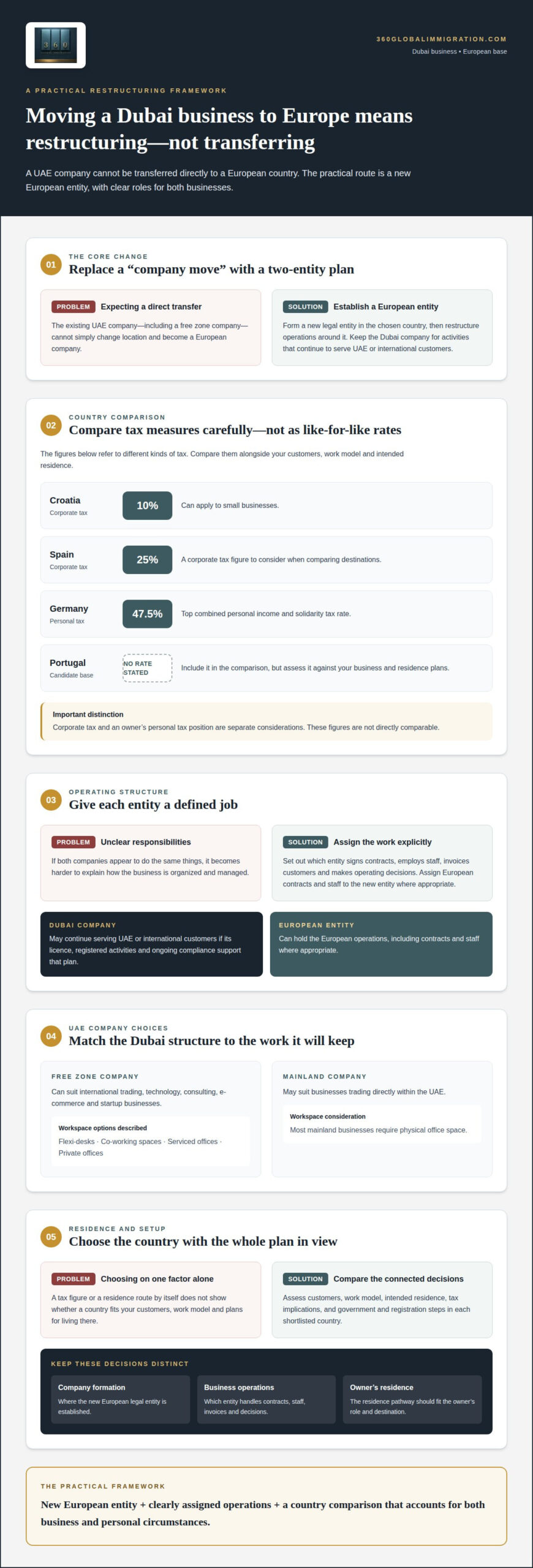
A UAE company cannot be transferred directly to a European country. The practical route is to establish a new legal entity and restructure operations around it. Keep the Dubai company for activities that continue to serve UAE or international customers; assign European contracts and staff to the new entity where appropriate. This separates company formation from the owner’s immigration decision and gives each business structure a clear purpose.
Compare countries against your customers, work model and intended residence. Croatia can have a 10% corporate tax rate for small businesses, while Spain’s corporate tax rate is 25%. Germany’s top combined personal income and solidarity tax rate reaches 47.5%, so business profits and the owner’s personal position need separate consideration. Portugal is another candidate, while hubs like Hungary also draw interest for low corporate tax rates, where corporate advisory firms such as Elevate Advisory Group Kft assist companies with local incorporation and ongoing administration. Ultimately, the right comparison depends on where clients are based, how the company earns income and where the entrepreneur plans to live.
Management and control deserve deliberate attention. Set out which entity signs contracts, employs staff, invoices customers and makes operating decisions; keep governance records consistent with that division. A foreign owner’s move does not itself transfer the UAE company, so plan its continuing role alongside the European formation process. Compare the government and registration steps in each shortlisted country before committing resources. If Cyprus enters your shortlist, the Cyprus Business Residence Visa may be relevant to your residence planning.
The practical route is to establish a new legal entity in your chosen country, then assign European contracts and staff to it where appropriate. Define which entity signs contracts, employs staff, invoices customers and makes operating decisions. Before committing resources, compare each country’s government and registration steps with your customer base, work model and intended residence.
3. Tax planning when becoming a European tax resident
European tax residence is not decided by counting days alone. The 183-day rule is one test, and spending fewer days in a country may still leave other residence factors relevant. Italy, for example, may treat someone as resident when their spouse and children move there, even if they spend only 90 days in Italy. Before relocating, map your destination, family ties, home and business management alongside your travel calendar.
Residence and immigration status are connected but separate decisions. A visa or residence permit establishes a pathway to live in a country; it does not, by itself, settle every tax question. Entrepreneurs and investors should align the chosen business setup with where they will live, manage the company and earn income. Cyprus’s non-dom regime includes a 60-day rule, with dividends and interest exempt under the stated regime. The applicable residence and tax rules depend on the person’s circumstances and destination.
For transfers from the UAE, distinguish moving money from realizing income or transferring ownership of assets. Tax treatment turns on the transaction, asset type, timing and the national rules that apply to the owner and company. A double-tax treaty can allocate taxing rights or provide relief, but it does not create one Europe-wide outcome. The UAE and the UK signed an income and capital tax agreement on April 12, 2016; that agreement concerns the UK, not every European country.
Personal belongings follow a separate customs process. People moving their main residence to an EU country typically qualify for transfer-of-residence relief on used personal belongings, although national rules vary. The United Kingdom operates its own Transfer of Residence scheme, separate from the EU scheme. Prepare an asset and ownership schedule before moving, separating household goods from business equipment, shares and other company assets. This helps keep immigration, tax and customs planning aligned.
4. Transferring a Dubai business and establishing a European entity
A Dubai company cannot be transferred directly to a European country. Instead, establish a new entity and restructure contracts, operations and ownership arrangements around both companies. Planning how to move your business from Dubai to Europe starts with deciding which activities remain in the UAE and which move to the new entity.
Company formation requirements and processing times vary by destination, legal structure and submitted documents. In Germany or another chosen country, formation involves selecting a structure, preparing company and ownership records, appointing a director where required, and registering with the relevant government authority. For entrepreneurs whose broader structure includes digital asset activities or specialized international entities, corporate specialists such as Consulting24 facilitate cross-border company registration. The destination, business activity and document preparation affect the sequence and timing.
Moving operations does not automatically end UAE obligations. While the Dubai company remains active, maintain its trade licence and meet applicable compliance requirements, including corporate tax, VAT registration, accounting, labour-law duties, and immigration or visa renewals. If closing the company, coordinate licence cancellation and deregistration with the relevant free-zone or mainland authority, and address outstanding filings.
Use a staged transition. First, map contracts, employees, assets, intellectual property and customer payments to the entity responsible for each. Next, prepare formation records, ownership details, director information, activity descriptions and registered-address arrangements for the European company. Then align banking, invoicing and employment changes with registration. This sequence helps keep records consistent across both entities.
There is no single timeline for relocating a Dubai business to Europe. Formation, residence applications, banking, infrastructure and employee permits can follow separate schedules. For families, coordinate housing and school plans with business milestones. A practical plan for how to move your business from Dubai to Europe links each milestone to the destination’s requirements and the documents needed at that stage.
If Cyprus is your intended base, explore the Cyprus Business Residence Visa as part of your relocation planning.
360 Global Immigration: Cyprus Business Residence Visa
360 Global Immigration can guide you through the Cyprus Business Residence Visa when Cyprus is your preferred base for living and developing your European plans. The next step is to align your intended business activity and personal circumstances with the residence pathway, then prepare the application around the relevant requirements.
If another destination better fits your plans, available pathways include the France Passeport Talent, Netherlands Self Employed Visa, Ireland Business Residence Visa and UK Innovator Founder Visa. The right option depends on where you intend to live and the nature of your business or professional plans. Clear visa planning connects your relocation decisions with the European base you choose.
Contact 360 Global Immigration to discuss your intended destination and residence pathway.
Make Your European Move Deliberate
Before changing contracts or moving assets, create a decision map linking your intended residence with the future role of each business entity. Identify who will direct operations, where client relationships will sit and which responsibilities remain in Dubai. This gives your advisers a shared framework and helps keep immigration, ownership and operational decisions aligned.
Planning how to move your business from Dubai to Europe also means selecting a residence route that matches your professional plans. For France, 360 Global Immigration offers the France Passeport Talent; for the Netherlands, the Netherlands Self Employed Visa; and for the UK, the UK Innovator Founder Visa. Each pathway addresses a different destination and applicant profile.
When you’re ready to shape your next steps, contact 360 Global Immigration to discuss the residence pathway relevant to your plans. A considered decision now can give your European transition a clearer direction and a stronger starting point.
Frequently Asked Questions
Does Your UAE Free Zone Company Still Work After You Move?
Your Dubai company can remain part of your business structure if it continues to meet its licensing and compliance obligations. For example, a Dubai free zone company could retain international clients while a European entity handles local hiring and contracts. Keep responsibilities distinct in company records, invoices and agreements. Your personal move and the company’s ongoing operations are separate matters, so plan each deliberately.
Can I transfer my business from Dubai to Europe, and what are the tax benefits?
You can’t transfer a UAE company directly to a European country. The route is to form a new entity and restructure operations. Moving does not automatically create a tax benefit. Your overall position depends on the destination’s rules, where owners become tax resident, and how income and assets are allocated between entities. Compare the intended structure before shifting contracts or changing ownership arrangements.
Which European countries are best for relocating a business from Dubai, and how do they compare on taxes, costs, and market access?
There isn’t one best country for every business. Croatia’s corporate tax rate can be 10% for small businesses, Spain’s is 25%, and Germany’s top combined personal income and solidarity tax rate reaches 47.5%. These figures measure different tax categories, so compare like with like. Portugal also belongs on a shortlist if its customers, operating environment and residence options fit your plans.
What corporate tax, VAT, payroll tax, and annual compliance costs apply in each destination?
Rates and obligations depend on the country and the company’s activities. In the UAE, the standard corporate tax rate is 9% on taxable income above AED 375,000, and VAT is 5%; mandatory VAT registration begins at AED 375,000 in taxable imports and supplies. In Europe, compare corporate, payroll and indirect taxes alongside accounting, filing and licence-renewal duties.
What visas and residency permits are available for Dubai business owners, directors, and employees moving to Europe?
Available pathways depend on the destination and the applicant’s role. Business owners may consider routes such as the Netherlands Self Employed Visa or Cyprus Business Residence Visa; eligible talent applicants may consider France Passeport Talent. The UK Innovator Founder Visa is a UK pathway. Employees need a route that fits their intended work and destination, since permission in one country does not authorize work elsewhere.
How do I transfer business assets, contracts, intellectual property, and employees from a UAE company to a European entity?
Use a transfer schedule to assign each asset, agreement and worker to the intended entity. For a client contract, document whether it stays with the UAE company or moves to the European one, then address any required approvals and updated billing details. Record intellectual property ownership and permitted use separately. Align employee transfers with the destination’s work authorization and the new entity’s hiring arrangements.