
Could a confident promise be the very reason to pause? For applicants in the UAE exploring an overseas visa, a polished website or reassuring sales pitch isn’t enough to show that a legit immigration consultant can provide reliable support. It’s reasonable to want clear guidance, fewer avoidable mistakes, and an honest explanation of what a consultancy can and can’t do.
Trust is built through relevant, verifiable expertise, a transparent explanation of services and responsibilities, and realistic expectations. No consultancy controls a government’s decision, and requirements vary by country and pathway. Support for options such as France Passeport Talent or the UK Innovator Founder Visa should help you understand the process and prepare carefully, not promise an outcome.
This guide explains how to assess a consultancy’s credibility, identify warning signs, and understand who is responsible for each part of an application. You’ll also learn what responsible support looks like, where a consultant’s role ends, and how to take an informed next step toward a suitable pathway.
Key Takeaways
- Look for a legit immigration consultant whose relevant credentials and claims can be independently verified.
- Understand the difference between application guidance and the government’s authority to assess and decide a visa application.
- Use a clear service scope to distinguish what the consultancy supports, what you must provide, and what remains the government’s decision.
- Follow a practical trust check: clarify your goals, explore pathway fit, review the scope, and confirm responsibilities.
- See how tailored guidance can help applicants understand business and talent-based pathways such as France Passeport Talent and the UK Innovator Founder Visa.
What Makes an Immigration Consultant Legitimate, and What Their Role Really Is
A legit immigration consultant makes the working relationship clear. They explain what guidance they provide, what falls outside the agreed scope, what information they need from you, and which decisions belong to the relevant government authority. Credibility comes from transparent, relevant support, not confident claims or promises of a particular visa result.
The term Immigration consultant describes a professional role, but rules on immigration advice and representation vary by country and service type. If you’re considering a move abroad, assess whether the guidance fits your destination and pathway. Check current requirements through that destination’s official government sources.
What can an immigration consultancy do for an applicant?
A consultancy can help you understand how a pathway relates to your goals and circumstances, identify requirements you may need to address, and organize application materials for review. For example, France Passeport Talent and the UK Innovator Founder Visa are distinct routes, with different requirements to research and prepare for. Relevant guidance can help you identify the right questions and understand the steps involved.
Guidance doesn’t replace your own careful review. You remain responsible for providing accurate, complete information and ensuring application details reflect your circumstances. A consultant can help clarify and organize documents, but that doesn’t guarantee acceptance or prevent a government authority from requesting more information or refusing an application.
Consultant, lawyer, and government authority: understanding the difference
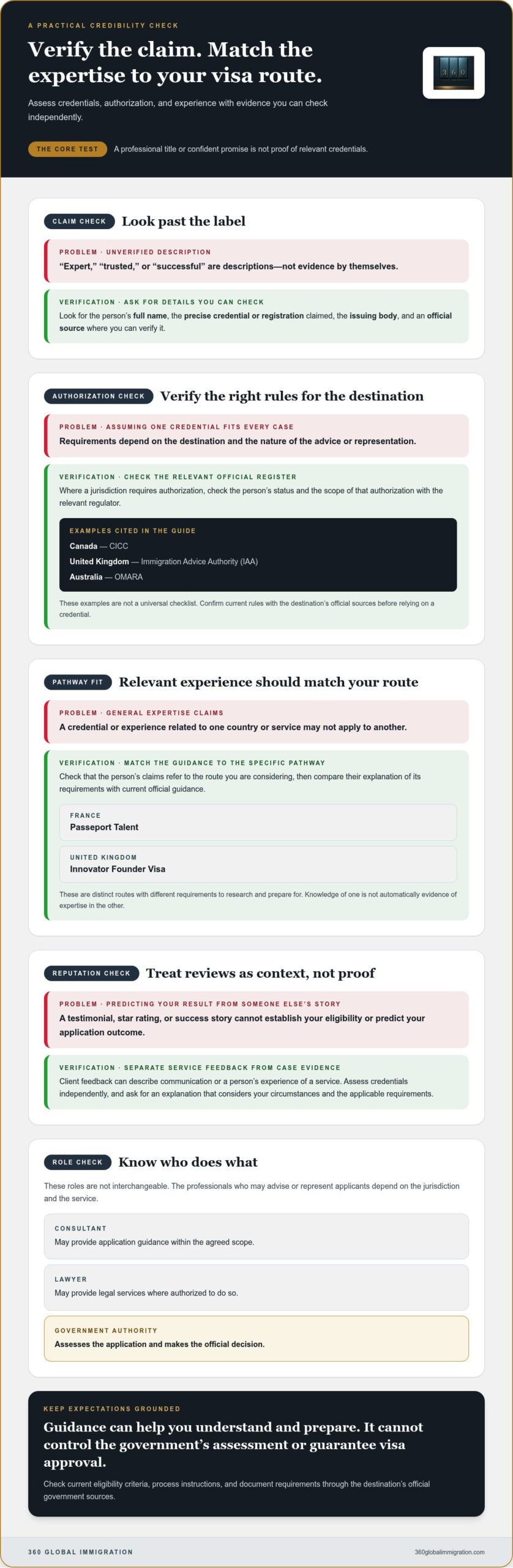
These roles aren’t interchangeable. A consultant may provide application guidance within the agreed scope; a lawyer may provide legal services where authorized to do so; and the government authority assesses the application and makes the official decision. Which professionals may advise or represent applicants depends on the jurisdiction and the nature of the service. Don’t assume a title alone establishes authority to provide every kind of advice.
Before relying on a claim about registration, licensing, or representation, verify the current rules with the destination’s official regulator or government source. Check the government’s published eligibility criteria, process instructions, and document requirements too. These are the reference points for an application, not a consultancy’s interpretation alone.
A responsible consultant should describe the boundaries of their role in plain language. They can guide preparation, explain process steps, and help you approach the application in an orderly way. They cannot control assessment, processing, or the final outcome. The government authority makes the decision, so no professional assistance can guarantee visa approval.
This distinction helps you set realistic expectations, understand your responsibilities, and judge whether the proposed support addresses your pathway. Next, assess the credentials behind a consultant’s claims and whether their experience is relevant to your destination.
How to Assess an Immigration Consultant’s Credentials and Claims
A professional-sounding title isn’t proof of relevant credentials. To assess whether a legit immigration consultant is suitable for your case, match the person’s verifiable qualifications and experience to the destination and type of assistance you need. A credential relevant to one country or service may not authorize someone to advise on another.
Start with claims you can check independently. Look for the person’s full name, the precise credential or registration claimed, the body that issued it, and a way to verify it through an official source. Words such as “expert,” “trusted,” and “successful” are descriptions, not evidence by themselves. A clear explanation of relevant pathway knowledge is more useful than broad claims of expertise.
Which credentials and registrations matter for immigration advice?
Requirements depend on the destination and the nature of the advice or representation. Where a jurisdiction requires authorization, use the relevant regulator’s official register to check the person’s status and the scope of their authorization. For example, Canada’s CICC, the UK’s Immigration Advice Authority (IAA), and Australia’s OMARA have roles in their respective systems. These examples aren’t a universal checklist. Confirm current rules with the destination’s official sources before relying on a credential.
For a business or talent-based application, consider whether the guidance relates to your specific route. Knowledge of France Passeport Talent, for instance, isn’t automatically evidence of expertise in the UK Innovator Founder Visa. Check that claims refer to the pathway you’re considering and compare explanations of its requirements with current official guidance. Don’t assume that a general immigration qualification covers every country or service.
How to read success claims, testimonials, and online reviews
Client feedback can describe communication or someone’s experience of a service. It can’t establish that you’re eligible or predict the outcome of your case. Each application is assessed against the applicable requirements and its own details. Treat a testimonial, star rating, or success story as context, not a substitute for verifiable credentials or a careful explanation of your circumstances.
When reviewing public claims, look for details you can assess: which service or pathway is being discussed, what the consultant actually did, and whether the statement is attributable and presented with the client’s permission. Be cautious of language that turns past outcomes into a promise. The USCIS resource Avoid Immigration Scams offers guidance on fraud involving U.S. immigration services. For other destinations, use the relevant government source.
For applicants in the UAE exploring business and talent-based routes, 360 Global Immigration provides immigration pathway guidance to help clarify options and application requirements. Ground your assessment in what can be verified, what is relevant to your pathway, and what the consultant clearly commits to doing.
What a Transparent Immigration Consultancy Should Explain Before an Application
Before work begins, you should be able to see where consultancy support ends and your responsibilities begin. A clear written scope explains what guidance is provided, how information and documents will be handled, and which decisions remain with government authorities. This clarity is a practical sign of a legit immigration consultant, not a promise of a particular outcome.
The roles can be understood at a glance:
| Area | Consultancy support | Applicant responsibility | Government authority |
|---|---|---|---|
| Pathway and preparation | Explain the relevant pathway and its application requirements. | Share accurate details and consider whether the pathway fits their circumstances. | Set and assess eligibility requirements. |
| Documents and information | Provide guidance on organizing application materials and identifying information needed for the process. | Supply complete, accurate documents and review details for correctness. | Assess submitted materials and may request further information. |
| Application outcome | Support preparation within the agreed scope. | Make informed choices and meet applicant obligations. | Assess the case and make the official decision. |
This division matters because an application is a shared process, not a transfer of responsibility. Support can make the steps easier to follow, but you must ensure your information is truthful and complete. The authority’s assessment remains independent of the consultancy’s involvement.
Scope, responsibilities, and communication
A written engagement scope should make the work understandable: which application or pathway it concerns, what guidance is included, what information you must provide, and how updates or next steps will be communicated. Clear document requests help you prepare methodically. For a founder, self-employed, or talent-based application, guidance should reflect the selected route rather than treat every case as identical.
Before proceeding, make sure you can explain what the consultancy will support and what remains yours to do. If a request or process step is unclear, seek an explanation before acting. Clarity at the outset supports better coordination and reduces avoidable confusion, though it cannot ensure approval.
Consultancy fees versus government application fees
Professional service fees pay for consultancy support. Government application fees are separate charges set by the relevant authority, and they may depend on the destination and application. 360 Global Immigration does not cover government fees. Keep these costs distinct when planning your application and refer to the relevant government source for current fee information. Don’t assume that consultancy support includes charges payable to an authority.
Pathway-specific support also helps you focus your preparation. A founder route, a self-employed route, and a talent-based route can involve different eligibility considerations and supporting information. Guidance for the UK Innovator Founder Visa should relate to that route’s published requirements, while France Passeport Talent concerns a different destination and pathway. A transparent consultancy explains which route its support concerns, helps you understand the preparation involved, and keeps the government’s decision-making role clear.
A Practical Trust Check: Review the Process, Documents, and Outcome Expectations
A clear process helps you judge whether the proposed support fits your goals before you commit time and effort. Use this four-step check to assess the pathway, understand the work involved, and keep expectations grounded. A careful process can reduce avoidable confusion, but it can’t control how an application is assessed.
- Clarify your goal. Identify what you want to achieve, such as developing a business abroad or pursuing a talent-based route.
- Understand pathway fit. Ask why the proposed pathway may suit your circumstances and which official requirements are relevant to your profile.
- Review the scope. Make sure you understand what guidance is covered, what documents or information are needed, and how you’ll receive next-step information.
- Confirm responsibilities. Establish what you must provide and review, which government charges are separate, and which decisions rest with the authority.
Questions that reveal whether the process is clear
Ask what pathway is being considered, why it’s relevant to your goals, and what key stages may follow. Clarify which documents you need to provide, how questions or updates will be handled, and what the next step is after each stage. 360 Global Immigration guides applicants considering business and talent-based options, including France Passeport Talent and the UK Innovator Founder Visa.
Organizing documents can help you keep records, requests, and application details in order. Before sharing materials, understand what is needed and how each item relates to the application. Keep your own copies and review all information for accuracy. If a document request or instruction isn’t clear, ask for a plain-language explanation before proceeding. This can help prevent mix-ups, but it doesn’t guarantee approval or prevent a government authority from requesting further information.
Distinguish consultancy service fees from government application fees. Government charges are separate, and 360 Global Immigration does not cover them. Check the relevant authority’s official information for current application charges rather than assuming they’re part of a consultancy service.
Why no consultant can promise a government decision
Each application is assessed against the requirements and evidence relevant to its pathway. A consultant can support preparation and explain the process, but can’t make the authority’s decision or guarantee its result. Be cautious of any promise of approval or pressure to hide, change, or misrepresent facts. Reliable guidance should address your circumstances honestly, including any limitations or reasons a pathway may not suit you.
Use the questions above to frame a discussion about your goals and potential business or talent-based pathways. Explore immigration pathway guidance from 360 Global Immigration to consider options relevant to your plans.
How 360 Global Immigration Supports Business and Talent-Based Visa Applicants
For applicants in the UAE exploring a business or talent-based move abroad, a first challenge is often understanding which pathway aligns with their plans. 360 Global Immigration is an independent consultancy focused on these routes, providing application guidance to help applicants understand pathway requirements and prepare with clearer expectations. The consultancy supports your planning, while the relevant government authority assesses the application and makes the decision.
Specialist pathways for founders and business applicants
France Passeport Talent and the UK Innovator Founder Visa are distinct options for applicants exploring business or talent-based opportunities. Each has its own destination, criteria, and application process, so guidance should be specific to the route. Applicants considering France can explore the France Passeport Talent Business Creator guide to learn more about that pathway. For the UK route, the UK Innovator Founder Visa endorsement bodies guide offers further context on an important part of the process.
360 Global Immigration also supports applications involving the Netherlands Self-Employed Visa, Cyprus Business Residence Visa, Ireland Business Residence Visa, and Denmark Startup Visa. These routes reflect different national systems and applicant circumstances. A thoughtful assessment starts with your goals and profile, then considers the relevant pathway and requirements you may need to address. It should also make room to discuss limitations openly, rather than present every route as suitable for every person.
For a founder, that may mean examining whether a business-focused route aligns with their plans. A self-employed applicant may need to understand different pathway considerations, while a talent-based applicant may be assessing a route designed around their professional profile. Preparation depends on the chosen destination and current official criteria. Guidance can help organize the application process, but it cannot replace accurate information from you or determine how an authority will assess your case.
A clear next step for assessing your immigration pathway
Begin by outlining your intended destination, business or professional goals, and the questions you need answered. A discussion about pathway fit can help you understand which options may merit closer consideration, what application guidance involves, and what remains your responsibility. Keep expectations realistic: professional support can clarify the process and assist with preparation, but no consultancy controls a government decision or can promise approval.
If you’re ready to explore a suitable business or talent-based route, discuss your immigration pathway with 360 Global Immigration. A clear conversation about your goals is a practical next step toward understanding your options.
Take Your Next Step with Clarity
Your next move doesn’t need to be a commitment to a particular visa. Start by defining what you want to achieve, the countries you’re considering, and the questions that remain unresolved. That gives you a practical basis for exploring your options and deciding what kind of support would be useful.
Finding a legit immigration consultant means building a working relationship grounded in clear guidance and realistic expectations. For applicants considering UK or European residency through business or talent-based pathways, focused support can help turn a broad ambition into a more considered plan. The decision, however, remains with the relevant government authority.
When you’re ready to explore how your goals may align with a pathway, discuss your immigration pathway with 360 Global Immigration. A thoughtful first step can help you move forward with greater confidence and a clearer sense of direction.
Frequently Asked Questions
How can I tell if an immigration consultant is legitimate?
Assess whether the consultant’s credentials are verifiable and relevant to the destination and service you need. If registration is required for that work, check the appropriate official register and make sure the person’s status matches their claim. A legit immigration consultant should also explain the service scope in plain language, avoid promises of approval, and distinguish their guidance from the government authority’s role. Be cautious if the process remains vague when you ask how it works.
Can an immigration consultant guarantee visa approval?
No. An immigration consultant can’t control a government authority’s decision, so treat a promise of visa approval as a serious warning sign. Professional support may help you understand application requirements and prepare information, but it can’t guarantee that an authority will accept your evidence or grant a visa. Consider whether the explanation focuses on the work involved rather than a promised result.
What should an immigration consultancy explain before I apply?
Before you apply, the consultancy should explain why a particular pathway is being considered, what its guidance covers, and what you’ll need to provide or do. Clarify how you’ll receive document requests and process updates, and what the next steps may be. Ask which charges are consultancy fees and which are government fees. If you need to obtain a document yourself, the process should make that responsibility clear.
Is an immigration consultant the same as an immigration lawyer?
No. Titles and permitted activities can differ by destination and by the kind of assistance provided. A consultant may guide applicants through a process, while a lawyer may provide legal services where authorized. Neither role makes the professional the decision-maker. If you’re unsure what a representative is permitted to do for your destination, consult the relevant government or regulator’s current guidance before relying on their advice.
Can a consultant help if I do not know which visa pathway fits?
Yes. A consultancy can discuss your goals and circumstances, then help you understand which pathways may be relevant and what requirements to investigate. For instance, someone planning to establish a business may want to compare business-focused routes with other options suited to their profile, whereas global investors exploring residency by investment might look to firms like McKinsey Citizenship and Residency Solutions. This discussion helps you make a more informed next step, but it doesn’t establish eligibility or predict whether an authority will approve an application.
What is the difference between consultancy fees and government fees?
Consultancy fees pay for professional immigration support, while government fees are charges set by the authority handling an application. They’re separate costs, and the amount or payment process can depend on the destination and application. 360 Global Immigration does not cover government fees. Check the relevant authority’s current instructions to understand its charges and how they’re paid, rather than assuming they’re included in a consultancy service.
Does 360 Global Immigration provide job placement or book flights and hotels?
No. 360 Global Immigration does not provide job placement services or book flights and hotels. Its focus is immigration consultancy support, including guidance for business and talent-based pathways and visit visa services. If you’re exploring an overseas move, you can discuss the immigration pathway and application guidance relevant to your plans. Travel arrangements and employment searches are separate from this consultancy support.