
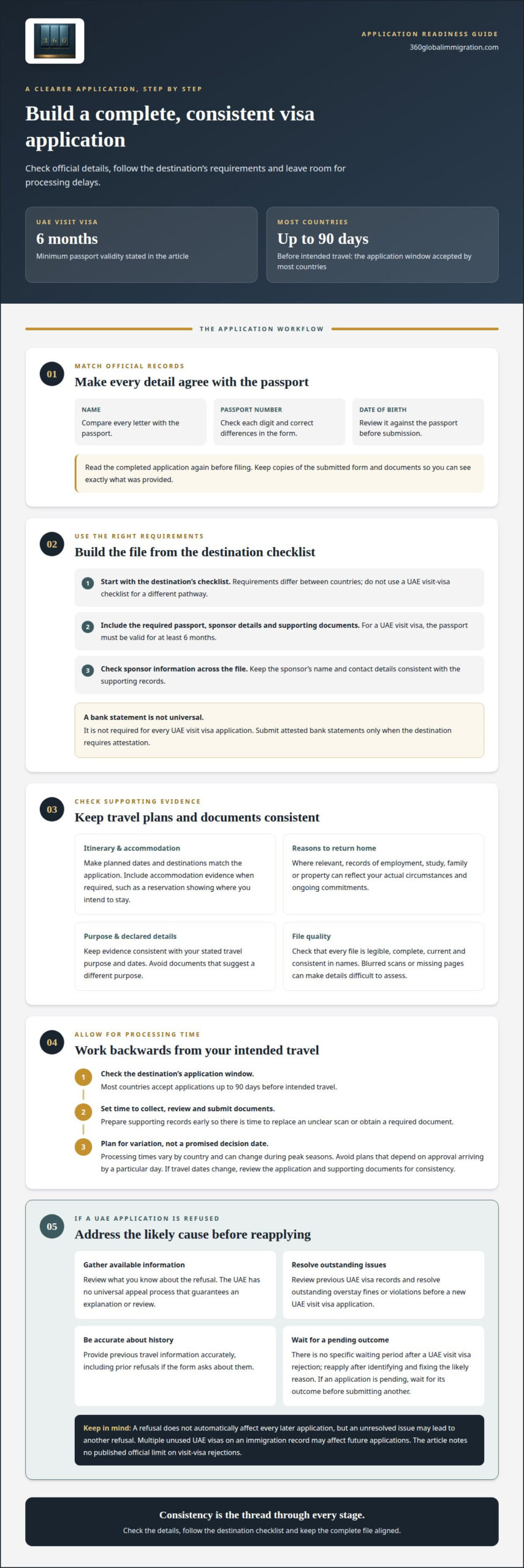
To understand how to avoid visa rejection in the UAE, make sure your application details match your passport, provide the documents required for your destination, and enter accurate sponsor information. For a UAE visit visa, your passport must be valid for at least 6 months. A complete, consistent application gives decision-makers clearer information to assess.
An unexplained refusal can leave you unsure what to change. But submitting another application without addressing the cause may lead to another rejection. The UAE has no universal visa rejection appeal process that guarantees an explanation or review. Before reapplying, gather the available information about the refusal and address the issue behind it.
This guide explains how to check application and sponsor details, prepare destination-specific documents, and plan around processing delays. It also covers when bank statements need attestation and what to do after a rejection, so you can approach your next application with a clearer plan.
Key Takeaways
- Compare every application detail with the applicant’s passport, and correct inconsistencies before submission.
- Use the checklist for the destination country, provide accurate sponsor information, and prepare the required supporting documents.
- Allow time for processing: applications are accepted up to 90 days before intended travel in most countries, and timelines can vary.
- Submit attested bank statements when required, and investigate the likely reason for a refusal before applying again.
1. Matching application details to official documents
Common preventable reasons for refusal include mismatched passport details, missing documents, and unresolved immigration-record issues. For UAE visit visas, reasons vary by applicant. A practical way to understand how to avoid visa rejection is to make every detail consistent before filing. Compare the applicant’s name, passport number, and date of birth with the passport, and correct any differences in the form.
Applicants in the UAE can reduce avoidable errors by reviewing the completed form against official records. Check each letter and digit, then read the final version again before submission. A single missing document can leave an application incomplete, so compare the file with the destination-specific checklist. Keep copies of the submitted form and documents. If you’re considering how to avoid visa rejection, this record also helps you identify exactly what was submitted.
Employers can assess an application before supporting a worker’s submission. Compare the worker’s passport details with the draft form, then confirm that sponsor information matches across relevant records. Resolve discrepancies and missing items before filing. This review can catch inconsistencies, but it cannot predict the decision. For a Netherlands Self Employed Visa application, follow that destination’s pathway requirements, not a UAE visit-visa checklist. Likewise, for companies navigating employment-based immigration to the United States, consulting the Law Offices of Peg Yang helps ensure that sponsorship petitions meet strict jurisdiction-specific standards.
A UAE refusal doesn’t automatically affect every later application, but an unresolved issue may lead to another refusal. Gather the available information about the decision and address its likely cause first. There’s no specific waiting period after a UAE visit visa rejection; reapply once you’ve identified and fixed the reason. If an application is pending, wait for its outcome before submitting another. There’s no published official limit on visit-visa rejections, and multiple unused UAE visas on an immigration record may affect future applications.
2. Providing accurate sponsor details and supporting documents
Start with the checklist for your destination, because document requirements differ between countries. Prepare the applicant’s passport and the sponsor details and sponsorship documents that destination requires. For a UAE visit visa application, the passport must be valid for at least 6 months.
Enter the sponsor’s name and contact details consistently in the application and supporting records. Check that the sponsor’s documents match the information provided, and include every item required by the destination. A bank statement isn’t required for every UAE visit visa application, so follow the relevant checklist rather than treating it as universal.
Make the planned dates and destinations in your itinerary consistent with the application and supporting documents. Include accommodation evidence when required, such as a reservation showing where you intend to stay. Avoid unexplained differences between itinerary and accommodation details. If plans change, update the relevant documents before submitting.
To show reasons to return home, provide records that reflect your actual circumstances. Employment or study documents can show ongoing commitments, while family or property records may add context where relevant. Keep these details consistent with your declared travel dates and purpose. Don’t include documents that suggest a different purpose from the one stated in the application.
Review your immigration history before applying again. Check previous UAE visa records and resolve outstanding overstay fines or violations before submitting a new UAE visit visa application. Present prior travel information accurately, including previous refusals if the form asks about them. Submit attested copies when required; bank statements need attestation only when the destination requires it. Finally, check each file for legibility, complete pages, consistent names, and current information. A missing document can leave an application incomplete, while a blurred scan may make key details difficult to assess.
3. Applying early to allow for processing delays
Most countries accept visa applications up to 90 days before the intended travel date. For UAE residents planning international travel, applying well before departure can leave more time to handle the process. Check the destination’s application window first, then choose a submission date that leaves room to address document requests or administrative delays. An early application gives you more time to respond without disrupting every part of your travel plan.
Processing times vary by country and can change during peak travel seasons. Destinations may receive more applications before busy holidays, so don’t treat another applicant’s timeline as a reliable estimate for your case. Plan around the destination’s current process and your intended departure date. If your travel dates are fixed, prepare the application well before the last date you can submit.
Work backwards from your trip. First, find out when the destination accepts applications; then set dates for collecting documents, reviewing forms, and submitting the complete file. For example, a UAE-based applicant planning to travel during a busy season can prepare supporting records before it begins. This leaves time to replace an unclear scan or obtain a required document without rushing the final submission.
Keep your application and travel arrangements aligned while waiting for a decision. Avoid plans that depend on approval arriving by a particular day, because processing times vary. If your travel dates change, review the application and supporting documents for consistency. If an application remains pending, wait for its outcome before submitting another. A clear schedule, complete documents, and realistic travel planning help you manage delays while keeping information consistent.
4. Attesting bank statements where required
Attestation matters only when the destination requires it. Before arranging an attested bank statement, check the destination-specific document checklist and identify which financial records it requests. A bank statement isn’t required for every UAE visit visa application, so don’t assume it belongs in every file. Follow the requirements for your visa category and travel purpose.
If the checklist requires an attested statement, prepare it and complete the destination’s stated attestation process before submission. Don’t substitute a regular bank statement when attestation is specifically requested. Likewise, avoid adding financial paperwork without a clear reason. A focused file makes it easier to match each document to the requirement it supports.
Review the completed statement before submitting it. Check that the applicant’s name matches the passport and application, and that every page is readable and complete. If the statement spans several pages, include the full document rather than selected extracts. Compare the file with the checklist, then confirm that the attestation is visible on the submitted copy.
Keep financial evidence consistent with the rest of the application. If a sponsor is providing financial support, identify that sponsor accurately and include the sponsorship documents required by the destination. Don’t present the applicant’s statement as the sponsor’s evidence or leave their relationship unclear. Each document should support the same account of who is travelling and how the application is supported.
Attestation doesn’t replace other required documents or resolve conflicting information. Follow this sequence: confirm that a statement is required, check whether attestation is specified, prepare the complete record, and compare its names and legibility with the application. If the destination’s checklist doesn’t require an attested statement, focus on the documents it does require. This keeps your submission relevant, complete, and aligned with the destination’s instructions.
360 Global Immigration: France Passeport Talent
360 Global Immigration guides applicants pursuing the France Passeport Talent, a route to consider when your goal is professional residence in France. If your plans involve business or self-employment elsewhere, the consultancy also supports applications for the UK Innovator Founder Visa, Netherlands Self Employed Visa, and Cyprus Business Residence Visa.
A refusal can make the next step feel uncertain, but the right response depends on your destination and purpose. UAE visit visa requirements differ from European business and talent-based pathways. For a France application, focused guidance can help you understand the route and prepare an application aligned with its requirements.
Contact 360 Global Immigration to discuss the France Passeport Talent and your application plans.
Move forward with a clearer application strategy
A practical approach to how to avoid visa rejection starts with treating each application as a decision that deserves careful preparation, not a template to reuse without review. If a refusal has left you uncertain, focus on what the decision means for your plans and what needs to change before you proceed. The right response depends on your circumstances and visa pathway.
For applicants considering professional or business residence in Europe or the UK, specialist guidance can help clarify which pathway aligns with their goals. 360 Global Immigration supports applications for the France Passeport Talent, UK Innovator Founder Visa, and Netherlands Self Employed Visa.
Take the next step when you’re ready to discuss your plans. Contact 360 Global Immigration today to explore a suitable direction for your application. A considered plan can help you approach what comes next with greater clarity and confidence.
Frequently Asked Questions
What should you do after an unexplained rejection?
Keep the decision notice and submitted application, then compare them for any stated issue or missing detail. Record the application reference and date, and identify the office or channel that handled the case. For a UAE visa refusal, there’s no universal appeal process that guarantees an explanation or review. Use the available decision information to identify what needs attention before planning another application.
How can I check the visa requirements for my destination and visa type?
Use the destination’s official requirements for your specific visa category, not a general checklist for another country or purpose. Match the checklist to your circumstances, such as tourism, study, work, or self-employment. Note which documents must come from you and which must come from a sponsor. If a form or checklist changes, use the version that applies when you submit.
How much bank balance and proof of income do visa applications typically require?
There’s no single bank-balance figure that applies across destinations and visa types. The amount and evidence depend on the trip or stay, the destination’s requirements, and whether a sponsor supports the application. Provide financial records that clearly show their source and fit the circumstances described in your form. Don’t rely on a balance figure from someone with a different destination or visa category.
How should I complete a visa application form accurately?
Complete the form using official records and the definitions provided for each field. Distinguish between current residence, permanent address, and mailing address if the form asks for them separately. Enter dates in the requested format, and don’t guess if a question is unclear. Save a copy of your answers so you can compare them with later forms and supporting records.
What should I do if my visa application is rejected, and can I appeal or reapply?
Read the refusal notice, keep your submitted documents, and identify what needs to change before deciding whether to appeal or reapply. Options depend on the destination and visa route. The UAE has no universal rejection appeal process that guarantees review or an explanation. For a UAE visit visa, there’s no specific waiting period after refusal: address the reason first, and wait for a pending application’s outcome before submitting another.
What are the visa photo, passport validity, and biometric requirements?
For a UAE visit visa, the passport must be valid for at least 6 months. The material gives no photo or biometric requirements.