
A visa or moving quote is only one part of your budget. The hidden costs of immigrating to Europe from the UAE can also include shipping, customs clearance, insurance, food, restaurant charges and work-permit consultancy fees. The total depends on your destination, visa route and personal plans.
It’s reasonable to want a clear figure before committing to a move, but there is no universal total for every UAE resident relocating to Europe. A business residence or talent-based route also has different cost considerations from a move based on employment.
This guide explains which expenses may sit outside the headline quote and why they arise. You’ll learn what to budget for household goods, insurance, customs, everyday food, dining and professional support for European work permits, so you can plan more completely before making decisions.
Key Takeaways
- Build a relocation budget around your destination, shipment size and timing, rather than relying on a single headline estimate.
- Understand how customs requirements and the scope of moving insurance can affect the protection and cost of transporting household goods.
- Allow room in your food budget for local dining habits and charges that may not be obvious from a menu.
- Separate private consultancy charges from government fees, and match professional immigration support to the visa route you plan to pursue.
Relocation flights and shipping household goods
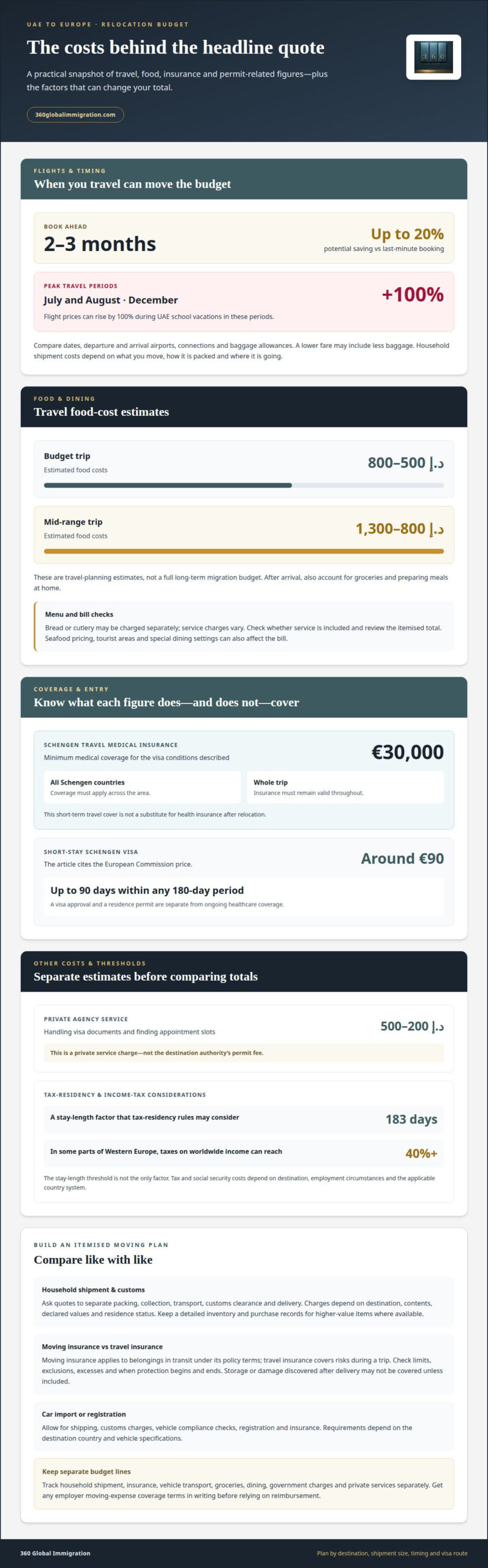
Flight and shipment costs can shift a moving budget before accommodation or everyday expenses begin. Return flights from the UAE to Europe vary by date and route, while booking two to three months ahead may save up to 20% compared with last-minute booking. This travel benchmark covers airfare, not the full cost of relocating household belongings or settling after arrival.
Timing matters. Flight prices can rise by 100% during UAE school vacations in July and August and in December. Compare departure dates from UAE airports, connection options, baggage allowances and arrival airports. A cheaper fare may include less baggage, which matters when each extra suitcase competes with space for items shipped separately.
For popular destinations such as France, the Netherlands and Cyprus, relocation costs differ with shipment volume, route, accommodation needs and residence process. No single destination ranking captures those differences. Compare your actual moving components, not a headline airfare. If applying for a short-stay Schengen visa, the European Commission puts its price at around €90. The European Union states that it permits stays of up to 90 days within any 180-day period.
Tax and social security costs also depend on destination and work arrangements. Tax-residency rules may consider whether your stay exceeds 183 days, but that is not the only factor. In some parts of Western Europe, taxes on worldwide income can reach 40 per cent or more. Social security contributions depend on the applicable country system and employment circumstances, so include them when comparing salaried work with self-employment.
Customs clearance and moving insurance
Customs clearance can add paperwork and service charges to an international household shipment. Charges and procedures depend on the destination, shipment contents, declared values and your residence status. A detailed inventory helps you describe each item consistently across shipping and clearance documents. Keep purchase records for higher-value belongings, where available, and ask the moving company to separate transport charges from customs-related charges in its quote.
Review insurance terms carefully. Moving insurance covers belongings in transit under the policy’s terms, while travel insurance addresses risks during a trip. Compare coverage limits, exclusions, excesses and when protection begins and ends. For example, a policy covering transport may exclude storage or damage discovered after delivery unless those stages are included in its terms. For major consignments travelling by sea or air freight, comparing dedicated transit coverage from specialists like Cargo Insure Online can ensure high-value belongings are protected throughout global transit.
Schengen travel medical insurance has specific coverage conditions: it should provide at least €30,000 in medical coverage, apply across all Schengen countries and remain valid throughout the whole trip. This is short-term travel cover, not a substitute for health insurance needed after relocation. A visa approval and a residence permit are separate from the practical question of ongoing healthcare coverage.
For longer stays, health insurance costs depend on the destination, your age, coverage level and personal circumstances. Include the premium and any applicable out-of-pocket costs in your relocation budget. An employer may cover some moving expenses, so get the coverage terms in writing before counting on reimbursement.
Importing or registering a UAE car in Europe can involve shipping, customs charges, vehicle compliance checks, registration and insurance. Requirements and costs depend on the destination country and the vehicle’s specifications. Include each stage in your moving plan before deciding whether to ship the car.
Keep separate estimates for household shipment, insurance and vehicle transport. This makes it easier to compare international moving quotes and see exactly which services each estimate covers.
Food costs and unexpected restaurant charges
Food spending depends on how often you cook, your city and your itinerary. Estimated food costs in Europe are د.إ500 to د.إ800 for a budget trip, and د.إ800 to د.إ1,300 for a mid-range trip. These figures offer a travel-planning reference; a longer migration budget should also account for groceries after arrival and the cost of preparing meals at home.
Restaurant menus may list charges separately from the advertised prices. Bread or cutlery, for example, may appear as additional charges. Read the menu details before ordering, especially for seafood, and ask how the final price is calculated.
Service charges vary by country and restaurant. Check whether service is included on the menu or bill, then review the itemised total before paying. A central location, tourist area or special dining setting can also affect the bill. In Germany, budget for planned restaurant meals alongside groceries rather than treating dining out as a substitute for everyday food shopping.
Set a separate allowance for premium medical needs and paid services. A restaurant budget cannot cover an unexpected medical expense, and a high-end service or special meal can quickly change daily spending. Keep these categories separate from groceries and dining so one costly day does not distort your estimate for the full period.
Agency and entry-permit charges belong in a separate migration line, not in the food total. Travel agencies may charge د.إ200 to د.إ500 for handling visa documents and finding appointment slots. That is a private service charge, not the destination authority’s permit fee. Keep government charges, agency services and restaurant spending separate when planning your country-by-country budget.
Consultancy fees for European work permits from the UAE
A work-permit budget can include private advisory charges, official fees, document preparation and currency conversion costs. List these separately to plan for your destination and application route.
Consultancy and Advisory Fees
Consultancy and legal advisory fees are private charges for professional support with a migration application. Depending on the agreed scope, support may cover route assessment, document-preparation guidance and application coordination. These charges are separate from government tariffs, so list them independently in your budget. The amount depends on the work involved and the application’s complexity, not on a standard government-set fee.
Government Permit and Visa Fees
Government fees are charges set by the destination authority to process permits, visas, residence cards or appointments. The applicable charges depend on the country and route. Budget for each official charge separately, including any appointment service fee. A tourist or Schengen visa serves a different purpose from a long-stay work permit, so do not assume one application fee covers another. Where possible, pay through the authority or its published service provider and retain receipts.
Document Attestation and Translation Costs
Attestation, translation and legalisation charges relate to preparing documents for use in another country. Costs depend on the documents required by the destination, the language needed and the authentication steps involved. There is no single amount for every applicant. List each document and its preparation stages separately, including any required translation or authentication, to distinguish these expenses from application fees and professional advice.
Also allow for currency conversion when paying in another currency. Using a regular UAE debit card for non-AED transactions may incur a 2%-3% conversion fee. For guidance on a relevant European immigration route, discuss your visa options.
360 Global Immigration
360 Global Immigration helps UAE residents understand how their immigration route shapes the costs and preparation involved in moving to Europe. Its guidance covers business residency and talent-based visa pathways, including France Passeport Talent, Netherlands Self Employed Visa and Cyprus Business Residence Visa. The right route depends on your professional plans and the country where you intend to live.
Use this support when you’re narrowing down a suitable pathway and want to understand the application requirements alongside your broader relocation budget. Visa guidance can clarify immigration-related steps, while expenses such as flights, shipping, insurance and daily living remain separate parts of your move.
Contact 360 Global Immigration to discuss your plans and relevant visa options.
Make your next move with a clear plan
A relocation budget is most useful when it helps you make a decision, not just list expenses. Before committing, align your destination and professional plans with your immigration route, then consider how each affects your timing and preparation. A clear plan for the hidden costs of immigrating to Europe from the UAE can help you distinguish visa-related decisions from the practical arrangements of moving.
For applicants whose plans involve an eligible business or talent-based pathway, 360 Global Immigration can provide guidance on relevant options, including the UK Innovator Founder Visa. The right route depends on your intended work and destination, so start by defining what you want your move to make possible.
Take the next step by contacting 360 Global Immigration to discuss your immigration plans. With a considered route and a budget built around your priorities, you can move forward with greater clarity and confidence.
Frequently Asked Questions
Are these the total fees I will pay?
No. A headline estimate may leave out costs linked to your household, dependants, payment method or arrival arrangements. Treat it as a starting point, then build a personal budget with separate lines for one-time charges and ongoing expenses. For example, a single applicant moving alone will have different housing and document needs from a family relocating with children and household goods.
What are the visa and residence permit fees for moving from the UAE to European countries?
There is no single fee for every European destination or immigration route. The total depends on the visa category, destination authority, residence documentation and any appointment service involved. A short-stay Schengen visa is distinct from a national visa for work or residence. List each applicant separately, including dependants and any later residence-card or renewal charges, and consult the destination authority’s current fee schedule.
What are the costs of medical exams, police certificates, and biometrics for European visa applications from the UAE?
These costs depend on the destination’s application requirements and the providers involved. Medical checks, police certificates and biometric appointments are separate items, not necessarily one bundled charge. The required documents or examinations depend on the visa route and your circumstances. For a clear estimate, itemise each applicant’s required checks, certificate issuance, translation and appointment charges before adding them to your application budget.
What are typical international moving and shipping costs from the UAE to Europe, including customs duties?
There is no reliable single shipping total for every move. Costs depend on shipment volume, packing, route, delivery arrangements and customs treatment in the destination country. Customs duties are determined by the destination’s applicable rules and the goods being imported. Request a written, itemised estimate that separates transport, packing, clearance, duties and final delivery. This makes it easier to compare quotes for the same services.
What upfront rental costs and housing deposits are required in major European cities?
Upfront housing costs depend on the city, property, lease terms and whether the accommodation is furnished. Your move-in budget may need to cover a security deposit, rent paid in advance and initial utility arrangements. The required amounts and payment schedule are set by the rental agreement and local practice. Review the full written terms before committing, and budget for temporary accommodation if your long-term lease starts later.
What are the cost and requirements for private health insurance before qualifying for European public healthcare?
Private insurance costs depend on your destination, age, coverage level, policy duration and medical needs. Eligibility for public healthcare also depends on the destination’s rules and your residence or employment status. If a policy is needed for an application, compare its coverage area, validity dates, exclusions and required medical benefits with the visa route. Budget separately for insurance and any out-of-pocket healthcare expenses.