
Public healthcare access in Cyprus depends on your residence status and eligibility, not simply on holding a non-EU passport. People staying in Cyprus for three months or more are considered residents and can register with the General Healthcare System (GeSY), while applicants for permanent residence are required to have private health insurance. What you pay for treatment then depends on whether you qualify for public cover or use private care.
It’s understandable to want clear answers before moving: healthcare quality matters, but so does knowing what cover you need and which costs you may have to pay. This guide explains how the healthcare system in Cyprus for non-EU residents works, including residence-related cover requirements, emergency treatment and the differences between public and private care.
You’ll also learn what can affect affordability and how to assess your healthcare arrangements alongside your residence plans, so you can make informed decisions before settling in Cyprus.
Key Takeaways
- Learn how residence status and eligibility affect access to Cyprus’s public healthcare system.
- Understand when private health cover may be required and what to consider for your residency plans.
- Know which emergency numbers to use and what can affect the cost of urgent care.
- Assess the trade-offs between public and private care, including quality, access and potential out-of-pocket costs.
How the Cyprus Healthcare System Works for Expats?
Cyprus has public and private healthcare, but access depends on residence status, employment and eligibility. For non-EU residents, insurance arrangements matter because registration with the public system is not automatic.
Public and Private Care
Cyprus’s two-tier system combines publicly funded services with private providers, giving residents different routes to treatment. Public hospitals and facilities serve eligible patients through the national system, while private hospitals and medical centres charge for care under their own arrangements. Many private patients pay upfront, so private health insurance can help manage treatment costs. Visitors on Schengen or tourist visas must have travel insurance covering at least €30,000 for medical expenses and medical repatriation, according to the European Union.
Public Healthcare Eligibility and Registration
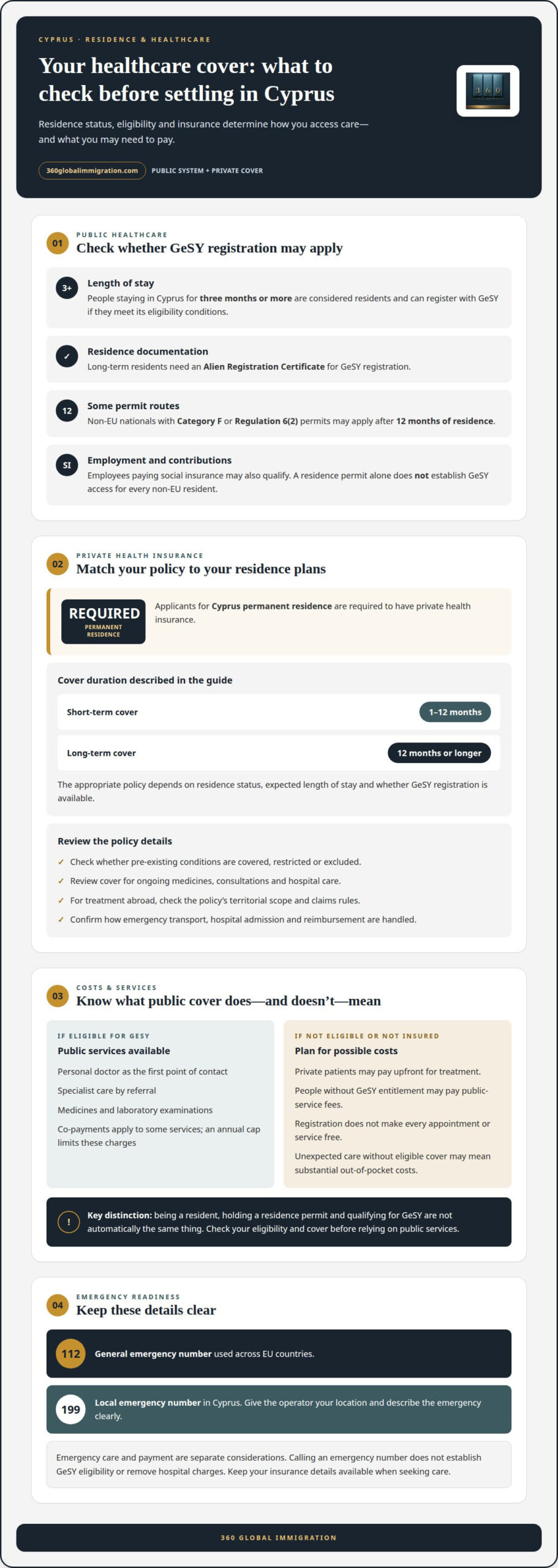
Public healthcare eligibility is based on residence and qualifying circumstances, rather than nationality alone. People staying in Cyprus for three months or more are considered residents and can register with the General Healthcare System, or GeSY, if they meet its eligibility conditions. Long-term residents need an Alien Registration Certificate for registration. Non-EU nationals with Category F or Regulation 6(2) permits may apply after 12 months of residence. Employees paying social insurance may also qualify. These requirements matter: a residence permit alone does not establish access for every non-EU resident.
Healthcare Access Across Cyprus
In the Republic of Cyprus, GeSY-registered patients use personal doctors as their first point of contact; referrals are required to see specialists. Eligible patients can obtain prescriptions through the system, while people without medical-card entitlement pay prescribed fees for public hospital services. In emergencies, call 112 or 199. EHIC access applies to eligible cardholders at state hospitals and clinics, not as a substitute for non-EU residents’ residence cover. The EHIC is not valid in Northern Cyprus, so Republic-side eligibility should not be assumed to apply there. Check which area your care is in and whether your cover applies before relying on public services.
Cyprus residency and healthcare-cover requirements
Residence status, GeSY eligibility and the type of cover you hold shape what you pay for care in Cyprus. Private insurance remains important for residents who cannot access public healthcare.
GeSY Services and Co-payments
GeSY provides eligible beneficiaries with public health services, including personal doctors, specialist care by referral, medicines and laboratory examinations. Patient co-payments apply to some services, and an annual cap limits these charges. Registration does not mean every appointment or service is free. A general practitioner is the first point of contact, while seeing a specialist usually requires a referral.
Uninsured and Pre-existing Condition Risks
Without insurance, an expat may be responsible for private treatment costs or public-service fees if they are not entitled to GeSY. A pre-existing condition can also affect private health insurance: policy terms determine whether treatment is covered, restricted or excluded. Review cover for ongoing medicines, consultations and hospital care before relying on a policy. Without eligible cover, an unexpected health service may lead to substantial out-of-pocket costs.
Cyprus permanent residence applicants are required to have private health insurance. Short-term cover is described as lasting 1-12 months, while long-term cover lasts 12 months or longer. The appropriate policy depends on residence status, expected length of stay and whether GeSY registration is available. For treatment abroad, check the policy’s territorial scope and how it handles claims. Expats planning elective or specialised care overseas can also turn to resources like Clinic Group to find and compare reputable clinics abroad.
Ambulance cover also depends on your healthcare arrangements. An EHIC holder can travel by ambulance without charge for covered care, but the card does not cover air ambulance transport. Non-EU residents should not assume EHIC provisions apply to them. Confirm how your insurance covers emergency transport, hospital admission and reimbursement, especially if you are not eligible for GeSY.
Emergency medical care and ambulance numbers
In Cyprus, call 112, the general emergency number used across EU countries, or 199, the local emergency number. Both are emergency contact options; the local number is useful to remember alongside the EU-wide number. For an urgent medical incident, give the operator your location and describe the emergency clearly so responders can identify the situation.
Emergency care and payment are separate considerations. A visit to an Accident and Emergency centre carries a co-payment, and a minimum charge for emergency treatment is payable at the hospital upon arrival. EU and Cypriot pensioners are exempt from that charge. For other patients, the applicable payment matters even when immediate assessment is needed.
Non-EU residents should distinguish access to emergency care from entitlement to publicly funded healthcare. Calling an emergency number does not, by itself, establish GeSY eligibility or remove hospital charges. Your cover and status affect how treatment is funded, so keep your health insurance details available when seeking care. If you are treated at a public hospital, payment rules still apply if you do not qualify for an exemption.
Ambulance cover also depends on your healthcare arrangements. An EHIC holder can travel by ambulance without charge for covered care, but this rule applies to eligible cardholders and should not be assumed to cover non-EU residents. The EHIC does not cover air ambulance transport. International visitors should understand the transport provisions in their own policy, since emergency ambulance and air ambulance benefits are distinct. Once urgent care has been arranged, follow the hospital’s instructions about payment and required documentation.
Healthcare quality and affordability in Cyprus
Cyprus’s care combines national health services with private treatment, so quality and affordability depend partly on access. The Global Health Index 2024 ranked Cyprus’s healthcare system 29th worldwide. That ranking offers one broad measure, but it cannot predict an individual patient’s experience with a particular specialist, hospital or facility.
Public healthcare can reduce direct costs for eligible beneficiaries, although co-payments and eligibility rules still matter. Cyprus’s public system is funded through contributions, including social insurance contributions from people employed in the country. A medical card or GeSY registration can affect what patients pay, while residents outside public eligibility may face private fees. For non-EU residents, the practical affordability question is whether they qualify for national health coverage or need private health insurance.
Household out-of-pocket spending was 45% in 2018, 18% in 2020 and 10% in 2021. These figures show a substantial change over those years, but they don’t establish what a particular expat will spend. Personal costs depend on eligibility, treatment needs, referrals and whether care is public or private. Private care can offer another route to appointments, but patients may pay upfront and rely on their policy’s reimbursement terms.
For travel or a longer stay, assess cover against likely needs: routine consultations, specialist care, prescriptions and hospital treatment. Check how the policy treats pre-existing conditions and whether it covers care in Cyprus. Compare those terms with your public-system eligibility before choosing a level of cover. If Cyprus residency is part of your plans, coordinate healthcare planning with your residence plans so coverage fits your intended status and length of stay.
360 Global Immigration: Cyprus Business Residence Visa
360 Global Immigration supports applicants pursuing a Cyprus Business Residence Visa, helping connect residence planning with the practical considerations of settling in Cyprus. This is a relevant next step if your move is based on a business residence pathway and you need to understand how your plans relate to residency requirements.
Healthcare access depends on your status and eligibility, so residence planning and health-cover arrangements should be considered together. 360 Global Immigration also assists with other qualifying pathways, including France Passeport Talent, the UK Innovator Founder Visa and the Netherlands Self Employed Visa.
If you’re planning business residence in Cyprus, contact 360 Global Immigration to discuss your application.
Plan your next move with clarity
As you prepare to move, consider the healthcare system in Cyprus for non-EU residents as part of your wider residency decision. Set out your intended residence route, expected length of stay and who will relocate with you. Then align your healthcare arrangements with those plans, rather than leaving cover until the last minute. This gives you a clearer framework for planning your residence and settling in.
For business-led relocation, the next step is to consider which residence pathway fits your plans and prepare the application accordingly. 360 Global Immigration supports clients with residence and talent-based visa pathways, including France Passeport Talent, the UK Innovator Founder Visa and the Netherlands Self Employed Visa.
Contact 360 Global Immigration to discuss your next step. With a considered plan, you can move forward with greater confidence.
Frequently Asked Questions
How should I choose health insurance in Cyprus: local or international?
Choose cover based on where you need it and how you expect to access care. A local policy may suit someone whose treatment will mainly be in Cyprus, while international insurance may be relevant if you need cover abroad. Compare outpatient and hospital benefits, exclusions, pre-existing-condition terms, direct payment or reimbursement arrangements, and policy limits. The right fit depends on your residence status, healthcare eligibility and personal medical needs.
How much will I pay?
Your healthcare costs depend on eligibility, the service you use and whether treatment is public or private. GeSY beneficiaries may have co-payments, while people outside public entitlement may pay prescribed fees or private treatment costs. For a private appointment, hospital admission or diagnostic test, the provider and treatment affect the bill. Review your policy’s excess, reimbursement terms and exclusions to estimate your likely out-of-pocket share.
What documentation do I need to access healthcare in Cyprus?
For GeSY registration, long-term residents need an Alien Registration Certificate. Keep your identification and residence documents available when arranging registration or attending care, and bring insurance details if treatment is privately funded. The required evidence may depend on your eligibility route, such as employment or residence category. Keeping these records together helps distinguish proof of identity, residence and insurance when accessing healthcare.
What standard of care does the Cypriot healthcare system offer?
Cyprus provides care through public hospitals and private medical facilities, with access shaped by location, eligibility and the type of service needed. Preventable-cause death rates are among the lowest in the European Union. This indicator describes a population-level outcome, not the experience or result of any individual treatment. For a planned procedure, consider the relevant specialty, referral route and whether your cover applies at that facility.
How does Cyprus’s healthcare system work for non-EU residents?
Non-EU residents may access public healthcare if they meet the applicable eligibility and registration conditions; otherwise, private care and insurance can be important. The route depends on residence status and personal circumstances, not nationality alone. For example, a long-term resident’s registration documents and a worker’s social-insurance position can affect access. The healthcare system in Cyprus for non-EU residents therefore requires planning for both residence and cover.
Is private health insurance mandatory for non-EU residents in Cyprus?
Private health insurance is required for applicants seeking permanent residence in Cyprus, but this does not mean the same rule applies to every non-EU resident. Public-system eligibility depends on individual circumstances and registration status. Temporary visitors, workers and permanent-residence applicants may have different cover requirements. Identify your residence route first, then align your insurance with its requirements and your expected access to healthcare.