Most expats view the French residency process as an impenetrable bureaucratic maze, yet the Passeport Talent is actually a precision-engineered fast track for global excellence. You likely feel the weight of choosing between 11 distinct categories, worrying that a minor error in your salary calculation or professional classification might lead to an immediate rejection. It’s a high-stakes transition, and the uncertainty of meeting the 2026 criteria can be overwhelming when your career and family’s future are on the line.
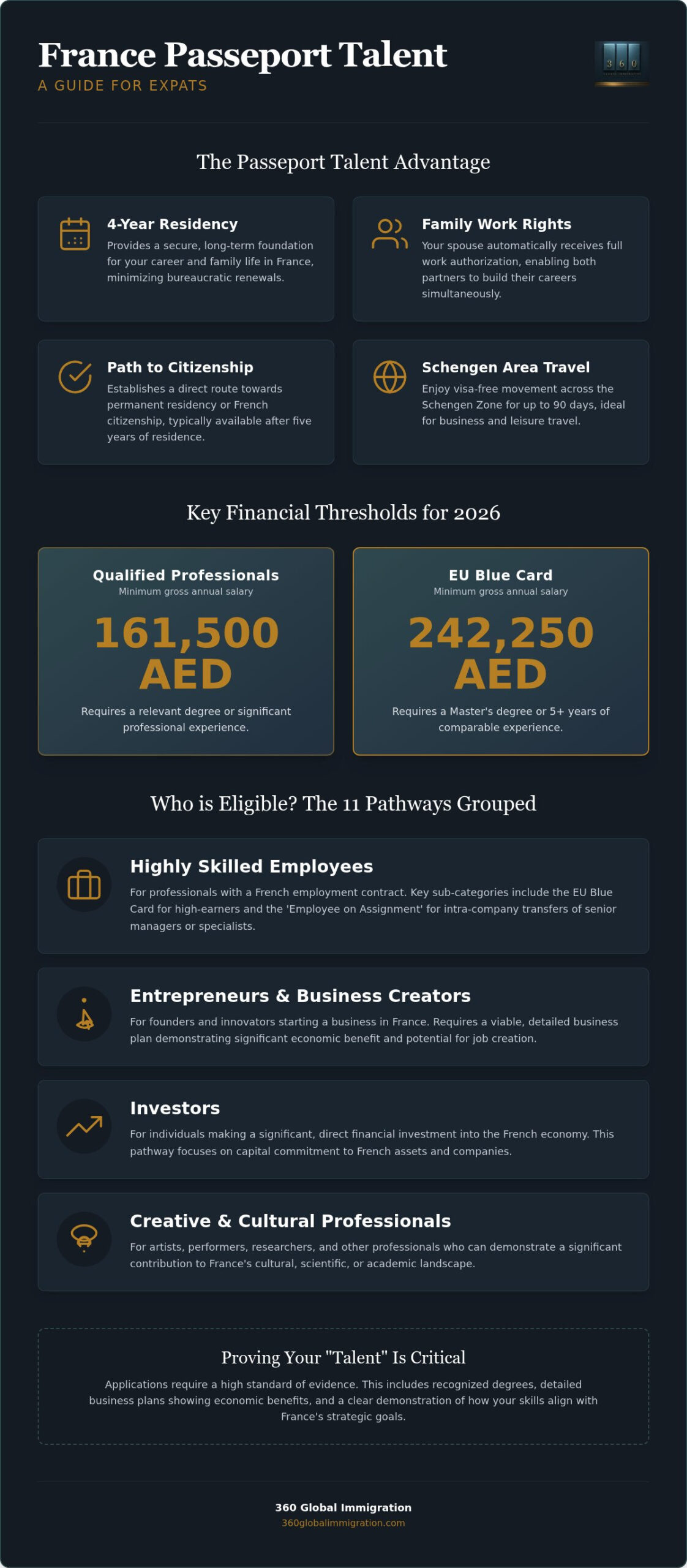
This guide provides the definitive framework for France talent visa eligibility for expats, offering the clarity you need to move forward. You’ll discover if you meet the specific financial thresholds, such as the 161,500 AED minimum for qualified employees or the 242,250 AED requirement for the EU Blue Card. We will break down the 11 eligibility pathways, from business investors to creative professionals, providing a clear roadmap of the documentation required to secure your residency. By the end of this breakdown, you’ll have the confidence to begin your application with the precision of a seasoned professional.
Key Takeaways
- Identify which of the 11 specialized pathways aligns with your professional profile to confirm your France talent visa eligibility for expats.
- Master the updated 2026 financial thresholds, including salary requirements starting from approximately 161,500 AED for qualified professionals.
- Learn how the Passeport Talent provides a secure, four-year residency permit that extends full work rights to your spouse and family.
- Understand the high evidence standards required to prove your “talent,” including the creation of business plans that demonstrate economic benefit to France.
- Discover the strategic timing and documentation roadmap necessary to navigate the transition from your current residence to a successful life in France.
Understanding the France Passeport Talent Framework
The France Passeport Talent represents the pinnacle of French immigration policy, designed to streamline the entry of high-value professionals from outside the European Union. Unlike standard work visas that often involve cumbersome employer-led applications, this framework empowers the individual. It serves as a flagship residency permit for those who can demonstrate a significant contribution to France’s economic or cultural vitality. To understand the History of the French Talent Visa, one must look at how it evolved from the restrictive ‘compétences et talents’ card into the flexible, multi-year solution it is today.
For many professionals moving from the UAE, France talent visa eligibility for expats hinges on the administrative simplicity of the transition. In most of the 11 categories, you don’t need a separate work permit. This removes a massive administrative hurdle that typically delays international relocations. The permit is specifically tailored for individuals who bring specialized skills to the table. The framework targets four primary groups:
- Highly skilled employees holding recognized degrees or significant professional experience.
- Entrepreneurs and business creators investing in the French market.
- Investors who commit significant financial capital to French assets.
- Creative professionals, including artists and researchers, who enrich the national culture.
Why France is Targeting Global Talent in 2026
France’s “Choose France” initiative has reached a mature stage in 2026. The government actively courts tech founders and innovative creators who can drive the digital economy. By positioning itself as the primary gateway to the European Single Market, France offers expats a stable environment for business growth. This strategic focus means the administration is more inclined to approve applications that show clear potential for job creation or technological advancement. It isn’t just about filling a role; it’s about importing innovation that keeps France competitive on a global scale.
The Advantage of the 4-Year Residency Permit
Stability is the core value proposition of this permit. While other visas require annual renewals, the Passeport Talent is typically issued for four years. This duration provides a secure foundation for families. Spouses benefit from an automatic “family simplify” procedure, granting them immediate work rights without additional paperwork. This eliminates the stress of the “trailing spouse” dynamic, allowing both partners to build careers simultaneously.
Beyond immediate comfort, this permit sets you on a direct path toward permanent residency or French citizenship, which generally becomes an option after five years of residence. It also facilitates seamless professional travel, allowing for visa-free movement across the Schengen Area for up to 90 days in any 180-day period. This mobility is essential for professionals who manage regional offices or consult across multiple European jurisdictions.
The 11 Eligibility Categories: Where Do You Fit?
Identifying the correct pathway is the most pivotal decision in your residency journey. The framework isn’t a generic solution; it’s a strategic matching process designed to align your professional profile with French economic priorities. Selecting the wrong category remains a leading cause of application delays or outright rejections. You must undergo a detailed assessment of your professional history, academic credentials, and financial standing before submitting any paperwork. This precision ensures you meet the specific Passeport Talent Application Process requirements for your unique situation.
Qualified Employees and Highly Skilled Workers
The “EU Blue Card” remains the gold standard for high-salary professionals moving to France. To qualify in 2026, you must demonstrate a gross annual salary of at least 242,250 AED. This category requires either a Master’s degree or at least five years of comparable professional experience. If you’re being transferred within an international corporate group, the “Employee on Assignment” category may be more suitable. It focuses on intra-company mobility for senior managers and specialists, provided you’ve been with the group for at least six months. The academic prerequisites are strict, so ensuring your UAE degrees are properly recognized is a vital first step.
Entrepreneurs, Business Creators, and Investors
Founders often find their home in the France Passeport Talent business creator pathway. This requires a minimum investment of approximately 122,500 AED into a new or existing French business. You must also hold a Master’s degree or have five years of professional experience in your field. For those with deeper capital reserves, the “Investor” category demands a direct economic investment of at least 1,224,000 AED in tangible or intangible assets. There’s a significant distinction between starting a fresh company and taking over the management of an existing one; the latter requires you to prove you’ll be a corporate officer with a salary exceeding 267,750 AED annually.
Innovative Projects and Artistic Talents
The “Recognized Innovative Project” category, often called the French Tech Visa, is ideal for tech founders whose startups are backed by a public partner or incubator. If your work falls into the creative sphere, the “Artist and Creative Professionals” category offers a path for those with world-renowned talent. You’ll need to demonstrate monthly resources of at least 5,200 AED, with 51% of that income derived from your artistic activity. Scientists and researchers also have a dedicated path under the “International Renown” category, provided they have a hosting agreement from a recognized French research organization. If you’re feeling overwhelmed by these distinctions, reaching out to a specialized immigration consultant can help you navigate the nuances of France talent visa eligibility for expats with absolute certainty.
Key Qualification Criteria and Financial Thresholds
Success in securing residency depends on precise financial alignment with French standards. The administration uses the Salaire Minimum Interprofessionnel de Croissance (SMIC) as the foundational metric for assessing most applications. As of January 1, 2026, the gross monthly SMIC is 7,438 AED. However, France talent visa eligibility for expats often requires significantly higher multiples of this figure to demonstrate high-level professional value. You must provide clear evidence of these funds through formal employment contracts, detailed bank statements, or binding letters of intent from French entities.
Salary Requirements for 2026
The 2026 thresholds provide a predictable framework for both employees and corporate leaders. For the “EU Blue Card” category, you’re required to secure a gross annual salary of at least 242,250 AED. If your profile fits the “Qualified Employee” pathway, the threshold is set at 161,500 AED. Corporate officers face the most demanding requirement, needing to demonstrate an annual gross salary of 267,750 AED. These figures are hard boundaries; even a minor shortfall can result in a refusal. For artists and creative professionals, the monthly requirement is 5,200 AED gross, provided at least 51% of that income stems directly from artistic activities.
Academic and Professional Background
While financial figures are vital, your academic pedigree or professional history forms the second pillar of your eligibility. Most employee-based categories require a Master’s degree or an equivalent high-level diploma recognized by the French state. If you don’t hold a Master’s degree, you can often substitute this with five years of professional experience at a comparable level. This experience must be documented meticulously through previous contracts, reference letters, and salary certificates to prove your expertise matches the “talent” designation.
You’ll need to have your foreign diplomas validated for use within the French administrative system to ensure they meet European standards. For specialized tech roles, specific multipliers might apply if the position is identified as a shortage role. This could potentially lower the threshold for an EU Blue Card to approximately 193,800 AED for certain STEM positions. Precision in these details prevents the administrative friction that leads to rejection. Every document must be translated by a certified professional to be accepted by the consulate or the local prefecture. Entrepreneurs preparing their dossier can benefit from reviewing a comprehensive France talent visa document checklist for UAE-based entrepreneurs to ensure no critical paperwork is overlooked.
Navigating the Eligibility Assessment and Proofs
Proving France talent visa eligibility for expats requires a dossier that functions as a persuasive business case. It isn’t enough to list your professional achievements; you must demonstrate how those achievements translate into a tangible benefit for the French republic. This is particularly critical for the “Business Creator” and “Innovative Project” categories. In these instances, the “Opinion of the Ministry” acts as a definitive gatekeeper. The Ministry of Economy assesses whether your project is “real and serious” based on your local market research and capital allocation. If this assessment is negative, the consulate will reject the application regardless of your professional standing in the UAE.
Proving “Innovative” or “Exceptional” Status
For those seeking “Innovative” or “Exceptional” status, the evidentiary bar is high. You must secure recognition from public bodies such as Bpifrance, which evaluates the technological viability of your startup. In the French Tech ecosystem, an endorsement from a recognized incubator acts as a certificate of quality. Essential proofs often include:
- Official recognition or funding from a French public investment bank or recognized incubator.
- Documented patents or intellectual property filings registered in your specific field.
- International awards or significant media coverage from reputable industry journals.
This validation signals to the administration that your project has been vetted by experts. Without it, you’re forced to prove the innovative nature of your work from scratch, which often leads to administrative friction. It’s a complex layer of the 2026 framework that requires meticulous preparation before you even begin the visa application.
Common Pitfalls in Eligibility Self-Assessment
Self-assessment remains the stage where most errors occur. Applicants frequently underestimate the detail required for their business investment plan. A brief summary is insufficient; you need three-year financial projections and a clear recruitment strategy that aligns with French labor laws. Another common pitfall involves misinterpreting the “Employee on Assignment” criteria. Many believe any internal transfer qualifies, but you must prove a strict intra-group relationship and at least six months of seniority. Understanding France talent visa eligibility for expats requires looking beyond the surface, as detailed in the France Passeport Talent categories explained guide.
Failing to prove the “Real and Serious” nature of a business project is a primary cause of refusal. The administration looks for evidence that you’ve already begun the groundwork, such as commercial contracts or lease agreements in France. If your application feels speculative, it won’t succeed. Our team acts as your protective navigator, ensuring every piece of evidence is meticulously verified and translated. To avoid the stress of a potential rejection, secure your professional assessment today and begin your journey with absolute confidence.
Strategic Planning for Your France Talent Visa Application
Confirming your France talent visa eligibility for expats is a significant milestone, but it doesn’t guarantee a successful outcome. The transition from eligibility to residency requires a strategic approach that accounts for timing, administrative precision, and the nuances of French consular policy. Many applicants wait until they have a signed contract to begin their preparation; however, the most successful transitions start months earlier with a comprehensive document audit. Strategy determines the outcome when dealing with a system that values meticulousness over speed.
Timing your application in relation to your relocation goals is vital. UAE residents often face complex notice periods or school term alignments that require a synchronized approach to visa issuance. If you apply too early or without a complete dossier, you risk administrative delays that can disrupt your entire professional timeline. For a detailed breakdown of every procedural step, the France Passeport Talent application UAE professionals rely on covers the complete 2026 process from document attestation at VFS Global through to final permit issuance. A well-timed application ensures that your four-year residency permit is ready exactly when your career in France is set to begin.
Why Professional Consultancy Matters
French bureaucracy is notoriously meticulous. A single missing translation or an incorrectly formatted business plan can trigger a refusal, forcing you to restart a process that typically takes several weeks to resolve. Professional consultancy provides a layer of security that self-application lacks. We act as a protective navigator, identifying potential friction points in your dossier before they reach the prefecture. This bespoke preparation ensures your professional background is presented in the specific administrative language that French authorities expect. We don’t just fill out forms; we build a persuasive case for your residency.
How 360 Global Immigration Secures Your Transition
Our expertise focuses on the complex intersection of UAE professional life and European residency requirements. We manage the heavy lifting of the application process, allowing you to focus on your professional relocation rather than tracking down obscure administrative forms. Whether you’re a tech founder launching a startup or a corporate leader moving under an intra-company transfer, our advisory services are tailored to high-growth talent pathways. We understand that your time is a valuable asset, and our role is to protect it.
We provide comprehensive national service coverage for UAE-based expats, ensuring that your transition to France is handled with absolute precision. By managing the end-to-end documentation and providing strategic timing advice, we transform a complex legal process into a predictable journey. Your success in France begins with a solid foundation built on expert knowledge and proactive planning. We take the weight of the bureaucracy off your shoulders so you can step into your new life with confidence.
Your Professional Path to the French Republic
The journey to French residency is a strategic undertaking that rewards precision and professional foresight. We have explored how the 11 specialized categories offer a tailored path for everyone from tech founders to corporate executives. Success depends on more than just meeting the 2026 financial thresholds; it requires a meticulous alignment of your professional history with French economic priorities. Understanding the nuances of France talent visa eligibility for expats is the foundation of a successful transition.
Navigating these complex legal systems doesn’t have to be an overwhelming burden. 360 Global Immigration offers specialized expertise in the France Passeport Talent, providing bespoke consultancy for high-value expats. We act as your protective navigator, handling the heavy lifting of the application process while providing comprehensive national reach across the UAE. Our team ensures that your document preparation is flawless and your strategy is sound.
Secure your European residency with 360 Global Immigration and begin your next chapter with absolute security. France is ready to welcome your expertise, and we’re here to ensure your journey is seamless and successful.
Frequently Asked Questions
Who is eligible for the France Talent Visa in 2026?
Eligibility extends to 11 specific categories of non-EU professionals who demonstrate high-level expertise or economic contribution. This includes qualified employees, EU Blue Card holders, innovative startup founders, and world-renowned artists or researchers. To confirm France talent visa eligibility for expats, you must meet specific academic requirements, such as a Master’s degree, or provide evidence of at least five years of high-level professional experience in your specialized field.
What is the minimum salary for the France Passeport Talent EU Blue Card?
The minimum gross annual salary for the EU Blue Card category in 2026 is 242,250 AED. This threshold is calculated as 1.5 times the French reference salary for qualified employees. For certain STEM shortage roles, this requirement may be reduced to approximately 193,800 AED. You must provide a valid French employment contract with a duration of at least 12 months to satisfy this specific financial criterion and secure your residency.
Can I apply for the France Talent Visa if I am self-employed?
Self-employed professionals can apply under the “Business Creator” or “Artist and Creative Professionals” categories. For business creators, you must invest at least 122,500 AED into a new or existing French company and hold a Master’s degree or equivalent experience. Artists must demonstrate monthly resources of at least 5,200 AED, with 51% of that income derived from their artistic activities, supported by contracts or letters of intent from French clients.
Do I need to speak French to be eligible for the Talent Visa?
There is no formal French language requirement for the initial issuance of the Passeport Talent. This makes it an attractive option for international professionals and tech founders who primarily work in English. However, basic French proficiency is highly recommended for daily integration and is eventually required if you choose to apply for French citizenship or certain types of long-term permanent residency after five years of living in the country.
Can my family join me on a France Passeport Talent?
Your spouse and minor children are eligible to join you through the “Talent – Family” procedure, which allows for simultaneous relocation. Spouses receive a residence permit that grants them full work rights in France without needing a separate work permit. This is a significant benefit for UAE residents moving with their families, as it ensures both partners can continue their professional careers immediately upon arrival in the European Union.
What qualifies as an “innovative project” for the French Tech Visa?
An innovative project must be officially recognized by a French public body, such as Bpifrance, or a partner incubator within the French Tech ecosystem. To qualify, your startup or project must demonstrate a technological or scientific nature that provides a competitive advantage. Recognition usually requires a detailed business plan showing potential for economic growth and job creation, distinguishing it from standard commercial ventures that fall under the general business creator category.
How long does the France Talent Visa eligibility assessment take?
The initial eligibility assessment usually takes between two to four weeks, depending on the complexity of your professional profile and the category selected. Once your dossier is submitted to the French consulate or prefecture, processing times for the long-stay visa typically range from 15 to 45 days. Our team manages the heavy lifting of document verification to ensure your France talent visa eligibility for expats is confirmed quickly, avoiding unnecessary administrative delays.
Is there an age limit for the France Passeport Talent application?
There is no official upper or lower age limit for the Passeport Talent application, provided you meet the professional and financial criteria. The focus of the administration remains entirely on your qualifications, your potential economic contribution, and your ability to meet the salary or investment thresholds. Whether you are a young tech founder or a seasoned corporate executive, your eligibility is determined by the “talent” you bring to the French market.