
The France Talent Passport can grant a residence permit for up to four years. Its business-creator route has specific investment and professional-experience criteria. For applicants across the UAE considering a France talent passport consultant, eligibility depends on the chosen route, not simply on having a business idea.
It’s understandable to want clear answers before committing time and money to a move. This guide explains the permit duration, what applicants must demonstrate under the business-creator route, and which government charges may apply. It also distinguishes those charges from consultancy fees.
You’ll also learn how the main eligibility categories differ, what can affect the application process, and how to prepare for the next steps from the UAE. With the criteria and costs set out clearly, you can assess whether the France Talent Passport fits your plans and what support from 360 Global Immigration may help you prepare an organised application.
Key Takeaways
- Separate government charges from consultancy fees so you can plan for each part of the application budget.
- Identify which Talent Passport pathway matches your work or business plans before preparing supporting documents.
- Assess whether your business-creator application can demonstrate the required qualifications, resources and viable business plan.
- Understand how permit validity, renewal timing and family applications may affect your longer-term plans in France.
- Prepare for a structured application process by organising your business, financial and personal documents in advance.
Government application and company registration fees
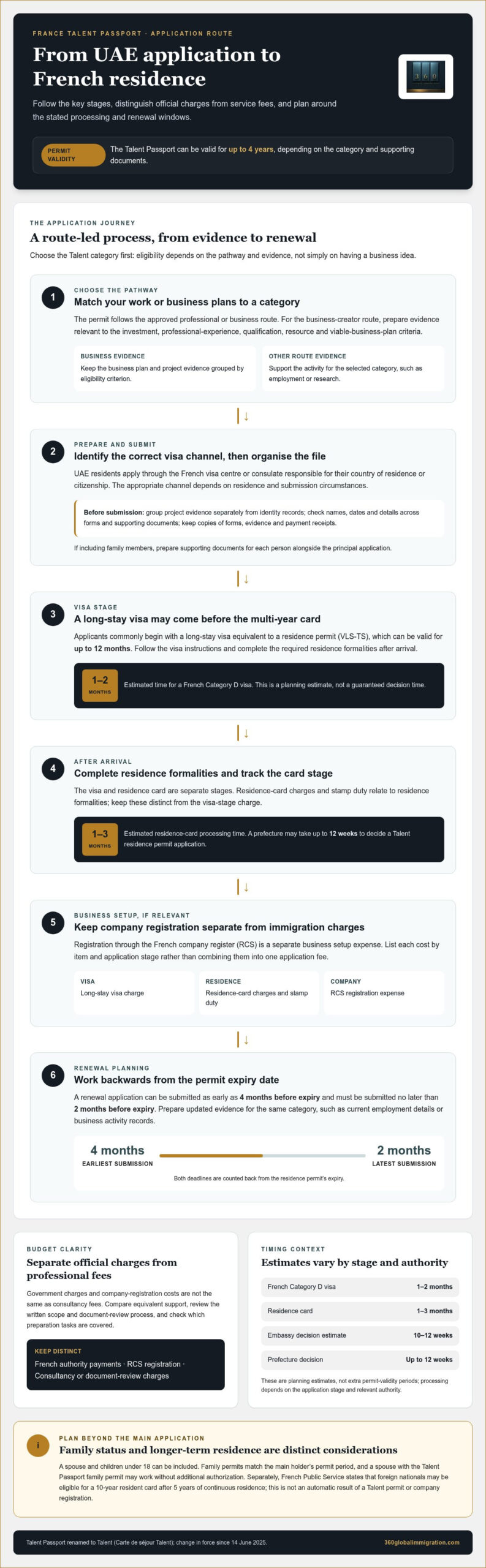
Budget separately for French government charges and company-registration costs, rather than treating them as one application fee. Depending on the route and stage, expenses may include a long-stay visa charge, residence-card charges, stamp duty, and registration through the French company register, known as the RCS. These are separate from consultancy fees. List each item individually and note the application step it relates to.
French charges may arise at different stages. A long-stay visa charge relates to the visa application, while residence-card charges and stamp duty relate to residence formalities. Company registration is a separate business setup expense. Keep payment records with your application documents, and distinguish amounts paid to French authorities from professional service charges in your budget.
Where do applicants in the UAE submit France Talent Passport applications? UAE residents apply through the French visa centre or consulate responsible for their country of residence or citizenship. The appropriate channel depends on residence and submission circumstances, so identify it before organising the application file.
Applicants residing outside the UAE should use the visa channel serving their country of residence or citizenship. First identify the correct submission route, then organise documents for the selected Talent category. A business applicant, for example, should keep project evidence separate from identity records. Applicants including family members should prepare supporting documents for each person alongside the principal application.
For UAE residents, distinguish the visa submission from the residence formalities that follow arrival in France. Keep copies of forms, submitted evidence, and payment receipts, and track instructions from the relevant French authority at each stage. This helps separate the visa application charge from later residence charges or business-registration expenses.
When comparing France visa consultants in the UAE, review the written scope, document-review process, fee breakdown, and explanation of government charges. Compare equivalent work, such as route assessment, file preparation, or submission guidance. A clear quotation should separate consultancy charges from official expenses and specify which preparation tasks it covers.
Application support and document review can help organise evidence for your chosen route. A master’s certificate, business plan, or proof of experience may serve different purposes, so group documents by eligibility criterion. Before submission, check names, dates, and details across forms and supporting records to identify inconsistencies that need attention.
Residence status and permanent residence are separate matters. French Public Service states that foreign nationals may be eligible for a 10-year resident card after five years of continuous residence. Treat that as a later residence pathway, not as an automatic result of a Talent permit or company registration.
What is the France Talent Passport and how long does it last?
The France Talent Passport is a multi-year residence permit for eligible professionals and founders. It can be valid for up to four years, depending on the applicant’s category and supporting documents. France renamed the Passeport Talent to Talent (Carte de séjour Talent), with the change in force since 14 June 2025. The permit’s duration follows the approved professional or business pathway.
Applicants commonly begin with a French long-stay visa equivalent to a residence permit, known as a VLS-TS. It can be valid for up to 12 months before transition to the multi-year Talent card. The visa and residence card are separate stages, so follow the instructions attached to the visa and complete the required residence formalities after arrival.
Processing time depends on the application stage and the relevant authority. A French Category D visa can take 1-2 months, while a residence card can take 1-3 months. Embassy decisions are estimated at 10 to 12 weeks, and a prefecture may take up to 12 weeks to decide a Talent residence permit application. These are planning estimates, not extra permit-validity periods.
Plan renewal around the permit’s expiry date. A France Talent Passport renewal application can be submitted as early as 4 months before the residence permit expires and must be submitted no later than 2 months before expiry. Prepare updated evidence for the same category, such as current employment details or business activity records, so the renewal file reflects the applicant’s situation.
Common application risks include choosing a category that does not fit your work, research, or business evidence, and submitting documents that conflict or leave key criteria unsupported. A researcher’s file, for example, should support the relevant research activity, while a founder’s file should substantiate the business project. Review every document against the selected pathway before submission.
The permit allows eligible holders to work, do business, and study in France without separate work authorization under the permit described here. Researchers and other applicants should still ensure their activity matches the approved category. Holders can also travel visa-free within the Schengen Area for up to 90 days, subject to the stated travel conditions.
Family members can be included in the application, including a spouse and children under 18. Family permits are valid for the same period as the main holder’s permit, and a spouse holding the France Talent Passport family permit may work without additional authorization. This can help families plan residence and employment together instead of treating each status separately.
For applicants comparing routes, a France Talent Passport application review can help organise category-specific evidence and renewal planning before submission.
Who qualifies for the Talent business-creator route?
France has distinct Talent pathways for business creators, French Tech founders, and economic investors. The right route depends on your project, experience, and supporting evidence.
Business Plan and Financial Means
A business creator needs a clear plan showing what the company will do, how it will operate, and how it will be funded. France’s business-creator route requires a business plan and budget covering at least 4 years of company operations. Organise documents so the projected activity, planned expenses, and financial resources form a consistent picture.
Financial evidence matters alongside the plan. Applicants must show financial resources of at least €22,404 gross annually, stated as the French minimum wage equivalent. The business-creator route also lists annual income of at least €20,814.73. Present the relevant financial records in a way that clearly supports the project and the applicant’s ability to carry it forward.
Investment and Experience Criteria
According to the French Ministry of the Interior, France’s business-creator Talent route requires a minimum project investment of EUR 30,000. Applicants also need a qualification or at least five years of comparable experience. Link the proposed activity to the applicant’s professional background, then organise documents that demonstrate the investment and relevant experience.
Your experience should support the business plan, not appear as a disconnected credential. For example, if you propose a specialist consultancy, connect your previous work and qualifications to the services you plan to provide in France. The route also assesses whether the project is credible and viable, so explain the business model, target clients, and operating needs with specific supporting evidence.
Distinguish the business-creator route from other founder options. The French Tech founder route has no capital floor, but requires backing from an incubator, accelerator, or French Tech Capital. A French Tech project therefore depends on that support, while the business-creator route has its own investment and experience criteria.
The French Startup Innovante track is described as requiring a minimum €225,000 commitment from a recognised business incubator or accelerator. This is a separate route criterion, not a substitute for the business-creator investment. Identify the pathway first, then match the project’s innovation profile and supporting documents to its stated conditions.
Economic investors follow another set of requirements. France’s economic-investor Talent route requires at least EUR 300,000 in fixed assets, ownership or operation of at least 30% of the invested business, and a commitment to create or maintain jobs over four years. These criteria differ from business creation, so investors should organise evidence around ownership, assets, and employment plans.
Consultancy service costs
Consultancy charges are separate from French government application and company-registration fees. The consultancy price depends on the case and is provided after a quote request. Key factors include the selected route, document volume, family-member applications, and support required. A file involving a business plan and several applicants may need a different scope from a single professional application. A France Talent Passport consultant in Dubai can explain how the proposed scope relates to your case.
Compare written scopes, not just headline quotations. Ask what work is included at each stage, such as route assessment, document review, application preparation, and submission guidance. For example, an initial review may not include later revisions or family-member documents. A clear scope lets you compare equivalent services and identify tasks that remain your responsibility.
The selected Talent category affects the preparation required. A business-creator file may involve reviewing the business plan, investment evidence, qualifications, and financial records. An employee or researcher application requires evidence tailored to its route. Before accepting a quote, identify your category and list the documents the consultant will review.
The condition of your documents also affects the work involved. Inconsistent names, missing pages, or records requiring translation can add preparation steps before submission. Create an inventory of passports, qualifications, employment records, and project evidence. If you are including a spouse or children, list their documents separately so the proposed scope accounts for every applicant.
If you are applying from the UAE, request the consultancy quotation in AED and keep it separate from French government charges. Ask for the quotation to show covered tasks, excluded work, and how additional document review is handled. This makes the expected consultancy spend easier to compare with separate visa, residence, and business-registration expenses.
Payment terms should also be clear before work begins. Review due dates, the work linked to each payment, and the process for requesting changes. For example, a revised business plan may require additional review if the project changes after the initial assessment. A written scope gives both sides a practical reference point.
Consultancy supports application preparation; it cannot secure French approval or replace your evidence. Treat promises of guaranteed approval as a warning sign, and assess whether the proposed work addresses your route. A Schengen travel plan, future European residence goals, or eventual citizenship questions should not be confused with the defined scope of a current Talent application.
Before choosing support, compare the quote against your checklist: route analysis, document review, family-file coordination, and submission guidance. A France Talent Passport consultant in Dubai should explain how the agreed work addresses these needs. This helps you understand what the professional assistance covers and how its cost fits your wider France application budget.
France Talent Passport overview and eligibility
France’s Talent Passport covers 11 or more eligibility categories, so the central task is matching your professional activity to the right route. Some pathways require a job offer; others focus on business creation, research, or investment. Start by identifying the activity you intend to carry out in France, then organise evidence around that category.
For qualified employees, the listed salary criterion is above €42,000 per year. The EU Blue Card pathway has a separate gross salary threshold above €53,836 per year and accepts applicants with a 3-year degree or 5 years of professional experience. These are distinct routes, so compare the relevant role, qualifications, experience, and salary evidence before choosing.
Researchers need a qualification equivalent to a master’s degree. Their application should connect that education to the proposed research activity in France, supported by documents about the role and professional background. A researcher’s file differs from a founder’s: the key question is whether the evidence fits the chosen category, not whether every applicant meets one universal test.
Founders should distinguish a business-creator application from a French Tech route. The French Tech founder pathway has no capital floor, but requires backing from an incubator, accelerator, or French Tech Capital. The French Startup Innovante track is described as requiring a minimum €225,000 commitment from a recognised business incubator or accelerator. These pathways rely on different forms of project support.
Economic investors also face a separate eligibility test. The route requires at least EUR 300,000 in fixed assets, ownership or operation of at least 30% of the invested business, and plans to create or maintain jobs within four years. Evidence should connect the investment, the applicant’s role, and employment plans, rather than presenting financial documents without explaining their relationship to the project.
A practical route check has three steps: name the activity, identify its category, and match each criterion to a supporting document. For example, an employee can match the employment offer and salary evidence to the qualified-employee route, while a researcher can align a master’s-equivalent qualification with the research role. This comparison helps reveal gaps before submission.
Eligibility also determines what the permit authorises. The permit may cover activities such as work, business, or study in France, depending on the route. The route therefore affects both the evidence required and the activities covered. Choose the category that reflects the work you will actually do, not simply the title that seems most suitable.
For a structured review of your route and supporting evidence, request France Talent Passport guidance before preparing the application file.
360 Global Immigration: France Passeport Talent
360 Global Immigration supports applicants pursuing the France Passeport Talent by helping them understand the route and prepare for its requirements. Turn to this guidance when you need to connect your professional or business plans with the relevant eligibility pathway, organise supporting documents, or clarify the distinction between government charges and consultancy costs.
The right preparation depends on your circumstances. A founder’s supporting file differs from an employee’s or researcher’s, so align your documents with the activity you plan to pursue in France. If your plans point elsewhere, the consultancy also supports the UK Innovator Founder Visa, Netherlands Self Employed Visa, and Cyprus Business Residence Visa.
For guidance on your France Passeport Talent plans, contact 360 Global Immigration or visit 360globalimmigration.com.
Turn your France plans into a clear next step
Your next step is to connect your intended activity with the evidence you can provide. Write down your professional goal, the route you believe fits, and any questions about your documents or family plans. This gives your discussion with a France Talent Passport consultant in Dubai a practical starting point, focused on your circumstances rather than general assumptions.
360 Global Immigration offers France Passeport Talent support, alongside the UK Innovator Founder Visa and Netherlands Self Employed Visa. If your plans involve more than one destination, compare the purpose of each route before committing to an application path. A clear decision now can help you direct your preparation toward the residence option that matches your goals.
For guidance on your France plans and the appropriate next steps, contact 360 Global Immigration. Begin with your goals and questions, then move forward with a more organised understanding of your application.
Frequently Asked Questions
Can I apply for the Talent Passport from Dubai or India?
Yes. Applicants can submit through the French visa channel serving their country of residence or citizenship. From Dubai, applications go through a visa centre or French consulate responsible for the applicant’s residence or citizenship. Applicants in India follow the corresponding local submission route. First identify the correct channel, then prepare the Category D visa file and supporting evidence for the selected Talent category.
Do I need to speak French for the Talent Passport?
French ability does not replace the eligibility criteria for your chosen route. Focus first on the qualifications, professional activity, or business evidence required for your category. A researcher’s education and proposed work, for example, differ from a founder’s project documents. French may be useful for daily life and business in France, but assess your application against its specific pathway.
Does the Talent Passport cover artists or performers?
Artists and performers need to identify which Talent category fits their planned professional activity and provide supporting evidence. A performer’s file could include documents describing the work and professional engagements, while a creator may need evidence relevant to another category. The key is to match the actual activity to the route’s eligibility conditions, rather than relying on the job title alone.
Who will receive the residency?
The principal applicant receives the Talent residence status if the application is approved. Eligible applications can also include the applicant’s spouse and children under 18, with family permits valid for the same period as the holder’s permit. For instance, a family applying together should prepare each person’s identity and relationship documents alongside the principal applicant’s category evidence.
What is the France Talent Passport and who qualifies?
The France Talent Passport is a residence pathway for eligible professionals and founders whose activities fit a recognised category. Requirements depend on the route: an employee’s role and salary evidence, a researcher’s academic background, or a founder’s project documentation may be relevant. Start by defining the work or business activity you plan to pursue in France, then organise evidence that directly supports that route.
What are the France Talent Passport categories and eligibility requirements?
Examples include qualified employee, EU Blue Card, researcher, business creator, and economic investor pathways, as well as French Tech founder routes. Requirements vary by category. A researcher needs a qualification equivalent to a master’s degree, while an EU Blue Card applicant’s listed criteria include a three-year degree or five years of professional experience. Choose the category according to the activity and evidence, not a general label.
How can UAE residents apply for a France Talent Passport from Dubai?
UAE residents start by selecting the Talent category that matches their intended work or business activity. They then prepare the supporting file and apply for a Category D visa through the visa centre or French consulate serving their country of residence or citizenship. Keep copies of submitted forms and supporting records, and follow the instructions for the specific application channel.
What documents are required for a France Talent Passport application in the UAE?
Documents depend on the category, but applicants should prepare identity records and evidence supporting their professional or business route. Examples include qualifications and experience records, employment evidence, or a business plan and financial documents. Criminal history certificates must be issued no earlier than 90 days before submission. Applicants must provide certificates for countries where they spent at least three months during the past five years.