A visa comparison can turn on a family question as much as a founder’s business plan: can your spouse work after you move? Under France’s Talent family status, an accompanying spouse has unrestricted access to the labour market. The France Passeport Talent vs UK Innovator Founder Visa comparison therefore needs to consider spouse rights alongside business and application requirements.
It’s reasonable to want a clear view of the full commitment before choosing a route. Fees are only one part of the decision: eligibility, how each business plan is assessed, application steps and processing considerations all affect how you prepare.
This guide compares these factors for applicants planning from the United Arab Emirates. It explains what each route asks of founders, how spouse work rights differ, which costs to account for, and how application timing can shape your plans, helping you assess which pathway better fits your circumstances.
Key Takeaways
- Compare spouse work rights alongside founder eligibility to see how each route fits your family’s plans.
- Assess how France and the UK evaluate business plans, innovation and the founder’s professional background.
- Build a clearer application picture by considering supporting documents, fees and processing stages together.
- Use the comparison to identify which pathway best aligns with your business model and relocation priorities.
Application documents and process
Both routes require a documented business case, personal evidence and a clear application sequence. The exact documents differ because France assesses residence-permit criteria, while the UK route focuses on its founder pathway.
Applicant Qualifications and Financial Means
Qualifications and financial means help show whether the founder can establish the proposed business and support their stay. They matter because a strong business plan alone may not meet personal eligibility requirements.
For France’s Talent Passport Business Creation route, applicants need a master’s-level diploma or comparable professional experience. They must also demonstrate sufficient personal resources and provide evidence supporting the business project. The French Tech Visa founder route assesses qualifying innovative startups differently. Co-founders need separate applications, with each applicant’s qualifications and investment evidence presented clearly.
The France Talent Business Creation residence card is valid for four years and renewable. Renewal depends on the business operating and the holder earning at least the income needed for support. For UK Innovator Founder applicants, the grant and any extension depend on the route’s requirements and the applicant’s continued eligibility.
France’s potential permanent-residence pathway is described after five years of residence. This is not a universal day-count formula. UK settlement and citizenship also depend on qualifying residence; applications need to address residence history and absences under the applicable rules.
Application Steps and Processing Times
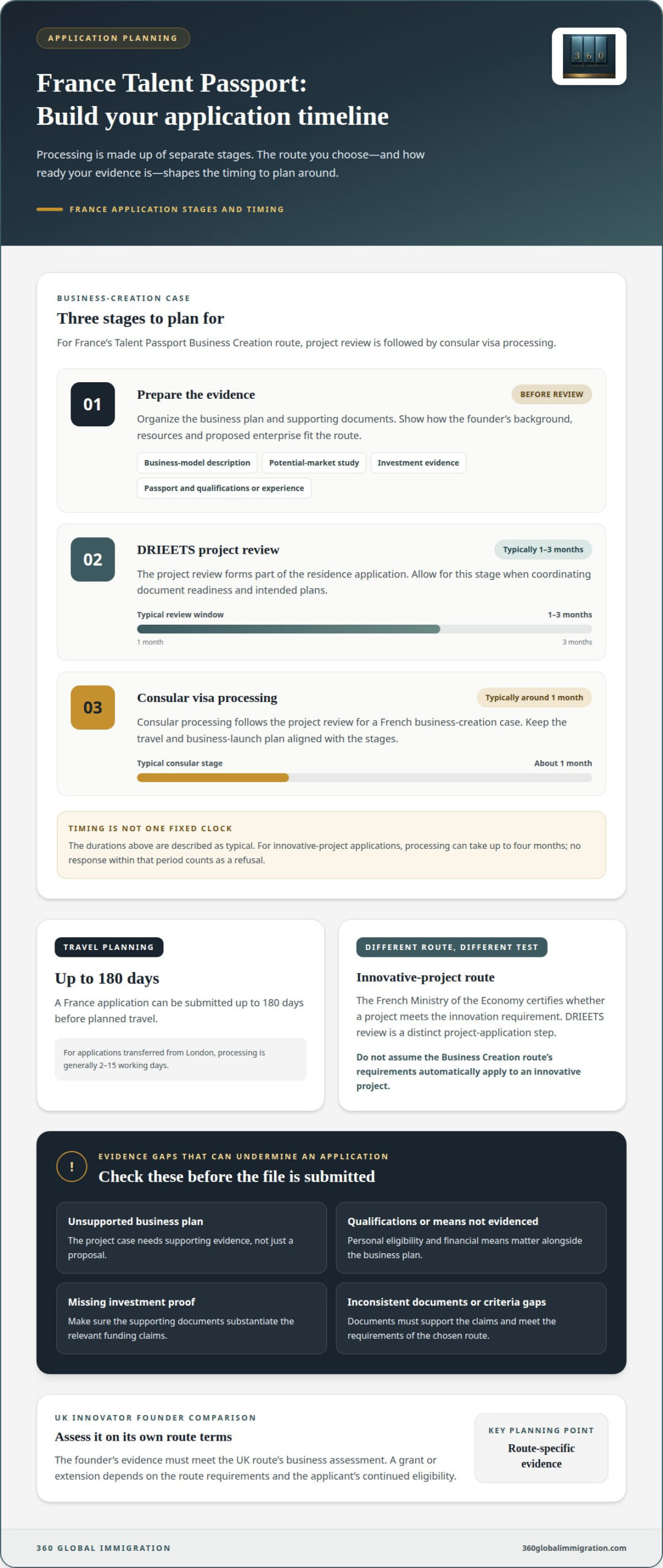
An immigration professional organizes the evidence, aligns the business plan with route criteria, and checks that application documents support each claim. For a UK-based applicant pursuing France, the process includes coordinating the French application submission and consular stage. The application can be submitted up to 180 days before planned travel, and London-transferred applications are generally processed within 2 to 15 working days.
For a French business-creation case, project review by DRIEETS typically takes 1 to 3 months, followed by consular visa processing that typically takes around 1 month. Innovative-project applications can take up to four months; no response within that period counts as a refusal. These stages affect when travel and business launch plans can proceed, so the professional coordinates document readiness with the intended timeline.
Refusal risks include an unsupported business plan, insufficient evidence of qualifications or financial means, and missing investment proof. For the UK route, the founder’s evidence must also meet the route’s business assessment. In either case, inconsistent documents or an application that fails the relevant criteria can undermine the case.
Business plan and real-and-serious project assessment
France and the UK assess a founder’s proposal through different visa routes. The business plan must show how the venture fits the chosen route and how its funding supports the proposed activity.
Business-Creation Route Requirements
France’s Talent Passport Business Creation route assesses the founder’s qualifications, resources and planned enterprise. These requirements matter because the business plan must connect the applicant’s background to a viable project.
The route requires at least a master’s-level diploma or five years of comparable professional experience. According to the French Ministry of the Interior, applicants must commit a minimum investment of €30,000 to the business. The application should connect that investment to the proposed activity, rather than presenting it as an isolated figure.
The assessment also considers whether the project is real and serious. Documents for the Talent – Business Creator attestation procedure include a business-model description, potential-market study, investment evidence, passport and proof of qualifications or experience. Together, they explain the project’s purpose, resources and founder fit.
Eligible Business Activities
Eligible activities depend on each route’s purpose, so the proposed venture should match the category selected. This distinction matters when choosing between business creation and an innovation-focused application.
France separates its Business Creation route from its innovative-project talent route. For the innovative route, the Ministry of the Economy certifies whether the project meets the innovation requirement. The French process therefore turns on the project’s classification and evidence, not simply its label as a startup.
The UK Innovator Founder route is assessed as a founder visa, but this comparison does not establish a sector list or a direct equivalent to France’s separate categories. Clearly describing the venture, its customers and its commercial model helps explain the proposed activity without assuming the two countries apply identical tests.
Investment, Endorsement, and Funding
Funding evidence explains how a founder will establish the proposed business and sustain the plan. The financial claims in the business plan need to align with the activity and the applicant’s role.
For France’s Business Creation route, the €30,000 investment must be committed to the business. France also requires personal resources of at least €21,621 for this route. The application should distinguish business investment from the founder’s personal means, since they address separate parts of the case.
France’s innovative-project route uses innovation certification by the Ministry of the Economy. DRIEETS reviews project applications, with processing typically taking 1 to 3 months. These are distinct steps: certification addresses the innovation criterion, while project review forms part of the residence application. The UK comparison should assess the proposed venture and its supporting evidence on its own route terms, not assume France’s investment threshold applies.
Eligibility by qualification or professional experience
Eligibility can depend on qualifications, professional history, salary or the nature of the proposed activity. For founders comparing France and the UK, French category-specific tests should not be treated as automatic UK eligibility criteria.
France’s Talent Passport Business Creation route accepts a master’s-level diploma or at least five years of comparable professional experience. Experienced entrepreneurs without the specified degree level can therefore demonstrate their background through relevant work history. Evidence should connect previous responsibilities and expertise to the proposed business, rather than relying on a résumé alone.
Other French Talent categories use different criteria. The qualified-employee route lists a gross annual salary threshold of €39,582 as of late 2025, while the medical and pharmaceutical category lists €41,386 per year. The corporate-executive category lists €64,865 per year. Artists applying under the creative-professions category must earn at least 51% of their income from artistic work.
These distinctions matter: an applicant may fit one French route but not another. A startup founder’s experience, an employee’s contract and salary, and an artist’s income profile each support different eligibility assessments. The French government’s category determines which evidence carries weight, so the application must align the applicant’s professional record with that route.
The UK Innovator Founder Visa is a separate route, so French degree or salary thresholds should not be applied to it by assumption. Compare the UK application’s own business and founder criteria with the evidence available for the individual applicant. A spouse’s plans may affect the family’s relocation decision, but they do not replace the principal applicant’s eligibility evidence.
For entrepreneurs weighing both options, map qualifications and career evidence against each route independently. A master’s degree, five years of relevant experience or a qualifying French salary may support a specific French category, but none alone establishes eligibility across both countries. The right route depends on the business activity and the applicant’s documented profile.
Fees and processing considerations
Budget for official charges and supporting-document expenses separately. For a France application, relevant cost categories include the long-stay visa, residence card, translations, apostilles and appointment services. Business registration is separate from immigration fees, so include it in the wider business budget. A France Passeport Talent vs UK Innovator Founder Visa comparison should separate these items rather than treat them as one application charge.
The precise total depends on the French Talent category and the application stages required. The first issue of the Talent – porteur de projet card has a set government charge, separate from the long-stay visa charge. These are official-route costs, not the price of professional assistance.
For the UK Innovator Founder route, distinguish application charges from the Immigration Health Surcharge. The total depends on the visa and related charges. Applicants based in the UAE should also account for the currencies authorities charge in and any document-preparation expenses. This distinction makes the France Passeport Talent vs UK Innovator Founder Visa cost comparison more useful for household planning.
Timing affects when those costs arise. In France, DRIEETS project review typically takes 1 to 3 months, followed by consular processing that typically takes around 1 month. These are separate stages, so applicants should allow for both rather than treating project review as the final visa decision.
Documents can affect preparation time and expenditure. Translation and apostille requirements depend on the records submitted, such as a degree certificate or business evidence. Organize passports and supporting documents early, because missing or inconsistent evidence can delay a complete submission. France’s innovative-project route can take up to four months to process; no response within that period counts as a refusal.
Compare official charges, document preparation and business expenses as separate budget lines. That makes the investment requirement easier to distinguish from application costs and future residence expenses. For a tailored comparison of route-specific fees and timing, discuss your application with 360 Global Immigration.
360 Global Immigration: France Passeport Talent
360 Global Immigration provides guidance for applicants considering France Passeport Talent or the UK Innovator Founder Visa. After comparing eligibility, business-plan assessment and fees, the next step is to match your professional background and venture with the route’s requirements.
For a France application, professional immigration consultancy can help organize the business case, qualifications and financial evidence into a coherent application. For the UK route, the focus is on presenting the founder’s proposal and supporting documents against that visa’s criteria. This support is especially useful when weighing two destinations or coordinating a family’s relocation plans.
If your circumstances point toward a different business-residence pathway, 360 Global Immigration also assists with the Netherlands Self Employed Visa and Cyprus Business Residence Visa.
Contact 360 Global Immigration to discuss your France or UK visa application.
Choose the Route That Fits Your Next Chapter
Choosing between France Passeport Talent and the UK Innovator Founder Visa is ultimately about where your business can develop sustainably, not only which application appears simpler. Consider where you can build customer relationships, manage the venture and support your family’s plans. That strategic fit gives your visa choice a practical foundation.
An immigration professional can help translate that decision into a route strategy, connect your founder profile with the relevant requirements, and organize supporting evidence. 360 Global Immigration offers France Passeport Talent and UK Innovator Founder Visa support, as well as the Netherlands Self Employed Visa for applicants whose plans point toward independent work there.
Your next step is to define the business model and destination you’re ready to commit to, then discuss how your application can reflect that choice. For guidance based on your plans, Contact 360 Global Immigration. A considered decision can help you move forward with greater clarity and confidence.
Frequently Asked Questions
Can my spouse work under either route?
A spouse accompanying a France Talent Passport holder has unrestricted access to the French labour market. For the UK route, don’t assume the same conditions apply: a spouse’s work permission depends on their immigration status and the rules attached to it. Include your partner’s employment plans in the comparison, especially if household income matters during the move.
Do you need to speak French?
French isn’t required for entrepreneurs applying under the Talent program, based on the position as of July 2025. That is separate from later naturalisation: France requires B2-level French for naturalisation applications from 1 January 2026. A founder can therefore assess the residence application and any future citizenship plans as separate language questions.
How much does each cost in 2026?
The total depends on the route and the costs included, such as government application charges, residence documents, translations and business expenses. France’s charges are set in euros, while your UAE budget is in dirhams; an accurate AED comparison needs a current exchange rate and the applicant’s specific cost items. The UK total likewise depends on its visa and related charges.
So which one should I choose?
Choose the route that matches your business plan, founder profile and destination priorities. Assess a France-focused project against the relevant Talent category, and ensure a UK plan fits the Innovator Founder route’s criteria. In a France Passeport Talent vs UK Innovator Founder Visa comparison, also consider your spouse’s work plans and the documents you can support with credible evidence.
Can you apply before you have registered the company?
The business-creation application focuses on evidence describing the proposed venture, including its business model and potential market. The case therefore needs a developed project, not merely a company name. France also requires committed investment for its Business Creation route. The relationship between company registration and filing depends on the route and project stage, so present a consistent timeline in the application.
Do France and the UK both have a language requirement?
For France’s Talent program, entrepreneurs did not have an official French-language requirement as of July 2025. That does not answer the separate language rules for UK Innovator Founder applicants. Keep visa eligibility distinct from later settlement or citizenship requirements: France’s B2 French threshold applies to naturalisation applications from 1 January 2026, not to the entrepreneur visa itself.