
Could a residence permit in one European country secure your child’s education across the continent? Not automatically. European residency for children’s education may shape where your family can live and which education options are available, but school access, university fees and a child’s immigration status depend on national rules and your family’s circumstances. A permit for one country does not grant the right to live or study throughout the EU.
For a practical education and relocation plan, start with the parent’s genuine business or talent eligibility, then assess what the route means for each family member. This guide explains the difference between national residence and EU-wide rights, and compares relevant pathways, including France Passeport Talent, the Netherlands Self-Employed route, and business residence options in Cyprus and Ireland. It also sets out the questions to resolve about dependent-child eligibility, school access, tuition classification and long-term status. Use them to weigh your education priorities against the legal and practical requirements of relocation.
Key Takeaways
- Define whether your priority is primary or secondary schooling, future university study, or both, then identify the destination that fits your family.
- Assess European residency for children’s education alongside the parent’s genuine business or talent eligibility. A preferred school destination alone does not establish a viable residence route.
- Compare pathways by the parent’s qualifying basis and the family rules that apply, rather than assuming different routes offer equivalent outcomes.
- Build a checklist around your child’s age, education stage, preferred timing and relocation needs before weighing the options.
- Use structured application guidance to connect your family’s priorities with a suitable business or talent-based pathway, while planning school admission separately.
European Residency for Children’s Education: What Families Need to Define First
Start with two connected questions: where does your child need to study, and which residence route could the parent genuinely qualify for? The destination determines the education rules; the parent’s eligibility shapes whether the family can lawfully establish residence there. European residency for children’s education is not one benefit to secure. It is a family decision that brings education planning together with immigration eligibility.
Separate immediate schooling from longer-term university goals. A child entering primary or secondary school may need a confirmed relocation plan and a suitable local school. A teenager approaching university may need to compare admissions timelines, language of instruction and how their residence status could affect tuition classification. These are distinct planning questions, even if the family hopes one move will address both.
Start with the child’s education stage and timeline
Map your child’s age, current school year, likely transition date and preferred destination. Then decide whether the family expects to relocate before enrolment or maintain residence elsewhere while the parent pursues a route. This affects practical planning. Relocating may mean coordinating the child’s arrival and guardianship arrangements, while planning from abroad may require understanding application sequences and deadlines before making commitments.
Age, guardianship requirements and application timing can affect which family arrangements are possible. Treat these as route-specific questions to verify against current immigration and education rules, rather than assumptions that apply uniformly across Europe. For university planning, distinguish the child’s status when applying from the status the family hopes to obtain later.
Set realistic expectations about education benefits
A residence permit does not by itself guarantee a school place, a particular tuition rate or the right to study in another European country. Public-school access, admissions processes and fees are governed by destination-specific rules. University fee classification may also depend on the student’s status and, in some cases, factors such as how long the family has lived in the country. Confirm the relevant conditions with national authorities and education institutions before relying on an expected saving.
Keep residence rights distinct from EU citizenship rights. A permit issued by one country generally relates to that country’s rules; it should not be treated as permission to settle or study throughout the EU. The Freedom of movement in the EU concerns rights associated with EU citizens and qualifying circumstances, not an automatic benefit of holding any European residence permit. A child’s rights depend on their own status and the family’s legal basis.
- For school-age children: establish the intended location, enrolment period and family relocation plan.
- For future university students: compare admissions timing and the rules used to determine fee status.
- For every route: verify dependent-child eligibility, residence conditions and education access in the specific country.
Assess education benefits country by country, after clarifying the child’s education stage and the parent’s qualifying basis.
What European Residency Actually Grants a Child
A child’s residence permission is a legal status under the immigration rules of the country that issued it. Depending on the route and national rules, it may allow the child to live in that country as a family member of the main applicant. It does not create identical rights in every European country, and the child’s permission may have its own conditions, duration limits or renewal requirements.
This distinction matters when comparing European residency for children’s education options. A national permit can support residence in the issuing country, but it is not the same as EU citizenship. EU citizens have rights to move and reside in other EU countries under applicable rules; a non-EU child holding a national residence permit does not automatically receive those rights. A future citizenship application is separate, with eligibility criteria and timelines that vary by country and need to be assessed under that country’s rules.
Residence, citizenship, and EU mobility are not interchangeable
Schengen travel and permission to settle are also different. A visa or residence document may allow short visits within the Schengen area under applicable conditions, but travel permission does not itself authorise a child to live, enrol in school or study long-term in another country. For family members joining an EU citizen in another member state, the EU guidance on residence rights for non-EU family members explains a specific framework. It is not a universal rule for every family or route.
Check the child’s own status, not only the parent’s permit. Confirm whether the route allows dependent children to accompany or join the parent, which documents apply, and whether the child’s permission has separate renewal conditions. For non-EU families whose parent’s route is based on business or talent, consult the relevant national immigration authority for current family eligibility and residence conditions.
School access and university fee status require separate checks
Immigration permission and education access are related, but they answer different questions. A residence permit may establish a child’s permission to live in a country; it does not, by itself, secure admission to a particular school. School admission can involve local procedures and institution-specific requirements. University fee classification is a separate decision, and national rules or institutions may consider criteria beyond residence status, such as the student’s circumstances or residence history.
Immigration status determines whether a child may reside in a country; tuition classification determines which fees may apply. The two are not automatically the same.
Before making education plans, consult the destination country’s immigration authority about residence and dependent rules, then the relevant school or university about admissions and fee classification. Keep copies of written guidance and note which authority or institution provided it. This gives your family a clear basis for comparing routes without assuming that a permit in one country carries the same education consequences elsewhere. Families assessing business or talent-based residence can use structured European residence application guidance to organise the parent’s route comparison alongside family priorities.
Compare European Residency Routes Against Your Family’s Education Priorities
Compare the parent’s eligibility first, then assess how each destination aligns with the child’s schooling plans. These are business or talent-based residence pathways, not education visas. None should be treated as a guarantee of school admission, a particular tuition rate or identical rights for every family member. Use the comparison below as a starting framework, then consider the current route and education rules that apply to your circumstances.
Compare the parent’s qualifying basis before comparing destinations
A route should match the parent’s real professional profile and proposed activity. A founder developing a business, a self-employed professional and a person applying on a talent basis may face different eligibility criteria. For France, review the France Passeport Talent business creator guide alongside the parent’s plans. For UK founder context, the UK Innovator Founder endorsement guide can help frame the route’s business basis.
| Destination and route | Parent’s qualifying basis | Family and education questions to resolve |
|---|---|---|
| France Passeport Talent | Talent-based or qualifying business activity, depending on the route. | Check dependent-child eligibility, application sequence, residence conditions, school access and tuition classification. |
| UK Innovator Founder | Founder route based on the parent’s qualifying business proposal. | Confirm family-member rules and UK residence conditions separately; the UK is not an EU member state. |
| Netherlands Self-Employed | Self-employment basis for the parent. | Verify dependent-child rules, timing and local education criteria. The Netherlands Self-Employed visa requirements guide offers relevant route context. |
| Cyprus or Ireland business residence | Business-based residence pathway. | Check each country’s family eligibility, residence conditions, school admission rules and fee classification independently. |
| Denmark Startup | Startup-based route for the parent. | Verify current dependent-child provisions and education requirements for the intended period of residence. |
Use family eligibility and education rules as comparison criteria
For each destination, check whether a child can apply with the parent or must follow a separate sequence, which residence conditions apply, and whether age or other circumstances affect eligibility. Then assess education questions against the child’s age, intended school stage and expected length of stay. A family planning for a near-term school transition may weigh timing differently from one focused on the university years.
Record the answers route by route, using national immigration authorities for residence rules and the relevant school or university for admissions and fee classification. This makes European residency for children’s education a practical comparison of parent eligibility, family provisions and destination-specific education rules, rather than a search for one route that promises the same outcome everywhere.
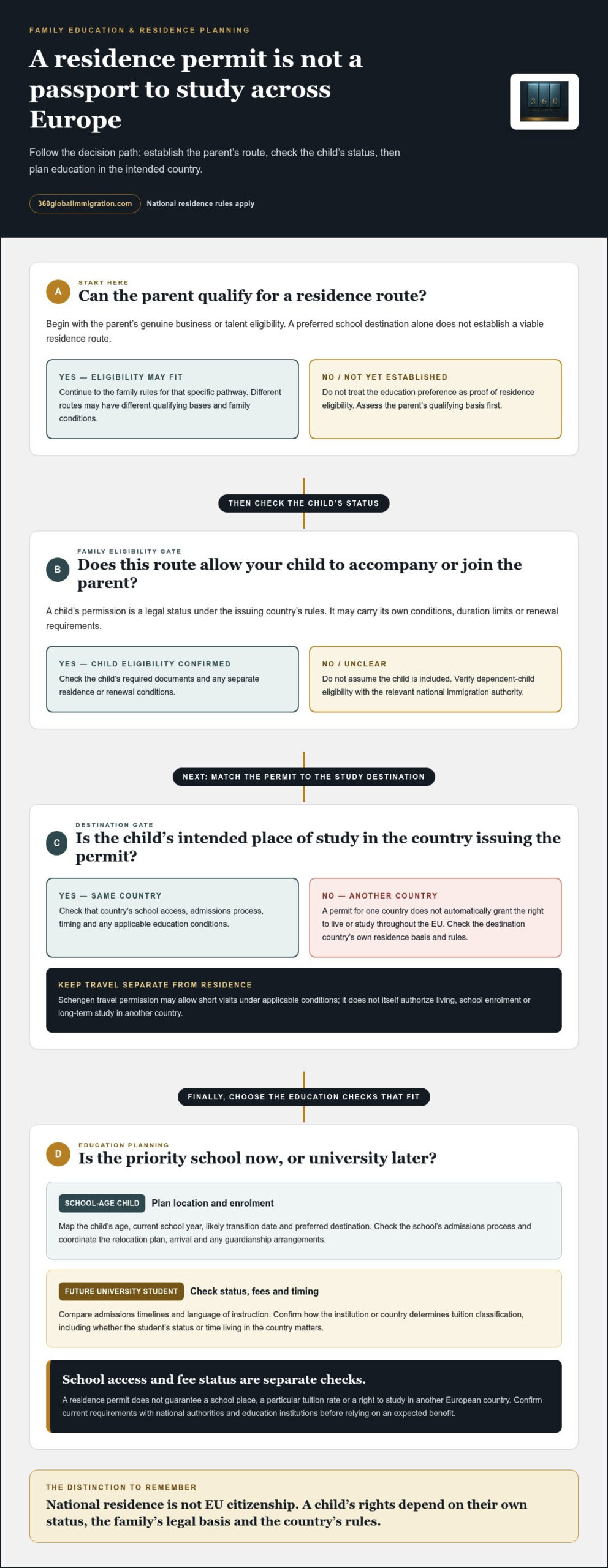
A Practical Checklist for Choosing a Family Residence Pathway
A clear decision process helps families compare immigration eligibility and education priorities without relying on assumptions. Work through these steps in order and record the evidence behind each conclusion. This is more useful than choosing a destination based only on an expected school or tuition benefit.
- Define the education goal. Record the child’s age, current education stage, preferred destination and likely enrolment timing. Note whether the priority is an immediate school move, future university planning or both. Include whether the family expects to relocate together or manage the process from the UAE before moving.
- Assess the parent’s eligibility. Identify which parent may qualify through a genuine business, startup or talent profile. Compare the parent’s actual experience, proposed activity and plans with the route’s current criteria. A destination is a practical option only if the parent’s profile fits its pathway.
- Compare family and education rules. For each shortlisted route, record whether dependent children may be included, how applications are sequenced and which residence conditions apply. Separately investigate school admission, university fee classification and any local conditions relevant to the child’s intended study period.
- Verify current requirements. Use the destination’s official immigration authority for permit and dependent-child rules, and the relevant school or university for admission and tuition questions. Check the requirements for the specific route and the child’s circumstances, rather than applying a rule from another country.
- Plan documents and timing. Build a route-specific file, resolve document requirements and map key application and education dates before making relocation commitments.
Questions to resolve before selecting a route
Which parent has the strongest qualifying business, startup or talent profile? Can the child be included, and what ongoing conditions might apply to the family’s residence? Which education outcomes are supported by official or institutional rules, and which remain assumptions, such as reduced fees or broad mobility? Keep these answers distinct so an expected benefit does not become the basis for an unsupported decision.
Build a reliable document and verification plan
Organise identity, parent-child relationship, education and parent eligibility records as applicable to the route. Before preparing or submitting documents, check current official guidance for translation, legalisation and validity requirements. Maintain a simple verification log recording the rule, the authority or institution consulted, the source and the date checked. This makes it easier to identify outdated information as plans develop.
For families considering European residency for children’s education, this process connects the child’s timeline with the parent’s genuine eligibility while keeping residence, school access and fee questions separate. 360 Global Immigration provides guidance on European business and talent residency pathways to help structure the route comparison. Explore European business and talent residency guidance to consider how the parent’s profile and family priorities fit together.
Plan Your Family’s European Residency with 360 Global Immigration
Choosing a residence pathway is a family decision, but it begins with the parent’s eligibility. 360 Global Immigration supports business and talent-based residence applications for Europe and the UK. Its guidance helps families organise route comparisons around a parent’s profile, intended destination and relocation priorities, without confusing immigration planning with school admissions.
For European residency for children’s education, keep the roles clear: an immigration adviser can guide the parent’s application pathway and family-residence planning, while national authorities decide applications and education institutions set their own admission and fee rules. No route guarantees a permit, a school place or a particular tuition outcome. These are separate decisions governed by the relevant authority or institution.
What a focused residency planning discussion should clarify
A useful discussion starts with the parent’s business, startup or talent profile and the destination being considered. It then maps the child’s potential inclusion against current country-specific requirements, including the child’s age and intended timing. Finally, it separates immigration questions from education and tuition questions, identifying which details need direct verification with national authorities, schools or universities.
This structure helps families distinguish what is known from what needs an official answer. For example, a parent may have a credible business plan for one destination, while the child’s school transition makes a particular move date important. Considering these factors together can clarify whether the parent’s qualifying route and the family’s timeline are aligned, without assuming that residence automatically brings an education benefit.
Move forward with a clear, evidence-led plan
Before progressing, create a concise summary of the preferred pathway, the parent’s eligibility basis, the child’s details and the documents likely to be relevant. Add decision points such as application sequencing and expected relocation timing, then list open questions about dependent eligibility, residence conditions, school access and tuition classification. Keep the source and date beside each rule so the family can revisit the information if requirements change.
If Cyprus is among the destinations under consideration, the Cyprus business residency guide can help frame the business-residence pathway within the wider family comparison. The same disciplined approach applies across destinations: assess the parent’s genuine qualifying profile, understand the family provisions, and verify education matters separately. This gives your family a more grounded basis for action than selecting a route solely for an assumed school or university advantage.
360 Global Immigration helps organise application plans around family priorities and the parent’s business or talent profile. The relevant authorities retain decision-making responsibility, and education outcomes remain subject to country-specific rules. Speak with 360 Global Immigration to discuss the family’s pathway and the questions to resolve before proceeding.
Turn Your Family’s Priorities into a Clear Next Step
Your child’s education plans can help shape a relocation decision, but they should not rest on assumptions about residence or future tuition. Treat education as one part of a wider family plan: define the destination and timing you hope for, then match those priorities with the parent’s genuine eligibility and the rules that apply to your circumstances. This gives you a sounder basis for deciding whether to proceed, adjust the plan or compare another destination.
For families considering European residency for children’s education, 360 Global Immigration provides guidance across business and talent-based residence pathways in Europe and the UK, including application support for France Passeport Talent, UK Innovator Founder and other specialised routes. The focus is organising a pathway around the parent’s profile and the family’s objectives, while education decisions remain subject to the relevant authorities and institutions.
Discuss your family’s priorities and the parent’s potential route with 360 Global Immigration. Speak with 360 Global Immigration about your family’s residency pathway to plan your next steps around clear questions and informed choices.
Frequently Asked Questions
Can European residency give my child the right to study anywhere in the EU?
No. A residence permit generally relates to the country that issued it and does not automatically let your child settle or study in another EU country. Permission to visit is different from permission to reside or enrol for long-term study. For example, do not assume a child can attend school in a second country based on a permit issued by the first. Check current official immigration and education guidance for the intended destination.
Does a European residence permit reduce university tuition fees for my child?
Not automatically. A residence permit and a university’s fee classification are separate matters. Depending on the country and institution, classification may consider nationality, residence duration, domicile or other criteria. A child eligible to live in a country may still be assessed under a different tuition category than the family expects. Before budgeting, review the chosen university’s current fee-status rules alongside the immigration conditions that apply to the student.
Can I include my child in a European business or talent residence application?
Possibly, but it depends on the specific route and the child’s circumstances. Countries and programmes can differ in how they define eligible dependants, which relationship or identity documents they require, and whether a child applies with the parent or later. Age may also matter. Before committing to a move or school timetable, review the current dependent-child rules for the parent’s exact application and identify the required evidence.
Is a residence permit the same as European Union citizenship?
No. A residence permit grants permission under the issuing country’s immigration rules; citizenship is a different legal status that may carry different rights. Holding a permit does not itself make a child an EU citizen, and it does not guarantee that citizenship will follow. Any future citizenship application depends on the country’s law and the individual’s eligibility at that time. Avoid basing long-term plans on an assumed route or timeline.
What should families compare when choosing European residency for children’s education?
Compare the parent’s eligibility and intended destination alongside the child’s age, study stage and likely length of residence. Then assess whether the child may be included, which residence conditions apply, how school admission works and how a university could classify tuition fees. These questions need separate answers. Use the destination’s immigration authority for permit rules and the relevant education institution for admission and fee policies before making relocation plans.
Do children need a separate student visa if a parent has European residency?
There is no single answer for every family. The child’s required status can depend on the country, the parent’s permit, the child’s age and whether the child is included as a dependent. Residence permission and enrolment requirements may also be handled separately. For example, permission to live with a parent does not by itself confirm admission to a particular school. Verify both immigration status and education requirements with the destination’s relevant authorities and institution.