
A European residence permit can give a family a foothold in Europe without granting a second passport. For families considering European residency alternatives to a second passport, the key distinction is that a permit generally allows residence in the issuing country, while Schengen travel and citizenship are separate rights. Most digital nomad residence programmes may include dependent adult children up to age 30 if they’re full-time students.
It’s understandable to focus on bringing your spouse and children, but family eligibility is only one part of choosing a route. This comparison explains how investment, digital nomad, business and other residence options differ in family inclusion, application speed and the rights they provide. You’ll also see why a residence permit may suit a family seeking a European base, while a passport offers a different level of mobility and status.
We’ll compare the practical trade-offs so you can identify which pathways merit a closer look for your family’s plans.
Key Takeaways
- Compare investment routes by more than processing speed: weigh the residence rights, travel access and investment structure that fit your family’s priorities.
- Separate citizenship goals from residence plans, since a European residence permit does not itself grant a passport.
- When assessing digital nomad options, look closely at which dependants can be included and how the family’s work and residence plans fit the route.
- If a talent-based pathway in France fits your plans, France Passeport Talent is one option to explore alongside other residence routes.
Which European residence by investment programmes are the fastest?
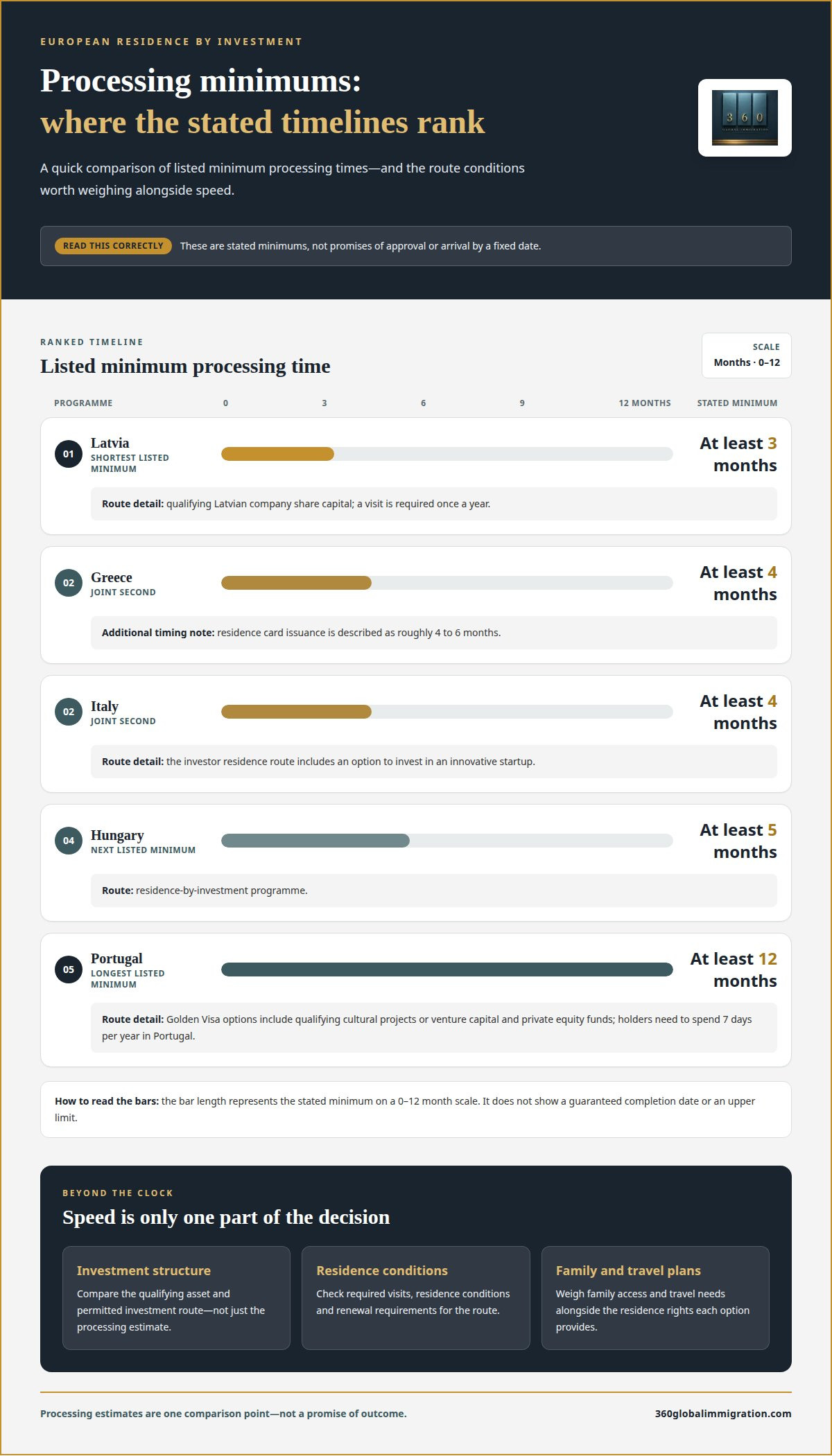
Processing speed matters, but it shouldn’t outweigh family access, travel needs, or the investment asset you prefer. Greece lists processing of at least 4 months; Italy, at least 4 months; Latvia, at least 3 months. These are stated minimums, not promises of approval or arrival by a fixed date. Applications also differ in investment structure, residence conditions, and renewal requirements.
Portugal’s Golden Visa offers qualifying investment routes connected to cultural projects or venture capital and private equity funds. Holders need to spend 7 days per year in Portugal. Italy’s investor residence route includes an option for investment in an innovative startup, and its application process usually takes at least 4 months. Applicants seeking citizenship should treat residence as a separate step, not as an immediate passport.
Latvia’s investment options include share capital in a qualifying Latvian company. Its first residence permit is valid for 5 years, with a visit required once a year. The interest-free government-securities route worth €250,000 does not apply from May 20th, 2026. Consider the investment’s liquidity and permitted structure alongside the permit’s conditions.
Income, health insurance, background checks, and documentation depend on the route. Prepare evidence relevant to the case, such as income or funds, insurance, identity, criminal-record checks, and proof of the qualifying investment. Tax residency is separate from holding a residence permit; spending more than 183 days a year in most EU countries can make a person tax resident there.
Key risks include committing capital to a regulated investment or property, changes to programme rules, and confusing residence rights with citizenship. Latvia’s securities route is one example of a route that no longer applies.
| Programme | Stated processing time | Route or condition |
|---|---|---|
| Latvia | At least 3 months | Qualifying company share capital; annual visit |
| Greece | At least 4 months | Investment residence; card issuance roughly 4 to 6 months |
| Italy | At least 4 months | Includes an innovative-startup option |
| Hungary | At least 5 months | Residence-by-investment programme |
| Portugal | At least 12 months | Golden Visa; 7 days per year in Portugal |
To prepare an application, identify the route, document your eligibility and any investment, submit the file, then track renewal and visit conditions. Choose the option that best balances travel access, residence rights, processing requirements and the investment asset you’re prepared to hold.
Is European Citizenship Without Residency Even Possible?
For most applicants, no: European citizenship typically requires 5-10 years of long-term residence. Marriage, descent, or exceptional national-interest admission can create different routes, but these are not standard investment shortcuts. Financial independence may help someone qualify for a residence route; it does not by itself confer citizenship or remove that country’s naturalisation conditions.
Residence and a second passport grant different rights. A European residence permit generally gives you the right to live in the issuing country, while citizenship provides nationality and the ability to enter and leave without relying on that permit. Residence by investment may suit applicants seeking a European base while retaining international flexibility, but a permit is not citizenship.
Naturalisation timelines differ. Greece’s investment-residence pathway lists 7 years to citizenship; Italy’s lists 10 years, and Portugal’s citizenship route takes 10 years. These timelines should be considered alongside the actual residence conditions, renewal obligations, and family plans. A residence programme can be a first stage, rather than a substitute for the later citizenship process; learning how formal naturalisation benchmarks work through resources like Citizenship Shortcut can clarify what long-term eligibility entails.
Some European citizenship exceptions are distinct from investment residence. Serbia’s Citizenship Law, Article 19, allows citizenship in the Republic’s interest without a statutory residence requirement. However, Serbia is not an EU member and has no formal citizenship-by-investment programme; admission by exception depends on a government decision. That route does not provide EU citizenship.
For financially independent applicants, compare the asset commitment with the relocation outcome. Some residence routes involve real estate or regulated investments, while others depend on business or talent qualifications. Check whether your priority is a residence permit, a potential path to naturalisation, or immediate citizenship. Each leads to different rights and responsibilities.
For families, assess the proposed route against dependants’ schooling, healthcare and relocation needs before selecting an investment. Consider the issuing country’s due diligence, tax implications, compliance obligations and rules for passing status to the next generation. These factors can matter as much as border access.
If residence, rather than immediate citizenship, fits your plans, European residence planning can help frame the next decision.
Residence rights in European countries
A European residence permit generally grants the right to live in the country that issued it. It doesn’t automatically provide residence rights in every EU state. Permits typically provide access to healthcare and education in the issuing country, while the specific benefits depend on the national route and its conditions.
Schengen travel is separate from residence. Visitors using the short-stay allowance may stay in Europe for up to 90 days in any 180-day window, according to the European Commission. EU residence permits typically allow visa-free travel across the Schengen Area, but that travel access isn’t permission to settle in another country. Families should distinguish short visits from a move, and plan around the rights attached to the permit itself.
Permit conditions vary by country. Cyprus permanent-residence applicants under the investment route must visit once every 2 years. Malta permanent residence is indefinite, but its residence card must be renewed every 5 years. These examples show why families should track both status and card validity, then plan required visits and renewal steps.
Different rules can apply when a non-EU family member joins or accompanies an EU citizen in another EU country. Under EU residence-rule conditions, the family member can stay for consecutive periods of up to 3 months per country visited. For a stay exceeding 3 months, they can apply for a residence card after arrival; authorities must issue it within 6 months of application. The EU information covers 27 countries, plus Iceland, Liechtenstein, Norway, and Switzerland.
Keep travel and residence compliance distinct. A non-EU family member travelling alone without a valid residence card or permit remains subject to the 90-day-in-180-day short-stay allowance. A valid residence card as an EU citizen’s family member can provide broader visa-free travel rights. Before choosing a route, map each family member’s status, destination country, travel purpose, and renewal obligations against the permit’s terms. That practical comparison matters more than the residence-permit market label.
European digital nomad residence permits
European digital nomad residence permits can suit families whose main applicant works remotely and wants a European base. Among European residency alternatives to a second passport, this pathway focuses on remote work rather than an investment asset. It grants residence under the destination country’s rules, not immediate citizenship or a global passport.
Start by checking how the chosen programme treats each family member. Definitions of spouses and children, supporting evidence and dependant status vary by country. Make a family eligibility list before planning a move, so everyone’s application and relocation needs are considered together.
Compare permits by the work arrangements they allow, which relatives can join, and the conditions for continued residence and renewal. These details affect how your family can organize work, schooling and a possible move. Match the permit’s terms to your actual plans rather than treating every digital nomad route as interchangeable.
Before preparing applications, organize records about the remote-work arrangement, employer or client relationship, income, insurance, identity and family relationships. Required documents depend on the destination’s rules. Keeping a clear file for each applicant helps you see what evidence supports the application and how it relates to eligibility.
A digital nomad permit can be a European residency alternative to a second passport for families seeking a residence base without committing wealth to real estate. Its scope is different: permission to reside in one member country doesn’t itself grant citizenship or settlement rights across Europe. Consider work location, travel plans and tax residence separately when assessing whether the route supports your long-term objectives.
If your plans centre on establishing or operating a business rather than remote employment, explore Cyprus and Ireland business residence options as a different route to European residence.
360 Global Immigration: France Passeport Talent
360 Global Immigration can help you assess whether France Passeport Talent fits your professional profile and European residence goals. It’s a relevant next step when your plans centre on a talent-based route rather than investment alone. The right pathway depends on your circumstances and the purpose of your move.
For other plans, options include the UK Innovator Founder Visa, Netherlands Self Employed Visa and Cyprus Business Residence Visa. Compare these routes by your intended activity, destination and desired residence outcome. A permit supports residence under its issuing country’s rules; it is not a second passport or automatic citizenship.
Contact 360 Global Immigration to discuss which listed pathway best matches your plans.
Choose a pathway that fits your family’s next chapter
For families weighing European residency alternatives to a second passport, start by defining what security means for your household. Consider where you may want to live, which family members need to be included, and whether your plans centre on professional activity, remote work or investment. These priorities help narrow the options before you assemble documents or commit to a route.
Build a shortlist around your family’s intended destination and main applicant’s circumstances. Then assess each pathway against your relocation timeline, dependants’ plans, and the responsibilities that come with residence. A clear comparison makes it easier to identify practical questions and prepare for an informed discussion. 360 Global Immigration offers France Passeport Talent, the UK Innovator Founder Visa, and the Netherlands Self Employed Visa.
Contact 360 Global Immigration to discuss a European pathway that aligns with your plans. A considered first step can help your family move forward with greater clarity.
Frequently Asked Questions
Family Inclusion: Who Can You Bring?
Family eligibility depends on the specific permit and how it defines dependants. Start by mapping each family member to the programme’s categories, including spouse, children, and any adult dependants. Most European digital nomad programmes may include dependent adult children up to age 30 if they’re full-time students. Prepare to show each dependant’s relationship to the main applicant and relevant study status where applicable.
Which European countries offer residency by investment or other qualifying routes?
Options span investment, business, talent and remote-work pathways. Investment-residence examples include Greece, Italy, Latvia, Portugal, Hungary, Cyprus and Malta. Other routes include France’s Passeport Talent, the UK Innovator Founder Visa, the Netherlands Self Employed Visa, and business residence options in Cyprus and Ireland. Digital nomad permits are another category. Compare the qualifying activity and residence conditions, not just the country name.
What are the minimum investment amounts and fees for European residency programs?
Minimum investment requirements depend on the country and qualifying route. Programmes may involve qualifying real estate, company share capital, cultural projects, funds or startup investment. Separate the investment commitment from application, administration and professional costs, since these are different budget items. For a family based in the UAE, compare the full financial exposure in AED and account for currency movements before choosing an investment structure.
Which European residency permits lead to permanent residency, and after how many years?
Some programmes grant permanent residence through a qualifying route rather than after a standard waiting period. Cyprus’s investment-residence option can grant permanent residence, while Malta’s permanent-residence status is indefinite; its card must be renewed every 5 years. These are distinct from citizenship. Before choosing, identify whether your goal is permanent residence, a renewable temporary permit, or eligibility to apply for naturalisation later.
What are the residence and physical-presence requirements for maintaining each permit?
Presence rules vary by programme, so build a family travel calendar around the selected permit. Latvia’s investment route requires a visit once a year, Cyprus’s permanent-residence investment route requires a visit once every 2 years, and Portugal’s Golden Visa requires 7 days per year in Portugal. Keep records of travel and permit renewals, and distinguish required visits from the separate question of tax residence.
Which European countries allow residents to apply for citizenship, and what are the timelines and conditions?
Naturalisation pathways exist in several European countries, but residence alone doesn’t grant citizenship. Cyprus may allow naturalisation after legal residence for 8 out of the past 11 years, subject to residence requirements before applying. Greece’s investment-residence pathway lists 7 years to citizenship, while Malta’s permanent-residence programme lists 5 years. Each country applies its own eligibility and residence conditions, so assess the full route.