The best European country for tech startups in 2026 isn’t automatically the biggest market or the lowest-tax option. The right choice depends on your sector, funding strategy, tax position and ability to establish yourself there, with the Netherlands worth close consideration for founders weighing its business environment and visa pathway.
It makes sense to compare countries on more than headline tax rates: a startup also needs the right customers, investors and practical route to operate. A strong ecosystem on paper may not fit your company’s stage or growth plan.
Compare European startup funding, sector fit and tax incentives, then consider how the Netherlands’ visa and business environment may affect your decision. This framework can help you match a jurisdiction to your priorities instead of relying on a one-size-fits-all ranking.
Key Takeaways
- Compare startup ecosystems by access to funding, customers and sector-relevant networks, not headline rankings alone.
- Match a country to your startup’s sector and growth plan before weighing its tax incentives.
- Assess how the Netherlands’ startup visa and business environment fit your plans to establish and grow in Europe.
- If France fits your strategy, explore how the France Passeport Talent pathway may support your move.
European startup funding and ecosystem momentum
The best European country for tech startups in 2026 depends on more than funding headlines. Compare talent, investor access, operating costs and the networks relevant to your sector.
Nordic Ecosystems and Operating Costs
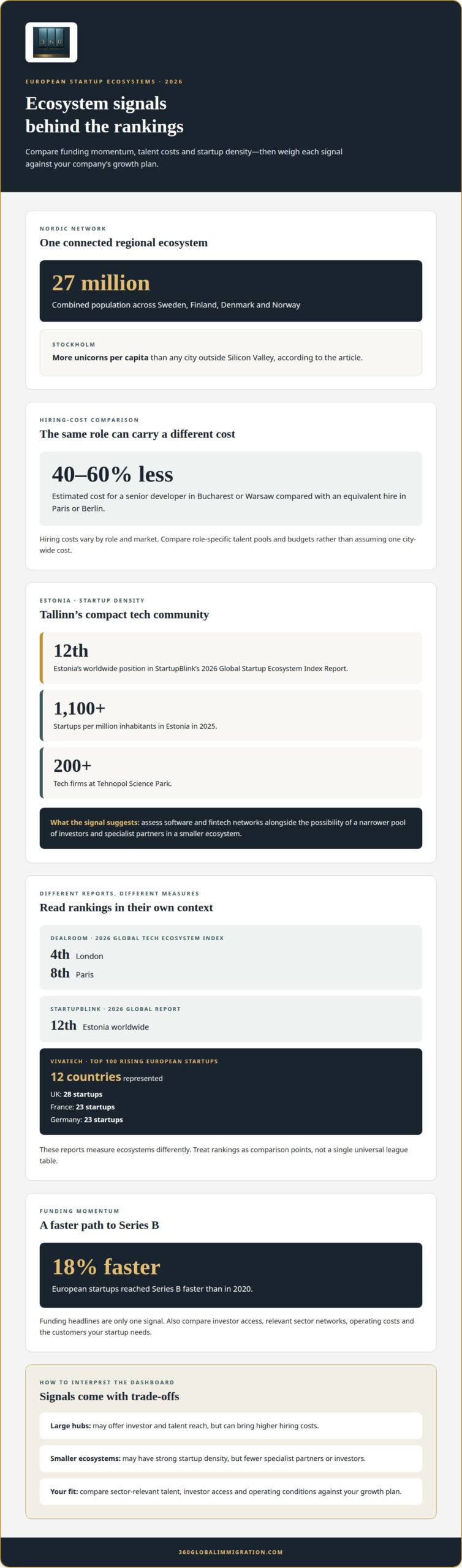
Nordic ecosystems connect founders across Sweden, Finland, Denmark and Norway, whose combined population is 27 million. Stockholm has generated more unicorns per capita than any city outside Silicon Valley, but that signal alone doesn’t establish a fit for every startup. Hiring costs vary by role and market: a senior developer in Bucharest or Warsaw is estimated to cost 40-60% less than an equivalent hire in Paris or Berlin.
Tallinn and Estonia’s Startup Ecosystem
Tallinn stands out for startup density and a compact tech community. Estonia ranked 12th worldwide in StartupBlink’s 2026 Global Startup Ecosystem Index Report and had over 1,100 startups per million inhabitants in 2025. Tehnopol Science Park is home to more than 200 tech firms. These indicators can help founders assess the software and fintech networks available, while a smaller ecosystem may offer a narrower pool of investors and specialist partners.
Ranking Criteria and Ecosystem Trends
Rankings measure different strengths, so examine criteria before comparing results. EU and national grant funding is one of five dimensions used to evaluate startup ecosystems. VivaTech’s Top 100 Rising European Startups ranking represents 12 countries; the UK accounts for 28 startups, while France and Germany each account for 23. European startups reached Series B 18% faster than in 2020. London, Paris, Amsterdam, Tallinn and Stockholm each offer distinct network signals; compare their events and sector communities when assessing access to investors, accelerators and coworking.
For hiring, compare role-specific talent pools and budgets; the cited developer-cost comparison places Bucharest and Warsaw below Paris and Berlin. Risks also differ: a large hub may bring higher hiring costs, while a smaller market may offer fewer specialist partners. Choosing the best European country for tech startups in 2026 means weighing those trade-offs against your growth plan.
| Option | Ecosystem signal | Decision factor |
|---|---|---|
| Stockholm | Unicorn track record | Nordic network fit |
| Tallinn | Startup density | Compact ecosystem |
| London | Global ecosystem standing | Investor and talent reach |
| Paris | Strong ranking presence | Hiring budget |
| Berlin | Major tech hub | Compare talent costs |
Choose the ecosystem whose talent, investor access and operating environment best support your next stage of growth.
Matching a startup jurisdiction to its sector and growth strategy
There is no single European ranking that captures every founder’s priorities. Dealroom’s 2026 index places London fourth and Paris eighth, while StartupBlink ranks Estonia 12th worldwide.
Country Selection by Sector and Startup Stage
Compare locations against three factors: sector infrastructure, access to customers and your next funding milestone. A science venture may prioritize research partners and specialist facilities, while a corporate software startup may value enterprise customers and access to global markets. For fintech, consider how local banking networks and support for regulated sectors fit product development. At an early stage, prioritize validation and talent; later, weigh expansion opportunities and investor connections.
European Country Rankings for Tech Startups
Rankings provide a comparison point, not a complete decision. London’s fourth-place position and Paris’s eighth-place position in Dealroom’s 2026 Global Tech Ecosystem Index reflect their standing in that index; Estonia’s 12th-place position comes from StartupBlink’s 2026 global report. Since the reports measure ecosystems differently, compare their criteria with your own growth needs before treating any country as the leader.
Events can help founders test sector fit and meet potential partners. Money20/20 Europe takes place in Amsterdam on June 2-4, 2026, for fintech and banking connections. South Summit runs in Madrid on June 3-5, 2026. For science-led ventures, Hello Tomorrow Global Summit is scheduled in Amsterdam on June 11-12, with Investor Day on June 10. Choose events around your immediate goal, such as customer discovery, technical partnerships or investor conversations.
Regulated-sector founders should also examine practical development infrastructure. The Bank of Lithuania’s LBChain blockchain sandbox supports fintech startups in prototyping and bringing products to market. That makes it a concrete example to assess when automation depends on testing financial technology. Founders relocating from the UAE can also review European business immigration guidance as part of comparing jurisdictions and growth plans.
Corporate tax and personal income tax incentives
Tax incentives can shape a startup’s investment plan, but the headline rate is only part of the picture. Compare corporate tax treatment with personal income tax, eligibility criteria and expected research and development activity. A digital startup with qualifying research may assess incentives differently from a business focused on commercial expansion. Model each country against your company structure and growth priorities.
France’s Crédit d’Impôt Recherche reimburses 30% of eligible research and development expenditures. This can be relevant to deep tech companies with qualifying research costs. Italy offers tax deductions of 30-50% for investments in innovative startup equity. These measures work differently: one relates to eligible research expenditure, while the other concerns investment in startup equity. Founders should distinguish the company’s potential relief from incentives available to investors.
Lithuania has a 15% corporate tax rate. Lithuania offers a 5% corporate tax rate for small businesses that meet specific criteria, according to tax.gov.ae. The criteria matter: a startup should assess whether its business qualifies before using the reduced rate in forecasts. This is a distinct consideration from national support for a startup ecosystem, such as grants or sector-specific infrastructure.
Cyprus combines company and talent considerations. Qualifying technology companies can achieve an effective corporate tax rate as low as 2.5% on profits generated from intellectual property under the Cyprus IP Box Regime. Cyprus also offers a 50% personal income tax exemption for high-earning foreign talent. The IP-related treatment concerns qualifying company profits, while the personal exemption relates to eligible individuals. Separate the two when comparing relocation and operating plans.
Slovenia offers tax deductions for research and development investments and regulations supporting employee stock option plans. Latvia’s Startup Law provides startup employees with a specialized flat-tax regime intended to reduce labor tax burdens on early-stage companies. For a practical comparison, list expected research spending, intellectual property income, hiring needs and equity plans. Then assess which incentives align with those activities instead of treating a tax headline as a forecast of success. London’s ecosystem ranking, for example, does not determine a company’s tax outcome.
The Netherlands’ startup visa and business environment
The Netherlands merits a closer look when founders compare European routes to establish a business. Assess immigration eligibility separately from the commercial case: a suitable residence pathway does not, on its own, show whether the market fits your venture.
Founders comparing European startup immigration options should consider pathways in the Netherlands, Denmark, France, the UK, Cyprus and Ireland. The names alone do not mean eligibility or conditions are equivalent. Match a route to your intended activity, company structure and role, then assess how it supports your planned location and growth.
Assess the Netherlands startup visa and business environment as connected but distinct decisions. Map your product, customer base, engineering needs and prospective partners against the market you plan to serve. Amsterdam’s international business connections may support a venture looking beyond one national market, while proximity to Germany may matter if you are targeting customers there. The practical advantage depends on your sales and hiring plans.
Regulations, employment arrangements and compliance shape operations in every country, including the Netherlands and Germany. Before hiring, map the issues your startup must manage: employment terms, payroll, data handling, tax administration and any sector-specific approvals. This creates a practical compliance checklist without assuming that one country’s rules apply across Europe.
Incorporation processes and costs depend on legal form, ownership structure, registration steps, professional support and banking needs. Build a country-by-country checklist around these factors, then compare the work involved with your launch timeline. There is no single setup process or cost for all leading European countries.
Use the Netherlands as a serious candidate when its business connections and your intended operating model align. For tailored guidance on European immigration pathways, compare your founder visa options.
360 Global Immigration: France Passeport Talent
360 Global Immigration helps founders assess European business and talent-based residence pathways, including France Passeport Talent. Turn to this option when France fits your startup plans and you need guidance on a talent-based route. The right jurisdiction depends on more than ecosystem rankings: your business model and intended role also shape the decision.
Other pathways include the UK Innovator Founder Visa, Netherlands Self Employed Visa and Cyprus Business Residence Visa. Each serves different plans, so compare the route and country with your intended business activity before deciding. If your plans point to France, the France Passeport Talent route is another relevant option to explore.
For guidance on how these options relate to your plans, contact 360 Global Immigration or visit 360globalimmigration.com.
Turn Your European Expansion Plan into a Clear Next Step
The best European country for tech startups in 2026 is the one that supports your actual operating plan, not simply the one that leads a ranking. Before committing, define where you need to live and work, which market you intend to serve, and what your company must establish first. That sequence helps connect jurisdiction research with a practical founder relocation decision.
For founders considering France Passeport Talent, the UK Innovator Founder Visa, or the Netherlands Self Employed Visa, 360 Global Immigration can guide them through the relevant pathway. The right option depends on the founder’s plans and the route’s fit with their intended activity.
Take the next step with a focused discussion about your destination and business plans. Contact 360 Global Immigration to explore your options and move forward with clarity.
Frequently Asked Questions
How do European startup ecosystems compare by funding, startup count, and growth?
European hubs differ in scale, startup density and growth signals. For example, Estonia recorded over 1,100 startups per million inhabitants in 2025, while the 2026 VivaTech ranking represented startups from 12 countries. Use startup counts to understand ecosystem concentration, then compare funding access and sector networks. A dense ecosystem may offer relevant peers, while a larger market can provide a broader customer base.
Which European countries offer the best access to venture capital and angel investors?
London, Paris, Amsterdam and Stockholm are useful hubs to compare for venture connections. Amsterdam ranks among Europe’s top five tech hubs by venture capital volume, while London and Paris hold prominent positions in global ecosystem rankings. Access to angel investors depends more on sector, stage and founder networks than on a country label. Prepare a focused pitch and identify investors whose portfolios match your product and expansion plans.
What are the corporate tax rates and startup tax incentives by European country in 2026?
Rates and incentives vary by country and by activity. Italy offers tax deductions of 30-50% for investments in innovative startup equity, an incentive relevant to investors. Other examples include France’s research credit and Cyprus’s intellectual-property regime, while Slovenia offers research and development deductions. Compare eligibility and the type of benefit, such as company research relief, investor deductions or employee tax treatment, rather than headline rates alone.
How do regulations, employment laws, and compliance requirements affect startups across Europe?
Specific rules can affect hiring and incentives. Latvia’s Startup Law offers startup employees a specialized flat-tax regime intended to reduce labor tax burdens, while Slovenia supports employee stock option plans. Lithuania’s reduced corporate tax rate applies only to small businesses that meet specific criteria.
How easy is it to incorporate a tech startup in leading European countries, and what does it cost?
Estonia allows company registration online in under 15 minutes from anywhere in the world.
What are the main risks and disadvantages of launching a tech startup in each leading European country?
A large hub may bring higher hiring costs, while a smaller market may have fewer specialist partners and investors. The cited comparison estimates senior developers in Bucharest or Warsaw cost 40-60% less than equivalent hires in Paris or Berlin.