
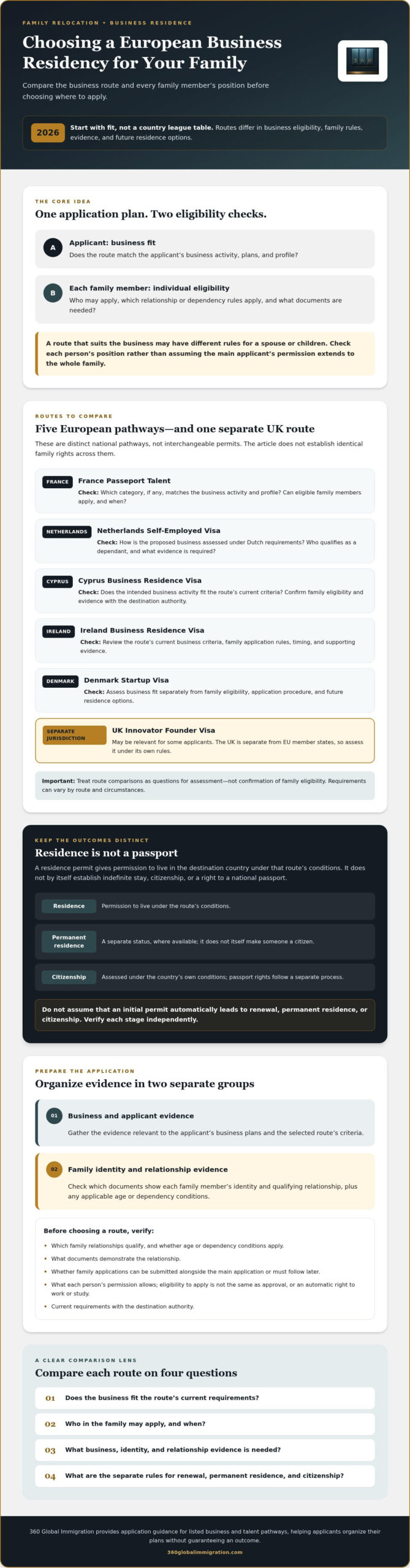
The most attractive European business route may not be the right choice for your family. A permit that suits your business plans may have different rules for a spouse or children, so choosing a European business residency for family starts with checking both business eligibility and each family member’s position.
If you’re comparing countries, you’ll want to know who may apply with you, what evidence is needed, and what the pathway may lead to. This guide explains what to compare in 2026, how family applications and supporting evidence fit into the process, and why residence permission should not be confused with permanent residence or citizenship.
We’ll look at business-based options such as France Passeport Talent, the Netherlands Self-Employed Visa, Cyprus Business Residence Visa, Ireland Business Residence Visa, and Denmark Startup Visa. The UK Innovator Founder Visa may also be relevant for some applicants, but the UK is a separate jurisdiction from EU member states. Family eligibility, application procedures, and future residence options vary by route, so confirm current requirements with the destination authority before applying.
Key Takeaways
- Choosing European business residency for family means assessing both the applicant’s business fit and each family member’s eligibility under the specific route.
- Compare routes by business requirements, family application rules, supporting evidence, and longer-term objectives rather than treating them as interchangeable.
- Review business evidence separately from family identity and relationship documents, then confirm current requirements with the destination authority.
- Residence permission, permanent residence, and citizenship are distinct outcomes. Verify the rules for each instead of assuming one automatically leads to another.
- 360 Global Immigration provides application guidance for listed business and talent pathways, helping applicants organize their plans without guaranteeing an outcome.
European business residency for family: what residence can, and cannot, offer
Relocating a business is also a family decision. Alongside the founder’s plans, the family needs clarity about who may join, what evidence is required, and what each person’s permission allows. European business residency for family isn’t one Europe-wide status. It means applying under a particular country’s rules and a specific residence route.
A business residence permit generally grants permission to live in the destination country under that route’s conditions. It does not, by itself, establish a right to remain indefinitely. Temporary residence, permanent residence, citizenship, and eligibility for a national passport are distinct legal stages, each with its own rules. Meeting the requirements for an initial permit doesn’t guarantee renewal or a later status.
Does business residency include a spouse and children?
Some routes allow eligible family members to apply, but dependant definitions, evidence requirements, and application timing differ by country and route. A spouse or child’s eligibility to apply is not the same as approval, and approval does not automatically establish a right to work or study. Check each family member’s position individually rather than assuming the main applicant’s permission extends to everyone.
Before selecting a route, confirm the current rules with the destination authority. Check which relationships qualify, whether age or dependency conditions apply, what documents demonstrate the relationship, and whether family applications can be submitted alongside the main application or must follow later. Even related routes can treat accompanying family differently. For context, the EU Blue Card is a separate work-and-residence pathway. Its family provisions shouldn’t be assumed to apply to business routes.
Is European residency the same as a second passport?
No. A residence permit is authorization to reside under specified conditions, not citizenship and not a travel document. Permanent residence, where available, is a separate status and doesn’t itself make someone a citizen. Citizenship applications are assessed under the relevant country’s own conditions, which may differ from those for the original residence permit.
A residence permit grants permission to live in a country; nationality establishes citizenship, and passport rights follow a separate process. For families considering a long-term move, verify the rules for initial residence, renewal, permanent residence, and citizenship independently. Treating one as an automatic route to the next can lead to expectations the permit doesn’t support.
Which European business residency routes may fit a family relocation?
Route selection starts with the business, not a league table of countries. France Passeport Talent, the Netherlands Self-Employed Visa, Cyprus Business Residence Visa, Ireland Business Residence Visa, and Denmark Startup Visa are distinct national pathways, each with its own eligibility rules. The UK Innovator Founder Visa is also separate: the UK is not an EU member state.
Use the comparison below to identify questions for further assessment, not to assume that routes have matching family rights. The EU rules on family residence rights explain rights in relevant EU free-movement situations, but don’t establish eligibility for every non-EU business applicant or route. Check the destination authority’s current rules for your circumstances.
| Country | Route | Business-fit question | Family-rule verification | Source to check |
|---|---|---|---|---|
| France | France Passeport Talent | Which category, if any, matches your business activity and profile? | Can eligible family members apply, and when? | Official French immigration guidance for the relevant category |
| Netherlands | Netherlands Self-Employed Visa | How will the proposed business be assessed under Dutch requirements? | Who qualifies as a dependant, and what evidence is required? | Official Dutch immigration guidance |
| Cyprus | Cyprus Business Residence Visa | Does the intended business activity fit this route’s current criteria? | Which relatives may apply, and do they apply together or later? | Official Cyprus authority guidance |
| Ireland | Ireland Business Residence Visa | Does the business plan meet the route’s current requirements? | Check family eligibility, timing and any separate conditions. | Official Irish immigration guidance |
| Denmark | Denmark Startup Visa | Is the venture suitable for this specific startup pathway? | Confirm who can accompany the applicant and what permissions follow. | Official Danish immigration guidance |
| United Kingdom | UK Innovator Founder Visa | Does the proposed venture fit the UK route’s criteria? | Check dependant eligibility and conditions under UK rules. | Official UK government guidance |
How do the France and Netherlands routes differ for founders?
France Passeport Talent is a named pathway with categories that must be matched to the applicant’s circumstances. Don’t assume the Business Creator category applies without checking its current criteria. The Netherlands Self-Employed Visa involves a separate, country-specific assessment of the proposed business. Compare each route against your actual plan, then verify dependant rules through the relevant official guidance.
How should families compare Cyprus, Ireland, Denmark, and the UK?
Assess Cyprus and Ireland independently rather than treating “business residence” as one shared legal route. Denmark’s Startup Visa and the UK Innovator Founder Visa are also distinct national pathways, with separate business and family conditions. Official authorities make eligibility and permit decisions; application guidance can help organize a case but cannot guarantee an outcome. A tailored review of your business plans and family priorities may help narrow the options. 360 Global Immigration provides guidance for its listed routes through its business residence application support.
What should families compare before choosing a business residence route?
A useful comparison weighs the founder’s business case and the family’s practical needs together. There is no universally best option for European business residency for family relocation. A route may suit a particular business model but involve different application steps or permissions for accompanying relatives. Assess each option against the same questions, then verify the answers with the destination authority using current rules.
Start with four decision areas:
- Business fit: Does the route assess a startup, self-employment activity, investment, or another profile? What business activity and evidence does the authority require?
- Family rules: Can a spouse apply? Which children qualify as dependants, and are there age or dependency conditions?
- Application and documents: Can the family apply together, or are separate or later applications required? Which identity and relationship documents must be provided?
- Longer-term objectives: What are the renewal conditions, and what separate rules govern family members’ residence, work, study, or possible future status?
Does the proposed business fit the route’s purpose?
Read the route criteria against the actual business plan, not just the route’s label. A startup pathway, a self-employment route, and a category for another business profile may assess different factors. Depending on the route, applicants may need to establish the venture’s nature, explain their role, or provide specified supporting evidence. Confirm endorsement or business-plan requirements in official guidance instead of assuming they match another country’s process.
A promising business case is only one part of an application. It doesn’t guarantee residence approval or establish that family members qualify. Record the route’s business criteria separately from its family requirements so you can see what evidence is needed for each part of the application.
What family and long-term factors should be checked?
Review each relative’s case individually. Confirm which relationships qualify, whether dependency must be demonstrated, and whether the authority requires documents such as marriage or birth records. Check with the relevant authority whether documents need translation, certification, or submission in a particular format. Then verify application timing and what each family member’s permission allows.
Family eligibility must be verified under the specific route and current rules, not inferred from the main applicant’s eligibility. A spouse’s rights may differ from a child’s, and permissions to reside, work, or study shouldn’t be presumed. Compare renewal requirements and application sequencing only after confirming the official rules. Keep longer-term aims in view, but check permanent residence and citizenship separately from initial permission. This approach makes comparisons more useful than ranking countries without considering a family’s circumstances.
How can you prepare a family business-residency application?
A clear preparation process helps keep the business case and each family member’s application organized. For European business residency for family, begin with your relocation goals, then confirm the route and its current requirements with the responsible destination authority before collecting final documents.
- Define the plan: Set out the intended business activity, the applicant’s role, and the family’s priorities for the move.
- Verify the route: Check the official criteria, family application sequence, renewal conditions, and current document checklist.
- Build separate evidence files: Organize business records independently from each family member’s identity and relationship documents.
- Review before filing: Check every form and supporting document against the destination authority’s instructions, then resolve gaps before submission.
What information should applicants gather first?
Write a concise description of the business, its ownership, planned operations, and the applicant’s intended responsibilities. Match this information to the route’s official criteria rather than assuming a general business plan will satisfy every pathway. Keep relevant records together and note any evidence the authority specifically requests.
Make a preliminary list of accompanying family members and each person’s relationship to the main applicant. For every person, note questions about dependant eligibility, required relationship evidence, separate applications, and timing. Also identify whether the family needs clarification on work or study permissions and renewal arrangements. These are route-specific questions to verify, not rights to assume.
How can applicants reduce avoidable document problems?
Use the current checklist published by the destination authority. Separate the applicant’s business evidence from family identity and relationship documents, and check that names, dates, roles, and other details are consistent across forms and records. If an explanation is needed to clarify a detail, keep it factual and aligned with the supporting evidence.
Before obtaining or submitting documents, confirm the required format and whether translation, certification, validity periods, or particular submission methods apply. Instructions can vary by country and route. Timing, fees, and processing expectations also depend on the pathway and current official information, so don’t rely on old estimates or guidance for a different route.
A professional document review can help identify inconsistencies, missing evidence, or unanswered questions before filing. It can improve preparation, but it cannot assure a decision. For guidance organizing a business-residence application and related family documents, request application guidance.
How 360 Global Immigration can help assess family business-residency options
Choosing a route means weighing two connected plans: the business the applicant intends to pursue and the family’s relocation priorities. 360 Global Immigration is a UAE-based consultancy that provides application guidance for business and talent residence pathways across Europe and the UK. A discussion of your circumstances can help organize the options to assess, identify questions for official verification, and clarify what information may be needed to prepare an application.
Its listed pathways include France Passeport Talent, the Netherlands Self-Employed Visa, Cyprus Business Residence Visa, Ireland Business Residence Visa, Denmark Startup Visa, and the UK Innovator Founder Visa. These are distinct national routes, not interchangeable versions of European business residency for family. The UK is also separate from EU member states, and family eligibility and rights must be checked under each route’s current rules.
What can an immigration consultancy support?
Professional guidance can help compare a proposed business with the relevant route criteria and organize application materials around those requirements. A structured document review may help identify missing evidence, inconsistencies, or questions to resolve before submission. It supports preparation, but it cannot replace the destination authority’s instructions or guarantee a decision.
360 Global Immigration provides application guidance for its listed pathways. It does not provide job placement, flight or hotel bookings, or government-fee coverage. Applicants should confirm official criteria, required documents, fees, processing expectations, and family procedures directly with the responsible authority, since requirements can change.
What should families ask before starting?
Bring a clear outline of the business activity, ownership, operating plans, and the applicant’s role, along with a preliminary list of family members who may relocate. Then ask focused questions:
- Which listed route appears relevant to the proposed business, and which official criteria still need confirmation?
- How may a spouse or child qualify, when can each person apply, and what relationship evidence is required?
- What permissions may family members receive, and which work or study rights need destination-specific verification?
- Which application, renewal, or longer-term status requirements should be checked separately with official sources?
Clear answers can help you move from broad comparisons to practical next steps. To discuss your business plans and family priorities, discuss business and family residency options with 360 Global Immigration. Eligibility decisions remain with the relevant authorities, and no application outcome can be assured.
Make your next move with a clear family plan
The right European business residency for family relocation depends on more than the founder’s business idea. Compare each route’s business criteria, check spouse and child eligibility separately, and confirm application timing, permissions, and longer-term requirements with the relevant authorities. Residence permission doesn’t automatically lead to permanent residence or citizenship, so set expectations around each stage.
360 Global Immigration provides application guidance across several business and talent pathways, including France Passeport Talent, the Netherlands Self-Employed Visa, Cyprus and Ireland business residence options, Denmark Startup Visa, and the UK Innovator Founder Visa. The UK route is distinct from EU member-state pathways, and every application remains subject to the responsible authority’s decision.
To discuss how your business plans and family priorities may shape your options, discuss your business and family residency options. With the right questions and careful preparation, you can take the next step with greater clarity.
Frequently Asked Questions
Can my family join me on a European business residence permit?
Possibly, but family inclusion depends on the specific country and residence route. Check whether a spouse and each child meet the route’s dependant definition, whether they apply with the main applicant or later, and what relationship evidence is required. Permission to apply doesn’t guarantee approval, and family members’ rights may differ from the applicant’s. Confirm current eligibility and procedures with the destination authority before making relocation plans.
Does European business residency give my family a second passport?
No. A residence permit grants permission to live in a country under specified conditions; it isn’t citizenship or a passport. Citizenship is a separate legal process with country-specific requirements, and eligibility isn’t guaranteed by holding a business residence permit. Permanent residence is also distinct from citizenship. Check the destination country’s official rules for each stage rather than assuming temporary residence automatically leads to nationality or passport rights.
Which European business visa is best for a family?
There’s no universally best route; suitability depends on the proposed business, the applicant’s profile, and each family member’s eligibility. Compare the business criteria and family application rules for routes such as France Passeport Talent, the Netherlands Self-Employed Visa, Cyprus Business Residence Visa, Ireland Business Residence Visa, and Denmark Startup Visa. Verify current details with official authorities. A route that fits the founder’s plans may not offer the family conditions you expect.
Can my spouse work if we move through a business residency route?
Possibly, but don’t assume a spouse’s residence permission automatically includes work rights. Rules depend on the destination and the family member’s specific status. Check whether a separate authorization is needed, what activities are permitted, and whether conditions apply before your spouse accepts work. Verify the answer with the responsible authority for the exact route and current rules, since another country’s dependant provisions may differ.
What documents may a family need for a business residence application?
Requirements vary, but applicants may need identity documents and evidence of family relationships, such as marriage or birth records. The main applicant may also need documents about the proposed business, ownership, operating plans, and personal role. Treat these as possible document categories, not a definitive checklist. Use the destination authority’s current instructions to confirm formats, validity, translation or certification requirements, and whether family members submit separate applications.
How do I choose between France, the Netherlands, Cyprus, Ireland, and Denmark?
Start by matching your business activity and role to each route’s official criteria. Then compare how each destination handles spouse and child eligibility, application timing, supporting documents, renewals, and family permissions. France Passeport Talent, the Netherlands Self-Employed Visa, Cyprus Business Residence Visa, Ireland Business Residence Visa, and Denmark Startup Visa are distinct pathways, not interchangeable options. Verify current requirements with each authority before deciding which route merits further assessment.
Is the UK part of the European Union for business residency applications?
No. The UK is not an EU member state, so its business residence applications follow UK rules rather than EU member-state procedures. The UK Innovator Founder Visa is a separate national pathway from routes such as France Passeport Talent or Denmark Startup Visa. If you’re comparing destinations, assess UK business and dependant criteria through official UK guidance, and check EU-country requirements separately with the relevant national authorities.