
Could the obvious Europe startup visa route be the wrong fit for your business? There isn’t one shared European program: each country sets its own pathway, eligibility terms and assessment process. For founders planning a move from the UAE, that distinction matters before investing time in an application.
It’s reasonable to expect similar requirements across routes, but startup assessments can differ significantly. Some focus on innovation and scalability; others also require support from an approved body or facilitator. A promising business can still be a poor match for a particular pathway if its model doesn’t meet that country’s criteria.
This guide compares selected founder and business-residence routes, including Denmark’s Start-up Denmark, France’s Talent Passport route, the Netherlands’ startup pathway and the UK Innovator Founder Visa. You’ll learn what assessors commonly consider, how to shortlist routes and what business, financial and personal evidence to organize. A clear comparison helps you focus on a pathway that aligns with your business and plans.
Key Takeaways
- “Europe startup visa” describes country-specific routes, not one universal program.
- Compare each pathway’s purpose and business assessment instead of assuming founder visas use the same criteria.
- Assess your business profile separately from your personal immigration eligibility, since both may affect the route.
- Use your destination priorities and planned business activity to narrow down routes for closer review.
- Organize business, personal and financial evidence early, then verify current requirements for your selected pathway.
What does “Europe startup visa” mean for a founder in 2026?
The phrase Europe startup visa is a useful search term, not the name of a single immigration program. It refers broadly to national pathways that may let founders live in a particular country while developing a business. Europe does not have one universal startup visa that gives every founder permission to settle in every European country. Each destination sets its own route, eligibility criteria and application process, and a program name alone doesn’t show whether a founder or business qualifies.
These pathways also differ in purpose. A startup or innovation route may focus on the business model and its growth potential. A self-employment or business-residence route may suit someone establishing or operating a business without applying through a startup-specific scheme. Talent pathways assess professional or business profiles under their own criteria. Treat these as broad categories, not interchangeable legal labels. Startup visa on Wikipedia provides a general overview, but the destination country’s current rules determine application requirements.
Is there one visa that lets founders settle anywhere in Europe?
No. A residence permit issued by one country doesn’t automatically give its holder the right to live or work in another. Permission to reside and permission to make short visits are separate questions. Travel eligibility depends on factors such as the traveller’s nationality, destination and applicable entry rules.
Keep the terms EU, EEA and Schengen Area distinct. They describe different memberships and arrangements, not one shared immigration zone. Before planning a move across borders, identify which country would issue your residence permission and check the rules that apply to other destinations in your plans.
Which kinds of founder routes appear in European searches?
Search results can group several distinct pathways under “startup visa.” Common categories include:
- Startup-specific routes: Designed for qualifying new ventures, often with a formal review of the business concept.
- Innovative-business pathways: May require a proposal to meet innovation or growth criteria and receive support or assessment from a designated organization.
- Self-employment routes: Focus on a person’s plan to work independently or operate a business, with criteria set by the destination.
- Business-residence or talent pathways: Provide other frameworks for business activity or professional profiles, rather than one shared startup test.
For example, Denmark’s Start-up Denmark assesses whether a proposed business is innovative and scalable, with review by an expert panel. France’s Passeport Talent includes a French Tech route for qualifying innovative projects, with support or selection tied to the relevant pathway. The UK Innovator Founder Visa uses an approved endorsing body to assess innovation, viability and scalability. In the Netherlands, the Startup Visa involves guidance from a recognized facilitator and is distinct from a self-employed residence route.
These examples show why labels aren’t enough. The same founder may face different assessments, supporting organizations and application stages in different countries. Compare the route’s purpose with your actual business activity, then verify the destination’s current requirements before preparing an application.
How do European startup and founder visa programs assess a business?
A founder application can be assessed on two related but distinct questions: does the business fit the route, and does the applicant meet the personal immigration requirements? Depending on the country and pathway, assessors may consider whether the proposal is viable, innovative, suited to the founder’s experience and supported by a clear plan for activity in the destination. These are possible themes, not a universal checklist. A strong business case alone doesn’t establish that every personal eligibility requirement is met.
The authority, endorsing body or other designated assessor applies the criteria for its own route. For instance, the UK Innovator Founder pathway assesses innovation, viability and scalability through an approved endorsing body. Denmark’s Start-up Denmark uses an expert panel to assess business proposals. The process, evidence and definitions can change, so verify current country-specific rules before relying on general comparisons.
What makes a startup proposal relevant to an innovation-focused route?
Explain what differentiates the product or service, who it is intended for, how far development has progressed and what the next milestones are. Where relevant, show how the business could reach its target market and grow. Make the proposal easy to assess by identifying the customer need, describing the solution and connecting planned activity to the founder’s capabilities. Don’t assume every country defines innovation or applies the same threshold in the same way. Check the destination’s current criteria and assessment process.
Which founder documents help make the case coherent?
Document requirements depend on the route. A business plan, founder CV or professional records, company documents and financial evidence may all be relevant. Treat each as part of one account, rather than paperwork assembled at the last minute.
- Business plan: Keep the proposed activity, market description, milestones and financial projections consistent.
- Founder background: Connect relevant experience and responsibilities to the work described in the plan.
- Company evidence: Where applicable, align registration or ownership details with the proposed business activity.
- Financial records: Ensure figures, dates and explanations match across statements and application materials.
A credible founder application presents aligned evidence, a clear business plan and a direct fit with the selected route’s criteria. Review every figure and date across the file so inconsistencies don’t obscure an otherwise clear proposal. For France-focused preparation, the France Talent Visa document checklist can help organize route-related materials.
For founders comparing options from the UAE, structured business and talent residency route assessment can help organize country-specific criteria and application preparation. It supports a clearer case, while the relevant authority makes the decision.
How do Denmark, France, the UK, and other founder routes compare?
Compare the purpose of each route, the business it is designed for and who assesses the application. Use the table as a starting point, then check current official rules and required evidence for your circumstances.
| Route | Purpose and business profile | Assessment focus | Evidence to verify |
|---|---|---|---|
| Denmark Start-up Denmark | Startup route for founders proposing an innovative, scalable business. | Expert panel assessment of the business idea. | Current program criteria, business plan, founder details and supporting documents. |
| France Passeport Talent | Talent pathway that includes a route for qualifying innovative business projects. | Project innovation and applicable support or selection requirements. | Current route category, project recognition process, support evidence and personal eligibility. |
| UK Innovator Founder Visa | Founder route for a business proposal that meets the route’s requirements. | Approved endorsing body assesses innovation, viability and scalability. | Endorsement requirements, business plan, founder credentials and personal eligibility. |
| Netherlands self-employed residence | Self-employment route, distinct from the Dutch startup permit. | Country-specific criteria for the applicant’s planned independent business activity. | Current eligibility test, business evidence, financial records and application procedure. |
| Cyprus business residence | Business-residence pathway for applicants planning business activity in Cyprus. | Requirements depend on the specific residence category. | Current category, qualifying activity, company documents and personal requirements. |
| Ireland business residence | Business-residence pathway, with route suitability depending on the applicant’s plans. | Applicable program criteria and assessment process. | Current program terms, business plan, financial evidence and applicant requirements. |
Route names do not establish eligibility; the destination’s current official criteria do. When comparing a Europe startup visa, assess your actual business model against the route’s stated purpose, then confirm which documents and personal conditions apply.
When might a startup-specific or innovation-led route merit review?
Consider one when your plan closely matches a route’s stated focus and you can clearly explain the business’s innovation, development, target customers and growth plans. Denmark’s Start-up Denmark assesses proposed businesses for innovation and scalability. France’s Passeport Talent includes a French Tech pathway for qualifying innovative projects, with specific support and recognition requirements. Review the Denmark Startup Visa for International Founders guide for a focused look at that route, and verify current rules before preparing an application.
When could another business or talent pathway be more relevant?
A founder whose plans align better with independent business activity may want to compare a self-employment or business-residence pathway, while a qualifying professional or business profile may point toward a talent route. France’s business-creator option and the Netherlands self-employed pathway should not be treated as identical to startup-specific programs. The UK is not an EU member, so its Innovator Founder Visa is a separate national route, not an EU pathway. Explore the France Passeport Talent business creator guide and UK Innovator Founder Visa guide alongside current official criteria.
For a structured comparison of country-specific requirements and application preparation, a tailored route assessment can help organize your next steps.
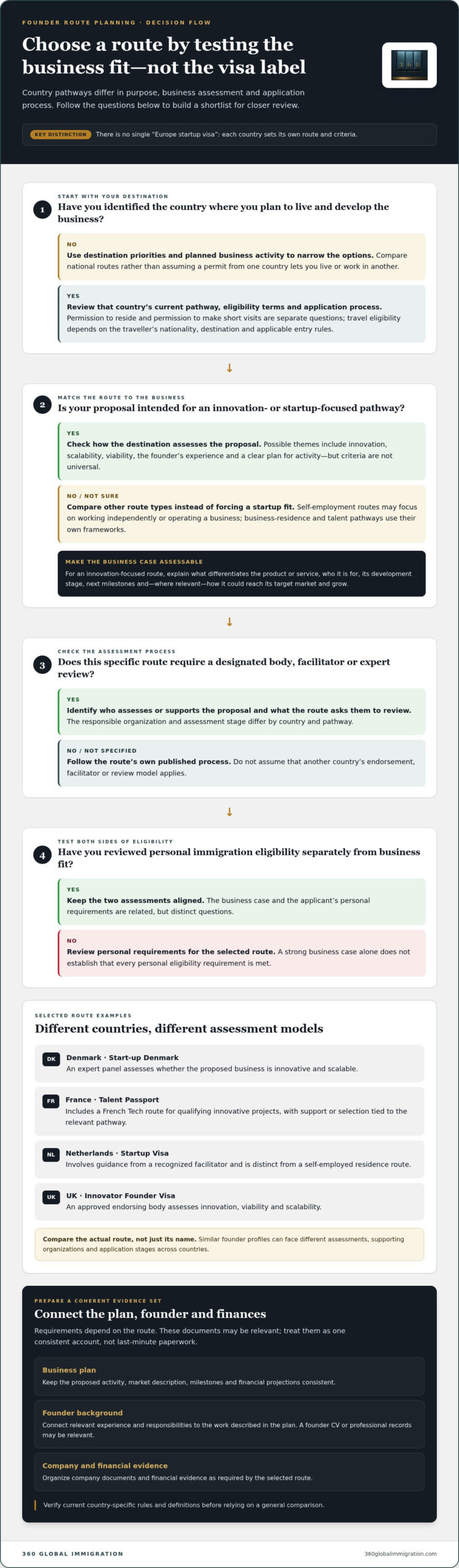
How can founders narrow down a Europe startup visa route?
Build a shortlist around your actual business and relocation priorities, not the visa label that sounds most familiar. Use this five-step framework to compare options systematically. It helps identify routes for closer review, but it isn’t a legal eligibility decision or a guarantee of approval.
- Define destination goals. Identify where you want to live and operate, and why that location suits your plans.
- Describe the business. Summarize its activity, current stage, customers, growth plans and your role as founder.
- Review each route’s purpose. Determine whether it is designed for a startup, innovation-led project, self-employment, business residence or another profile.
- Map the evidence. Link each relevant criterion to a document or other support, and note what is missing.
- Verify current rules. Check official guidance for eligibility, application stages, permitted activities and required evidence before deciding how to proceed.
Keep relocation priorities separate from assumptions about what a permit provides. A route that supports residence in one country doesn’t, by itself, settle questions about permanent residence or living and working elsewhere. Treat those as separate objectives to investigate under the applicable country’s rules.
What should founders clarify before comparing countries?
Write down the planned business activity, your day-to-day responsibilities, the intended target market and a realistic relocation timeframe. Then distinguish personal aims, such as where you want to live, from the business case a particular pathway may assess. Family plans, existing company structures and timing constraints can also affect preparation. Recording these factors early helps you compare routes against a complete picture instead of selecting one based on a single appealing feature.
How can applicants check route fit without relying on assumptions?
Create a simple evidence map: list each published eligibility point, the document or fact that may support it, and any unanswered question. Check current official guidance for the route’s criteria, stages and permitted activities, then revisit the map if the rules or business plan change. For broader context on professional pathways, the Talent-Based Immigration to Europe guide can help frame your comparison.
Before committing to a route, review whether your business stage, founder role and available records support the case you intend to present. A gap doesn’t automatically rule out a pathway, but it should be understood and addressed before application preparation advances. Keep a dated record of the official guidance you relied on so you can identify what needs to be rechecked.
For a structured review of country-specific requirements and application preparation, request tailored founder route guidance from 360 Global Immigration. This can help organize your next steps while leaving eligibility and approval decisions to the relevant authorities.
How can 360 Global Immigration support a founder’s application planning?
After comparing route purposes and evidence requirements, the next challenge is turning that research into a coherent plan. 360 Global Immigration provides consultancy support for business and talent-based residency applications, including the Denmark Startup Visa, France Passeport Talent, UK Innovator Founder Visa and Netherlands Self-Employed Visa. Guidance helps founders organize country-specific requirements and prepare application materials around their business and personal circumstances. Government authorities and designated assessors make the decisions, so consultancy support cannot guarantee an outcome.
What does structured application guidance help founders organize?
A structured process connects the proposed business activity to the selected route’s criteria, identifies relevant documents and organizes preparation into manageable steps. This may include reviewing the business plan alongside the founder’s background, company information and personal evidence. The aim is a consistent application narrative: dates, responsibilities and business details should align across materials rather than raise questions through conflicting descriptions.
Because requirements and application stages differ by country, route-focused planning matters. A founder considering Denmark may need to organize materials for a startup-focused assessment, while an applicant pursuing France Passeport Talent or the UK Innovator Founder Visa must prepare for that route’s own process. For the Netherlands, self-employment planning should be considered on its own terms, rather than treated as interchangeable with a startup permit.
What is a practical next step for a founder considering Europe?
Prepare a concise briefing before discussing route options. It can make the initial assessment more focused and show what information still needs to be assembled.
- Business summary: Describe the product or service, development stage, customers and planned activity.
- Founder profile: Outline your experience, responsibilities and role in the business.
- Destination priorities: Note where you hope to live and operate, your preferred timing and any family or company considerations.
- Available evidence: List business, personal and financial documents already to hand, along with any gaps.
Use a route-focused discussion to explain your objectives and circumstances, then organize the next preparation steps around the pathway under consideration. If you’re weighing a europe startup visa against a broader business or talent route, 360 Global Immigration can help structure that comparison and plan application preparation without promising approval.
For a considered discussion of your goals and potential routes, Discuss your European business residency options.
Turn your route shortlist into a confident next step
Turn broad research into a plan grounded in your business, personal priorities and available evidence. Rather than choosing a destination based on a familiar visa name, focus on where your proposed activity and longer-term goals align with the route’s purpose. A well-organized comparison gives you a clearer basis for deciding what to investigate and prepare next.
360 Global Immigration provides application guidance across business and talent residency pathways, including support for Denmark Startup Visa, France Passeport Talent and UK Innovator Founder Visa applicants. Consultancy can help structure route research and preparation, while the relevant government authority or designated assessor makes the application decision.
Ready to explore the options that fit your plans? Explore your European founder residency options with 360 Global Immigration.
Frequently Asked Questions
Is there a single startup visa for all of Europe?
No. Each country sets its own business and immigration routes, so there’s no single Europe startup visa that grants residence throughout the continent. A founder interested in Denmark, for example, would assess Denmark’s program, while someone considering France would review the relevant French pathway. Start by naming the country where you intend to live and conduct business, then check its official immigration guidance rather than relying on a general “Europe” label.
Which European country has a startup visa for international founders?
Several countries have founder or startup pathways, but their names and criteria differ. Examples include Denmark’s Start-up Denmark, France’s Passeport Talent routes for qualifying talent and business profiles, and the Netherlands’ startup pathway, which involves a recognized facilitator. The UK has the Innovator Founder Visa, but it is a UK route, not an EU program. Compare each route’s current purpose and eligibility before deciding which country merits a closer review.
Can I apply for a European startup visa with an early-stage business?
Possibly. An early-stage company isn’t automatically excluded, but the route may require a clear, credible plan even if the business has limited trading history. Be ready to explain what has been developed, who the intended customers are, what you will do next and how your experience supports delivery. Requirements vary, so check whether the specific pathway accepts a proposed venture at your stage and what evidence it expects.
What is the difference between a startup visa and a self-employed visa in Europe?
A startup route is generally designed around a qualifying venture, while a self-employed pathway may focus on the applicant’s planned independent work or business activity. The practical difference matters: a founder proposing a scalable new product may need to demonstrate how the venture fits a startup route, while an independent professional may need to show how their planned work meets a self-employment route’s criteria. Country rules determine the actual distinction and requirements.
Does the UK Innovator Founder Visa allow residence in the European Union?
No. The UK Innovator Founder Visa is a UK immigration route and doesn’t grant residence in an EU country. Permission to live or work in the UK should not be confused with entry or residence permission elsewhere in Europe. If your business plans involve working or relocating to an EU member state, assess that country’s own immigration pathway. Any short-term travel rights are a separate question and depend on the applicable entry rules.
How do authorities assess a startup visa business plan?
Assessment depends on the route, but a business plan may need to explain the customer problem, proposed solution, market, development priorities and founder’s role. Make the connections clear: show why the intended customers need the product, how the business will develop it and which founder capabilities support the plan. Keep claims consistent with supporting records, such as company materials or financial documents, and follow the country’s current assessment criteria.
Can an immigration consultancy guarantee approval for a Europe startup visa?
No responsible consultancy can guarantee a visa decision. The relevant government authority or designated assessor decides each application under the applicable rules. A consultancy can help organize route research, prepare supporting materials and present the applicant’s business and personal evidence coherently, but it can’t control the decision. Treat any promise of guaranteed approval with caution, and focus instead on understanding the criteria, addressing gaps and preparing an accurate application.