
A “Europe business expansion visa” doesn’t come with one Europe-wide fee. The cost and funds required depend on the destination and visa route, so an offer from a UAE consultant should identify the specific country and permit it covers. For a UK Expansion Worker application, for example, costs can include an application fee and an Immigration Health Surcharge, while applicants may also need to show maintenance funds for themselves and eligible dependants.
It makes sense to understand the full financial picture before committing to a business move. This guide explains how visa fees, healthcare charges and dependant maintenance funds affect the budget for a Europe business expansion visa from UAE, and what to look for in a consultant’s offer. You’ll learn why the route matters, which costs may apply to the applicant and family, and how government charges differ from consultancy fees. This clarity helps you assess whether an offer covers the route and financial requirements relevant to your expansion plans.
Key Takeaways
- Identify the exact country and visa route in an offer, since fees and eligibility rules vary across Europe.
- Separate application charges, healthcare costs and sponsor fees to understand what may form part of the total budget.
- Factor in maintenance requirements for the applicant and eligible dependants when planning available funds.
- Assess whether a consultant’s offer clearly explains the permit route, services covered and relevant cost categories.
Application fees and healthcare surcharge
Business expansion visas differ from startup, investor and self-employment routes. They commonly allow an employee to support an overseas business, while other routes assess an entrepreneur’s own venture or activity. The UK Expansion Worker route has no fixed business investment requirement. For other countries, capital or turnover criteria depend on the specific permit, so an adviser should first match the company’s expansion plan to the route.
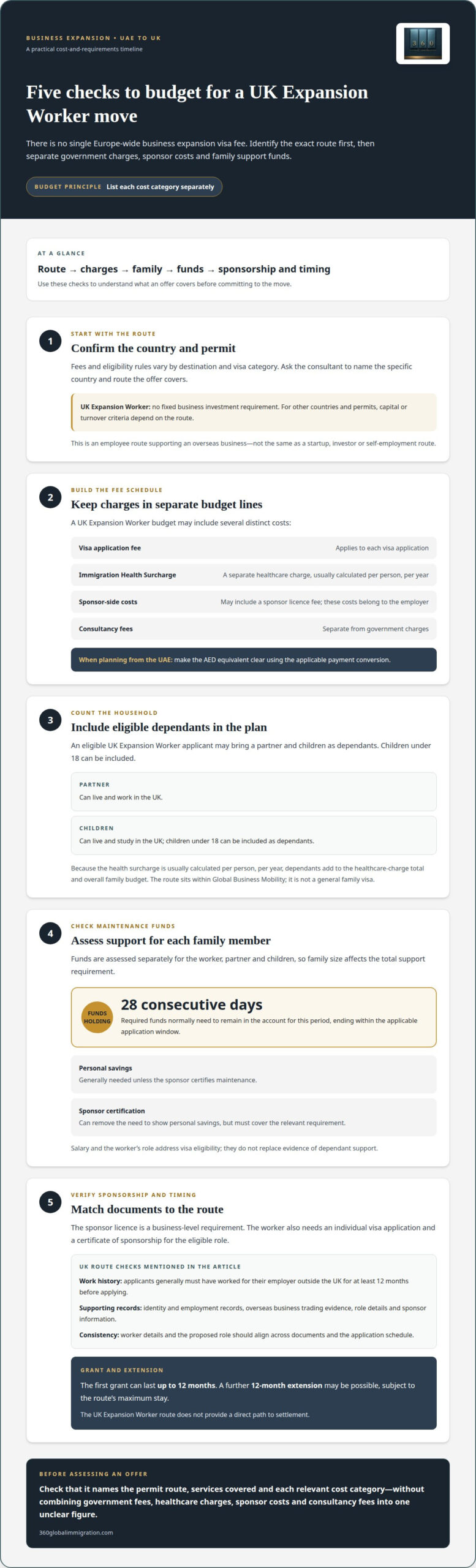
For a UK Expansion Worker application, budget separately for the visa application, the Immigration Health Surcharge and any sponsor-side costs. The surcharge is a distinct healthcare charge, not part of the application fee. As the required amounts are charged under UK rules, a UAE budget should identify each charge clearly and show its AED equivalent using the applicable payment conversion. A typical processing time for this application is 3 weeks as of October 2026.
Italy’s decreto flussi allows 497,550 non-EU worker entries over 2026 to 2028. This is a quota for worker entries, not a European business-expansion visa fee or a guarantee of a place. For an employer application, professional advisers coordinate the employer’s case, worker information and supporting documents against the relevant quota process, then align the visa stage with the resulting employment documentation.
For a European business visa from the UAE, a professional gathers the applicant’s identity and employment records, the overseas business’s trading evidence, role details and sponsor information. The precise document set follows the selected country and permit. For the UK Expansion Worker route, the employer must provide a certificate of sponsorship. UK Visas and Immigration says applicants generally must have worked for their employer outside the UK for at least 12 months before applying.
Timing depends on the route and when the sponsor completes its part. A professional can coordinate the certificate of sponsorship with the application schedule, check that the worker’s details and proposed role are consistent across documents, and organise the submission sequence. This matters because a certificate is required for the UK route, while Italy’s quota process follows a different, employer-led framework. Separating the fee schedule, healthcare charge and document timeline into distinct budget lines makes an offer easier to assess.
Dependants and maintenance funds
Family eligibility and support-fund rules depend on the destination and visa category. The UK Expansion Worker route offers a clear example for UAE-based employees planning to move with family.
Family members and dependants
On the UK Expansion Worker route, an eligible applicant may bring a partner and children as dependants. Children under 18 can be included, and dependants can live, work and study in the UK. This matters when a senior manager or specialist employee is assigned overseas: the family’s planned move, schooling and partner’s work plans can be considered alongside the worker’s assignment. The route is part of Global Business Mobility, not a general family visa.
Maintenance funds and dependant work rights
Maintenance funds show that the applicant and accompanying family can support themselves after arrival. UK Expansion Worker applicants generally need personal savings unless the sponsor certifies maintenance. The required support is assessed separately for the worker, partner and children, so family size affects the total. A dependant partner can work, while children can live and study in the UK. These rights help families decide whether the proposed assignment suits their plans.
For the UK route, required funds normally need to remain in the account for at least 28 consecutive days, with the period ending within the applicable application window. A sponsor’s maintenance certification can remove the applicant’s need to show personal savings, but it must cover the relevant requirement. Salary and the worker’s role address visa eligibility; they are not substitutes for dependant support evidence.
The first UK Expansion Worker grant can last up to 12 months, with a further 12-month extension possible, subject to the route’s maximum stay. That timeframe can shape decisions about a partner’s employment and children’s schooling. A professional assesses family composition, sponsor arrangements and supporting documents together, then aligns them with the selected country’s rules. For guidance on family planning under a business route, consider a dependant eligibility assessment.
Government fees and Immigration Health Surcharge
For a UK Expansion Worker visa, budget for separate government charges rather than one combined payment. These may include the worker’s application fee, the Immigration Health Surcharge and, where relevant, the sponsor licence fee. They are separate from consultancy fees, so list each in its own budget line when planning for a UAE-based business opening a UK branch.
The application fee applies to each visa application, while the Immigration Health Surcharge is usually calculated per person, per year. Dependants therefore add to the healthcare-charge total and the overall family budget. Sponsor costs belong to the employer, not the individual manager. Keep these categories separate when assessing the funds needed for the expansion worker visa, and account for converting the payment currency into AED.
A sponsor licence is a business-level requirement, while the worker’s visa application is an individual immigration step. The sponsor must also assign a certificate of sponsorship for the eligible role. This distinction matters when a UAE company sends an employee to establish a UK branch: approval of the business’s sponsorship arrangements does not itself give the employee permission to travel or work.
The UK Expansion Worker route does not provide a direct path to settlement. A first grant can last up to 12 months, and an extension may add a further 12 months, subject to the route’s maximum stay.
Application weaknesses may include inconsistent role or sponsor details, missing supporting documents, or a mismatch between the proposed work and the expansion plan. Renewal planning should take account of the permitted stay and continued eligibility under the route. Changes to the sponsored role or employment can affect the visa’s basis, so employers should keep sponsorship records and worker information aligned throughout the assignment.
For a UAE company, a professional review can separate applicant charges from sponsor obligations, map the application sequence, and check that the branch plan, role details and supporting documents are consistent. This helps the business understand which government costs apply to its case without confusing them with professional service fees.
Choosing a UAE consultant for European work-permit applications
The right route depends on the company’s expansion model and the employee’s role. A specialist review should connect the eligibility evidence, destination and application scope before setting out an offer. A Europe business expansion visa from UAE is not a single permit, so the consultant should name the country and immigration category.
Eligibility for expansion routes
Eligibility means matching the applicant, employer and proposed activity to a specific immigration category. For the UK Expansion Worker route, the worker must be a senior manager or specialist employee of an overseas business establishing a UK branch or subsidiary. UK Visas and Immigration says applicants generally must have worked for their employer outside the UK for at least 12 months. These criteria help distinguish an employee transfer from a founder-led or self-employment application.
A professional assessment connects the UAE entity’s trading evidence with the role, sponsor arrangements and expansion plan. The consultant’s offer should name the route and explain which documents support each eligibility point. A broad promise of a “European work permit” does not establish whether the case concerns a sponsored worker, startup founder or self-employed applicant. For a Europe business expansion visa from UAE, that distinction clarifies the evidence and work involved.
Countries with business and startup routes
European routes vary by purpose: the UK Expansion Worker route concerns a new branch or subsidiary, while startup and self-employment visas suit different business models. Options include the UK Innovator Founder Visa, Denmark Startup Visa, Netherlands Self Employed Visa, Cyprus Business Residence Visa and Ireland Business Residence Visa. UAE residence alone does not determine eligibility; the applicant’s business plan, role and the route criteria matter.
Tax registration, company formation and local hiring are separate from immigration permission. Requirements depend on the destination, business structure and planned activity, so the written scope should distinguish visa application support from corporate or tax work. This prevents a permit application from being mistaken for permission to trade or a complete local setup. It should also explain what the immigration engagement covers and what falls outside it.
A clear offer identifies the named route, the applicant and employer evidence required, the work covered, government charges and any exclusions. The professional then aligns the proposed documents and application sequence with that route, rather than treating every country as one system. For a focused review of European work-permit options, request an eligibility assessment.
360 Global Immigration
360 Global Immigration helps UAE-based applicants assess business and talent visa pathways for European expansion. When your plans involve founding a venture, self-employment or business residence, the right route depends on your role and intended activity, not simply the wish to enter a particular country.
Available options include France Passeport Talent, UK Innovator Founder Visa, Netherlands Self Employed Visa and Cyprus Business Residence Visa. Guidance can help you identify a pathway that fits your plans and understand which application requirements to prepare for. This is a useful next step if you have narrowed your destination but want a clearer picture of the route and supporting case.
For tailored guidance on your European business visa options, contact 360 Global Immigration.
Move forward with a route that fits your plans
Your next decision is not simply which country to enter. Consider whether your expansion depends on an existing company, a founder-led venture or independent professional work. Matching that purpose to the right immigration category gives your planning a clearer direction. For a Europe business expansion visa from the UAE, consider how your role, business structure and intended activity fit the route before proceeding with your application.
360 Global Immigration supports applicants considering pathways including France Passeport Talent, UK Innovator Founder Visa and Netherlands Self Employed Visa. The appropriate option depends on your circumstances and the immigration objective you are pursuing. A focused discussion can help turn your business plans into a clearer understanding of which route to explore next.
Contact 360 Global Immigration for guidance on your European visa options and take your next step with greater clarity.
Frequently Asked Questions
How can a professional help UAE residents apply for a European business visa, and where should the application be submitted?
A professional can help identify a suitable route, review supporting documents and provide visa application assistance. The application is submitted through the channel designated for the selected country and visa, rather than through one Europe-wide system. For example, a UAE resident planning a founder-led venture needs a route assessment distinct from an employee transfer. 360 Global Immigration offers immigration consultation, document verification and guidance for relevant business and talent pathways.
What minimum investment, business capital, or turnover is required by country?
The UK Expansion Worker route has no fixed business investment requirement. For other countries, capital or turnover criteria depend on the specific permit.