The €50,000 capital requirement for the Ireland STEP might appear more demanding than Denmark’s self-sufficiency thresholds, yet for many founders, this financial commitment buys a level of predictability that an innovation score cannot always guarantee. Deciding between the Denmark Startup Visa vs Ireland STEP is about more than just geography; it’s a choice between two distinct philosophies of European market entry. We understand that as a UAE-based entrepreneur, you aren’t just looking for a permit. You’re seeking a stable environment where your business can scale and your family can eventually secure permanent residency without the stress of shifting regulatory goalposts.
This comparison offers a definitive look at both pathways to help you choose the most strategic gateway for 2026. You’ll gain a clear understanding of Ireland’s High Potential Start-Up metrics versus the Danish expert panel’s rigorous focus on sustainability and deep tech. We will break down the financial requirements, approval nuances, and the long-term path to citizenship for both nations. By the end of this guide, you’ll have the confidence to select a residency pathway that aligns with your available capital, your specific industry, and your vision for a secure future in the European Union.
Key Takeaways
- Identify whether your business model aligns better with Denmark’s focus on high-growth innovation or Ireland’s emphasis on capital-backed scalability.
- Gain clarity on the financial thresholds, including Ireland’s €50,000 funding requirement and Denmark’s specific self-sufficiency levels for UAE-based families.
- Compare the Denmark Startup Visa vs Ireland STEP to understand which evaluation body is more likely to approve your specific industry niche.
- Discover the strategic advantages of each location, from Denmark’s sustainability-driven ecosystem to Ireland’s status as a stable, English-speaking tech hub.
- Map out your long-term residency goals by comparing the timelines and requirements for permanent settlement in both European jurisdictions.
The European Startup Landscape: Why Denmark and Ireland Lead in 2026
For UAE-based founders, the decision to expand into Europe in 2026 represents a pivotal shift toward global scalability. While the UAE offers a robust launchpad, the European Union provides access to a unified market of over 450 million consumers. Securing a foothold here isn’t just about residency; it’s about institutional stability and operational reach. Two programs have emerged as the premier choices for those seeking a Self-employment visa (startup visa): the Startup Denmark Scheme and the Ireland Startup Entrepreneur Programme (STEP).
Choosing between the Denmark Startup Visa vs Ireland STEP requires a deep understanding of how each nation evaluates “talent” versus “capital.” These pathways aren’t designed for passive investors. They are rigorous, merit-based systems that demand active participation and genuine innovation. Navigating these shifting 2026 regulatory environments can feel overwhelming. This is where professional consultancy becomes essential, acting as a protective navigator to ensure your business plan meets specific national criteria before you commit significant resources.
Denmark: The Innovation Powerhouse
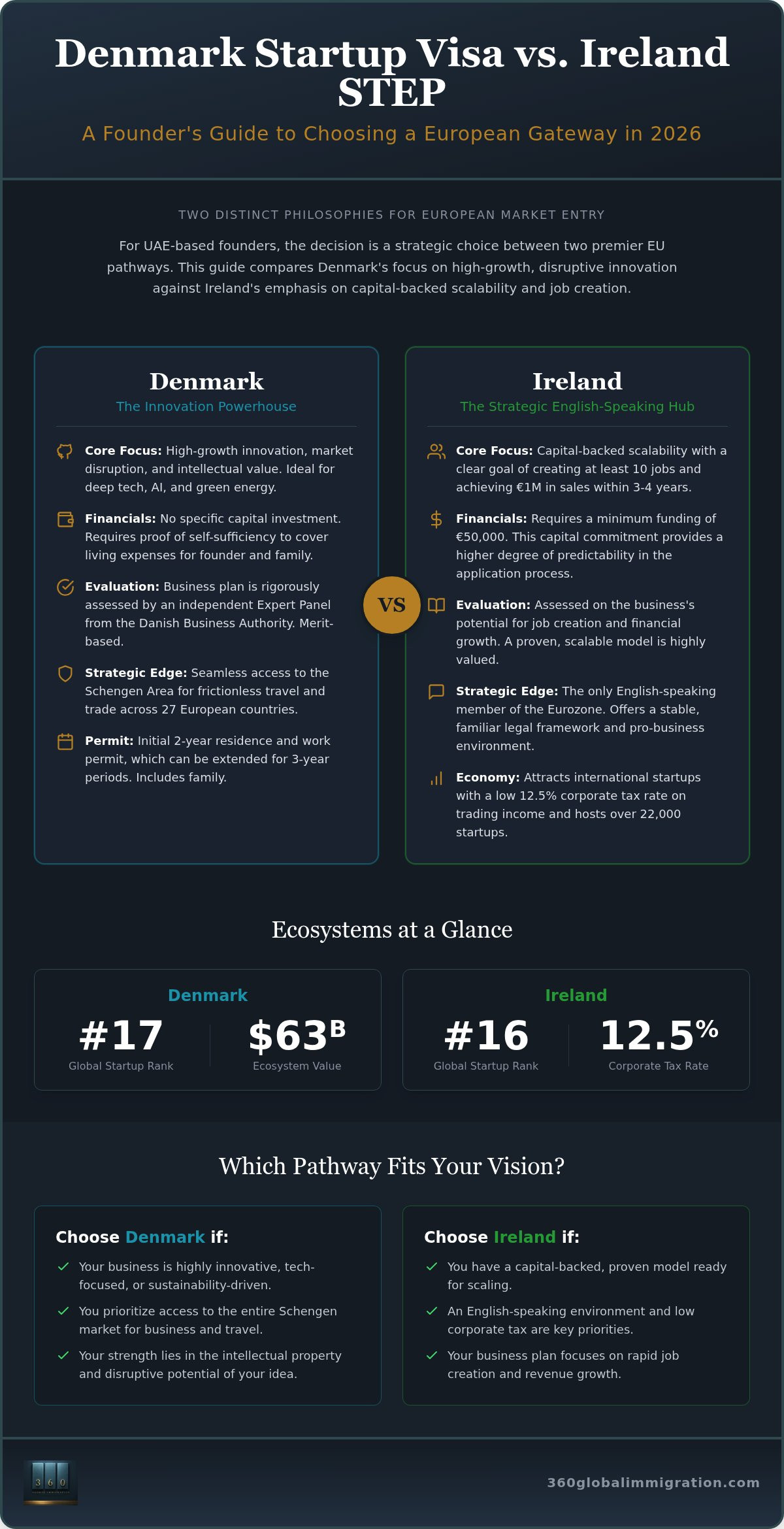
Denmark currently holds the #17 spot in the Global Startup Ecosystem Index 2026, making it a formidable leader in Western Europe. Its ecosystem, valued at approximately $63.56 billion, is particularly attractive for founders in deep tech, AI, and green energy. Beyond the statistics, Denmark offers seamless market access to the Schengen Area. This allows for frictionless travel and trade across Northern Europe, providing a logical base for businesses that prioritize high-growth innovation and sustainable practices. The Danish government actively supports this growth through R&D tax incentives, ensuring that the Denmark Startup Visa vs Ireland STEP debate remains a top priority for tech-centric entrepreneurs.
Ireland: The Strategic English-Speaking Hub
Ireland offers a distinct strategic advantage as the only English-speaking member of the Eurozone in 2026. This unique position makes it the primary “Gateway to Europe” for founders who want to avoid language barriers while benefiting from a pro-business environment. With a corporate tax rate of 12.5% on trading income, Ireland remains a magnet for international startups. It currently ranks #16 globally, slightly ahead of Denmark in ecosystem maturity, and hosts over 22,000 startups. For a UAE founder, Ireland provides a stable, familiar legal framework paired with explosive growth potential. The Ireland STEP specifically rewards businesses capable of creating at least 10 jobs, making it ideal for those with a proven, scalable model and the necessary capital to back it.
The Denmark Startup Visa: A Pathway for High-Growth Innovation
The Start-up Denmark scheme is an innovation-first residency pathway that grants residence and work permits to non-EU entrepreneurs with the potential to build high-growth, scalable businesses. Unlike programs that prioritize a specific liquid investment amount, Denmark focuses on the intellectual value and market disruptiveness of your concept. This distinction is a primary factor when founders weigh the Denmark Startup Visa vs Ireland STEP, as Denmark seeks builders who can contribute to its reputation as a global tech leader. It’s a merit-based system that rewards those who can demonstrate a clear path to international expansion.
The gatekeeper for this program is an independent Expert Panel appointed by the Danish Business Authority. They evaluate your business plan based on its growth potential and contribution to the Danish economy. Once you clear this hurdle, you apply for a residence and work permit through the Danish Agency for International Recruitment and Integration (SIRI). Successful applicants receive an initial two-year permit, which can be extended for three-year periods thereafter. For UAE-based founders, the ability to include a spouse and dependent children in the application provides a secure foundation for a new life in Northern Europe, offering access to world-class social services from day one.
Core Eligibility and the Innovation Threshold
To qualify, your business must offer something truly new to the Danish market. Traditional retail, restaurants, or standard consultancy services aren’t considered innovative under this scheme. The authorities look for scalability, the potential for international expansion, and a clear path toward job creation. You must also prove you can support yourself during the first year. In 2026, the self-sufficiency requirement for a single applicant is DKK 153,240, while founders relocating with a spouse must demonstrate DKK 306,480 in available funds. These figures ensure you can focus entirely on your startup’s growth without financial strain.
The Application Journey from the UAE
The journey begins with the submission of a detailed business plan to the Expert Panel. This document must go beyond a standard pitch deck; it needs to address specific Danish market gaps and technical feasibility. A common pitfall is submitting a plan that is too generic or lacks a localized strategy. Our experts offer specialized guidance on business plan alignment to ensure your application stands out. Once the panel grants approval, the subsequent SIRI application focuses on your personal background and financial standing. Precision at the panel stage is what ultimately determines your success in the Denmark Startup Visa vs Ireland STEP selection process.
The Ireland STEP: Capitalizing on Business Stability
Ireland has cemented its position as the primary EMEA headquarters for global tech giants, offering a unique blend of Eurozone access and a familiar English-speaking environment. For non-EEA founders, the Start-up Entrepreneur Programme (STEP) serves as a sophisticated gateway into this thriving ecosystem. While the Danish model focuses heavily on the “innovation” score of a concept, the Irish approach prioritizes business stability and the founder’s ability to scale. When weighing the Denmark Startup Visa vs Ireland STEP, entrepreneurs who possess significant initial capital often find the Irish framework provides a more predictable path to residency.
The cornerstone of a successful STEP application is a minimum funding requirement of €50,000. This capital must be unencumbered, fully transferable, and ready for deployment into the Irish startup. Unlike other visa categories that restrict activity, successful STEP applicants receive Stamp 4 permission. This status allows you to live and work in Ireland without the need for a separate employment permit, providing the operational freedom required to manage a growing enterprise. It’s a high-level residency permission that reflects Ireland’s commitment to attracting serious, growth-oriented business leaders.
The ‘High Potential Start-Up’ (HPSU) Criteria
Ireland targets High Potential Start-Ups (HPSUs) that can compete on an international stage. To meet this threshold, your business must be innovative, export-oriented, and capable of creating at least 10 jobs in Ireland within three to four years. The Evaluation Committee, comprising experts from Enterprise Ireland and the Department of Justice, meticulously reviews every proposal. For UAE residents, this process requires a bespoke approach to documentation. You’ll need to provide comprehensive financial proof and character references from recognized authorities to demonstrate both the project’s viability and your own professional standing.
Timeline to Permanent Residency and Citizenship
Ireland’s residency structure is designed for long-term security, following a 2+3+5 year permit structure. You receive an initial two-year grant, followed by a three-year renewal, which leads to eligibility for long-term residency after five years of continuous residence. When evaluating the Denmark Startup Visa vs Ireland STEP for family security, Ireland offers a distinct advantage in speed. While Denmark typically requires eight years for permanent residency, Ireland allows for naturalization and citizenship after just five years of reckonable residence. This timeline is notably efficient, even when compared to the France Passeport Talent, making Ireland a premier choice for founders who prioritize a fast and stable path to an EU passport.
Denmark vs. Ireland: The Head-to-Head Comparison
The core of the Denmark Startup Visa vs Ireland STEP decision lies in a fundamental trade-off: do you have a revolutionary tech concept or a solid, capital-backed business plan? Denmark’s expert panel prioritizes the “what” and “how” of your technology, looking for disruptive potential that can redefine markets. In contrast, Ireland’s evaluation committee focuses on the “how much” and “how many jobs,” seeking proof of stability and immediate scalability. In 2026, approval rates remain high for both, but the administrative journey favors those who align their strengths with the specific priorities of their chosen nation.
Living in Copenhagen offers a quintessential Nordic experience where English proficiency is nearly universal, yet the local language remains a key factor for long-term integration and permanent residency. Dublin, as a native English-speaking hub, provides a lower barrier for immediate cultural and professional networking. For the global traveler, the choice presents a logistical dilemma. Denmark grants you seamless access to the Schengen Area, allowing for frictionless business travel across most of Europe. Ireland, while not in Schengen, participates in the Common Travel Area, offering unique and simplified access to the United Kingdom’s markets and professional networks.
Financial and Administrative Comparison
The financial entry points differ in both amount and purpose. Ireland requires a hard minimum of €50,000 in unencumbered funding for the startup itself. Denmark requires proof of self-sufficiency for your first year, which in 2026 stands at DKK 153,240 for a single founder. Administratively, Denmark’s panel review typically takes 6 to 8 weeks, followed by a SIRI processing window. Ireland’s committee meets quarterly, meaning your application timing can significantly impact your total wait time, which often averages 3 to 4 months. To maintain residency in either country, you must generally remain in-country for at least 183 days per year, though Ireland occasionally shows more flexibility for founders engaged in international export activities.
Market Access and Business Growth Potential
Denmark serves as a strategic gateway to the affluent Nordic consumers and the broader EU Single Market, making it ideal for sustainability and deep-tech firms. Ireland acts as a bridge between the EU, the UK, and North American markets, which is a significant advantage for service-based or export-heavy startups. While Ireland maintains a competitive 12.5% corporate tax on trading income, Denmark offers a 22% rate supported by extensive R&D incentives for 2026 startups. Choosing the right path requires a precise match between your business model and these national frameworks. If you are unsure which criteria your business meets, you can compare your eligibility with our expert team to ensure a successful application.
Strategic Decision: Which Residency Pathway Fits Your Vision?
Selecting the right pathway is a matter of aligning your operational reality with your long-term family objectives. The Denmark Startup Visa vs Ireland STEP comparison often distills down to the nature of your assets. If your primary asset is a disruptive, tech-heavy intellectual property, Denmark’s ecosystem is built to accelerate your growth. However, if your vision involves a service-based model with clear export potential and you have the €50,000 liquid funds required for STEP, Ireland offers a more direct and capital-centric route. Both nations provide a secure environment, yet the “best” choice depends on whether you prioritize immediate market stability or radical innovation.
Founders must also look beyond the initial move. If your primary objective is the fastest possible path to EU citizenship, Ireland’s five-year naturalization timeline is difficult to beat. If your focus is deep integration into the Nordic market and the Schengen Area’s frictionless travel, Denmark remains the superior choice despite the longer eight-year residency requirement. 360 Global Immigration acts as your protective navigator throughout this process, de-risking your application by ensuring every document meets the exacting standards of European authorities. We handle the heavy lifting so you can focus on building your business.
A 5-Step Framework for UAE Founders
To ensure a seamless transition from the UAE to Europe, we recommend a methodical approach to your application. This structured flow minimizes errors and builds a compelling case for residency:
- Conduct a pre-eligibility assessment: Evaluate your business model against the specific “Innovation” vs. “Capital” thresholds of both programs.
- Align your business plan: We help you tailor your strategy to meet the national economic goals of either Denmark or Ireland.
- Prepare financial documentation: Gather proof of funds and character references that meet both UAE banking standards and EU regulatory requirements.
- Submit with professional representation: Present your case to the respective evaluation panels with a bespoke, polished narrative.
- Secure residency: Once approved, we guide you through the final SIRI or Irish Department of Justice filings to begin your relocation.
Why Professional Consultancy is Non-Negotiable
The cost of a visa rejection goes far beyond the loss of application fees; it involves lost time, wasted capital, and potential complications for future European visa eligibility. Our role is to provide a safe harbor for founders navigating these complex legal transitions. We specialize in business plan alignment, ensuring that your vision is translated into a language that government panels understand and reward. By choosing a partner who understands the nuances of the Denmark Startup Visa vs Ireland STEP, you secure your family’s future with confidence. Book a consultation with 360 Global Immigration today to begin your journey toward a European residency that fits your vision.
Secure Your Global Ambitions in Europe
Choosing between the Denmark Startup Visa vs Ireland STEP is a defining moment for your business and your family’s future. You now understand that Denmark rewards disruptive innovation through its expert panel, while Ireland offers a stable, English-speaking hub for those with the capital to scale rapidly. Both pathways provide a secure gateway to the European market; however, the right choice depends on your specific business model and long-term residency goals. Whether you prioritize Schengen access or a faster path to citizenship, your decision should align with your 2026 growth strategy.
360 Global Immigration specializes in UAE-to-Europe business relocation, providing bespoke business plan development and end-to-end application management. We offer expert guidance for the UK, Ireland, and Denmark startup pathways, acting as your protective navigator through these complex legal systems. Secure Your European Business Future with 360 Global Immigration and take the first step toward a thriving international legacy. The journey toward a new life in Europe is a significant transition, but with the right partner, it’s a path paved with clarity and success.
Frequently Asked Questions
Can I apply for the Denmark Startup Visa if my business is already registered in the UAE?
Yes, you can apply even if your business is currently registered in the UAE. The Danish Expert Panel evaluates the innovative nature of your concept rather than where it originated. While your UAE-based operations serve as a valuable proof of concept, you’ll be required to incorporate a new entity in Denmark once your application is approved. This allows you to scale your existing success into the European Union’s regulatory framework.
What is the minimum investment required for the Ireland STEP in 2026?
For 2026, the minimum funding requirement for the Ireland STEP remains at €50,000. This capital must be unencumbered and ready for deployment into your Irish startup. If your venture involves multiple founders, each additional principal applicant must demonstrate an additional €30,000 in funding. This financial threshold ensures that your business has the necessary liquidity to meet the High Potential Start-Up metrics required by Irish authorities.
Do I need to speak Danish or Irish to qualify for these residency programs?
You don’t need to speak Danish or Irish to qualify for the initial residency permits. Business in both ecosystems is primarily conducted in English. However, long-term goals like permanent residency in Denmark require passing a Danish language test after eight years. In contrast, Ireland’s five-year path to citizenship is particularly attractive for UAE residents because it doesn’t currently impose a language examination, as English is already the primary language of the state.
Can I bring my family with me on the Denmark Startup Visa or Ireland STEP?
Yes, both pathways are designed to keep families together during the relocation process. You can include your spouse and dependent children under 18 in your application. When choosing between the Denmark Startup Visa vs Ireland STEP, it’s important to note that Denmark requires proof of higher self-sufficiency funds for families. For instance, a founder with a spouse must show DKK 306,480, while Ireland focuses on the €50,000 business investment for the primary applicant.
How long does it take to get a decision on a Denmark Startup Visa application?
A decision typically takes between three and four months in total. The process begins with the Danish Expert Panel, which usually delivers a verdict on your business plan within 6 to 8 weeks. Following their approval, the Danish Agency for International Recruitment and Integration (SIRI) takes approximately 1 to 2 months to process your residence and work permit. We ensure your documentation is meticulously prepared to avoid delays during these critical windows.
What happens if my business fails after I receive my residency permit?
Both countries require you to be actively involved in your business to maintain your residency status. If your startup fails, you’re legally obligated to inform the immigration authorities. While your permit is tied to the business, both jurisdictions may allow a period of transition or the opportunity to apply for a different permit type. We act as your protective navigator to help you manage these complexities and protect your family’s future if market conditions shift.
Is the Ireland STEP a direct path to an Irish passport?
The Ireland STEP provides a clear and reliable path to naturalization and an Irish passport. After maintaining reckonable residence for five years on a Stamp 4 permit, you become eligible to apply for Irish citizenship. This is significantly faster than the eight-year residency requirement in Denmark. For founders who prioritize securing an EU passport for their family, the Irish program offers one of the most efficient timelines in the Eurozone.
Which program has a higher approval rate for founders from the UAE?
Approval rates depend heavily on whether your business is innovation-led or capital-led. Ireland tends to have a more predictable approval rate for UAE founders who can clearly demonstrate the €50,000 funding and the potential to create 10 jobs. Denmark’s approval is strictly tied to the Expert Panel’s view of your technology’s disruptiveness. Comparing the Denmark Startup Visa vs Ireland STEP reveals that Ireland often provides a more certain outcome for established businesses with liquid capital.