
Could a strong business idea still fall short if it doesn’t meet Denmark’s startup criteria? For UAE founders, the Startup visa Denmark requirements for UAE applicants involve two distinct checks: the business must satisfy the expert panel, and the founder must meet the residence-permit requirements. A compelling pitch alone may not be enough.
It’s understandable to be unsure whether your venture is innovative and scalable enough, how the approval stages fit together, or which documents need translation or authentication. Clarifying these points early can help you assess eligibility and identify gaps before investing time and resources in an application.
This checklist explains the key business and founder criteria, outlines the sequence from expert-panel assessment to the SIRI residence and work permit application, and highlights financial evidence and document-preparation issues to verify from the UAE. Requirements can depend on your circumstances, so confirm the current rules before filing. Tailored immigration guidance may help you organize a thorough, evidence-based application, but it cannot guarantee approval.
Key Takeaways
- Check your nationality and immigration circumstances separately from whether your startup meets Denmark’s business criteria. UAE residence alone doesn’t establish eligibility.
- Use the Startup visa Denmark requirements for UAE checklist to assess whether your business plan clearly presents innovation, market opportunity, growth potential, and your active founder role.
- Distinguish expert-panel approval of the business idea from the later residence-and-work permit decision.
- Organize business evidence and personal immigration documents separately, then verify the translation, certification, and submission rules that apply to your case.
- Identify evidence gaps and confirm current requirements before preparing your application. Tailored consultancy may help organize a complex submission, but cannot guarantee an outcome.
Denmark Startup Visa requirements for UAE founders: start with the eligibility checklist
Begin with two separate checks: your personal eligibility and your business’s eligibility. Living in the UAE, owning a UAE company, or holding UAE residence does not by itself qualify you for Start-up Denmark. The route is for self-employed entrepreneurs who are not citizens of the EU, EEA, or Switzerland and want to establish and actively run an innovative, scalable business in Denmark. Confirm the current criteria and instructions with the relevant Danish authorities before preparing an application.
- Founder: Check your nationality and immigration circumstances, not only your UAE residence status.
- Business: Assess whether the concept can demonstrate innovation, growth potential, and commercial viability.
- Role: Be prepared to show that you will be actively involved in running the venture.
- Process: Keep in mind that business approval and a residence permit are separate decisions.
Who can apply from the UAE?
Eligibility generally depends on whether you are a non-EU, non-EEA, and non-Swiss citizen, rather than where you currently live. If you are a UAE resident with another nationality, check how that nationality affects eligibility and follow the submission instructions that apply to your circumstances. Verify any nationality-specific requirements with the relevant Danish authority. Neither UAE residence nor existing company ownership automatically establishes eligibility.
Does your startup fit the programme?
Check whether your proposal explains what is innovative about the product, service, or business model; who the customers are; how the venture could earn revenue; and how it might grow beyond a small, locally dependent operation. A conventional consultancy or lifestyle business may need especially clear evidence of innovation and scalability. Ordinary trading models also warrant careful scrutiny: restaurants, retail shops, small trade, and import/export businesses are generally not eligible under the programme. The business is assessed on its specific merits, so don’t assume that a label alone determines the outcome.
The Startup visa Denmark requirements for UAE involve more than a founder’s location or company registration. Up to three people can apply together with a joint business plan, but each founder should understand their proposed role and contribution. For wider context on the country’s immigration framework, see Immigration to Denmark; use Danish programme guidance to verify specific eligibility rules. For a broader overview of the route, consult the Denmark Startup Visa for international founders guide.
Self-assessment
- Does your nationality meet the programme’s applicant criteria?
- Can you explain the venture’s innovation, target market, revenue logic, and growth potential with evidence?
- Will you take an active role in establishing and operating the Danish business?
- Have you checked whether your business model falls within a category that is generally not eligible?
If any answer is unclear, treat it as a point to verify before committing to the application process. A tailored review can help identify evidence gaps, but it cannot guarantee a decision.
What Denmark Startup Visa reviewers assess: business plan, innovation, and founder role
After considering basic eligibility, show why the business merits approval. The Start-up Denmark expert panel assesses the business concept before the separate residence-and-work permit application is handled by the Danish Agency for International Recruitment and Integration (SIRI). Panel approval is not a visa decision. Check the current criteria and process on the official Start-up Denmark scheme page before relying on any checklist.
Your business plan should connect the key details: what you offer, which customers need it, how the venture could earn revenue, and what supports its potential to scale. The Startup visa Denmark requirements for UAE founders are not met simply by describing an idea as innovative or promising. Reviewers need a clear explanation supported by evidence, not ambition alone.
How to demonstrate innovation and scalability
Start with the customer problem, then explain how your solution differs from existing options and why that difference matters. Support market assumptions with relevant research, customer interviews, pilot results, or other evidence you can substantiate. Set realistic growth milestones and explain the commercial steps and resources needed to reach them. Technology, a novel concept, or plans to sell internationally may strengthen a case, but none should be treated as automatic proof of innovation or scalability.
How founders should explain their contribution
Set out each founder’s responsibilities, relevant experience, and expected operational role. Explain who leads product development, customer acquisition, delivery, or other essential work. Check that those roles align across the business plan and application forms. Current programme information allows team applications with a joint plan, but verify the permitted founder limit and any conditions against official guidance before filing.
The table below is a preparation aid, not a substitute for the panel’s assessment. Verify each criterion and process detail against current Danish guidance.
| Assessment area | Evidence to prepare | Verify before applying |
|---|---|---|
| Innovation | Clear description of the solution, what differentiates it, and how that difference addresses a customer need. | How the current programme defines and evaluates innovation. |
| Market and commercial logic | Target-customer research, evidence of demand, revenue model, and realistic growth milestones. | Current business-plan criteria and any requested supporting material. |
| Founder contribution | Responsibilities, relevant experience, and a consistent account of each founder’s active role. | Current team-application rules, founder limit, and application sequence. |
Before submission, look for unsupported demand, unclear differentiation, optimistic growth forecasts, or overlapping founder responsibilities. Each can weaken the proposal’s logic. If you’d value help checking how your evidence fits together, 360 Global Immigration’s Denmark Startup Visa guidance may help you organize the application. No adviser can guarantee the panel’s decision.
Startup Denmark approval versus a Danish residence permit: what UAE applicants must know
A business concept can pass assessment without automatically securing permission to live and work in Denmark. Start-up Denmark has two distinct stages: the business proposal is assessed first, then the founder applies for a residence and work permit. The Startup Denmark expert panel, appointed by the Danish Business Authority, assesses the business idea. SIRI handles the subsequent permit application. Confirm the current sequence and instructions on the Start-up Denmark official requirements page before taking action.
| Stage | Decision and focus | What it does not establish |
|---|---|---|
| Business assessment | The expert panel considers whether the proposed business meets the programme’s criteria. | It is not a residence-permit decision and does not remove the need to apply to SIRI. |
| Residence-and-work permit | SIRI considers the applicant’s permit application and supporting information under current immigration requirements. | A promising business or panel approval alone does not confirm that the permit will be granted. |
What happens after a startup proposal is assessed?
If the business idea is approved, the next step is the residence-and-work permit application to SIRI. Follow the application route and submission instructions in force for your case, including any requirements about how and when to provide information. Don’t treat an expert-panel decision as permission to relocate, work, or begin operating in Denmark. Each stage has its own assessment and outcome.
What can affect the residence-permit application?
Prepare to provide the requested identity and travel-document details, complete the correct application form, and submit supporting evidence in the format specified by the authorities. Applicants must also document sufficient funds for their circumstances. Check the current financial evidence rules rather than relying on an old checklist or an amount quoted for another applicant category.
For UAE-based founders, document requirements may depend on nationality and individual circumstances. Before arranging translations or authentication, verify whether your documents need them and which submission method applies. Keep names, dates, business details, and founder roles consistent across the business proposal, personal documents, and permit application. Small discrepancies can prompt avoidable requests for clarification.
The Startup visa Denmark requirements for UAE applicants include both a business assessment and an immigration application. Fees, processing times, financial thresholds, permit duration, and extension rules can change. Confirm the current details directly with Danish authorities before filing or making plans based on a particular timeline. A strong proposal matters, but it does not replace the personal eligibility and documentation checks required at the permit stage.
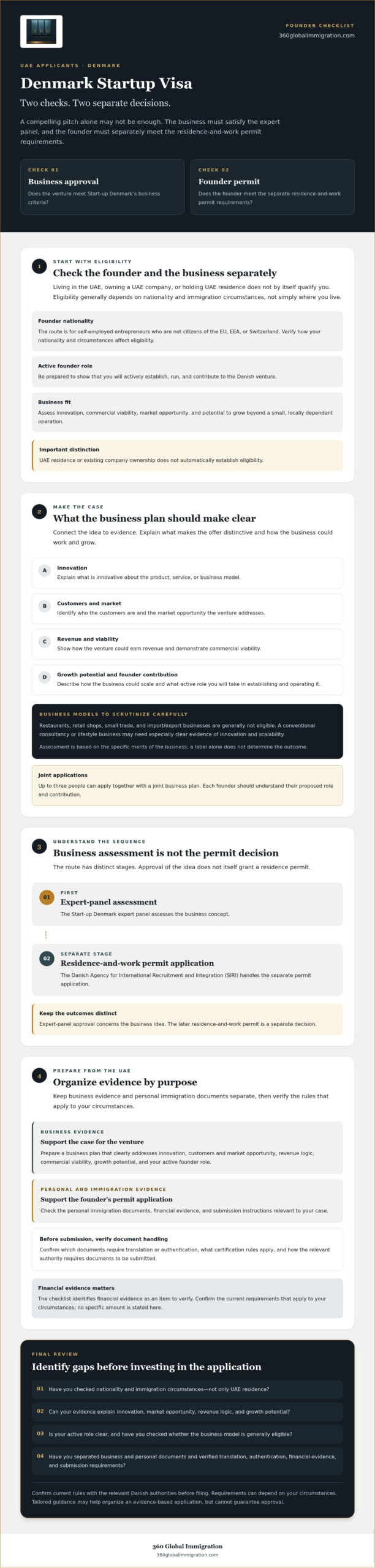
UAE-to-Denmark application checklist: documents, translations, and submission
A well-organized application makes it easier to show how your business evidence supports the proposal and how your personal documents meet the permit-stage requirements. The Startup visa Denmark requirements for UAE founders can vary with nationality and individual circumstances, so use this checklist to prepare, then confirm the current official instructions for your application route. This is a preparation aid, not a complete official document list.
Organize business and founder evidence
Keep business materials together and connect each item to a specific point in your proposal. A clear evidence trail is more useful than a large, unstructured collection of files.
- Business plan: Set out the concept, customer problem, target market, revenue model, and growth rationale.
- Market support: Include relevant research and credible customer or pilot evidence that supports demand and commercial assumptions.
- Ownership and team details: Document the proposed ownership structure and identify each founder’s responsibilities, experience, and expected operational contribution.
- Supporting records: Gather material that substantiates key claims, such as product development, customer interest, or partnerships, where relevant to your case.
- Consistency check: Compare names, dates, company information, financial assumptions, and founder roles across the plan and supporting documents. Resolve discrepancies before submission.
For a broader explanation of the stages, refer to the Denmark Startup Visa for international founders guide as you prepare your file.
Check UAE-held documents before submission
Prepare personal immigration documents separately from business evidence. Confirm the current requirements for your passport or other travel document, proof of residence status where relevant, application form, and supporting records. Don’t assume UAE residence means every applicant follows the same procedure. Instructions may depend on nationality and circumstances.
Check each document’s required format, translation, certification, and authentication with the relevant Danish authority before arranging services. Danish guidance states that documents not in English, German, Norwegian, Swedish, or Danish must be accompanied by certified translations into Danish or English. Verify how that rule applies to your documents and whether additional formalities are needed.
Before making plans, confirm the correct submission channel and whether your route requires an appointment, biometrics, or an in-person step. Keep digital and paper copies, and use a tracker to record each item’s status, translation, and submission instructions. For help organizing a Denmark Startup Visa application from the UAE, request guidance on your application documents.
Your next steps: assess eligibility and prepare a stronger Denmark Startup Visa application
Turn the checklist into a sequence. First, assess your nationality and founder eligibility. Next, test whether your evidence supports the business case. Then verify current rules with Danish authorities before preparing the submissions. This order helps surface gaps early, before you commit to document preparation or rely on assumptions about the process.
- Assess eligibility: Confirm that your circumstances fit the current applicant criteria and that your proposed business is suitable for assessment.
- Validate the evidence: Check that you can substantiate innovation, customer need, revenue assumptions, and realistic growth potential.
- Clarify founder roles: Make sure each founder’s responsibilities and active contribution are clear and consistent throughout the application materials.
- Verify the rules: Check current forms, supporting documents, financial evidence, translations, and submission instructions with the relevant Danish authorities.
- Prepare the submission: Organize business and personal documents separately, resolve inconsistencies, and use the current instructions for each stage.
Look for specific weaknesses rather than relying on a general sense that the application is “complete.” For example, a plan may describe an innovative product without showing which customer problem it solves, or forecast expansion without explaining how it will reach new customers. Founder experience may be strong while responsibilities remain vague. A document tracker can also reveal missing translations, outdated records, or mismatched company details.
When professional application guidance may be useful
Individual guidance may be useful if eligibility is unclear, several founders have different roles, or the business structure is difficult to explain consistently. 360 Global Immigration offers guidance on Denmark Startup Visa applications as part of its business and talent-based residency services. The consultancy can help with application preparation, but it cannot decide on behalf of Danish authorities or guarantee an outcome. Readers comparing entrepreneur pathways can also explore the firm’s related entrepreneur-visa assistance information.
A clear action plan for UAE-based founders
Before submitting, confirm the latest criteria and application instructions directly with the relevant Danish authorities. Finalize a coherent business case, check that every key claim has support, and organize personal documents according to the rules that apply to your nationality and circumstances. Recheck document format, translation, and any authentication requirements before sending anything.
If you’re ready to discuss tailored preparation, discuss Denmark Startup Visa application support. Consultancy guidance is optional, and government application fees are separate from consultancy fees. Approval remains a decision for the Danish authorities.
Take the next step with a clear application plan
The Startup visa Denmark requirements for UAE involve two separate tests: your business must meet the programme’s criteria, and you must independently satisfy the residence-permit requirements. A well-prepared case links the venture’s innovation and market potential to credible evidence, while keeping founder roles and personal documents consistent.
Verify current rules and submission instructions with Danish authorities before proceeding, especially if your nationality or circumstances may affect document requirements. If you’d like help organizing your application, 360 Global Immigration offers guidance for Denmark Startup Visa applications and other business and talent-based residency pathways. Consultancy support does not guarantee approval, and government fees are separate.
Discuss your Denmark Startup Visa application with 360 Global Immigration and take your next steps with greater clarity.
Frequently Asked Questions
Can UAE residents apply for the Denmark Startup Visa?
UAE residence alone doesn’t determine eligibility for Denmark’s Start-up Denmark programme. Your nationality and immigration circumstances matter, as do the business proposal and current Danish rules. The route is generally for self-employed entrepreneurs who are not citizens of the EU, EEA, or Switzerland. Check whether your circumstances fit the current criteria, then follow the application instructions that apply to your case.
What are the main Denmark Startup Visa requirements for founders applying from the UAE?
The main Startup visa Denmark requirements for UAE founders include a qualifying business concept and a separate application for a Danish residence and work permit. Prepare a credible business plan explaining the idea, market, commercial logic, and growth potential, with evidence to support its claims. You’ll also need personal immigration documents and any required financial evidence. Requirements can depend on your circumstances, so check current Danish guidance before applying.
Does Startup Denmark approval guarantee a residence permit?
No. Approval of the business concept and a residence-permit decision are separate outcomes. The expert panel assesses the proposed business, while the residence and work permit application is handled through the Danish immigration process. You must still meet the applicable immigration requirements, submit the requested evidence, and follow the current procedure. Confirm both stages with official Danish sources before making relocation commitments. Business approval alone doesn’t authorize residence or work.
What should a Denmark Startup Visa business plan include?
A strong plan should explain the business concept, the customer problem it addresses, its target market, revenue model, and potential for growth. Describe what differentiates the solution and explain each founder’s role in establishing and operating the venture. Support important claims with relevant market research or customer evidence rather than broad assertions. Compare the plan with current Start-up Denmark assessment criteria, and verify the required format before submission.
Do UAE documents need translation or attestation for a Denmark Startup Visa application?
It depends on the document, its language, and your circumstances. Danish guidance says documents not in English, German, Norwegian, Swedish, or Danish must be accompanied by certified translations into Danish or English. Check current instructions for any additional certification, authentication, or submission requirements that apply to your case. Confirm these details before arranging translations, and keep names and dates consistent across identity records, business evidence, and application forms.
How long does the Denmark Startup Visa application take?
There isn’t a guaranteed timeframe. The process includes a business assessment followed, if approved, by a residence-permit application. Timing can depend on each stage, the completeness of your file, and current authority processing. Check official processing information before making plans, and allow time to gather documents, arrange any required translations, and attend appointments if instructed. Avoid relying on old estimates or treating published processing times as a promise for an individual case.
Can a regular small business qualify for Denmark’s Startup Visa?
A business doesn’t qualify simply because it’s new, small, or founder-owned. Start-up Denmark is intended for qualifying innovative and scalable business concepts, so a conventional model may need careful assessment against the current criteria. Traditional businesses such as restaurants and retail shops are generally not eligible, but assess the specific proposal rather than assuming a category alone decides the outcome. Review official guidance and identify evidence of innovation, customer need, and growth potential.