
What makes a Denmark Startup Visa application persuasive is not just a promising idea, but a clear connection between the venture and the founder’s role. For UAE founders, bringing the business proposal and supporting information together can be challenging. A Denmark startup visa consultant can provide practical preparation guidance, without promising approval.
360 Global Immigration provides guidance for the Denmark Startup Visa process. The business plan is assessed by an expert panel first. If it is approved, the founder can then apply to SIRI for a residence and work permit. This article explains what the programme assesses, how to present a connected founder and venture case, and how to organise your preparation from the UAE. The Danish authorities decide whether an application is approved.
Key Takeaways
- Present the founder’s role and venture proposal as one connected case.
- Explain the business problem, solution, market, and operating model clearly.
- A promising idea alone may not be enough; show how the venture and founder fit together.
- Prepare methodically from the UAE by assessing programme fit, organising evidence, and reviewing the application.
- A Denmark startup visa consultant Dubai founders work with can guide preparation, but the Danish authorities make the decision.
Denmark Startup Visa consultant guidance: what the programme is designed to assess
A strong application needs more than an ambitious idea. Under the Start-up Denmark route, the venture proposal and the founder’s intended role are considered as part of the same case. Understanding this connection helps you prepare a clearer application and avoid assuming that registering a company establishes eligibility.
In plain English: Start-up Denmark is a route for eligible founders seeking to develop an innovative, scalable business in Denmark. The business plan is assessed first, followed, if approved, by a separate application for a residence and work permit.
What does the Denmark Startup Visa route mean for founders?
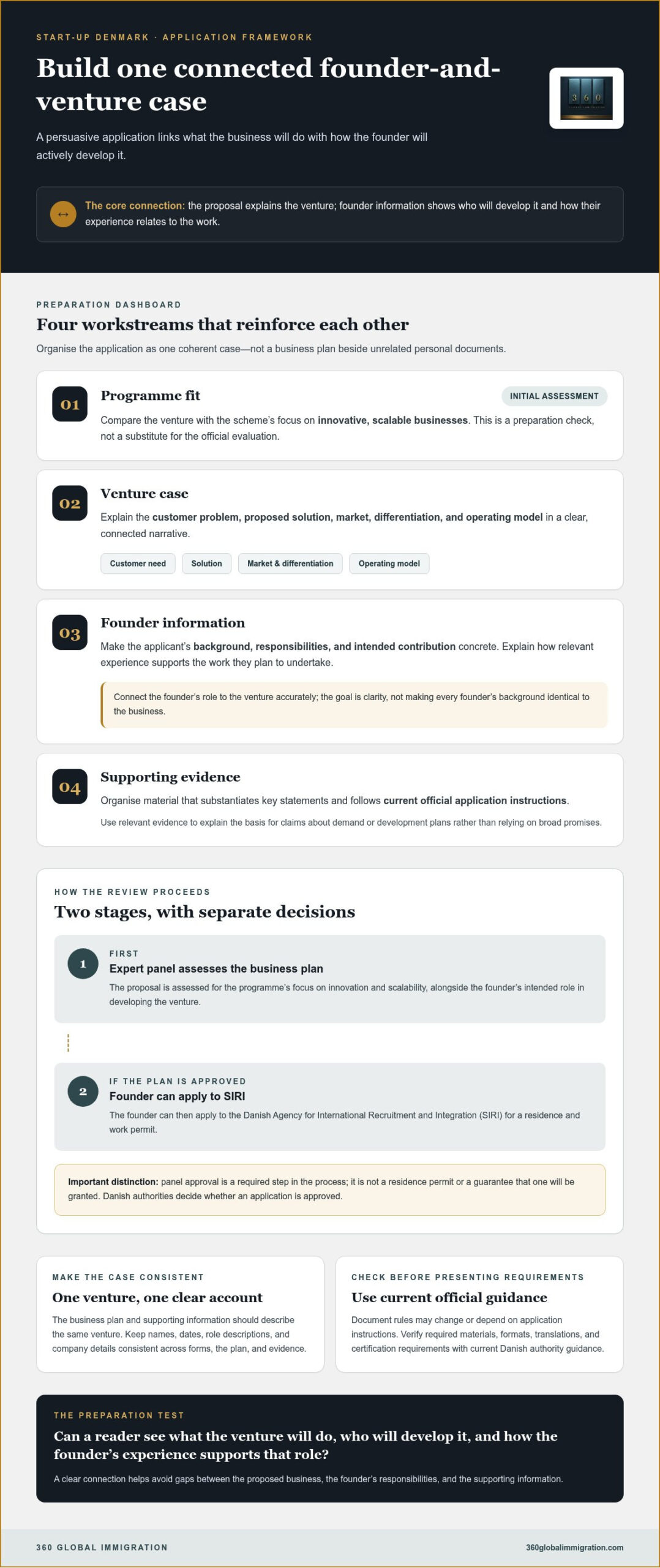
The process has two stages. First, an expert panel assesses the business plan. If the plan is approved, the founder can apply to the Danish Agency for International Recruitment and Integration (SIRI) for a residence and work permit. Panel approval is a required step in this process, not a residence permit or a guarantee that one will be granted. For general background on Denmark’s wider immigration categories, Immigration to Denmark offers context. Check current programme requirements against Danish authority instructions.
The proposal should explain how the business fits the programme’s focus on innovation and scalability. The founder’s role matters too: make clear how the applicant will actively contribute to developing the venture, rather than presenting only an investment or ownership interest. The business case and founder information should support a consistent account of what the company will do and how the applicant will help develop it.
Eligibility and outcomes depend on the rules in force and assessment by the relevant Danish authorities. A promising concept, company registration, or professional advice cannot replace those assessments. Review current programme guidance through Denmark’s official immigration information channels, including New to Denmark.
Why founders seek a Denmark Startup Visa consultant
The process can feel unfamiliar, especially when a business concept needs to be presented in a way that aligns with immigration requirements. A Denmark startup visa consultant Dubai founders work with can help structure the preparation: clarify the venture narrative, identify where the founder’s role needs explanation, and organise supporting materials into a coherent case.
For example, a proposal may describe a useful product but leave the intended customers, operating model, or founder’s responsibilities unclear. Reviewing these elements together can reveal gaps before submission and help ensure that the business plan and supporting information describe the same venture.
360 Global Immigration provides professional guidance for Denmark Startup Visa applicants. The consultancy helps founders approach the process in a structured way, while the expert panel and SIRI retain responsibility for their assessments and decisions.
How the Denmark Startup Visa application connects the founder and business case
Prepare the application as one connected case, not as a business plan beside a separate collection of personal documents. The proposal should explain what the venture will do. Founder information should show who will develop it and how their experience relates to the work. Supporting evidence can substantiate relevant claims across both parts.
A practical preparation framework has four workstreams:
- Programme fit: Compare the venture with the scheme’s current focus on innovative, scalable businesses. Treat this as an initial assessment, not a substitute for the official evaluation.
- Venture case: Explain the customer problem, proposed solution, market, differentiation, and operating model.
- Founder information: Describe the applicant’s relevant background, responsibilities, and intended contribution.
- Supporting evidence: Organise material that substantiates key statements and follows current official application instructions.
These workstreams should reinforce each other. If the plan describes a technical product but the founder’s experience and proposed responsibilities do not explain how they will develop or lead it, important questions may remain unanswered. The goal is not to make every founder’s background identical to the business, but to explain the connection accurately.
Build a clear and evidence-led startup proposal
Start with the customer need. Who experiences the problem, and how does the proposed solution address it? Then explain what distinguishes the offer, how it will reach customers, and what the operating model involves. Specific claims supported by relevant evidence are clearer than broad promises of rapid growth or market leadership.
Instead of simply asserting that demand will be high, explain the basis for that expectation and include relevant evidence where available. Describe development plans in a way that connects the product, intended customers, and delivery approach. Verify current Danish authority guidance before presenting any point as a formal programme requirement.
Prepare the founder’s application information
Make the founder’s role concrete: describe the responsibilities they expect to undertake and how their experience supports those activities. Keep names, dates, role descriptions, and company details consistent across forms, the business plan, and supporting documents. A chronology of education, work, venture development, and relevant milestones can help identify gaps or conflicting details.
Document rules can change and may depend on the application instructions. Check current official guidance for required materials, formats, translations, and certification requirements. Do not assume that a document issued in the UAE follows a particular process without verifying it. A structured review can help you organise the narrative and file. For tailored Denmark Startup Visa application guidance, 360 Global Immigration supports the preparation process, while Danish authorities make the decision.
Does a promising business idea qualify? Addressing the main Startup Visa misconception
An exciting idea can be a starting point, but it does not automatically make a strong Start-up Denmark application. The programme is intended for innovative, scalable businesses, and founders are expected to play an active role in the venture. The proposal needs to make its case clearly, while Danish authorities assess it under the rules in force. Careful preparation can improve clarity, but cannot predetermine the outcome.
The difference is between a concept that sounds appealing and a venture proposal that explains what the business will do, for whom, and how it can develop. The comparison below is a practical preparation guide, not a substitute for official eligibility criteria.
Idea versus assessable business proposal
Consider a founder who says, “We’ll use technology to improve healthcare.” The aim may be worthwhile, but the reader still needs to understand the specific customer problem, the proposed solution, how it will reach users, and what the founder will contribute. Evidence can help substantiate market assumptions. The examples below illustrate preparation quality, not additional official requirements.
| A broad idea | A clearer proposal |
|---|---|
| “Our platform will transform the industry.” | Defines a customer problem and explains how the proposed product addresses it. |
| “The market is enormous.” | Identifies the intended customer group and explains the basis for market claims. |
| “We’ll scale quickly.” | Sets out a credible development approach, delivery model, and assumptions behind growth plans. |
| “I’m the founder.” | Explains the applicant’s responsibilities and how their experience relates to developing the venture. |
Use this distinction carefully. Verify the programme’s official focus and requirements against current Start-up Denmark guidance before treating them as formal criteria. Customer evidence or a development plan can make a proposal easier to understand, but should not be described as mandatory unless Danish authorities say so.
Common preparation weaknesses founders can address
Some gaps can be addressed before submission. A market description may be too broad to show who will buy the product. Projections may promise rapid growth without explaining their assumptions. The founder’s responsibilities may also be unclear or differ between the business plan and application information. These gaps can obscure the venture’s logic, even when the underlying concept has potential.
- Replace general market claims with a defined customer group and a clear explanation of the need.
- Connect projections to stated assumptions and a realistic development approach.
- Describe the founder’s role consistently across the venture narrative and application materials.
A careful review can expose contradictions and sharpen the explanation, but it cannot turn an unsuitable venture into an eligible one or promise acceptance. Founders seeking a Denmark startup visa consultant Dubai can use specialist guidance to organise their case and distinguish preparation advice from the Danish authorities’ assessment.
Preparing a Denmark Startup Visa application from the UAE
Preparing from the UAE is more manageable when you separate what needs to be decided, developed, evidenced, and checked. Your place of residence does not by itself establish eligibility, and document-handling rules may vary by nationality or document type. Use current Danish authority guidance for programme criteria, application steps, and submission instructions.
A practical preparation sequence for UAE-based founders
Work through preparation in a deliberate order. This can help you identify unanswered questions early and keep the business narrative aligned with your application information.
- Define your objectives: Clarify the venture you intend to develop in Denmark, your proposed contribution, and what you need to establish about your plans.
- Assess programme fit: Read current official Start-up Denmark information and compare the programme’s stated focus with your venture. Separate eligibility questions from assumptions.
- Develop the venture case: Explain the customer need, solution, market, delivery model, and development plans. Identify evidence that supports important claims.
- Organise the information: Separate founder details from business-plan evidence, then map key statements to relevant supporting material where appropriate.
- Review and submit: Check the complete file for accuracy and follow the current official submission process. Verify any updated instructions before filing.
A consistency review is especially useful. Check names, dates, work history, company details, and descriptions of the founder’s role across forms and business materials. If the plan describes one operating model while another document suggests a different one, resolve the discrepancy or explain it clearly before submission.
Organising UAE-issued documents and supporting evidence
Document requirements can depend on the document and current instructions. Do not assume that every UAE-issued record needs the same translation, certification, or legalisation steps. Check the relevant official Danish guidance for each item, including accepted formats and submission instructions. Keeping a record of the guidance you used makes your preparation easier to track.
A folder system and tracker can make the file easier to manage. Use separate sections for applicant information and venture evidence, clear filenames, and a status column such as “draft,” “ready for review,” or “final.” A checklist might include:
- Applicant information: Personal details, background and experience information, and a consistent account of proposed responsibilities, as required by current instructions.
- Business-plan evidence: The venture narrative and relevant material supporting customer, market, product, operating, or development claims.
- Document checks: For each item, record its source, date, format, translation or certification instructions if applicable, and completion status.
360 Global Immigration provides Denmark Startup Visa application guidance to help founders structure their preparation. A Denmark startup visa consultant Dubai applicants work with can help organise and review the case, while Danish authorities assess eligibility and make the final decision.
How 360 Global Immigration supports Denmark Startup Visa applicants
Preparing an application involves more than completing forms. Founders need to understand the process, present their venture clearly, and make sure the founder information and supporting file fit together. 360 Global Immigration provides professional guidance for Denmark Startup Visa applicants, helping structure these preparation tasks. The consultancy’s work on business and talent-based residency programmes in Europe and the UK provides relevant context, while Danish authorities retain responsibility for assessment and decisions.
What professional application guidance can help organise
Guidance can help founders identify preparation priorities, organise application materials, and review whether the different parts of the case are consistent. This means considering the venture narrative alongside the applicant’s background and proposed role, then identifying where explanations or supporting evidence may need attention. The focus is a clear, well-organised application, not a prediction of how authorities will assess it.
Useful areas to work through include:
- Process understanding: Clarify the current application stages and distinguish business-plan assessment from the residence and work permit decision.
- Venture presentation: Check that the proposal communicates the business model and its intended development clearly.
- Founder information: Align the applicant’s experience and intended responsibilities with the account in the venture materials.
- File organisation: Review how information and supporting materials are arranged, using current official instructions for document requirements.
This structured approach can turn a complex preparation task into manageable next steps. It does not replace official guidance or assessment and cannot guarantee approval. Danish authorities make decisions under the rules and procedures applicable to each application. Professional support is for preparation, not influence over the outcome.
Take the next step with a structured consultation
A focused discussion can start with the essentials: what your venture does, the role you plan to take, where you are in preparing the proposal, and when you intend to apply. These details help identify practical priorities, such as clarifying the business case, checking consistency across materials, or reviewing which current official instructions apply to your situation. You do not need to have every document finalised to explain your objectives and questions.
For founders seeking a Denmark startup visa consultant Dubai, 360 Global Immigration offers specialist application guidance focused on preparation. A discussion can help you understand the next steps and organise your application priorities, while Danish authorities determine eligibility and outcomes.
Discuss your Denmark Startup Visa application
Move forward with a clear preparation plan
Your next step does not need to be a rushed submission. Define what you want to build, clarify the role you intend to take, and identify the questions you still need answered. A considered plan gives you a practical starting point for preparing your Denmark application. Follow current Danish instructions for decisions about eligibility and submission.
For UAE-based founders, working with a Denmark startup visa consultant Dubai can bring structure to early planning. Denmark is one of 360 Global Immigration’s specialist pathways, alongside its work on business and talent-based residency applications across European jurisdictions. The consultancy guides preparation; Danish authorities make the decision.
When you are ready, share your venture objectives, intended founder role, and current stage of preparation. Plan your Denmark Startup Visa preparation with 360 Global Immigration and identify your next steps.
Frequently Asked Questions
What is the Denmark Startup Visa?
The Denmark Startup Visa, known officially as the Start-up Denmark scheme, is a route for eligible entrepreneurs seeking to establish and develop an innovative, scalable business in Denmark. An expert panel assesses the business plan. If it is approved, the applicant may apply to SIRI for a residence and work permit. Registering a company alone does not establish eligibility, and neither stage guarantees residence. Danish authorities decide applications under the rules currently in force.
Can a UAE-based founder apply for the Denmark Startup Visa?
A founder based in the UAE can explore the route, but UAE residence alone does not establish eligibility. Assess current programme criteria against your circumstances, including any rules relevant to your nationality and proposed venture. Check official Danish instructions for application steps and requirements for documents, translations, and submission. A consultant can help organise materials and identify preparation questions, but the official decision standards apply to every applicant.
Does the Denmark Startup Visa require an innovative business idea?
The programme is intended for innovative, scalable businesses, but labelling an idea “innovative” does not explain the venture. Consult current published criteria and make the proposal understandable: who needs the product, how it will be delivered, and what the founder will contribute. Describing a customer group and delivery approach gives context to the concept. Verify formal assessment factors in official guidance before treating them as rules.
How do I apply for the Denmark Startup Visa from the UAE?
Begin by reviewing current official criteria, then prepare the business proposal and applicant information in line with those instructions. Organise relevant supporting materials and check that details agree across the file. Under the scheme’s stated process, the business plan goes to expert assessment before an applicant can proceed to the SIRI residence and work permit application if approved. Follow current submission instructions and respond to official requests. Document formalities depend on the applicable guidance.
How long does the Denmark Startup Visa application take?
There is no single duration that applies to every applicant and stage. Overall timing can depend on the current official procedure, whether materials are complete, and individual circumstances, including whether authorities request further information. Check the latest published processing information from the responsible Danish authority before making plans. A consultant can help organise the preparation and application file, but cannot control government processing or promise when a decision will be made.
Can a Denmark Startup Visa consultant guarantee approval?
No. A consultant cannot guarantee an independent government decision or influence the Danish authorities’ assessment. Professional guidance can help you understand the process, organise supporting evidence, and present a coherent application for review. The competent Danish authority decides under the applicable criteria. Working with a Denmark startup visa consultant Dubai founders can access means receiving structured preparation support, not securing a particular outcome.
What documents should I prepare for a Denmark Startup Visa application?
Use current official instructions as the definitive document checklist, since the exact materials can depend on your circumstances and application stage. Organise business-case materials separately from founder information and other supporting documents. For each item, check whether the instructions specify a format, translation, certification, or legalisation step. Do not assume that every document follows the same formalities; verify requirements for each document type before submission and keep the file organised for review.