
A UAE residence visa alone doesn’t determine whether you need a Cyprus visa. UAE passport holders may visit Cyprus without a visa for tourism or business for up to 90 days, while UAE residents who aren’t Emirati citizens generally need a Cyprus visa unless they qualify to enter with a valid double- or multiple-entry Schengen visa. A short business visit is different from pursuing a Cyprus business residence visa as a UAE resident.
It’s understandable to want clear guidance before arranging a business trip or planning a longer-term move. This guide explains which entry rules may apply, which documents to prepare for a business visa application, and how the process works from the UAE. It also clarifies the difference between permission for a short visit and a business residence pathway, so you can focus on the option that suits your plans.
Key Takeaways
- Distinguish a short business visit from a residence pathway before deciding which application fits your plans.
- Prepare your passport, UAE residency evidence, financial documents and business invitation materials as one application file.
- Build in at least 15 working days before travel to submit your application, and allow for longer processing if further review is needed.
- Business visa assistance can help organize the application steps and supporting documents; a residence plan may call for a different pathway.
Do UAE Residents Need a Cyprus Visa?
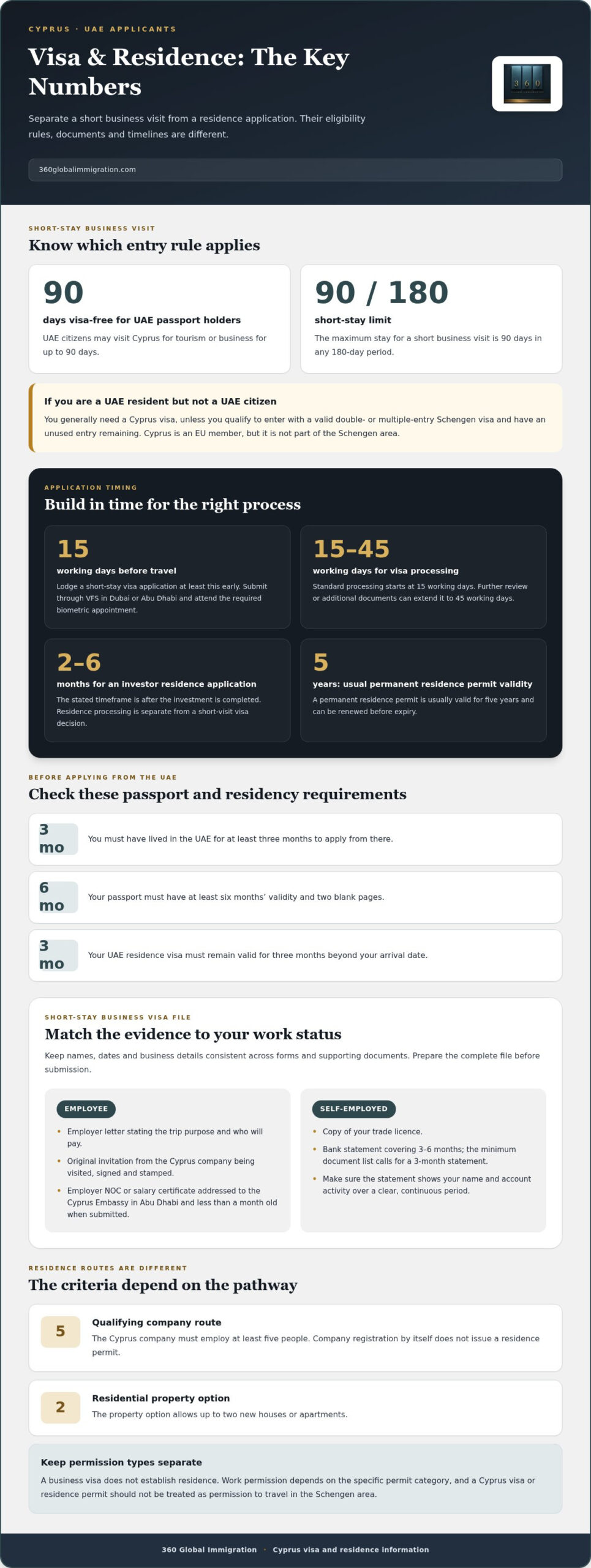
UAE passport holders may visit Cyprus visa-free for tourism or business for up to 90 days. Other UAE residents generally need a visa, subject to qualifying Schengen entry rules.
Distinguish short-visit permission from residence: a business visa does not, by itself, establish residence in Cyprus.
Residence Eligibility and Property Criteria
For a short business visit, Cyprus permits a maximum stay of 90 days in any 180-day period. A qualifying double-entry or multiple-entry Schengen visa may also allow entry, with an unused entry remaining. Cyprus is an EU member but is not part of the Schengen area.
Residence routes have different criteria. A qualifying Cyprus company investment requires the company to employ at least five people. The residential property option allows up to two new houses or apartments. UAE mainland company rules are separate: an office must measure at least 200 sq ft, and shareholder residence visas typically last three years.
Business Ownership and Investment Routes
Yes, UAE residents can pursue Cyprus residence through qualifying business ownership or investment routes. The company route focuses on the company’s eligibility and employment, while the property route concerns the purchase of eligible residential property. These are residence pathways, not substitutes for a short-stay business visa.
Cyprus has its own qualifying investment and company criteria, which differ from other European business residence options. Compare how each country’s route fits your business model and intended residence, rather than assuming a permit for one European country covers another.
Family, Work, and Schengen Considerations
Dependent children up to age 25 may be included in a Cyprus permanent residence application. Work permission depends on the specific permit category, so distinguish the right to reside from authorization to work.
A Cyprus visa permits travel to Cyprus, not to other Schengen countries. A Cyprus residence permit should not be treated as permission to travel in the Schengen area. Make separate travel arrangements for any other destination.
To apply for a Cyprus visa from the UAE, you must have lived in the UAE for at least three months. Your passport needs at least six months’ validity and two blank pages. Your UAE residence visa must remain valid for three months beyond your arrival date.
Application process through the Civil Registry and Migration Department
First determine whether you need a short-stay visa or a residence application. The submission routes, supporting documents, fees, and decision timelines differ.
Company Registration and Immigration Processing
A business residence application depends on the company and applicant meeting the relevant route’s criteria. Prepare company records and personal documents together, showing a clear link between the business activity and the residence status requested.
For residence matters, the Civil Registry and Migration Department is the relevant authority. Company formation and immigration processing are separate stages: registering a company does not, by itself, issue a residence permit. Timing and evidence requirements depend on the route, including whether the application relies on a qualifying investment.
Applying from Dubai
For a Cyprus visa application from the UAE, submit through VFS in Dubai or Abu Dhabi and attend the required biometric appointment. Book early: the application should be lodged at least 15 working days before intended travel.
Prepare a complete application file before submission. Include the relevant business invitation and employer documents, and check that the details match across forms and supporting papers. Check the passport arrangements before applying, and plan travel accordingly. A valid Schengen visa may affect eligibility to enter, but it is not a Cyprus residence permit.
Fees, Processing Times, and Validity
Standard visa processing starts at 15 working days. Further review or additional supporting documents can extend processing to 45 working days.
A Cyprus investor residence application may take 2-6 months after the investment is completed. A permanent residence permit is usually valid for five years and can be renewed before expiry. The permit issued depends on the approved application route, so distinguish residence processing from a short-visit visa decision.
For support organizing a residence application, explore Cyprus business residence assistance as a next step.
Cyprus visa application documents
Match each document to your travel purpose and applicant type. Keep names, dates, and business details consistent throughout the application.
Employer and Self-Employed Documents
For an employee applying for a business visa, obtain an employer letter explaining the trip’s purpose and who will pay. Include an original invitation letter from the Cyprus company being visited, signed and stamped. The employer’s no-objection or salary certificate should be addressed to the Cyprus Embassy in Abu Dhabi and be less than a month old when submitted.
Self-employed applicants should include a copy of their trade licence. Applicants should also prepare a bank statement covering 3-6 months; the minimum document list calls for a 3-month statement. Use a clear, continuous period and include the applicant’s name and account activity.
Investor and Work Visa Documentation
Investor residence applications and short-stay work-related visits follow different processes, so one checklist will not cover both. For an investor route, gather company and investment records showing how the application meets the relevant criteria. Ensure the evidence supports the business or property basis being presented.
For a business visa, pair the Cyprus invitation with the UAE employer’s letter and supporting financial documents. Employees should include an employer NOC or salary certificate. Self-employed applicants should provide a trade licence, rather than an employer letter, as evidence of their professional status.
Every applicant should prepare a valid passport, completed application, recent photograph, and travel medical insurance covering the entire stay. The stated photograph size is 4.5 cm by 3.5 cm. Previous travel documents can help present a coherent travel history when relevant, while the bank statement should support the financial information in the application.
- Check that the invitation identifies the Cyprus company and explains the business visit.
- Arrange employer or self-employed evidence to match your applicant category.
- Submit the bank statement and insurance documents with the rest of the application file.
These documents support a Cyprus visa application from the UAE, but they do not, by themselves, establish eligibility for a business residence permit.
Business visa assistance
Useful Cyprus visa assistance for UAE applicants begins with identifying the correct application type. A short business visit and a business residence application serve different purposes, so the application route and documents must match the intended stay.
Before submitting through VFS in Dubai or Abu Dhabi, organize your file around the business trip. The Cyprus invitation should explain the visit, while the UAE employer letter should state its purpose and who will pay. Self-employed applicants should include a trade licence instead of employee evidence. Consistent details help reviewers understand how each document supports the application.
Biometrics are part of the application process. Schedule the appointment with your travel plans in mind, and account for your passport being retained during processing. This is especially important if you have another trip planned or need the passport for a separate visa application. An adviser can help organize supporting documents and sequence these practical steps, but the relevant authority makes the decision.
- Clarify the route: identify whether the purpose is a short business visit or residence through a qualifying pathway.
- Match the evidence: align the Cyprus invitation, employer letter, financial records, and applicant category.
- Prepare for submission: arrange the VFS appointment and biometrics, and plan around passport retention.
- Review entry status: check whether a valid double-entry or multiple-entry Schengen visa with an unused entry applies.
These distinctions matter because Cyprus is an EU member but is not part of the Schengen area. A Schengen visa may help eligible holders enter Cyprus, but it does not turn a short visit into a residence permit. Likewise, a Cyprus visa does not authorize travel to other Schengen countries. When preparing your documents, align the destination, purpose, and permission requested.
If your plans involve longer-term business residence rather than a visit, request Cyprus business visa assistance to discuss the appropriate application route and supporting documents.
360 Global Immigration: France Passeport Talent
360 Global Immigration helps UAE residents assess business residence pathways, including the Cyprus Business Residence Visa. Turn to its guidance when your plans involve establishing a business or pursuing residence in Cyprus, and you need to distinguish a short visit application from a longer-term route.
If France is your intended destination, the France Passeport Talent may be more relevant. The UK Innovator Founder Visa and Netherlands Self Employed Visa are other pathways available for applicants whose plans fit those countries. Choosing your destination first helps focus preparation on the appropriate route and supporting documents.
For Cyprus, the key next step is aligning your business plans with the applicable residence pathway before assembling the application. Contact 360 Global Immigration to discuss your Cyprus business residence plans and the documents to prepare.
Align Your Residence Plan With Your Business Goals
A Cyprus business residence visa for UAE residents should support a clear commercial plan. Before proceeding, define your intended role in the business, the activities you plan to pursue in Cyprus, and how residence fits your longer-term objectives. This gives you a practical framework for assessing the route and preparing a focused application.
360 Global Immigration can help you assess whether the Cyprus Business Residence Visa fits your plans and guide you through the relevant application pathway. If your business direction points elsewhere, the consultancy also handles options including France Passeport Talent, the UK Innovator Founder Visa, and the Netherlands Self Employed Visa.
Share your plans and consider the best-fit route with 360 Global Immigration. A well-defined next step can make your business residence planning more focused and manageable.
Frequently Asked Questions
Do I have to apply in person?
For a short-stay Cyprus visa from the UAE, plan to attend your VFS appointment in person because biometrics are required. Applications are submitted through VFS in Dubai or Abu Dhabi. Schedule the appointment around your travel plans and account for your passport being retained during processing. A representative can help prepare the paperwork, but applicants must provide their own biometrics.
In what cases can a person be refused a visa?
An application may be refused if documents are incomplete, inconsistent, or fail to support the stated purpose of travel. For example, a business invitation that conflicts with the employer letter can weaken the application. A residence application may also fail if the applicant does not meet the selected company or investment route’s criteria. Organize evidence around one clear purpose before submission.
What is the Cyprus business residence visa and who is eligible?
A Cyprus business residence visa for UAE residents allows residence in Cyprus through a qualifying business or investment pathway, rather than simply permitting a short business visit. Eligibility depends on the selected route and the evidence supporting it. Under the company investment route, the qualifying company must employ at least five individuals. Distinguish this residence pathway from permission for a temporary business trip.
What are the requirements for UAE residents applying for a Cyprus business visa?
UAE applicants should establish UAE residence for at least three months and ensure their UAE residence visa remains valid for three months beyond arrival. Check that your passport meets the current application requirements before applying. UAE nationals are treated differently for short visits, so identify whether you are applying as a citizen or another type of resident before preparing your visa file.
What are the minimum investment and business capital requirements for Cyprus business residence?
The company route focuses on qualifying company criteria, including employment of at least five individuals; that criterion has no separate business-capital figure. The residence-by-investment route has a qualifying investment threshold, and its residential property option covers up to two new homes or apartments. Assess the company and investment routes separately: property ownership or shareholding alone does not establish eligibility for residence.
What documents are required for a Cyprus business visa or residence permit application from the UAE?
For a UAE business visa application, prepare your passport, application form, photograph, travel insurance, bank statement, and business invitation. Employees should also provide an employer letter explaining the visit and who will pay, plus an employer NOC or salary certificate. Self-employed applicants should include a trade licence. Ensure the invitation and employer documents describe the same business purpose and match the applicant’s details.