
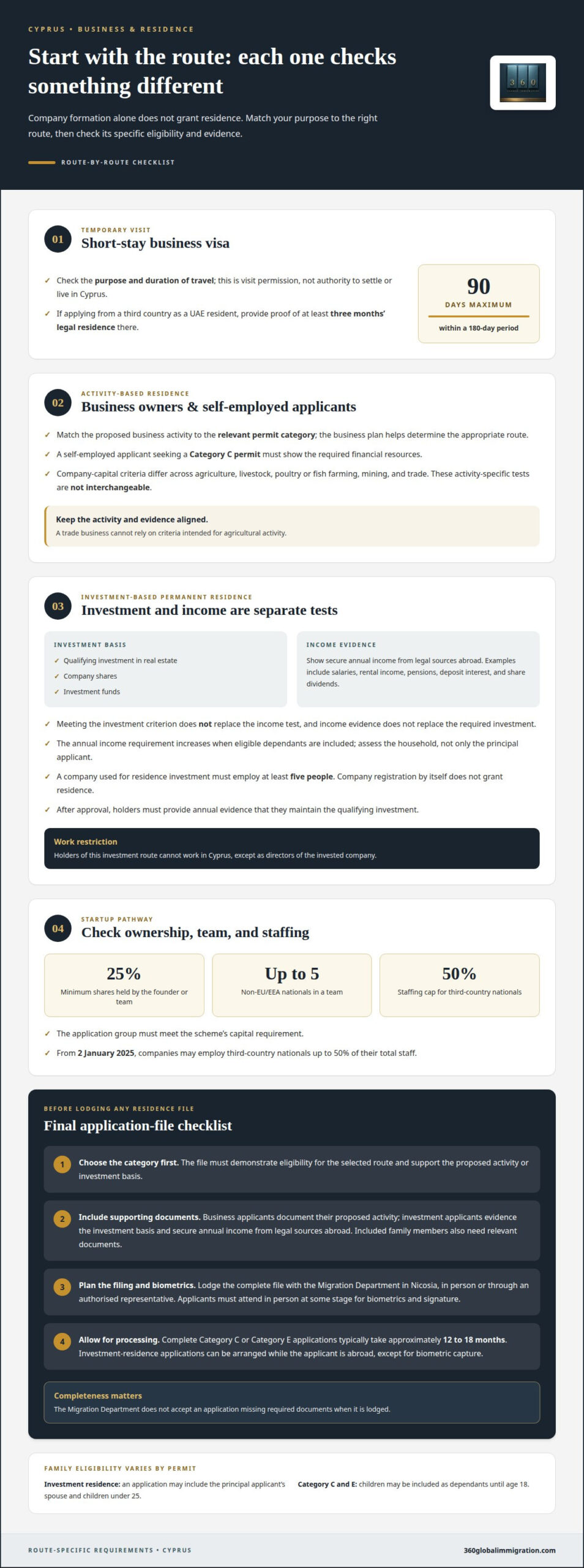
Cyprus business residence visa requirements depend on the route: a short-stay business visa is for temporary visits, while residence applications assess the applicant’s business, investment, income, and intended activity in Cyprus. A company registration alone does not grant its owner residence. For short visits, the Ministry of Foreign Affairs of the Republic of Cyprus says a business visa permits a maximum stay of 90 days within a 180-day period.
It’s easy to confuse permission to attend business activities with permission to live in Cyprus and run a business there. The distinction matters because each route has different eligibility criteria and supporting documents. This guide explains who may qualify, how business and income thresholds can apply, and how residence applications differ from short-stay business visas. It also outlines which route may suit your plans, so you can assess the requirements before preparing an application.
Key Takeaways
- Separate company formation from residence eligibility: the business must meet route-specific conditions, including a staffing requirement for some applications.
- Assess founder and startup-team eligibility through ownership, team composition, and the venture’s capital structure.
- Match the investment route to its qualifying business activity, then assess whether income from abroad can support the application.
- Compare temporary business-owner permits, permanent residence by investment, and startup pathways by their purpose and ongoing conditions.
Cyprus company formation and residence applications
Registering a Cyprus company alone does not grant its owner residence. A company used for residence investment must employ at least five people. Cyprus business residence visa requirements depend on the route: business residence relates to qualifying activity, while permanent residence by investment has separate investment and income criteria. Holders of that investment route cannot work in Cyprus, except as directors of the invested company.
Application Steps and Biometric Registration
Applicants lodge a complete file with the Migration Department in Nicosia, in person or through an authorised representative. They must attend in person at some stage to provide biometric data and sign. Investment-residence applications can be arranged while the applicant is abroad, except for biometric capture. Complete Category C or Category E applications typically take approximately 12 to 18 months to process.
Entrepreneurs and Self-Employed Applicants
Entrepreneurs and self-employed applicants must match their proposed activity to the relevant permit category. A self-employed applicant seeking a Category C permit must show the required financial resources. Separate company-capital thresholds apply to agriculture, livestock, poultry or fish farming, mining, and trade. Each category has distinct requirements, so a trade business cannot rely on criteria for agricultural activity. The business plan and the activity it describes help determine the appropriate route.
Required Application Documents
The application file must demonstrate eligibility for the selected category. Business applicants need documents supporting their proposed activity, while investment applicants need evidence of the investment basis and secure annual income from legal sources abroad. A spouse or other included family member also requires relevant supporting documents. The Migration Department does not accept an application that is missing required documents when it is lodged.
Citizenship processing is separate from residence. Cyprus offers an expedited citizenship application option with an eight-month processing period. This option does not replace the residence application or its eligibility criteria.
Eligibility for non-EU/EEA founders and startup teams
Non-EU/EEA founders are assessed against the criteria for their chosen immigration route, not simply their nationality or UAE residence. Permanent residence by investment generally depends on whether the applicant and investment meet the applicable requirements. A UAE residence visa alone does not establish eligibility for a Cyprus residence permit. The business plan and route-specific evidence also matter.
Startup teams have distinct ownership and composition rules. At least 25% of a Cyprus Startup Visa company’s shares must be held by its founder or team, and a team may include up to five non-EU/EEA nationals. The application group must meet the scheme’s capital requirement. From 2 January 2025, companies may employ third-country nationals up to 50% of their total staff. These criteria help distinguish a qualifying startup from a company formed only for immigration purposes.
Family eligibility depends on the permit. A Cyprus residence-by-investment application may include the principal applicant’s spouse and children under 25. For Category C and Category E permits, children may be included as dependants until age 18. Citizenship is a later, separate immigration decision: applicants may be eligible after seven years of residence, while non-EU nationals applying for naturalisation must have 12 months of continuous residence immediately before applying.
For a short-stay business visa, the key test is the purpose and duration of travel, not founder status. The Ministry of Foreign Affairs of the Republic of Cyprus states that the visa allows a maximum stay of 90 days within a 180-day period. UAE residents applying from a third country must provide proof of at least three months’ legal residence there. This visit permission is not permanent residence or authority to settle in Cyprus.
For a route-specific assessment of your founder or team profile, explore Cyprus residence application support.
Business investment and income thresholds
For founders assessing business investment and income thresholds, the key point is that investment and income are separate eligibility tests. The permanent-residence-by-investment route requires a qualifying investment in real estate, company shares, or investment funds. Applicants must also provide evidence of secure annual income from legal sources abroad. Meeting the investment criterion does not replace the income test, and income evidence does not substitute for the required investment.
The annual income threshold applies to the main applicant and increases when eligible dependants are included. A spouse and each minor child add to the household income requirement. If an application includes family members, the supporting evidence should cover the whole household, not just the principal applicant. Relevant income sources may include employment salaries, rental income, pensions, deposit interest, and dividends from shares.
Other permit categories use different financial criteria. Self-employed applicants and entrepreneurs seeking immigration permits must meet the requirements for their activity and permit category. Company-capital thresholds vary across agriculture, livestock, poultry, fish farming, mining, and trade. These are distinct tests, not interchangeable options. The business activity and chosen route determine which financial evidence applies.
Investment-residence holders also have ongoing obligations after approval. They must provide annual evidence that they maintain the qualifying investment. Annual proof of health insurance is also required if they no longer benefit from Cyprus’s General Healthcare System. Applicants must submit clear criminal-record certificates from their country of origin and country of residence every three years. The process therefore involves initial financial evidence and continued documentation after residence is granted.
What residence permits are available in Cyprus for non-EU business owners and investors?
Cyprus has distinct residence routes for investors, business owners, and people taking up employment. Permanent residence by investment is granted under Regulation 6(2) of the Aliens and Immigration Regulations. Category C and Category E business residence permits are based on Regulation 5. The route matters because each addresses a different purpose and carries separate conditions.
For an investor seeking permanent residence, the relevant route depends on their circumstances. The permit holder and adult dependants have residence rights of unlimited duration, although the residence card expires after 10 years. This distinction is practical: card expiry does not mean the underlying residence right has the same duration. Applicants must still meet the continuing requirements associated with their route.
Category C and Category E provide alternatives under Regulation 5. Category E is intended for a person offered permanent employment in Cyprus, provided the job does not create undue local competition in that line of work. A temporary residence permit for business owners is usually valid for one year and may be renewed if its conditions continue to be met. Renewal therefore depends on maintaining the basis for that permit.
A short-stay business visa serves a different purpose from residence permission. According to the Ministry of Foreign Affairs of the Republic of Cyprus, it permits a maximum stay of 90 days within a 180-day period. It can suit a temporary business visit, but it is not a residence permit for settling or operating in Cyprus long term. Match the application to the intended activity and length of stay.
Choosing between investment residence, a business-owner permit, and employment-based Category E starts with your intended role in Cyprus. Explore Cyprus Business Residence Visa guidance to identify the route that aligns with your business and residence plans.
360 Global Immigration: Cyprus Business Residence Visa
360 Global Immigration provides guidance on the Cyprus Business Residence Visa for entrepreneurs assessing residence routes, investment criteria, and supporting documents. This can help when you need to distinguish a business-owner permit from permanent residence by investment or a short-stay business visa, then align your application with your intended activity in Cyprus.
Bring your proposed business activity, investment plan, income evidence, and family details into the assessment. These factors shape which route may suit you and what the application needs to address. If your plans involve another destination, related pathways include the France Passeport Talent, UK Innovator Founder Visa, and Netherlands Self Employed Visa.
Contact 360 Global Immigration to discuss your Cyprus business residence plans.
Turn your Cyprus plans into a clear next step
Your next decision is not simply whether to establish a business in Cyprus. Consider whether your intended role, business model, and long-term plans align with the residence route you are considering. Organising these priorities before preparing an application can clarify which evidence is relevant and where your plans need further definition. Assess Cyprus business residence visa requirements against your specific circumstances, rather than treating them as a single checklist for every founder.
If your plans extend beyond Cyprus, 360 Global Immigration also offers the France Passeport Talent, UK Innovator Founder Visa, and Netherlands Self Employed Visa. These pathways may be relevant when your professional or business goals point to a different destination.
For guidance on your next step, contact 360 Global Immigration to discuss your plans. A considered route can give your application a clearer direction and help you move forward with confidence.
Frequently Asked Questions
What is a Cypriot business visa?
A Cypriot business visa allows a qualifying visitor to travel to Cyprus for temporary business purposes, rather than to settle there. According to the Ministry of Foreign Affairs of the Republic of Cyprus, a short-stay business visa permits a maximum stay of 90 days within a 180-day period. If your plan requires living in Cyprus or working there long term, assess a residence route instead.
Can I get Cyprus residency by setting up a company?
No. Registering a Cyprus company does not automatically give its owner residence rights. The company and applicant must meet the criteria of an applicable residence route, and company formation is only one part of the picture. For example, an investment-based application must qualify under its own rules. Decide whether you intend to manage a business, invest, or take employment before selecting a permit category.
How long does it take to get a Cyprus business residence permit?
Processing time depends on the application category. A complete Category C or Category E permanent residence application typically takes approximately 12 to 18 months. That estimate concerns those residence applications, not a short-stay business visa. A missing required document can prevent an application from being accepted at filing, so document completeness is important before submission.
What are the benefits of obtaining Cypriot residence through investment?
Investment-based residence can provide a route to live in Cyprus for applicants who meet its investment and income criteria. A spouse and eligible children may also be included, subject to the program’s conditions. It does not provide Schengen travel rights, since Cyprus is not in the Schengen area. Applicants should also distinguish residence from citizenship, which is a separate legal status.
What are the types of business visas in Cyprus?
Cyprus has short-stay business visas for temporary visits and separate residence routes for longer-term business or investment plans. Business owners and investors may assess Category C, Category E, or permanent residence by investment, depending on their circumstances. Category E concerns permanent employment, not simply owning a company. The appropriate category depends on the activity you plan to carry out in Cyprus.
What minimum investment, company capital, or income is required for a Cyprus business residence permit?
There is no single threshold for every permit. Investment-based permanent residence uses qualifying investment and secure income from abroad, while company-capital requirements for immigration permits depend on the business sector. Self-employed applicants follow a different financial test. Compare your intended activity, investment category, and dependants with the relevant route’s criteria before deciding which financial evidence to prepare.